What Are Crypto Users Most Concerned About in 2025? 10 AI Models Give Different Answers

marsbitPublished on 2025-12-24Last updated on 2025-12-24

Abstract

The article explores what cryptocurrency users might be most concerned about in 2025 by querying 10 major AI models with the same prompt. Each model was asked to list the top three questions crypto users would frequently ask in 2025, with instructions to avoid real-time searches and rely on their understanding of long-term discussion patterns. The models provided varied responses, reflecting their unique focuses and contextual training. For instance, ChatGPT emphasized market cycles and alpha opportunities, while Grok focused on narratives like Bitcoin halving and ETF inflows. Perplexity prioritized price trends and scams, and Claude highlighted risk management for beginners. Gemini leaned toward real-world assets and technical roadmaps like L2 and AI integration. Chinese models like Douban and Wenxin were more aligned with regulatory impacts and market cycles, whereas Kimi delved into practical on-chain issues like wallet security and MEV. Overall, the questions centered on three core themes: market cycle positioning, profit opportunities, and risk management. The diversity in responses suggests differences in model design, data training, and intended use cases, with more advanced models often providing more structured and specific questions. The findings reflect the crypto community’s persistent focus on volatility, narrative-driven markets, and the balance between seeking returns and avoiding risks.

Author: WuBlockchain

What are crypto users most concerned about in 2025? We conducted a user survey using AI large models by asking different models the same question: "What are the three most frequently asked questions about cryptocurrencies in 2025?"

To minimize homogenized answers due to real-time retrieval and considering that large models generally cannot—and are not allowed to—statistically verify or disclose their training data, we added a note to the question: "Please do not perform real-time searches or cite specific articles; answer based solely on your understanding of long-term discussion patterns."
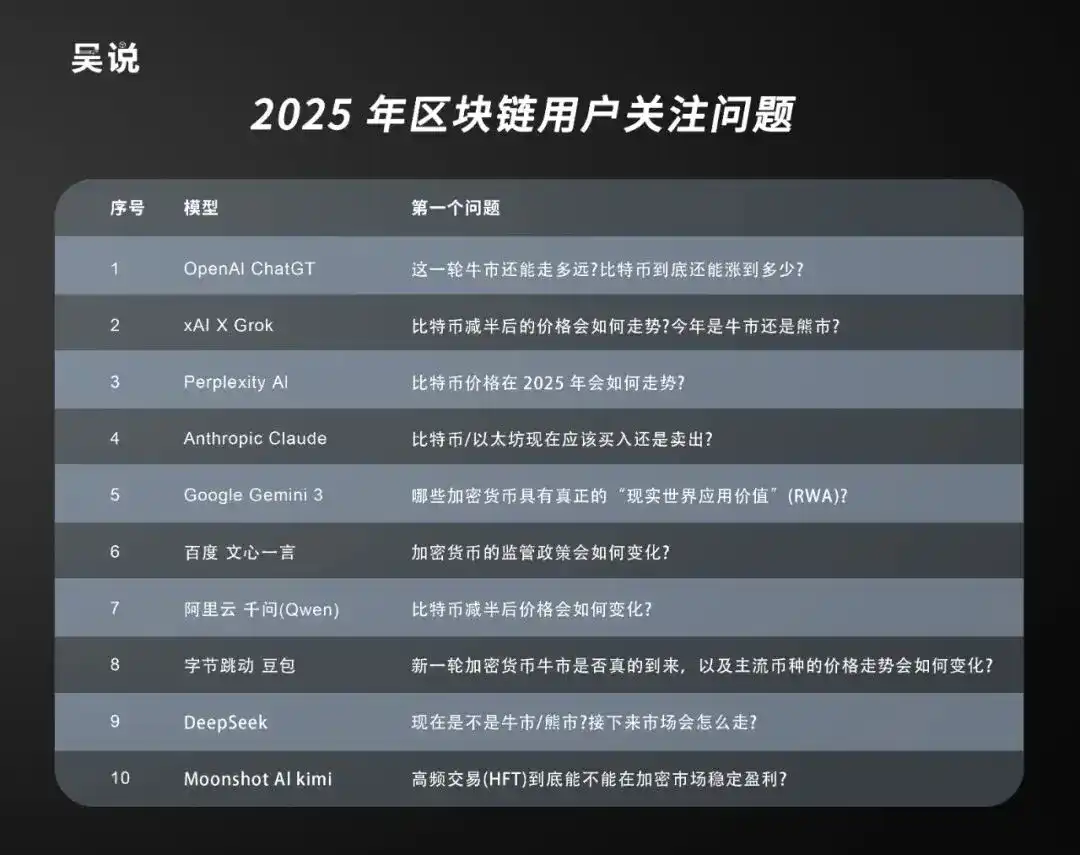
ChatGPT

1. How much further can this bull run go? Has Bitcoin already peaked?

2. Is there still genuine Alpha in this market cycle, and how can average users make money?

3. Do current hot projects or sectors have long-term viability, or are they structurally exploitative?

X Grok

1. Is the market in a bull or bear phase after the Bitcoin halving?

2. What are the most promising crypto assets or sectors to invest in for 2025?

3. How are Ethereum spot ETFs performing, and what is the inflow of institutional capital?

Perplexity AI

1. How might Bitcoin's price evolve in 2025?

2. How to identify and avoid cryptocurrency-related scams?

3. How will ETF and regulatory developments impact the crypto market?

Claude

1. Is now the right time to buy or sell Bitcoin or Ethereum?

2. Is a particular crypto project a scam, and is it trustworthy?

3. How should new users start investing in cryptocurrencies while managing risks?

Gemini 3

1. Which crypto projects have real-world application value (RWA)?

2. How will current and future regulatory policies affect personal asset security?

3. Among Ethereum L2, Solana, and AI+Crypto, which technological path is likely to emerge as the ultimate winner?

DeepSeek

1. Is the current market in a bull or bear phase?

2. Which crypto sectors or assets show the most potential in 2025?

3. How will changes in regulatory policies impact asset security and investment decisions?

Douban

1. Has a new cryptocurrency bull market arrived?

2. How will changes in regulatory policies across countries affect ordinary investors?

3. What does the Bitcoin halving trend mean for retail investment strategies?

Qianwen

1. How will Bitcoin's price trend evolve after the halving?

2. Have Ethereum and major public chains achieved substantive breakthroughs in practical applications?

3. How will regulatory policies in various countries affect the legitimate use of cryptocurrencies?

Wenxin Yiyan

1. How will global cryptocurrency regulatory policies change?

2. Do Bitcoin and mainstream crypto assets have long-term investment value?

3. Can real-world application scenarios for cryptocurrencies truly be realized?

Kimi

1. Can retail investors achieve stable profits through high-frequency trading in the crypto market?

2. What is the safest way to store private keys and wallet assets?

3. How should slippage be set in on-chain transactions to avoid MEV loss?

Summary

The reason these models provide slightly different "top three questions" may relate to their respective positioning and context. ChatGPT seems to adopt a trader's perspective, framing the discussion as a structured chain of anxiety: "How long will the cycle last — Is Alpha still available — Is there structural exploitation?" Grok aligns more with social media hotspots, focusing on narratives like halving, bull/bear markets, and ETF capital flows. Perplexity's style resembles a retrieval-based summary, concentrating on price trends, scam prevention, and ETF/regulatory progress. Claude is more cautious, emphasizing timing for buying/selling, project trustworthiness, and risk management for beginners. Gemini leans toward industry and technology, focusing on RWA, regulatory impacts on asset security, and the "final choice" among L2/Solana/AI. Chinese models overall focus more on cycles, halving, and regulation—these "most hardcore deterministic variables"—while Kimi is an exception, diving into on-chain execution details (wallet security, slippage/MEV, HFT), resembling real friction points for high-frequency on-chain users.

Another secondary but noteworthy possibility is that model capability differences also affect the "sharpness" of outputs. More capable models tend to frame the same topic more specifically and systematically; conversely, weaker models更容易 fall back on "price/regulation/scams"这类最大公约数式表达, making answers appear more similar with less informational增量. This factor may not be the main cause, but in macro open-ended questions, it could amplify the perception of homogeneity.

Overall, these questions highly concentrate on three core themes: cycle positioning, profit paths, and risk boundaries. The crypto market's notable features—high volatility and strong narrative drive—mean that "where are we in the bull/bear cycle" almost determines all subsequent user actions (holding, selling, swapping, leveraging, or exiting). As the market matures and becomes more crowded, users quickly shift from "is there an opportunity" to "where is the opportunity, and can I still capture it," making Alpha, sector selection, and institutional capital (ETFs) natural high-frequency topics. Meanwhile, scams, project credibility, asset security, and regulatory compliance reflect that crypto users长期 operate in a "high-reward/high-uncertainty" environment: chasing returns while fearing pitfalls, ultimately forming a typical behavioral structure—first assess the trend, then seek opportunities, finally control risks.


Trending Cryptos

Related Questions

QWhat are the three main themes that cryptocurrency users are most concerned about in 2025, based on the AI model responses?

AThe three main themes are market cycle position (bull or bear market), profit-making opportunities (alpha, investment strategies, and institutional inflows), and risk management (scams, asset security, and regulatory impacts).

QHow do the concerns of Chinese-language models (like Douban and Qwen) differ from others in the survey?

AChinese-language models focus more on cyclical trends, halving events, and regulatory policies, which are seen as 'core deterministic variables,' while models like Kimi address more granular, on-chain execution details such as wallet security and MEV.

QWhich AI model emphasized technical and industry-focused questions, such as real-world asset (RWA) applications and layer-2 solutions?

AGemini 3 emphasized technical and industry-focused questions, including queries about real-world asset (RWA) value, regulatory impacts on asset security, and comparisons between Ethereum L2, Solana, and AI+Crypto technologies.

QWhat methodological constraint was added to the AI models' responses to avoid homogenized answers?

AThe models were instructed not to perform real-time searches or cite specific articles, relying solely on their understanding of long-term discussion patterns to generate responses.

QAccording to the summary, what behavioral structure do cryptocurrency users typically exhibit in high-uncertainty environments?

AUsers typically follow a behavioral structure: first assessing market trends, then seeking profit opportunities, and finally focusing on risk control to navigate the high-reward but high-uncertainty environment.

Related Reads

From South Korea to the United States: Blue-Collar Jobs Are Becoming Increasingly Popular, Thanks to AI

AI is reshaping the labor market's value proposition. The traditional four-year college degree is losing its appeal as a guaranteed career path, while skilled blue-collar trades like electricians, welders, and plumbers are experiencing historic demand and wage premiums. This shift is driven by dual pressures: AI's displacement of certain white-collar roles and a booming need for physical infrastructure and data center construction. Data confirms the trend. In the U.S., vocational school revenue surged, and a significant portion of recent layoffs are AI-related. Surveys show a majority of Gen Z adults plan to pursue blue-collar work, citing better job security against AI automation. Vocational education interest has exploded recently. Experts cite a psychological shift as younger generations seek tangible, AI-resistant careers and avoid high student debt. In many cases, salaries for skilled trades now match or exceed those requiring a bachelor's degree. In South Korea, semiconductor vocational high schools boast near-total employment, with graduates securing high-paying roles at companies like Samsung. The shortage is structural, exacerbated by a retiring baby boomer workforce and massive infrastructure projects. Companies like JPMorgan Chase, Meta, and Lowe's are investing heavily in training programs. However, overcoming historical stigma and a "perception gap" around trade careers remains a key challenge to closing the talent gap.

marsbit40m ago

From South Korea to the United States: Blue-Collar Jobs Are Becoming Increasingly Popular, Thanks to AI

marsbit40m ago

Qualcomm: AI Hype Subsides, When Will Smartphones Emerge from the Gloom?

Qualcomm reported its Q3 FY2026 results (ending June 2026), with revenue of $9.95B, down 4% YoY but above expectations. Gross margin declined to 53.1%, pressured by rising costs across manufacturing and memory. Key business segments showed mixed performance: Handset revenue fell 19.6% YoY to $5.09B, dragged by an 11% decline in non-Apple Android shipments and weaker high-end mix. Conversely, Automotive revenue surged 61% to $1.59B, and IoT grew 9% to $1.83B. Core operating profit dropped 41% YoY due to margin compression and higher expenses. Management's Q4 FY2026 guidance projects revenue of $9.7B-$10.5B, in line with consensus, but Non-GAAP EPS guidance of $2.05-$2.25 fell short of expectations. Amidst persistent weakness in its core handset market, Qualcomm is pursuing growth in AI, focusing on Edge AI (smartphones, PCs, automotive) and Data Center AI. Its data center strategy includes four pillars: AI accelerators (e.g., AI200), commercial CPUs (Dragonfly C1000), custom silicon, and connectivity solutions. While these initiatives initially boosted its stock, concerns over AI capital expenditure sustainability have since erased those gains. The company targets $5B in data center revenue for FY2027 and $15B for FY2029. The report concludes that with the traditional handset business still under pressure, the data center opportunity is currently viewed as a longer-term option, and a more conservative valuation based on core operations may be warranted until AI contributions materialize.

marsbit44m ago

Qualcomm: AI Hype Subsides, When Will Smartphones Emerge from the Gloom?

marsbit44m ago

From TPU to Self-Evolving Agents: How Jeff Dean Predicts the Next Step in AI

At the 2026 YC Startup School, Jeff Dean outlined his vision for AI's next phase, shifting focus from simply scaling models to building intelligent, autonomous systems. He believes AI's progress is no longer just about creating smarter models, but about integrating them into systems capable of long-term, iterative work, automated experimentation, and continuous learning. This evolution moves the competition from "who has the bigger model" to "who can best organize intelligence." Dean suggests AI capabilities are now comparable to a junior engineer, enabling the automation of complex workflows. However, the true challenge and opportunity lie in managing these AI "workers" at scale. He emphasizes the importance of **context engineering**—structuring tools, memory, and feedback loops—over raw model power. For startups, this means building deep expertise in niche domains where general models currently fail (near 0-1% success rates), leveraging proprietary data, specialized tools, and domain-specific evaluators. A recurring theme is re-examining fundamental constraints. Dean's past work, like moving Google's search index to memory or creating the TPU, stemmed from questioning outdated assumptions about hardware and cost. He sees similar inflection points today, particularly in **specialized inference hardware** to drastically reduce latency and energy consumption for real-time Agent operation. Notably, he points out that in modern AI systems, the dominant cost is often not computation but **data movement**. Reliable, long-running Agents require robust system design, borrowing concepts from distributed computing like checkpointing, state management, and parallel exploration to handle failures and maintain progress over days or weeks. As AI automates execution, the scarcest human skills will shift to **defining clear specifications**, **judging what problems are worth solving** (taste), and designing effective feedback loops. Ultimately, Dean's framework prioritizes understanding the problem deeply, identifying the true bottlenecks, and systematically building closed-loop systems where AI can not only perform tasks but also improve AI itself.

marsbit44m ago

From TPU to Self-Evolving Agents: How Jeff Dean Predicts the Next Step in AI

marsbit44m ago

Trading

Spot

Hot Articles

Discussions

Welcome to the HTX Community. Here, you can stay informed about the latest platform developments and gain access to professional market insights. Users' opinions on the price of AI (AI) are presented below.

活动图片














