Warsh Deals a Heavy Blow to the 'Dollar Devaluation Trade'! Gold Crashes, Bitcoin Slumps, How Long Can the Chip Frenzy Hold?

华尔街日报Published on 2026-06-25Last updated on 2026-06-25

Abstract

The "dollar devaluation trade" that dominated Wall Street this year is rapidly unraveling, driven by a hawkish pivot from Fed Chairman Kevin Warsh and a surging U.S. dollar. This double pressure has triggered a sharp sell-off in non-yielding assets. Gold broke below $4,000 an ounce, silver tumbled below $60, and Bitcoin fell under $60,000, with all retreating significantly from their earlier 2025 peaks. The dollar index hit a 14-month high. Warsh's emphasis on price stability has solidified market expectations for aggressive rate hikes, increasing the opportunity cost of holding assets like precious metals. Concurrently, massive fund flows are rotating out of metals and cryptocurrencies into the semiconductor sector, providing a temporary boost to stocks like Micron and SK Hynix. However, analysts warn this chip rally shows signs of a speculative top. Extreme volatility, with semiconductor stocks seeing trillion-dollar swings, is historically characteristic of major market turning points. Factors like month-end rebalancing, a flood of new equity issuance, and insider selling further signal potential exhaustion. While Micron's strong earnings briefly stemmed selling, it may offer a favorable exit point for remaining chip bulls. The sustainability of the semiconductor frenzy is now in serious doubt as the broader market reprices assets around a stronger dollar and tighter monetary policy.

The 'dollar devaluation trade' that has dominated Wall Street this year is rapidly unraveling. Federal Reserve Chairman Kevin Warsh's hawkish stance has reinforced market expectations for interest rate hikes, combined with a sharp strengthening of the US dollar creating a dual squeeze. Gold, silver, and Bitcoin have all successively breached key levels. Meanwhile, substantial funds are flowing out of precious metals into the semiconductor sector, yet the sustainability of this chip frenzy is drawing increasingly strong market skepticism.

On Wednesday, gold fell below $4,000 per ounce for the first time in about eight months, down roughly 29% from its all-time high near $5,600 in January. Silver broke below $60 per ounce, retreating more than 50% from its peak of $121. Bitcoin also fell below $60,000, hitting a new low since late 2024. The US Dollar Index (DXY) has risen 2.8% this month, closing at its highest level in over 14 months and on track for its largest monthly gain in nearly a year.
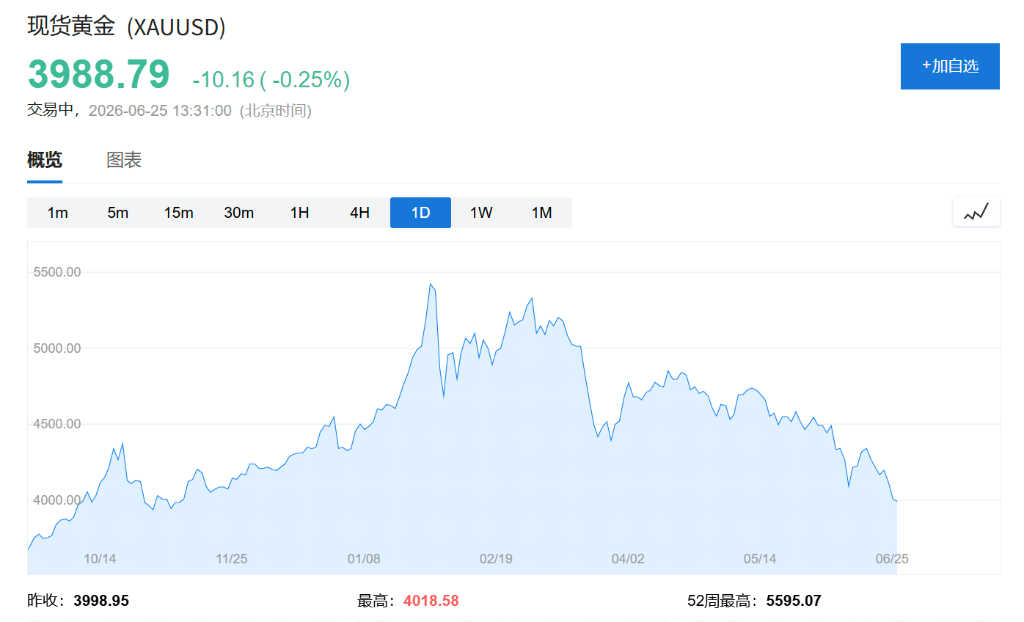
The key catalyst for this sudden shift was Warsh, who, during the Fed press conference, placed price stability as an overriding priority, further convincing the market that he will adopt a more aggressive stance against inflation. A strong dollar makes dollar-denominated precious metals more expensive for overseas buyers, while rising rate hike expectations directly increase the opportunity cost of holding non-yielding assets.

Micron Technology's better-than-expected earnings report after the bell temporarily stemmed the selling pressure in the chip sector, with South Korean chip stocks like SK Hynix also rebounding. However, several market participants warn that this chip rally, accompanied by extreme volatility, is already displaying several characteristics typical of historical market tops.

The logic of the 'dollar devaluation trade' is built on fears of fiscal profligacy and central bank tolerance of inflation, which has consistently driven gold, silver, and Bitcoin higher in recent years. When Warsh was nominated as Fed Chair in January, gold plunged over 13% that day, its largest single-day drop in over forty years, followed by a Bitcoin crash, while the dollar bottomed and rebounded after a prolonged downtrend—the market voted with prices, indicating Warsh's hawkish credibility was taken seriously from the start.

Robin Brooks of the Brookings Institution believes the root of the devaluation trade lies in misguided fiscal policy, with monetary policy merely acting as an 'accomplice': policymakers are forced to turn on the printing presses only when they attempt to dilute unsustainable debt through inflation. This framework explains why the market is so sensitive to Fed personnel choices, and why Warsh's emphasis on price stability in his first press conference was enough to trigger such a dramatic asset repricing.

Stephen Innes, Managing Partner at SPI Asset Management, stated that Warsh's first public appearance has already convinced the market he is taking a tougher line on inflation. The S&P 500 priced in gold—a classic indicator measuring whether economic growth stems from real expansion or currency depreciation—reversed significantly upwards three months ago, showing the market's confidence in the devaluation narrative has already crumbled. Notably, the ceasefire agreement in the Middle East has also provided an additional boost to the dollar.

The current precious metals decline is a dramatic reversal of the historic rally earlier this year. In early 2026, gold soared to a record high near $5,600 per ounce, silver broke above $121, with their gains even surpassing the 'Magnificent Seven' tech stocks to become Wall Street's most crowded momentum trade. That scene is now in the past.

Nate Miller, Vice President of Product Development at Amplify ETFs, noted that rising yields and a strengthening dollar increase the opportunity cost of holding metals. Silver, due to its dual nature as both a precious and industrial metal, often falls more sharply than gold during periods of macro tightening—precisely why its decline has been so rapid this time.

Ben McMillan, Chief Investment Officer at IDX Advisors, views rate hike expectations and liquidations as the 'main culprits' behind gold's plunge, but he also sees the current pullback as a 'generational buying opportunity'. Peter Grant, Vice President and Senior Metals Strategist at Zaner Metals, expects the next key support level for gold at $3,800 per ounce, with a potential rebound to $4,500 within the year. However, to rebuild confidence for gold to surpass its previous highs, it needs to reclaim territory above $4,800.

Bitcoin's drop below $60,000, coinciding with the Dollar Index hitting a new high in over 14 months, reaffirms the long-standing negative correlation between the two.

Steven Englander, a strategist at Standard Chartered, pointed out that real and nominal interest rate differentials have been the main driver of dollar strength since early May. He expects the Fed to keep rates on hold, while the ECB still has room for one more rate cut in the first half of next year. The US-Europe rate differential will continue to support the dollar, creating persistent headwinds for Bitcoin.

Vincent Deluard of StoneX Financial warned that while the Middle East ceasefire has eased oil price shocks, inflation will not smoothly return to the 2% target but will likely plateau at a high level between 3.5% and 4% for an extended period.

Torsten Slok, Chief Economist at Apollo Global, proposed a counterintuitive scenario: falling oil prices could act as a tax cut, further stimulating already overheated aggregate demand and thereby pushing inflation higher, providing grounds for the Fed to raise rates—a path that, if realized, would put further pressure on the devaluation trade.

Mark Hackett, Chief Market Strategist at Nationwide Investment Management Group, noted that a large, highly coordinated pool of funds is collectively shifting major positions from cryptocurrencies, meme stocks, and precious metals into semiconductor stocks. South Korean chipmakers like Samsung Electronics and SK Hynix have become primary destinations for this rotation.

He told MarketWatch that dollar strength was the trigger for the precious metals sell-off, while changing Fed policy expectations are the root cause of the dollar's rise. "But this is almost being used as an excuse for investors to collectively liquidate precious metals," he said.

Micron Technology's post-market earnings report alleviated short-term selling pressure in chips: its revenue guidance exceeded expectations, and profits were significantly better than expected. Its trailing twelve-month earnings quadrupled within two quarters, and its market cap after-hours returned to around $1.4 trillion. SK Hynix, which had been sold off after announcing a focus on lower-margin DRAM memory chip production, also got a boost—despite disclosing a massive $29 billion US stock offering plan on the same day.

However, extreme volatility itself is a warning sign. Larry McDonald of the Bear Traps Report noted that semiconductor stocks experiencing market cap swings exceeding hundreds of billions of dollars within hours is extremely rare and historically often occurs near major market tops or bottoms.

BCA Research advised closing the long-short strategy that has more than doubled year-to-date—namely, going long emerging market semiconductors while shorting the 'Magnificent Seven' hyperscale cloud companies financing them. BCA pointed out that the one-month implied volatility for South Korea's Kospi index has surpassed historical peaks. Historically, such levels tend to appear at 'stock market bear market bottoms, not at historical highs,' indicating the current rally exhibits topping characteristics driven by 'highly speculative forces.'

McDonald also warned that the approaching month-end, quarter-end, combined with the US long holiday weekend, historically often coincides with large-scale portfolio rebalancing and subdued summer trading. The spate of new stock offerings will absorb market liquidity, while large-scale insider selling is often a precursor to an impending top. For investors still holding long chip positions, Micron's after-hours strength might provide a relatively favorable exit opportunity at elevated levels.


Trending Cryptos

Related Questions

QAccording to the article, what triggered the reversal of the 'dollar depreciation trade' and the sell-off in assets like gold and Bitcoin?

AThe reversal was triggered by Federal Reserve Chairman Kevin Warsh's hawkish stance, which reinforced market expectations for interest rate hikes. This, combined with a sharp strengthening of the US dollar, created a dual pressure leading to the sell-off.

QWhat key price levels did gold, silver, and Bitcoin fall below according to the article?

AGold fell below $4,000 per ounce, silver broke below $60 per ounce, and Bitcoin dropped below $60,000 to a new low since late 2024.

QHow does the article describe the current sustainability of the semiconductor stock rally?

AThe article suggests the sustainability of the semiconductor rally is facing increasingly strong market skepticism. It notes that the extreme volatility is a warning sign and that the current market action exhibits several characteristics typical of a historical top.

QAccording to analysts cited, what is the primary fundamental reason for the dollar's strength?

AAnalysts cited in the article attribute the dollar's strength primarily to expectations of a more aggressive anti-inflationary monetary policy stance from the new Fed Chairman, Kevin Warsh, which is driving up both nominal and real interest rate differentials, particularly against the Eurozone.

QWhat alternative narrative does Apollo Global's chief economist, Torsten Slok, present regarding falling oil prices and inflation?

ATorsten Slok presents a counterintuitive scenario where falling oil prices could act like a tax cut, stimulating already hot aggregate demand. This, in turn, could push inflation higher, providing justification for the Fed to raise interest rates, which would further pressure the 'dollar depreciation trade'.

Related Reads

The War Without a Unified Name: The Domestic Tech Giants' World Model Landscape

The article outlines the diverse and fragmented landscape of "World Models" in China's tech industry, where major players are pursuing similar goals under different names like world foundational models, physical AI, or integrated within autonomous driving and embodied intelligence systems. The core aim is to enable AI to create an internal, dynamic environment for simulation, reasoning, and learning, reducing reliance on infinite real-world data. This "data engine" allows for unlimited generation, experimentation, and iteration. The report categorizes the approaches of different companies: * **Internet Giants:** Alibaba is developing models for linguistic, virtual, and physical worlds (Qwen-AgentWorld, HappyOyster, Qwen-RobotWorld). Tencent's HY-World focuses on 3D, game, and social scenarios. ByteDance leverages its vast video data for a potential "digital twin" model. Huawei integrates its model into industrial applications like smart cars and robotics without separately branding it. Baidu embeds world model capabilities within its Apollo autonomous driving and Ernie systems. * **Automakers:** Companies like NIO, Li Auto, XPeng, and Geely are using world models as virtual "driving schools" and "testing grounds." They generate complex scenarios (e.g., rain, snow) to train and validate autonomous driving systems in simulation, aiming for more capable and safer AI drivers. * **Autonomous Driving Suppliers:** Firms such as Momenta, Horizon Robotics, Haomo.ai, and DeepRoute.ai are building the underlying "world engines." They focus on large-scale video generation for simulation, reinforcement learning, and enhancing end-to-end autonomous driving models, often integrating these capabilities into commercial products. While startups bring focus and innovation, they face challenges like limited data, compute resources, and deployment channels. Large companies possess these advantages and are rapidly transitioning world models from research projects into core business infrastructure powering products in vehicles, games, and industry. The conclusion is that world models represent an evolution and convergence of existing AI fields into crucial industrial infrastructure, moving the competition from simply building a model to effectively deploying it to understand and interact with the physical world.

marsbit11m ago

The War Without a Unified Name: The Domestic Tech Giants' World Model Landscape

marsbit11m ago

The Crypto Industry Enters the 'Show Me' Era: Vision Alone Is No Longer Enough

The crypto industry has entered a "Show Me" era, where grand visions and white papers are no longer sufficient to gain traction. This shift is driven by increased skepticism, high-profile bad actors, and notably, the serious entry of traditional finance (TradFi) institutions like BlackRock, Fidelity, and JPMorgan Chase, which are launching real, scaled products such as tokenized funds and blockchain-based settlement. This raises the bar for what constitutes a credible project. The communication dynamic has fundamentally changed. The focus is no longer on "what you are building" but on "what you have built and who is using it." Startups must now provide a "proof stack": verifiable data like mainnet transaction volume and active wallets, genuine partnerships with signed contracts, and evidence of organic product-market fit from real users, not just investors. Announcements must be backed by concrete, chain-verifiable evidence. For communication strategies, this means leading with proven facts and hard data—even if modest—rather than speculative narratives. A compelling story must be grounded in demonstrated results. While vision remains important, the balance has inverted from 80% vision/20% substance to the opposite. This higher threshold ultimately benefits builders with genuine traction, filtering out noise and allowing their real signals to stand out clearly. The "Show Me" era is a permanent maturation, demanding that communication strategies prove value, not just promise it.

链捕手42m ago

The Crypto Industry Enters the 'Show Me' Era: Vision Alone Is No Longer Enough

链捕手42m ago

Meta Follows the Trend into Prediction Markets: Can It Avoid Repeating the Failure of the Metaverse?

Meta, the tech giant behind Facebook, has reportedly formed a team to develop "Arena," a new application focused on prediction markets. Users would use platform points to place bets on outcomes in politics, sports, and global events. This move follows Meta's massive, nearly $900 billion, losses from its heavily-invested metaverse division, Reality Labs. The prediction market industry is already showing strong demand, with leading platforms like Kalshi and Polymarket facilitating hundreds of billions in annual volume. Meta, with its 3.56 billion daily active users across its apps, possesses the unprecedented scale to bring this niche activity to a mainstream audience, similar to its past success in cloning features like Stories and Reels. However, Arena faces significant hurdles. Meta plans to start with a points-based system to avoid strict financial regulations, but this may dilute the core incentive of accurate prediction that real-money markets provide. More critically, Meta enters the space with a major trust deficit stemming from its past regulatory battles, notably the failed Libra/Diem stablecoin project, and its controversial history with political content and misinformation. The prediction market sector itself is under increasing regulatory scrutiny, with recent CFTC actions including fines and the first-ever insider trading case. While Meta's vast user base offers a unique opportunity to expand the market, its success hinges on navigating complex regulations and rebuilding the credibility necessary for a platform dealing with sensitive topics like elections. The outcome could range from Meta dramatically growing the industry to Arena becoming a high-profile regulatory target before it can scale.

Foresight News1h ago

Meta Follows the Trend into Prediction Markets: Can It Avoid Repeating the Failure of the Metaverse?

Foresight News1h ago

Trading

Spot
Futures

Hot Articles

What is $BITCOIN

DIGITAL GOLD ($BITCOIN): A Comprehensive Analysis Introduction to DIGITAL GOLD ($BITCOIN) DIGITAL GOLD ($BITCOIN) is a blockchain-based project operating on the Solana network, which aims to combine the characteristics of traditional precious metals with the innovation of decentralized technologies. While it shares a name with Bitcoin, often referred to as “digital gold” due to its perception as a store of value, DIGITAL GOLD is a separate token designed to create a unique ecosystem within the Web3 landscape. Its goal is to position itself as a viable alternative digital asset, although specifics regarding its applications and functionalities are still developing. What is DIGITAL GOLD ($BITCOIN)? DIGITAL GOLD ($BITCOIN) is a cryptocurrency token explicitly designed for use on the Solana blockchain. In contrast to Bitcoin, which provides a widely recognized value storage role, this token appears to focus on broader applications and characteristics. Notable aspects include: Blockchain Infrastructure: The token is built on the Solana blockchain, known for its capacity to handle high-speed and low-cost transactions. Supply Dynamics: DIGITAL GOLD has a maximum supply capped at 100 quadrillion tokens (100P $BITCOIN), although details regarding its circulating supply are currently undisclosed. Utility: While precise functionalities are not explicitly outlined, there are indications that the token could be utilized for various applications, potentially involving decentralized applications (dApps) or asset tokenization strategies. Who is the Creator of DIGITAL GOLD ($BITCOIN)? At present, the identity of the creators and development team behind DIGITAL GOLD ($BITCOIN) remains unknown. This situation is typical among many innovative projects within the blockchain space, particularly those aligning with decentralized finance and meme coin phenomena. While such anonymity may foster a community-driven culture, it intensifies concerns about governance and accountability. Who are the Investors of DIGITAL GOLD ($BITCOIN)? The available information indicates that DIGITAL GOLD ($BITCOIN) does not have any known institutional backers or prominent venture capital investments. The project seems to operate on a peer-to-peer model focused on community support and adoption rather than traditional funding routes. Its activity and liquidity are primarily situated on decentralized exchanges (DEXs), such as PumpSwap, rather than established centralized trading platforms, further highlighting its grassroots approach. How DIGITAL GOLD ($BITCOIN) Works The operational mechanics of DIGITAL GOLD ($BITCOIN) can be elaborated on based on its blockchain design and network attributes: Consensus Mechanism: By leveraging Solana’s unique proof-of-history (PoH) combined with a proof-of-stake (PoS) model, the project ensures efficient transaction validation contributing to the network's high performance. Tokenomics: While specific deflationary mechanisms have not been extensively detailed, the vast maximum token supply implies that it may cater to microtransactions or niche use cases that are still to be defined. Interoperability: There exists the potential for integration with Solana’s broader ecosystem, including various decentralized finance (DeFi) platforms. However, the details regarding specific integrations remain unspecified. Timeline of Key Events Here is a timeline that highlights significant milestones concerning DIGITAL GOLD ($BITCOIN): 2023: The initial deployment of the token occurs on the Solana blockchain, marked by its contract address. 2024: DIGITAL GOLD gains visibility as it becomes available for trading on decentralized exchanges like PumpSwap, allowing users to trade it against SOL. 2025: The project witnesses sporadic trading activity and potential interest in community-led engagements, although no noteworthy partnerships or technical advancements have been documented as of yet. Critical Analysis Strengths Scalability: The underlying Solana infrastructure supports high transaction volumes, which could enhance the utility of $BITCOIN in various transaction scenarios. Accessibility: The potential low trading price per token could attract retail investors, facilitating wider participation due to fractional ownership opportunities. Risks Lack of Transparency: The absence of publicly known backers, developers, or an audit process may yield skepticism regarding the project's sustainability and trustworthiness. Market Volatility: The trading activity is heavily reliant on speculative behavior, which can result in significant price volatility and uncertainty for investors. Conclusion DIGITAL GOLD ($BITCOIN) emerges as an intriguing yet ambiguous project within the rapidly evolving Solana ecosystem. While it attempts to leverage the “digital gold” narrative, its departure from Bitcoin's established role as a store of value underscores the need for a clearer differentiation of its intended utility and governance structure. Future acceptance and adoption will likely depend on addressing the current opacity and defining its operational and economic strategies more explicitly. Note: This report encompasses synthesised information available as of October 2023, and developments may have transpired beyond the research period.

449 Total ViewsPublished 2025.05.13Updated 2025.05.13

What is $BITCOIN

Discussions

Welcome to the HTX Community. Here, you can stay informed about the latest platform developments and gain access to professional market insights. Users' opinions on the price of BTC (BTC) are presented below.

活动图片