Wall Street Keeps Buying XRP: US Spot ETFs Post 19-Day Inflow Streak

bitcoinistPublished on 2025-12-16Last updated on 2025-12-16

Abstract

US-listed spot XRP ETFs have recorded 19 consecutive trading days of net inflows with zero outflows, accumulating nearly $1 billion in new investments by December 12, according to Sosovalue data. Total net assets reached approximately $1.18 billion. Industry experts, including Bitmern Mining CEO Giannis Andreou, attribute this sustained inflow to institutional demand rather than retail speculation. In a significant shift, XRP ETFs have now surpassed Solana ETFs in total assets under management, with $1.638 billion compared to SOL's $1.566 billion. Analysts suggest XRP's appeal lies in its institutional suitability and lack of staking, contrasting with Solana's on-chain efficiency for retail users. Despite strong ETF performance, XRP's price fell to $1.98 at press time, testing a key support level.

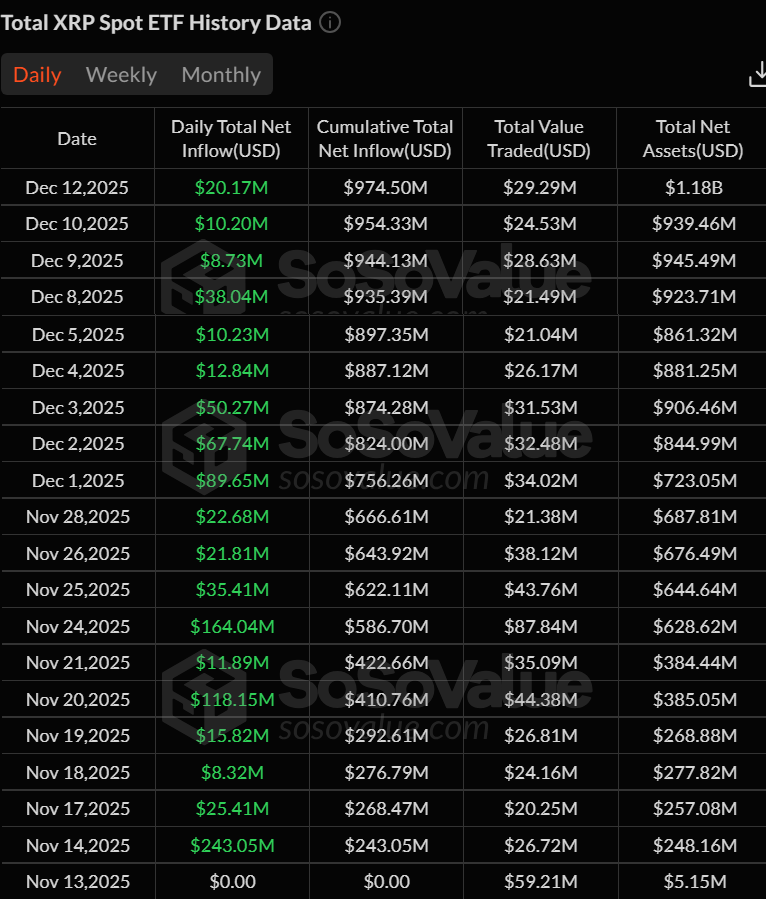
US-listed spot XRP ETFs just put together a streak that’s hard to ignore: 19 straight trading days of net inflows, with zero outflow sessions over the run, according to daily flow data compiled by Sosovalue.

The numbers add up quickly. By Dec. 12, cumulative net inflows sat at $974.50 million, while total net assets across the products were shown at roughly $1.18 billion.

XRP ETFs Log 19 Straight Trading Days Of Inflows

The early days did most of the heavy lifting. Sosovalue’s table shows $243.05 million of net inflow on Nov. 14, then another surge on Nov. 24 ($164.04 million). There were also chunky adds on Nov. 20 ($118.15 million) and Dec. 1 ($89.65 million). Even as the pace cooled, inflows didn’t flip—Dec. 8 posted $38.04 million, and Dec. 12 added another $20.17 million.
US spot ETF inflows | Source: X @gandreou007

On X, Bitmern Mining founder and CEO Giannis Andreou framed it bluntly today: “19 consecutive trading days of inflows. Zero outflow days. Nearly $1B in net capital added.” He called it “sustained institutional positioning,” not retail froth.

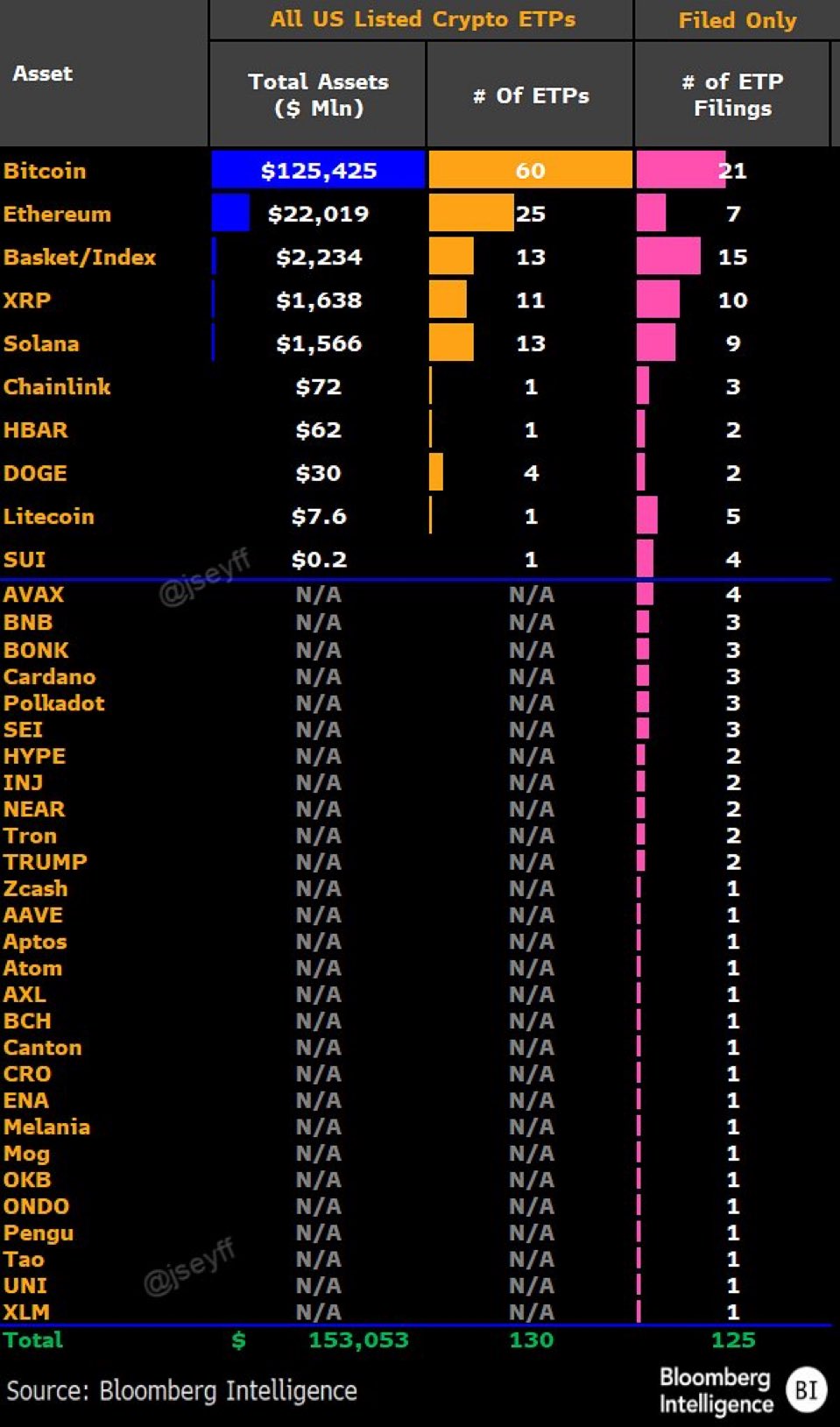
That “institutional bid” angle is also showing up in the asset rankings. In a Dec. 13 post, Canary Capital CEO Steven McClurg pointed to a separate snapshot of the US crypto ETP landscape showing XRP products now edging out Solana by total assets under management.

Bloomberg Intelligence data in the chart puts XRP ETP assets at about $1.638 billion, just ahead of Solana at $1.566 billion, in a market where Bitcoin still towers over everything at $125.425 billion and Ethereum sits at $22.019 billion.
Crypto ETF inflow data | Source: X @stevenmcclurg

McClurg’s explanation for the flip was less about Solana underperforming and more about where each asset “fits” in the wrapper trade.

“SOL ETFs launched before XRP, but XRP ETFs have now passed SOL in total AUM. I expected this,” McClurg wrote, adding “SOL is much more efficient to hold on-chain and to stake directly for retail audiences, whereas XRP has more institutional demand and no staking. As with everything, there will be an audience that prefers direct ownership, and an audience that prefers the ease of financial instruments. Some will do both.”

Notably, from Dec. 8 to Dec. 12, Bitcoin spot ETFs recorded net inflows of $287 million for the week, while Ethereum spot ETFs saw weekly net inflows of $209 million. SOL spot ETFs recorded net inflows of $33.6 million.

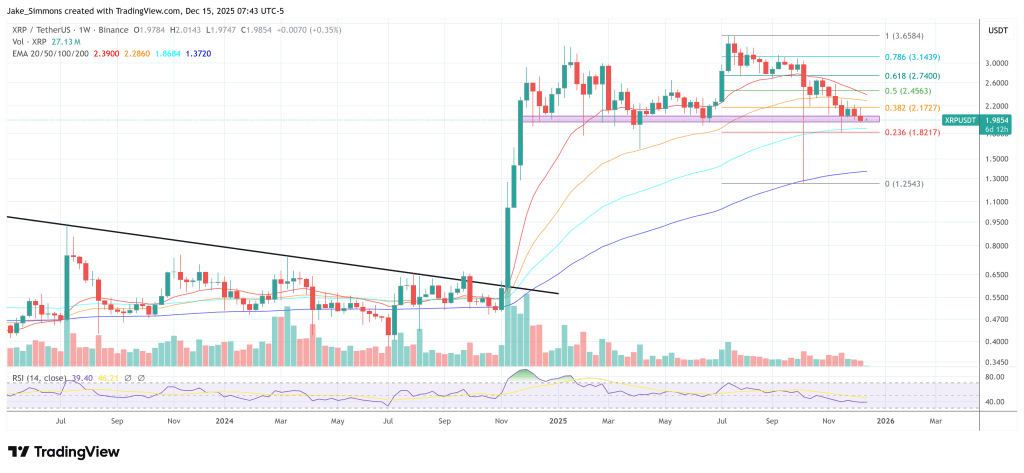
At press time, XRP once again fell below the $2 mark. The token traded at $1.98 and thus at the key support zone. A drop below the red support band could strengthen the bear case for a deeper crash to the 100-week or even 200-week Exponential Moving Average (EMA). XRP visited the latter during the October 10 crash.
Price hovers in crucial support zone, 1-week chart | Source: XRPUSDT on TradingView.com

Trending Cryptos

Related Reads

Are the Frantic Acquisitions of Crypto Companies by Giants Good or Bad?

In a bear market, giants are actively acquiring crypto companies. Recent months have seen at least five major deals: Samsung Securities bought a 2% stake in Upbit operator Dunamu; Robinhood acquired WonderFi for $180 million to enter the Canadian market; Figure purchased Kiavi for $717 million to expand into on-chain real estate credit; Franklin Templeton bought 250Digital to launch Franklin Crypto; and Blockworks acquired data platform Messari at a steep discount—over 90% less than its 2022 $300 million valuation. These moves highlight a strategic shift. Cash-rich giants are consolidating resources at low cost, targeting companies with established compliance frameworks to navigate tightening global regulations. Acquisitions like WonderFi and the Upbit stake provide immediate market access and licensed user bases. Figure's deal signals real-world asset (RWA) tokenization moving from concept to large-scale implementation, with Kiavi's $7+ billion annual transaction volume being integrated into on-chain capital markets. Franklin Crypto's launch targets institutional investors like pension funds, offering them tailored, compliant crypto strategies. For these strategic players, bear markets present an ideal entry point: valuations are depressed, speculative noise is minimized, and they can acquire robust technology and compliance infrastructure at a fraction of the cost. This acquisition wave marks a transitional phase for crypto—from a wild frontier toward an institutional, regulated financial system. Giants are positioning themselves to capture future growth when macroeconomic conditions and liquidity improve, leaving latecomers behind.

marsbit15m ago

Are the Frantic Acquisitions of Crypto Companies by Giants Good or Bad?

marsbit15m ago

In the MiCA Era, Europe's New Cryptography Landscape: Why is Germany Taking Center Stage?

With MiCA's transitional arrangements concluding, Europe's crypto industry has undergone a regulatory consolidation. Post-MiCA, platforms must secure CASP authorization to operate compliantly within the EU. As of July 1st, only about 12% of crypto firms have received authorization, with Germany emerging as a key player, holding 57 authorizations (roughly 23% of the EU total). This positions Germany as a primary compliance gateway to the EU's unified market. Germany's advantage stems from its established, function-based regulatory framework, which integrated crypto activities into existing banking, securities, and payment systems pre-MiCA. This allowed a smoother transition and attracted both domestic platforms (like Bitcoin.de, BISON) and international ones (like Coinbase Germany). A distinctive trend is German banks becoming direct retail entry points for crypto services. Examples include DZ Bank integrating "meinKrypto" into its VR Banking App and the Sparkassen savings bank network planning to offer crypto trading via DekaBank. This mainstreams crypto access for ordinary users. Beyond trading, Germany is evolving into a digital asset infrastructure hub. Deutsche Börse Group's Clearstream is developing a next-generation platform for issuing, settling, and servicing both traditional and tokenized securities. Furthermore, German banks like DekaBank and DZ Bank are key participants in the Qivalis project, a European initiative for a regulated euro stablecoin, positioning Germany at the intersection of critical future capabilities like custody, settlement, and cross-border services.

marsbit1h ago

In the MiCA Era, Europe's New Cryptography Landscape: Why is Germany Taking Center Stage?

marsbit1h ago

Trading

Spot

Hot Articles

How to Buy US

Welcome to HTX.com! We've made purchasing Talus Network (US) simple and convenient. Follow our step-by-step guide to embark on your crypto journey.Step 1: Create Your HTX AccountUse your email or phone number to sign up for a free account on HTX. Experience a hassle-free registration journey and unlock all features.Get My AccountStep 2: Go to Buy Crypto and Choose Your Payment MethodCredit/Debit Card: Use your Visa or Mastercard to buy Talus Network (US) instantly.Balance: Use funds from your HTX account balance to trade seamlessly.Third Parties: We've added popular payment methods such as Google Pay and Apple Pay to enhance convenience.P2P: Trade directly with other users on HTX.Over-the-Counter (OTC): We offer tailor-made services and competitive exchange rates for traders.Step 3: Store Your Talus Network (US)After purchasing your Talus Network (US), store it in your HTX account. Alternatively, you can send it elsewhere via blockchain transfer or use it to trade other cryptocurrencies.Step 4: Trade Talus Network (US)Easily trade Talus Network (US) on HTX's spot market. Simply access your account, select your trading pair, execute your trades, and monitor in real-time. We offer a user-friendly experience for both beginners and seasoned traders.

5.1k Total ViewsPublished 2025.12.11Updated 2026.06.02

How to Buy US

Discussions

Welcome to the HTX Community. Here, you can stay informed about the latest platform developments and gain access to professional market insights. Users' opinions on the price of US (US) are presented below.

活动图片