Wall: Inflation Has Cooled in the Past Four Weeks, AI is Reshaping the Economy, Forward Guidance Loses Necessity

链捕手Published on 2026-07-02Last updated on 2026-07-02

Abstract

Summary: At the European Central Bank's forum in Sintra, Federal Reserve Chairman Christopher Waller stated the Fed will no longer provide forward guidance on future interest rate paths. Policy decisions will be made at each meeting based on the latest data. He noted that U.S. inflation risks have eased over the past four weeks. Waller discussed the significant impact of artificial intelligence on the economy, acknowledging its potential to boost productivity and supply but also its uncertain effects on employment and inflation—a determination he stressed must be data-driven. He reaffirmed the Fed's independence from political pressure and indicated a continued desire to reduce the size of the central bank's balance sheet, though this will be a gradual process. Waller also highlighted the formation of five internal working groups to review various aspects of Fed policy and communication.


Author: Li Jia, Wall Street Insights


On July 1, at the annual Central Banking Forum held by the European Central Bank in Sintra, Portugal, Wall reiterated that the Federal Reserve will not provide forward guidance on the future path of interest rates. He hopes that policymakers can engage in full discussions based on the latest data at each meeting, rather than signaling policy direction to the market in advance.

He stated that U.S. inflation risks have eased somewhat over the past four weeks, and the supply expansion brought by AI could profoundly change the way the economy operates, with the U.S. at the center of this transformation. However, whether AI will ultimately bring inflation or deflation should be judged by the central bank based on data.
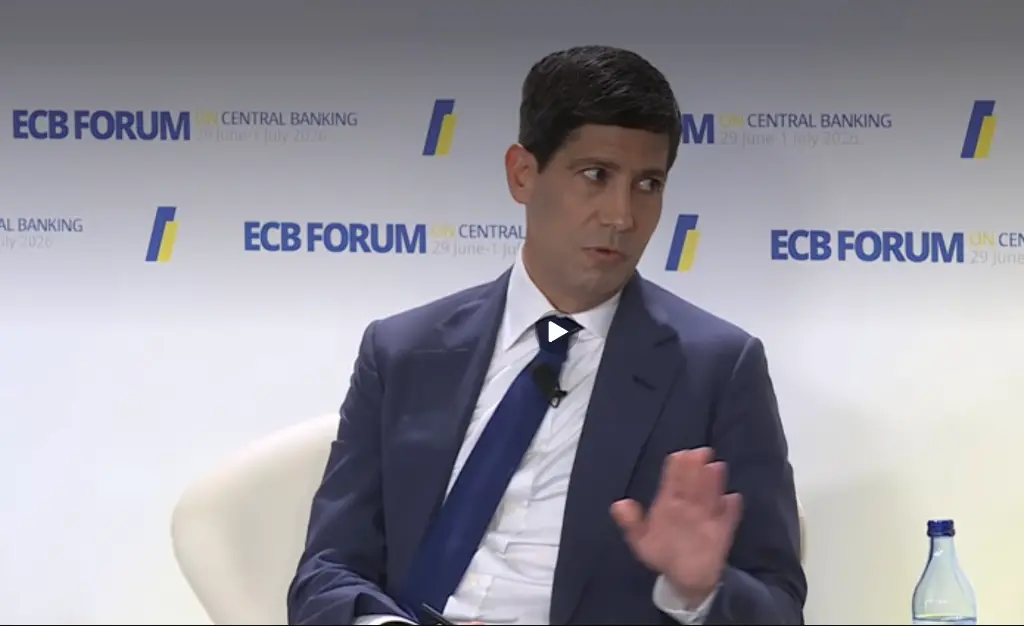
Will Not Provide Any Interest Rate Forward Guidance

Wall stated that the Federal Reserve is "charting a new course" and will not signal interest rate moves in advance as it did in the past. He said:

"We will hold our next meeting in four weeks, and I hope we can have a real family-style debate then."

He emphasized again that forward guidance is not the right policy for the current economic situation. In the future, the Fed will continue to make decisions based on the latest economic data, not by committing to a policy path in advance.

This means the Federal Reserve will rely more on real-time economic data rather than signaling policy to the market in advance.

At the June meeting, the Federal Reserve unanimously decided to keep the federal funds rate unchanged in the 3.5%-3.75% range. However, the latest dot plot showed that nine out of 18 officials still expect at least one rate hike this year, and the market has largely priced in the possibility of at least one 25-basis-point hike by the end of the year.

However, Wall himself declined to reveal his own policy inclination, only emphasizing that future policy decisions will depend on data performance.

AI is Changing the Economy at an Unprecedented Pace

Wall discussed the macroeconomic impact of artificial intelligence at the forum. He said the speed at which AI model capabilities are improving shows a clear exponential growth trend.

He pointed out that the supply capacity expansion driven by AI will become a new variable that future monetary policy must focus on, as productivity improvements mean the economy can achieve faster growth with lower inflationary pressure.

However, he also acknowledged that there is still great uncertainty about how AI will affect the job market.

"There is still a serious question about when AI will truly begin to affect employment."

He emphasized that the Federal Reserve must continue to achieve its dual statutory goals of maximum employment and price stability, and any policy adjustments must balance both.

Inflation Risk Down, but Whether AI Has an Inflationary Effect Remains to Be Seen

Wall stated that U.S. inflation risk has declined over the past four weeks, meaning price pressures have eased to some extent recently.

However, regarding the market's widespread discussion on whether AI is a deflationary force or a new source of inflation, Wall did not give a clear answer. He said:

"Whether AI has an inflationary effect should be decided by the central bank."

In his view, AI can both improve production efficiency and expand supply on one hand, and stimulate new investment and demand on the other. Therefore, the final effect needs to be judged based on data, not preset conclusions.

In addition, Wall pointed out that Fed policy not only affects the U.S. but also has significant spillover effects through global financial markets.

Reiterating Fed Independence: Policy Will Not Be Affected by External Pressure

Responding to ongoing external concerns about Federal Reserve independence, Wall once again made a clear statement. He said:

"The Federal Reserve has long been independent, and it will remain independent. You won't see any change."

This statement is also seen by the market as a response to President Trump's recent repeated calls for the Fed to cut rates. Wall emphasized that the Fed will independently decide the appropriate policy path and will not change decisions due to external political pressure.

U.S. Faces Great Opportunity for Productivity Enhancement

Beyond monetary policy, Wall also focused on the long-term growth prospects of the U.S. economy that day.

He said he has been focused on monetary policy work for the past four weeks, and the current era is one of great opportunity for the United States. Wall believes that the supply side of the U.S. economy remains strong, and potential growth rates appear to be trending upward. Therefore, there is ample reason to be optimistic about future productivity.

He said if the economic performance of the past four quarters can serve as a reference for the future, then the U.S. economic outlook deserves optimism. He stated:

"The United States is not afraid of productivity-driven economic growth."

However, he also acknowledged that it is not yet clear whether productivity improvements will have a direct impact on short-term monetary policy, but the continuous expansion of supply capacity will undoubtedly profoundly influence future policymaking.

Unchanged Stance on Balance Sheet Reduction

Besides interest rate policy, Wall also discussed the Fed's balance sheet.

He said, his view on the balance sheet has not changed over the past four weeks. "It's no secret that I want the Fed's balance sheet to be smaller."

However, he also said that the Fed remains open about the final appropriate size of the balance sheet. Wall noted that balance sheet policy mainly works through asset prices, so any major decisions regarding the balance sheet will be subject to public discussion and decided collectively by the FOMC.

He also stated that the current balance sheet size of about $6.7 trillion is still far above pre-pandemic levels, and even if reduction continues, it cannot be completed in a short time. "Eighteen weeks is far from enough."

Five Reform Working Groups to See New Progress

In fact, abandoning forward guidance is only part of Wall's push for Fed reform.

Last month, Wall announced the establishment of five internal special working groups, responsible for studying communication mechanisms, the balance sheet, data usage, productivity & employment, and the inflation framework, among other issues. He recently revealed that the list of special working group members will be announced as early as next week.

Wall stated that these working groups will not only involve internal Fed officials but also invite external experts, including some international figures from outside the United States. He hopes that through these reforms, the Fed's policy framework and communication mechanisms will be re-examined, making monetary policy more suitable for the rapidly changing economic environment.


Trending Cryptos

Related Questions

QAccording to Governor Waller, what is the main change in the Federal Reserve's communication strategy regarding future interest rate decisions?

AGovernor Waller stated that the Federal Reserve will no longer provide forward guidance about future interest rate paths. He emphasized that policy decisions will be made on a meeting-by-meeting basis based on the latest economic data, marking a departure from the previous practice of signaling future policy direction to the market.

QWhat assessment did Waller give about recent US inflation trends?

AWaller indicated that US inflation risks have eased over the past four weeks, meaning price pressures have shown a degree of moderation recently.

QHow does Waller view the impact of AI on the economy and inflation according to the speech?

AWaller believes AI is transforming the economy at an unprecedented, exponential pace. He noted that AI-driven supply expansion could allow for faster growth with lower inflation by boosting productivity. However, he did not conclude whether AI is ultimately inflationary or disinflationary, stating the Fed must judge its effects based on data as AI can both enhance supply and stimulate new investment and demand.

QWhat was Waller's stance on the Federal Reserve's independence in the context of political pressure?

AWaller strongly reaffirmed the Federal Reserve's independence. He asserted that the Fed has long been independent, remains independent, and will not change, emphasizing that policy decisions will be made autonomously and not be influenced by external political pressures.

QWhat are Waller's comments regarding the Federal Reserve's balance sheet (quantitative tightening)?

AWaller said his views on the balance sheet have not changed in the past four weeks, reiterating his clear desire for the Fed's balance sheet to shrink. He noted the current size of about $6.7 trillion is still well above pre-pandemic levels and that any significant reduction would take considerable time, far longer than '18 weeks'. The ultimate size remains an open question for FOMC discussion and collective decision.

Related Reads

Goldman Sachs In-Depth Report: Who Will Be the Long-Term Winners in China's AI Large Model Industry?

Goldman Sachs Report: China's AI Models at an Inflection Point China's open-source/open-weight large language models (LLMs) have reached performance parity with top global proprietary models, according to a Goldman Sachs report. This is driven by architectural innovations and higher parameter efficiency, allowing Chinese models to achieve comparable capabilities at 2%-10% the parameter size and significantly lower cost. The market is evolving into a two-tiered structure: a high-end segment (e.g., GLM5.2, Qwen3.7 Max) with premium pricing and a low-end, price-sensitive segment for global SMEs and individual users. Key points: * **Cost & Performance:** Innovations like Mixture of Experts (MoE) enable high performance with smaller models. Projects like Meituan's LongCat 2.0, trained on domestic hardware, highlight progress in tech self-sufficiency. * **Open-Source Strategy:** Most Chinese players use open-source/open-weight models for flexibility and ecosystem growth. However, Goldman notes this may underreport actual deployment and revenue. A shift toward "open-weight + community license" models with revenue sharing (e.g., MiniMax) could improve monetization. * **Market Shift & Global Expansion:** Enterprise AI adoption is shifting from "token maximization" to "ROI-first." International expansion, especially in non-US markets, is a major growth driver. Chinese models are increasingly available on global platforms like AWS Bedrock and Microsoft Copilot. * **Competitive Landscape:** Using a framework based on pricing power, cost advantage, and financial strength, Goldman identifies **Zhipu AI and DeepSeek** as the strongest in foundational text models, and **ByteDance** as the leader in multimodal/video generation. The report maintains Buy ratings on MiniMax and Kuaishou. * **Market Growth:** China's AI model API and subscription revenue is projected to grow from an estimated ¥35 billion in 2026 to ¥879 billion by 2030.

marsbit11m ago

Goldman Sachs In-Depth Report: Who Will Be the Long-Term Winners in China's AI Large Model Industry?

marsbit11m ago

Goldman Sachs Deep Dive Report: Who Will Become the Long-Term Winners in China's AI Large Model Industry?

Goldman Sachs Report: Who Will Be the Long-Term Winners in China's AI Large Model Industry? China's AI large model sector is at a historic inflection point. Goldman Sachs argues that the intelligence of Chinese open-source/open-weight models is approaching top global proprietary models. Rapid adoption by domestic enterprises and global SMEs is creating a data flywheel effect that will further drive model iteration. The evolution is summarized as moving from "DeepSeek's cost-efficiency moment last year to GLM's model-intelligence moment this year." Chinese models achieve near-state-of-the-art performance at significantly lower cost, primarily due to architectural innovations like Mixture of Experts (MoE) and higher parameter efficiency. Models like DeepSeek V4 Pro (1.6T params), GLM5.2 (0.7T), and MiniMax M3 (0.4T) are much smaller than global leaders. Recent advancements in coding capability are attributed to better data curation and RLHF. Landmarks like Meituan's LongCat 2.0, trained fully on domestic AI chips, demonstrate progress in hardware stack independence. The market is forming a "two-tiered structure." The high-end tier (e.g., GLM5.2, Alibaba's Qwen3.7 Max) prices around $1 per million tokens, about 10-25% of US top models, with estimated inference gross margins of 10-20%. The low-end tier (priced as low as $0.06-$0.2 per million tokens) targets price-sensitive global SMEs and individuals. MiniMax derives 60-70% of revenue overseas. Goldman forecasts China's AI model API/subscription revenue to grow from an estimated RMB 35bn in 2026 to RMB 879bn by 2030. Most Chinese players adopt open-source/open-weight strategies for deployment flexibility and community feedback, though this limits monetization as deployments on third-party platforms (e.g., Alibaba Cloud) may not generate direct revenue. A shift towards "open-weight + community license" models with revenue-sharing agreements (like MiniMax's approach) could improve unit economics. International expansion, particularly in non-US markets, is the key growth driver. The global enterprise AI paradigm is shifting from "token maximization" to "ROI prioritization." Chinese models are already hosted on major global platforms like AWS Bedrock and are under consideration for integration into Microsoft Copilot. Using a competitive framework based on pricing power, cost advantage, and financial strength, Goldman identifies the strongest players: In foundational text models, Zhipu AI (initiated coverage) and DeepSeek lead. In multimodal/video generation, ByteDance's Seed is the frontrunner, with Kuaishou's Kling and MiniMax's Hailuo also well-positioned. Goldman maintains a Buy rating on MiniMax, citing its attractive valuation.

链捕手16m ago

Goldman Sachs Deep Dive Report: Who Will Become the Long-Term Winners in China's AI Large Model Industry?

链捕手16m ago

Is Ethereum Truly a "World Computer"?

Title: Is Ethereum Really a "World Computer"? Ethereum, envisioned as a "world computer" by its founder Vitalik Buterin, aims to be a decentralized platform for global applications. However, a recent analysis by Four Pillars raises questions about whether it is more accurately a "Western computer," based on the geographical distribution of its validators. Currently, the United States dominates with 38.19% of all validators, followed by Germany at 13.04%. Combined, these two countries account for over half of the network. In contrast, Asian representation is minimal, with Singapore holding only 3.15%. The concentration is partly due to affordable cloud hosting services like Hetzner and OVH in Europe and North America, as well as the prevalence of residential validators in the U.S., where individuals run nodes via home internet connections. When examining professionally operated validators, the distribution becomes more balanced. The U.S. share drops to 25.81%, while Asian countries like Singapore (7.28%), Hong Kong (6.44%), Japan (6.38%), and South Korea (4.59%) collectively approach the U.S. level. This shift reflects strategic deployments by institutions to meet regulatory requirements and reduce latency for local users. However, regions like South America, the Middle East, and Africa remain underrepresented. Ethereum's peer-to-peer network mechanisms, such as gossipsub, disadvantage areas with low node density, creating a feedback loop where delayed message propagation reduces validator performance and rewards. This imbalance challenges Ethereum's promises of censorship resistance and global accessibility. Despite these issues, opportunities exist for growth in underrepresented regions. As demand for localized staking infrastructure rises, early entrants in areas like the Middle East could establish dominant positions by offering compliant, low-latency solutions. The evolving validator landscape highlights both the structural challenges and the potential for Ethereum to move closer to its "world computer" ideal.

Foresight News2h ago

Is Ethereum Truly a "World Computer"?

Foresight News2h ago

Trading

Spot

Hot Articles

Discussions

Welcome to the HTX Community. Here, you can stay informed about the latest platform developments and gain access to professional market insights. Users' opinions on the price of AI (AI) are presented below.

活动图片