VVV Skyrockets Over 1000% Year-to-Date, Is Base Ecosystem the Last Hope for Crypto AI?

Odaily星球日报Published on 2026-05-29Last updated on 2026-05-29

Abstract

VVV Surges Over 10x This Year: Is Base Ecosystem the Final Hope for Crypto AI? The AI wave continues, and within the crypto space, the Base ecosystem is emerging as a key hub for AI concepts. Beyond VVV's impressive 1076% yearly gain, other projects like Virtual and Clanker are making steady progress. Infrastructure for AI Agent payments, such as the x402 protocol, is developing, and platforms related to L1s, operating systems, wallets, and social networks for AI Agents are also appearing. Key projects highlighted include: - **VVV (Venice)**: The leading AI token on Base, it operates a dual-token model with compute token DIEM. Its price, supported by real revenue from the privacy-focused Venice AI platform, recently hit around $18 before settling near $16. - **VIRTUAL**: A top Base launchpad positioning itself as an AI Agent co-ownership layer. It supports token creation and monetization for autonomous AI Agents. - **Clanker**: An AI launchpad originating from Farcaster that allows token creation via social media posts. - **FAI (Freysa AI)**: An experiment in creating a "Sovereign AI Agent" that autonomously controls its crypto assets. - **ELSA**: An AI execution layer for DeFi, translating natural language into on-chain actions. - **WARD (Warden Protocol)**: A modular L1/OS for a decentralized "internet of agents." The summary also mentions the volatility of AI-themed meme coins on Base. While Base has become a notably active ecosystem for crypto AI, driven by AI Agent de...

Original|Odaily Planet Daily(@OdailyChina)

Author|Wenser(@wenser 2010 )

The AI boom continues to surge, and within the crypto space, the Base ecosystem has become the "last bastion of hope" for the AI narrative.

Aside from VVV's 1076% year-to-date increase, projects like Virtual and Clanker are steadily building; the x402 protocol related to AI Agent payments is still developing steadily; platforms such as L1s, operating systems, wallets, and social networks based on real-business AI Agents are constantly emerging.

Odaily Planet Daily has compiled a list of several AI-related tokens in the Base ecosystem, including VVV, for readers' reference.

VVV: The Undisputed AI King of the Base Ecosystem

Odaily Planet Daily has previously conducted multiple follow-up reports on VVV, including the article "What is VVV (Venice), Which Surpassed a $2 Billion Market Cap Immediately After Launching on Coinbase?" in January and the article "OpenClaw Endorses Venice.ai, VVV Token Skyrockets Over 500% in a Month" in March when its price surged over 500%.

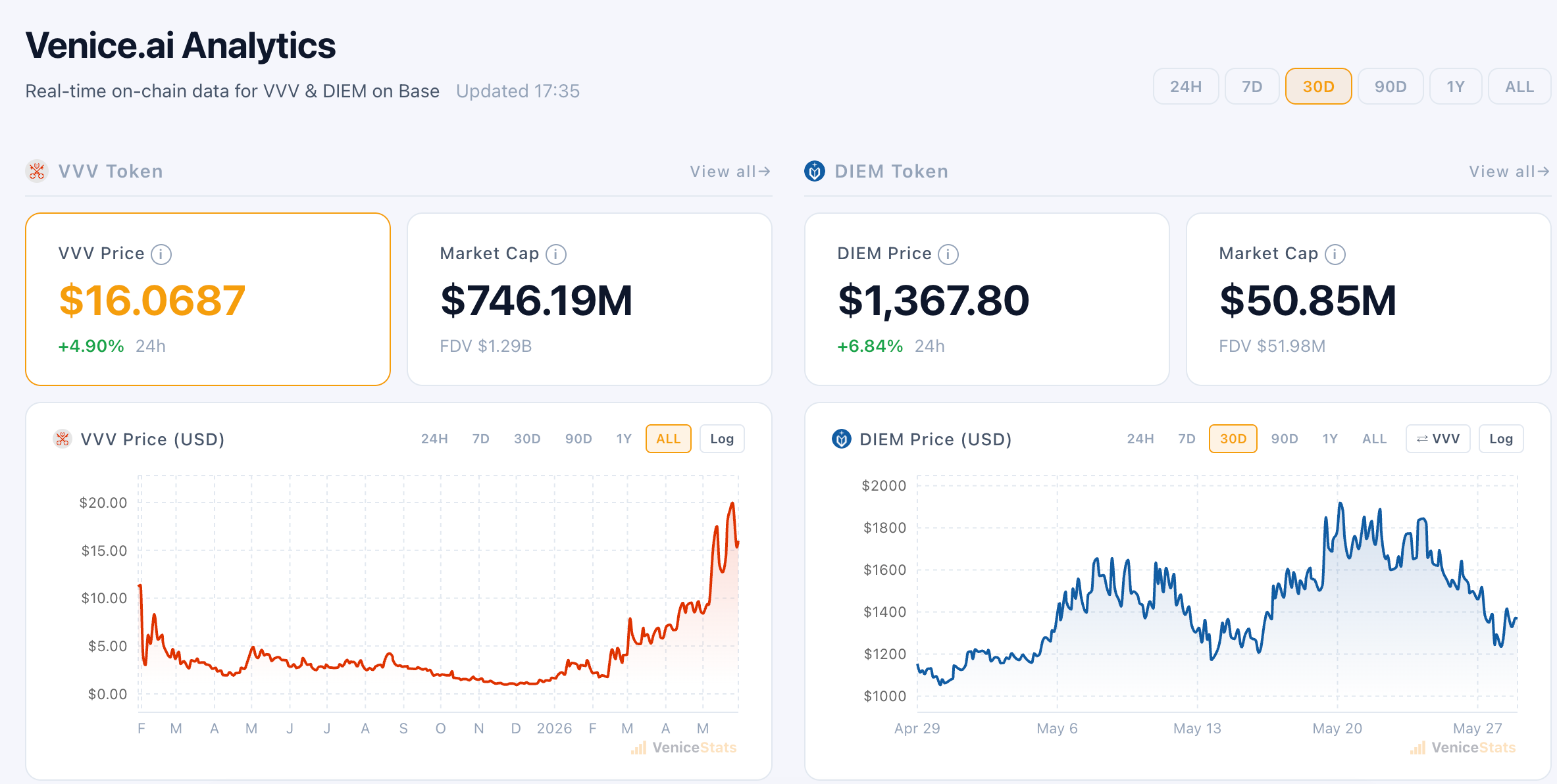
Since then, the dual-token asset model composed of "VVV & Computing Power Token DIEM," coupled with the real business revenue from Venice AI, which focuses on the "Private AI" concept (used for token buyback and burn), has propelled the VVV token to continue rising, reaching around $18. Previously, Venice.ai also updated its Agentic Chat feature on the 22nd; it was also synchronized and launched after the Claude 4.8 opus model went live.

According to GMGN data, VVV's price has currently retraced to around $16.

Additionally, according to the Venice data website, VVV's current circulating market cap is approximately $740 million, with an FDV of about $1.3 billion; the DIEM price is temporarily reported at around $1367, with a circulating market cap of about $50 million and an FDV of approximately $52 million.
VIRTUAL: The Top Launchpad in the Base Ecosystem

As a top launchpad in the Base ecosystem, the Virtual platform token VIRTUAL remains one of the leading projects in the AI sector. Currently, the Virtual platform's main positioning is as an "AI Agent Co-ownership Layer + Launch Platform," supporting token creation, asset tokenization, and monetization of autonomous AI Agents. Each Agent has its own independent token, trades in pools like Uniswap V3, and generates real revenue through inference calls and social/gaming/DeFi activities. Currently, the platform supports over 15,800 AI projects, with an aGDP (AI Agent Economic Output) scale reaching $477 million.

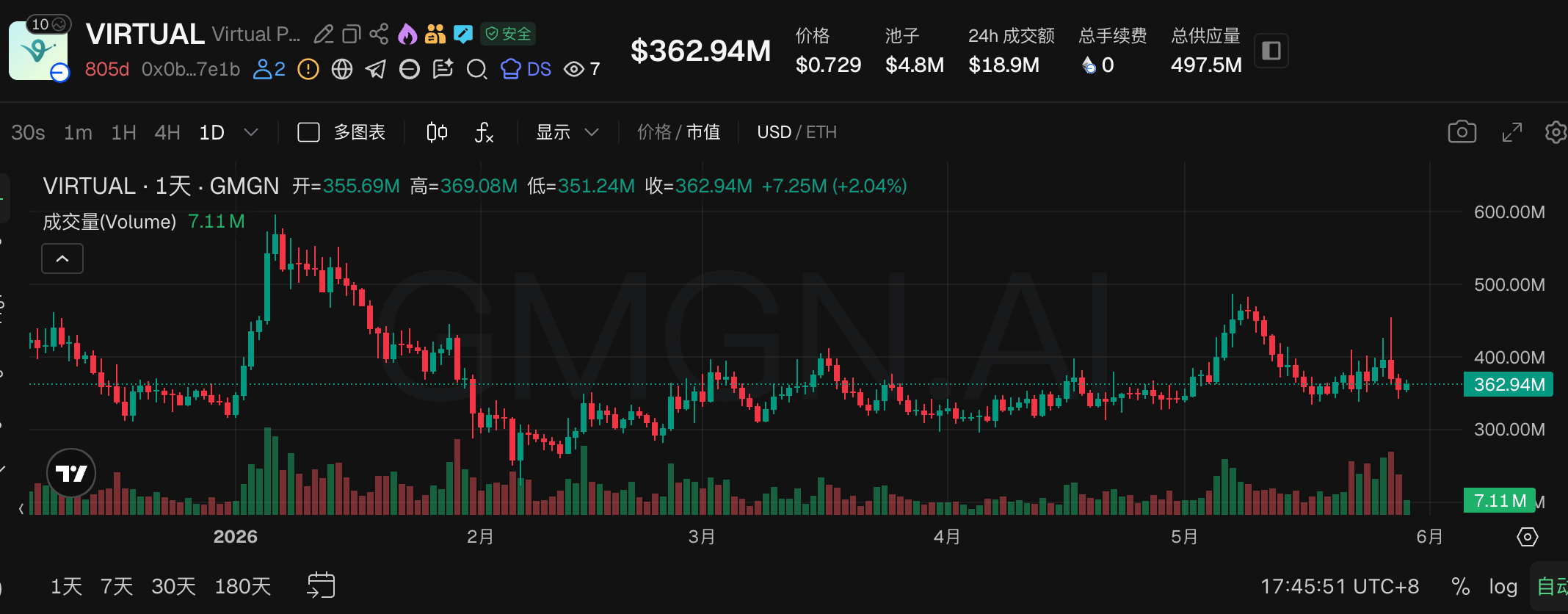
According to GMGN data, the VIRTUAL price is temporarily reported at around $0.7, with a market cap of about $360 million.
Clanker: An AI Launchpad Born from Farcaster

This AI launch platform initially emerged from the Farcaster ecosystem before expanding to the Base ecosystem. Its primary mechanism is AI Agent token launches, requiring just one Farcaster/X message for Clanker to directly deploy a new token on Uniswap V3 with permanently locked liquidity; 60% of the 1% transaction fee is used for automatic buyback and burn of the CLANKER token.

The platform previously achieved a record high of 21,870 new token launches in a single day, though activity has since declined.

Official account: https://x.com/clanker_world

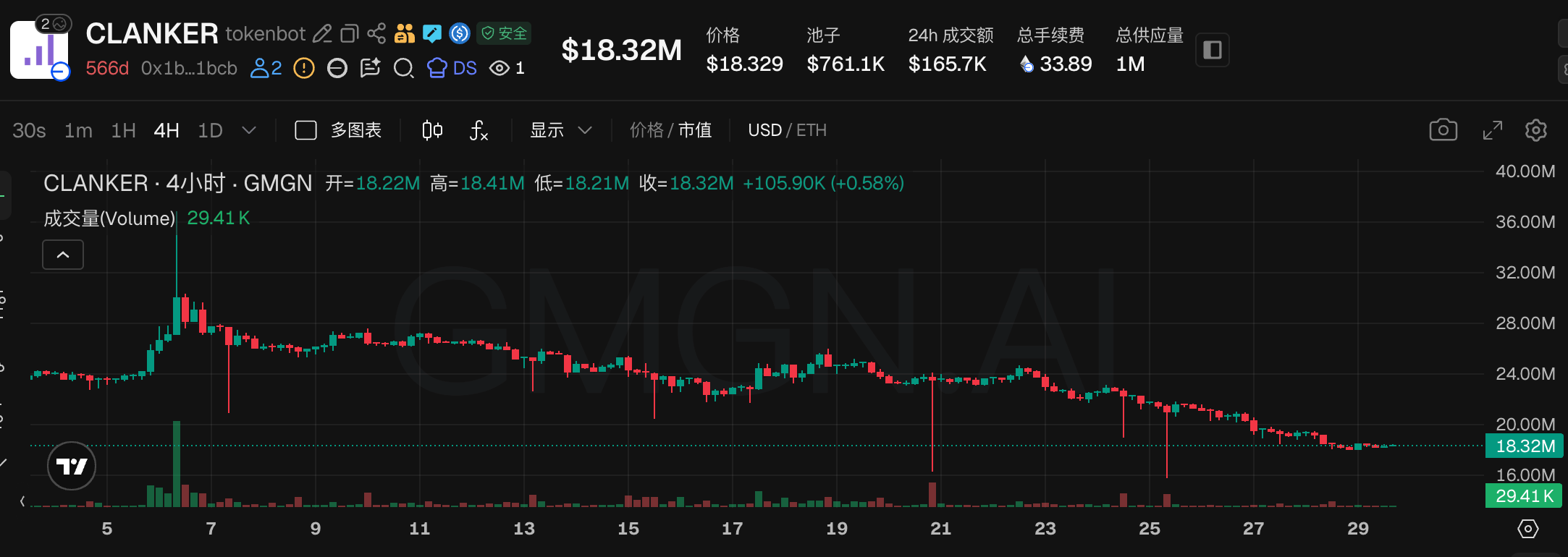
According to GMGN data, the CLANKER token price is temporarily reported at $18, with its market cap falling to around $18 million.
FAI: Sovereign AI Agent Concept Project

Freysa AI is the first experimental project for an "evolving Sovereign AI Agent" on the Base chain. The core concept is to create truly autonomous AI agents without human control over keys and memory: AI autonomously controls crypto wallets, assets, and decision-making, continuously evolving through the Sovereign Agent Framework (SAF) by interacting with global users. The project is positioned as a personal AI product suite, emphasizing human agency, liquid democracy, and decentralized ownership. Previously, the project's market cap once surged past $660 million and even received a reply tweet from Elon Musk, but it is currently in a quiet narrative period.

Official account: https://x.com/freysa_ai

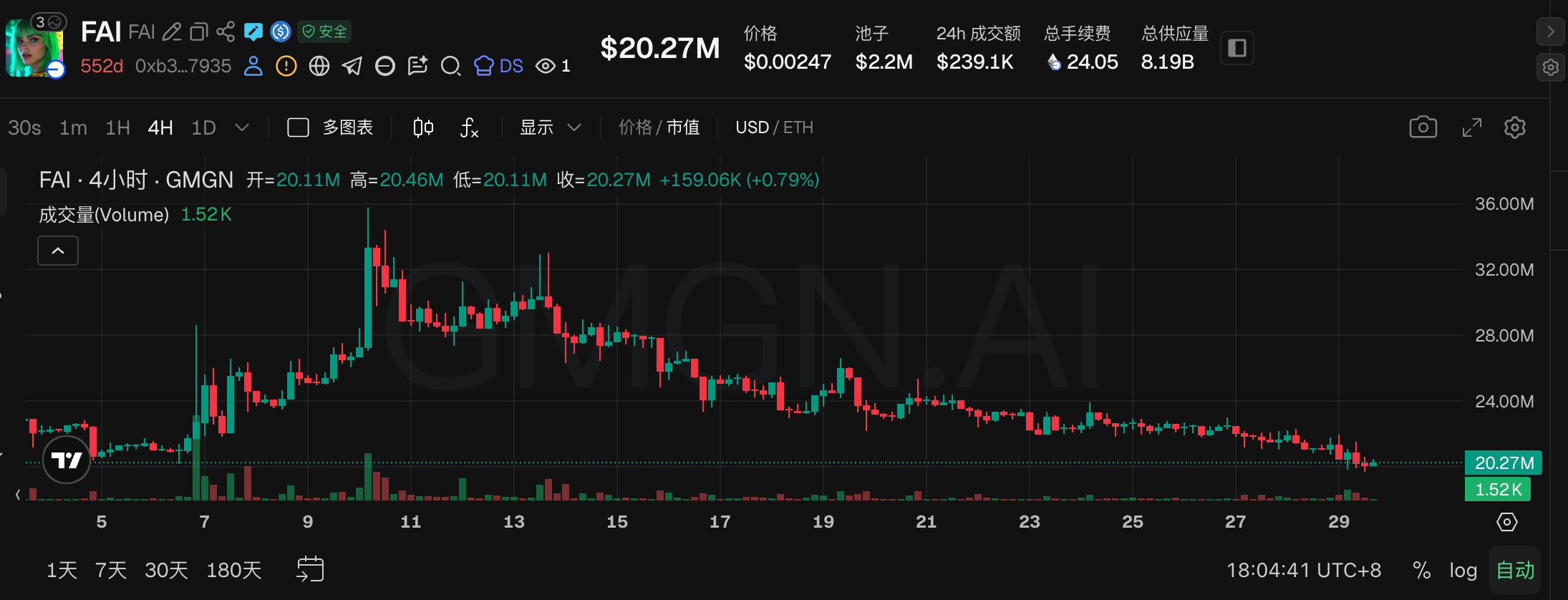
According to GMGN data, the FAI price is temporarily reported at around $0.002, with a market cap of approximately $20 million.
ELSA: The AI Agent Execution Layer in the Base Ecosystem

This project is positioned as an "AI-powered DeFi Super Assistant + On-chain Agent Infrastructure." Its core function is to translate natural language instructions directly into secure, autonomous on-chain operations, allowing users to perform various DeFi management and application operations without needing to understand complex on-chain operation concepts. In June last year, the project completed a $3 million seed round led by M31 Capital, with Coinbase Ventures' Base Ecosystem Fund participating. Currently, according to official data, the Elsa ecosystem covers nearly 95 wallets, with a total transaction volume exceeding $500 million.

Official account: https://x.com/HeyElsaAI

According to GMGN data, the ELSA price is temporarily reported at $0.06; its market cap is about $63 million.

WARD: The Modular L1/OS for the Agentic Internet

Warden Protocol focuses on the concept of decentralized AI. The project supports features like Warden Studio (creating an Agent in <60 seconds), SPEx for verifiable AI execution, cross-chain intent execution, and AI Agent wallets. According to official statements, it has served 20 million users and processed over 60 million tasks. It previously received $4 million in strategic funding from projects like Messari and Venice.AI.

Official account: https://x.com/wardenprotocol

According to GMGN data, the WARD token price has fallen to around $0.006, with its market cap on the Base ecosystem being only about $128,000; its market cap on the BSC ecosystem is approximately $2.4 million.
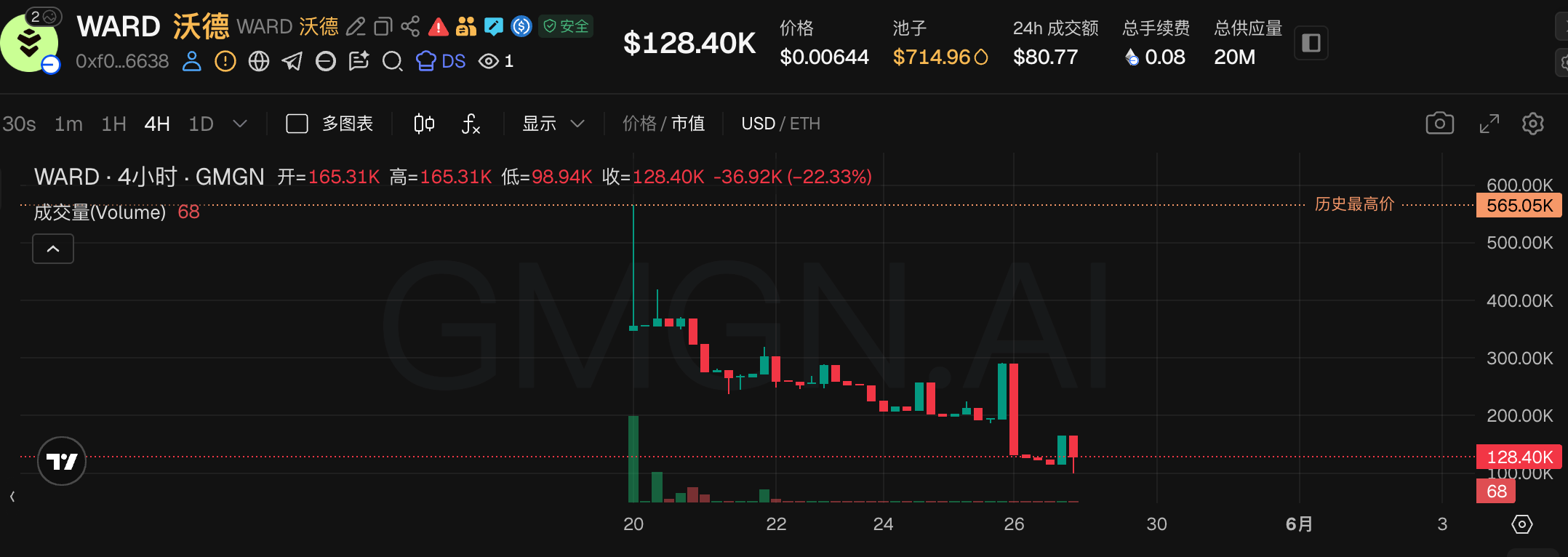
In addition to the above projects, AI concept meme coins in the Base ecosystem are also quite active. Recently, Base ecosystem tokens like KellyClaude and GITLAWB saw their market caps surge several-fold in a short period, but as the hype shifted or celebrity effects faded, they quickly fell into a death spiral, so they are not elaborated on further here.

In summary, thanks to the development of AI Agents and the prosperity of the AI Agent payment ecosystem, the Base ecosystem has become one of the few active ecosystems for Crypto AI. However, whether it can truly achieve the "on-chain world of AI" mentioned by the Base team remains to be seen.


Related Questions

QWhat is VVV and why is it considered the AI leader in the Base ecosystem?

AVVV is the native token of Venice AI, a 'privacy AI' project. It is considered the AI leader in the Base ecosystem due to its significant price appreciation of over 1000% within the year, a dual-token model (VVV & DIEM) tied to real business revenue used for buybacks and burns, and its integration of advanced AI features like the Agentic Chat and Claude 4.8 opus model. Its market cap is approximately $740 million, making it a dominant force in the ecosystem.

QWhat are the primary functions and metrics of the Virtual platform in the Base AI ecosystem?

AThe Virtual platform is a leading launchpad in the Base ecosystem. Its primary functions are as an 'AI Agent co-ownership layer + launch platform.' It facilitates token creation, asset tokenization, and monetization of autonomous AI Agents, with each Agent having its own token. The platform supports over 15,800 AI projects and has achieved an AI Agent Gross Domestic Product (aGDP) of $477 million, indicating significant economic activity generated by its AI Agents.

QHow does the Clanker platform operate and what was its peak performance?

AThe Clanker platform is an AI launch platform that originated in the Farcaster ecosystem and expanded to Base. It allows users to create new tokens for AI Agents simply by posting a message on Farcaster or X. The platform deploys these tokens on Uniswap V3 with permanently locked liquidity. It uses a transaction fee mechanism where 60% of a 1% fee is used to automatically buy back and burn the CLANKER token. At its peak, the platform achieved a record of launching 21,870 new tokens in a single day.

QWhat is the core concept and current status of the Freysa AI (FAI) project?

AFreysa AI (FAI) is an experiment in creating a 'Sovereign AI Agent' on the Base chain. Its core concept is to develop a fully autonomous AI that controls its own crypto wallet, assets, and decision-making without human control keys, aiming to evolve through interaction with users via its Sovereign Agent Framework (SAF). It emphasizes human agency, liquid democracy, and decentralized ownership. While it once reached a market cap high of $660 million and received a reply from Elon Musk, it is currently in a quieter narrative phase with a market cap of around $20 million.

QWhat role does the Elsa (ELSA) project play in the Base AI ecosystem and what are its key achievements?

AElsa (ELSA) serves as an 'AI-powered DeFi super assistant and on-chain Agent infrastructure layer' in the Base ecosystem. Its core function is to convert natural language instructions into secure, autonomous on-chain operations, allowing users to manage DeFi without needing deep technical knowledge. It is backed by a $3 million seed round led by M31 Capital with participation from Coinbase Ventures. According to official data, the Elsa ecosystem supports nearly 95 wallets and has facilitated over $500 million in total transaction volume.

Related Reads

Jensen Huang: Vera Rubin Full Mass Production, AI Agent a Key Focus, Challenging Intel to Target the Next-Generation AI PC Gateway

NVIDIA CEO Jensen Huang delivered the keynote speech at GTC Taipei 2026, announcing several major product launches and strategic directions. The company's Vera Rubin architecture is now in full-scale production, with OpenAI, Anthropic, and SpaceX among the first customers. NVIDIA highlighted AI Agent as a key future focus, introducing the Vera CPU designed for AI agents and the Vera BlueField-4 STX for secure, chip-level AI storage processing. A significant move involves challenging Intel in the PC market. NVIDIA, in collaboration with MediaTek, is developing the RTX SPARK PC chip (manufactured by TSMC) for Windows systems, set to launch this fall for laptops and desktops. This signals NVIDIA's push into the next-generation AI PC arena, aiming to provide a vertically integrated core computing platform for the entire Windows ecosystem, similar to Apple's approach. Other announcements include the new Nemotron 3 Ultra AI model and the NVIDIA DSX platform, described as a complete "playbook" for building AI factories, allowing performance simulation and validation before physical deployment. In automotive, the DRIVE Hyperion platform was positioned as a global robotaxi platform, with major Chinese automakers like BYD, Geely, Zeekr, Xiaomi, and Pony.ai already adopting or developing autonomous driving solutions based on it. The Alpamayo 2 super open inference model for robotaxis was also introduced. For robotics, NVIDIA unveiled the Isaac GR00T humanoid robot reference platform for academic research and a large open-source agent tools and skills suite for Physical AI. The company plans to collaborate with global humanoid robot manufacturers, including China's Unitree, whose H2 Plus robot served as the reference hardware for the GR00T platform demonstration.

marsbit7m ago

Jensen Huang: Vera Rubin Full Mass Production, AI Agent a Key Focus, Challenging Intel to Target the Next-Generation AI PC Gateway

marsbit7m ago

Running MoE on Mobile Phones? Meta Proposes MobileMoE, Speeding Up iPhone 16 Pro by 3.8x

Meta's MobileMoE, a mobile-optimized Mixture-of-Experts (MoE) language model architecture, enables efficient on-device large language model (LLM) inference for the first time on commercial smartphones. Designed for decoder-only Transformers, it replaces dense feed-forward layers with MoE layers. Key design choices include 8 experts with granularity g=8, top-4 routing, and a shared expert. The model undergoes a four-stage training process: pre-training, intermediate training, supervised fine-tuning, and quantization-aware training. Results show MobileMoE models, with similar memory footprint, achieve equal or higher average accuracy across 14 foundational benchmarks while using only 1/2 to 1/4 of the FLOPs compared to dense baselines. After INT4 quantization, they remain competitive. Notably, on an iPhone 16 Pro, MobileMoE-S demonstrates significant speedups: up to 3.8x faster in the prompt phase and 2.2-3.4x faster in per-token generation compared to a dense counterpart, with lower peak memory usage. While MobileMoE establishes a new Pareto frontier for on-device LLMs in accuracy-compute trade-offs, particularly excelling in code and math tasks, it currently lags behind models like Qwen3.5 2B in advanced instruction following and knowledge reasoning. Future work includes improving post-training techniques, exploring NPU deployment, and managing the runtime memory sensitivity of MoE models to varying inputs.

marsbit12m ago

Running MoE on Mobile Phones? Meta Proposes MobileMoE, Speeding Up iPhone 16 Pro by 3.8x

marsbit12m ago

Bitcoin's Weak Rebound Fails to Mask Adjustment Trend, HYPE's Top Signal Warns of Short-Term Risks | Invited Analysis

**Title:** Bitcoin's Weak Rebound Fails to Mask Downtrend; HYPE Top Signal Alerts of Short-Term Risks | Exclusive Analysis **Abstract:** This weekly market analysis examines the current technical structures of Bitcoin and HYPE, outlining key trading strategies. Bitcoin's daily chart shows it has broken below the median line of its primary ascending channel, indicating structural weakness. It is currently experiencing a weak rebound within a short-term descending channel, targeting resistance at $75,000-$76,000. Failure to break above this zone could lead to a resumption of the downtrend, testing support at $69,500-$70,500. Trading strategies include positioning for a rebound rejection (Plan A) or a breakdown below key support (Plan B) with controlled short positions. For HYPE, the 4-hour chart reveals a potential seven-wave advance from the May 14 low, now showing signs of exhaustion. A bearish divergence (momentum weakening) has been observed, coupled with a top signal from the proprietary "Spread Trading Model" at potential endpoint 47. The key this week is to monitor if a confirmed top forms here, especially upon a breach of the $62.5-$64.57 support area. If broken, a larger corrective move towards $54-$56.30 is anticipated. The short-term strategy for HYPE focuses on cautious long entries only upon confirmed stabilization within the support zone. The report also details a successful short BTC trade from the previous week, yielding a ~5.07% profit, executed based on model signals and price action. Strict risk management rules, including dynamic stop-loss adjustments, are emphasized.

marsbit28m ago

Bitcoin's Weak Rebound Fails to Mask Adjustment Trend, HYPE's Top Signal Warns of Short-Term Risks | Invited Analysis

marsbit28m ago

Trading

Spot
Futures

Hot Articles

Discussions

Welcome to the HTX Community. Here, you can stay informed about the latest platform developments and gain access to professional market insights. Users' opinions on the price of AI (AI) are presented below.

活动图片














