Vitalik Buterin Says Obfuscation Could Boost Blockchain Privacy

TheNewsCryptoPublished on 2026-06-29Last updated on 2026-06-29

Abstract

Ethereum co-founder Vitalik Buterin published an article exploring how cryptographic obfuscation could enhance blockchain privacy and security. Obfuscation protects the code of a program itself, making it unreadable while allowing it to function normally, unlike encryption which secures data. Buterin explained that combining obfuscation with blockchain's inherent ability to record ownership could create systems where user privacy is maintained and reliance on central authorities is reduced, enabling secure payments, finance apps, and confidential operations. However, major technical hurdles remain. While research in "indistinguishability obfuscation" has proven it theoretically possible, current implementations are extremely inefficient, with some methods taking impractically long times to execute. Scientists are working on optimizing cryptographic methods and mathematical tools to improve efficiency. Buterin concluded that practical, widely usable obfuscation will take considerable time to develop, but eventual progress could lead to highly secure blockchain products that operate without trusted third parties.

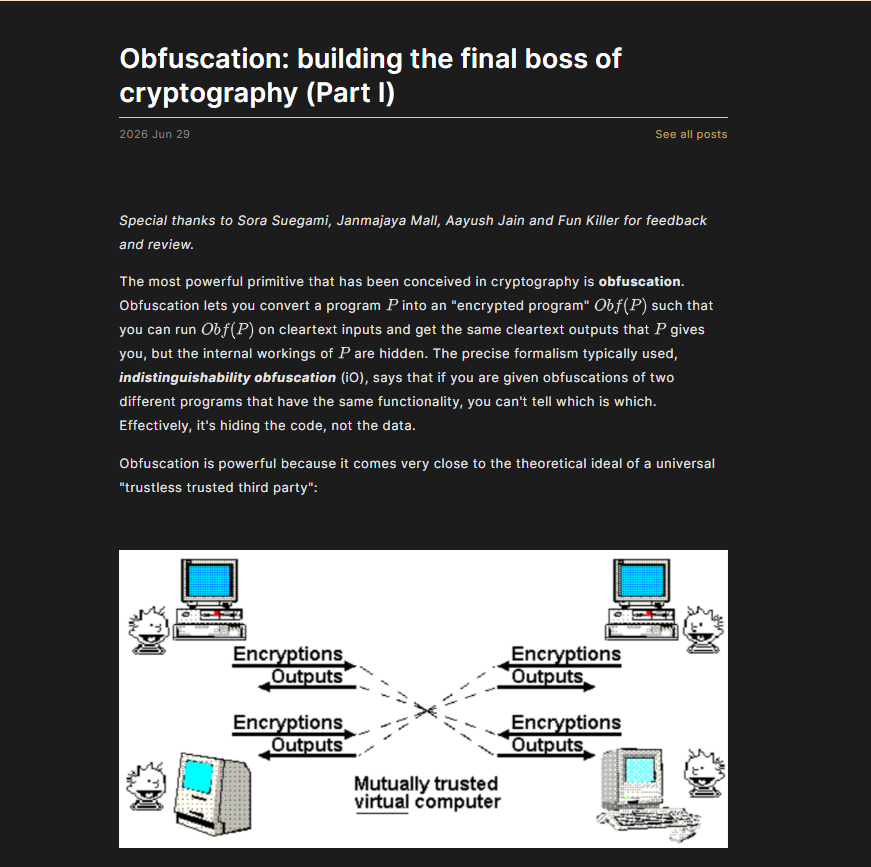
Ethereum co-founder Vitalik Buterin released a comprehensive piece describing Obfuscation in crypto industry. He explained how cryptographic obfuscation could strengthen blockchain privacy and security in the future. Obfuscation converts ordinary code into an encrypted form while allowing it to produce the same output.

As opposed to encryption that secures stored or transmitted information, obfuscation protects code itself. This is donefrom being analyzed by any user who tries to look at it and understand how it works.

This would allow the developer to develop applications using information which would remain secure. Without having to divulge any proprietary code or business logic. He stated that obfuscation along with blockchain technology could create systems which would maintain the privacy of the users. And while making less use of central authorities for their services.
Source: Vitalik.eth

Blockchain Could Enhance the Capability of Obfuscation

Obfuscation alone is not sufficient to securely handle digital assets like cryptocurrencies since users can simply duplicate obfuscation. Hence, it would not be possible to handle the balance and ownership through obfuscation alone.

However, blockchain networks have an inherent capability of recording ownership and transactions in the form of distributed ledger technology, which makes it suitable when combined with obfuscation to create applications that are able to prove ownership while hiding program logic. As stated by Buterin, this combination would enable secure payment systems, finance applications, confidential business operations, and many other blockchain applications.

Technical Difficulties Impede the Practical Application of Obfuscation

Buterin stated that researchers made considerable progress in an area called indistinguishability obfuscation, which seeks to make it impossible for an outside observer to distinguish among several programs generating the same output.

While researchers have already demonstrated that such obfuscation is possible by assuming certain accepted levels of security, the efficiency of those implementations is extremely poor. According to Buterin, some techniques currently employed are so resource-consuming that their execution would take longer than the lifetime of the universe.

There are still several techniques being researched by scientists that would help improve the efficiency of the algorithms. They involve optimizing currently used cryptographic methods, improving the mathematical tools, and even employing entirely novel approaches outside the existing framework.

Buterin concluded that practical obfuscation will take considerable time before becoming feasible, but further improvements will enable creating highly secure blockchain-based products that would not require the involvement of any trusted third parties.

Highlighted Crypto News:

India’s USDT Premium Surges Above 8.5% as Stablecoin Supply Tighten

TagsBlockchainEthereum (ETH)Vitalikvitalik ButerinVitalikButerin

Trending Cryptos

Related Questions

QAccording to Vitalik Buterin, what is the key difference between encryption and obfuscation in the context of blockchain technology?

AAccording to the article, encryption secures stored or transmitted information, while obfuscation protects the code itself from being analyzed and understood by users, while still allowing it to produce the same output.

QWhy is obfuscation alone insufficient for securely handling digital assets like cryptocurrencies?

AObfuscation alone is insufficient because users can simply duplicate an obfuscated program, making it impossible to reliably manage asset balances and ownership through obfuscation alone.

QHow can blockchain technology enhance the capability of obfuscation, as described by Buterin?

ABlockchain's distributed ledger technology inherently records ownership and transactions. When combined with obfuscation, it can create applications that prove ownership while simultaneously hiding the underlying program logic.

QWhat is the main technical difficulty currently impeding the practical application of cryptographic obfuscation?

AThe main difficulty is the extreme inefficiency of current obfuscation implementations. Some techniques are so resource-intensive that their execution time would exceed the lifetime of the universe.

QWhat type of obfuscation have researchers made considerable progress in, and what is its goal?

AResearchers have made progress in 'indistinguishability obfuscation.' Its goal is to make it impossible for an outside observer to distinguish between different programs that generate the same output.

Related Reads

Lightning Fast Five-Whip Combo! Strategy's Self-Rescue Plan Officially Released

Strategy, amidst the STRC de-pegging crisis, has unveiled its "Digital Credit Capital Framework" self-rescue plan. The five-part framework includes: 1) **Cash Reserves**: Management of ~$2.55B in USD reserves, dedicated solely to covering ~17.4 months of preferred stock dividends and debt interest, with a 12-month minimum coverage floor. 2) **Dividend Policy**: STRC's dividend yield rises to 12% from July 1st, with monthly reviews. Strategy clarifies de-pegging does not automatically trigger further hikes. 3) **Preferred Stock Buyback**: A $1B authorization, prioritizing STRC repurchases to support its price, reduce future dividend obligations, and signal commitment, using funds separate from dividend reserves. 4) **Common Stock Buyback**: A separate $1B authorization for MSTR stock, aimed at creating shareholder value when the stock is deemed undervalued, establishing a two-way capital management mechanism. 5) **Bitcoin Monetization**: Formal authorization to sell BTC (up to $1.25B earmarked) to build USD reserves, cover dividends/interest, or fund buybacks, marking a strategic shift where BTC becomes a managed asset rather than a strictly "hold-only" reserve. Market reaction saw MSTR and STRC shares rise pre-market, while BTC remained stable. The plan aims to restore confidence in STRC, ensure dividend sustainability, and reopen Strategy's funding channels.

Odaily星球日报57m ago

Lightning Fast Five-Whip Combo! Strategy's Self-Rescue Plan Officially Released

Odaily星球日报57m ago

The Sword of Damocles Over the AI Bull Market: Not Just in South Korea, Leverage in U.S. Stocks Is Equally Staggering

Global equity markets are hitting new highs driven by the AI boom, but the fuel behind this rally is becoming increasingly dangerous. From the US to South Korea, margin debt and leveraged ETF assets have soared to historical extremes, with their pro-cyclical nature amplifying tail risks in market volatility. In the US, margin debt rose 54% year-over-year in May, reaching a record $1.4 trillion. Simultaneously, leveraged ETF assets nearly doubled in under 70 days to over $220 billion by early June, with intense focus on tech, semiconductor indices, and single stocks like NVIDIA and Tesla. A warning sign appeared in South Korea, where the KOSPI index experienced extreme volatility, plunging 10% to trigger a circuit breaker, then sharply rebounding before halting again, partly driven by concentrated, highly leveraged positions in chip stocks. Analysts are raising alarms. Barclays warns that leveraged funds have accumulated roughly $300 billion in equity-linked derivatives since late March, creating a major source of non-discretionary risk. Morgan Stanley notes an unprecedented reliance on leveraged financing by marginal buyers, with financing becoming more expensive and scarce. Charles Schwab has tightened margin requirements. The core risk lies in the mechanics: leveraged ETFs and derivatives can create a "tail wags the dog" effect, where fund flows force market makers to buy underlying stocks, amplifying gains. This process reverses in a downturn, triggering a self-reinforcing selling spiral as funds deleverage. Additionally, the cost of borrowing to buy stocks has spiked to multi-year highs. Morgan Stanley warns this sets up a nonlinear risk: high financing costs stall momentum, a price decline triggers forced deleveraging, and selling pressure is multiplied by leverage, potentially leading to outsized declines. The current market breadth is narrow, with gains heavily concentrated in tech, making the rally vulnerable to a pullback in leveraged positions. In summary, the AI-fueled bull market is increasingly propped up by record leverage. When this trend reverses, the deleveraging process could magnify losses, posing a significant threat to financial stability.

marsbit1h ago

The Sword of Damocles Over the AI Bull Market: Not Just in South Korea, Leverage in U.S. Stocks Is Equally Staggering

marsbit1h ago

Strategy Launches 'Digital Credit Capital Framework': Authorizes Sale of $12 Billion in Bitcoin, Ending the 'Never Sell' Script

Strategic, the world’s largest corporate holder of Bitcoin (formerly MicroStrategy), has dramatically shifted its long-standing “never sell Bitcoin” strategy by announcing a new “Digital Credit Capital Framework” on June 29. This plan authorizes the sale of up to $1.25 billion worth of Bitcoin to raise cash, establishes a $2.55 billion USD reserve, increases the dividend rate on its STRG preferred shares to 12%, and authorizes up to $1 billion each for repurchases of its own digital credit securities and Class A common stock. This pivot comes amid severe financial pressure. The company’s STRG preferred shares are trading at a ~24% discount to their $100 face value, making new issuances difficult and stalling its buy-Bitcoin funding flywheel. Its annualized dividend obligation has surged to ~$1.2 billion. Meanwhile, its MSTR stock has plummeted 36% in eight days, erasing its traditional premium over its Bitcoin holdings per share. In recent weeks, Strategic has already shifted focus from accumulating Bitcoin to bolstering cash reserves by selling its own MSTR shares. The new framework formalizes this defensive turn, aiming to ensure liquidity, cover dividends, and support its securities prices through buybacks. However, the move risks triggering a “death spiral” if Bitcoin sales pressure the market, further devaluing the company’s core asset. The company also faces a potential securities investigation and carries significant debt, with Bitcoin’s current price below its average acquisition cost.

marsbit1h ago

Strategy Launches 'Digital Credit Capital Framework': Authorizes Sale of $12 Billion in Bitcoin, Ending the 'Never Sell' Script

marsbit1h ago

Deforming the Transformer, LLMs Become Smarter

A new research paper proposes "Tapered Language Models (TLMs)," a method that improves large language model performance without adding any parameters. It challenges the standard Transformer design where each layer has the same number of parameters ("feed-forward network" width). Building on evidence that layers are not equally important—earlier layers handle foundational information like grammar, while later layers often reinforce existing judgments—the researchers suggest reallocating model capacity from later to earlier layers. The core idea is to make the layer width taper off monotonically from start to end, keeping total parameters and compute constant. Experiments compared linear, cosine, and sigmoid tapering curves on a 440M parameter model. The cosine curve (e.g., starting width 1.5x baseline, ending 0.5x) achieved the best result, reducing perplexity by 1.84 points compared to the uniform baseline—a significant gain at zero cost. This finding proved robust across four different model architectures (including gated attention and memory-augmented models) and at larger scales (760M and 1.3B parameters), consistently improving performance on commonsense reasoning and language modeling tasks without harming long-context retrieval ability. The work highlights a long-overlooked design dimension: optimal parameter allocation across depth. It offers a "free lever" for efficiency, potentially applicable beyond language models to vision Transformers and diffusion models. The study was conducted by researchers from Mila, Cornell University, and the University of Montreal.

marsbit1h ago

Deforming the Transformer, LLMs Become Smarter

marsbit1h ago

Trading

Spot

Hot Articles

Discussions

Welcome to the HTX Community. Here, you can stay informed about the latest platform developments and gain access to professional market insights. Users' opinions on the price of ETH (ETH) are presented below.

活动图片