Author: Thejaswini M A
Original Title: AI Agents are Coming for Visa's Lunch
Visa's empire is built on "human involvement," and humans are stepping back.
Visa's entire business model is a big bet on human behavior. It's about human spending habits and psychology.
The points you accumulate, the fraud protection you rely on, the Centurion Black Card you aspire to, the "zero liability policy" that makes you feel safe when swiping your card at an ATM abroad—these exist not because "moving money" itself is difficult. It's because humans are anxious, status-driven, and not good at reading terms and conditions. Visa built a $500 billion company on this "cognitive gap."
AI agents, on the other hand, possess none of these traits.
They don't accumulate points. They don't feel safer because of fraud protection. They don't aspire to a black card. They have only one instruction: complete the task. And when the task involves payment, the agent will do the math that humans can never be bothered to calculate—the cheapest path, the fastest settlement, the lowest fees. Every time, automatically, without any emotion.

Last month, a Substack article titled "The 2028 Global Intelligence Crisis" caused Visa's stock to drop 4%, Mastercard to fall 6%, and American Express to plunge 12%.
The report was described as a "scenario envisioning" rather than a "prediction" (as stated in the original text). But the market didn't care. The technical claim itself isn't the point; the problem is: by 2027, agents will bypass existing clearinghouses and use stablecoins for settlement. Visa spent 50 years building a perfect, sophisticated product for a customer base that is being replaced.
In a "machine-to-machine" (M2M) commercial world, a 2% to 3% interchange fee is an obvious target. That sentence from Citrini Research is the entire core argument. It's not that AI will destroy Visa tomorrow, but that the fee structure on which Visa built its empire has always been a tax on irrational human behavior, and agents are perfectly rational. That's their whole point.
What Exactly Is Visa Selling?
To understand why this is crucial, you must understand what the interchange fee actually funds.
When you buy something with a credit card, the merchant pays a 2% to 3% fee to the card network and the issuing bank. This money pays for your reward points, fraud protection, purchase insurance, and dispute resolution. The entire consumer value proposition of credit cards is funded by merchants, who pass the cost on to everyone by slightly raising prices. It's an elegant and stable system that has run for 50 years because the "human" in the transaction was willing to pay for all of it—just not directly.
AI agents don't need these things. They don't need to dispute transactions, and they don't want cash back. The protections that justify the high fees are essentially protections against human error, human fraud, and human impulse. Once humans are removed from the transaction, the entire logic for this fee collapses.
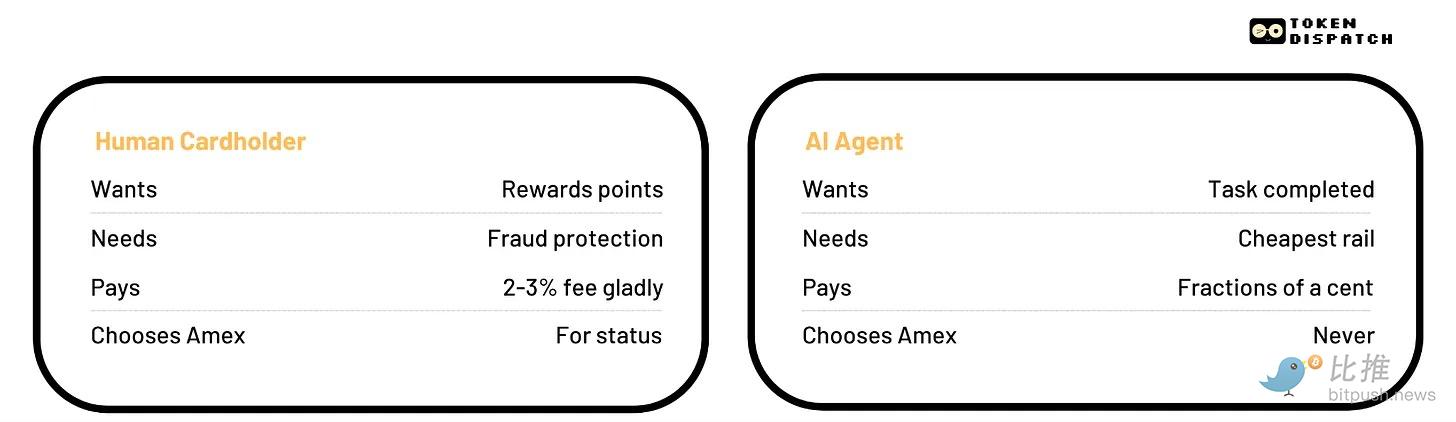
American Express (Amex) is the most extreme version of this problem. Its customers are high-income, high-spending, aspirational elite cardholders. Its fees are higher than Visa's or Mastercard's precisely because its customers are willing to pay for status and privilege. This entire model assumes a human is consciously making the decision to choose Amex over Visa for airport lounge access. But an agent won't choose Amex. An agent will only look for the cheapest option that gets the job done. In a world where software holds the cards, the concept of a "premium tier" simply doesn't exist.
Agent-driven commerce bypassing fees poses a huge risk to banks and mono-line issuers reliant on card business. These institutions heavily depend on their share of that 2% to 3% fee and have built entire business segments around reward programs subsidized by merchants. Visa and Mastercard have network businesses that can transform, but issuers whose P&L models are built around interchange and rewards will have nowhere to go.
The Week "Everyone Shipped at Once"
Citrini's report and the launch of various infrastructures all collided within the same three-week window.
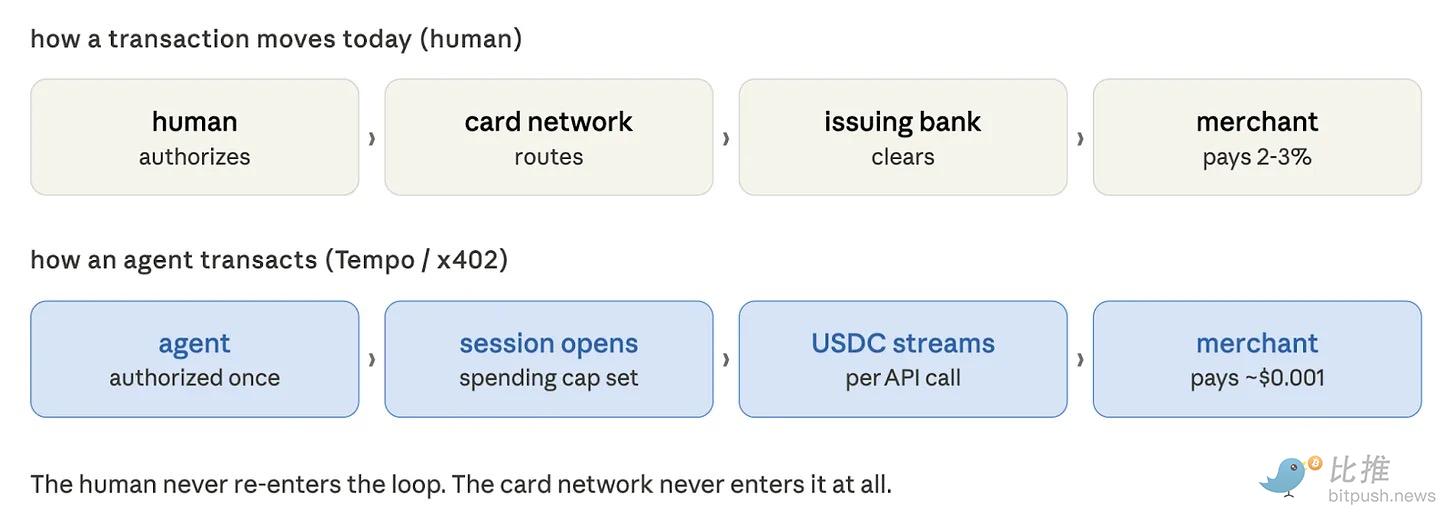
Tempo went live on its mainnet on Wednesday. Stripe and Paradigm's payment blockchain (built for high-volume stablecoin settlement) launched in sync with the Machine Payments Protocol. This is an open standard that allows AI agents to autonomously pay for services without human sign-off at every step. The protocol introduces the concept of "Sessions": a human authorizes a spending cap once, and then the agent makes continuous streaming micropayments as it consumes data, compute, or API calls. It's "OAuth for money." The human authorizes the budget, the agent spends it, no cards needed at any step.
Anthropic, DoorDash, Mastercard, Nubank, OpenAI, Ramp, Revolut, Shopify, Standard Chartered, and Visa are all listed as design partners for Tempo. The entire payments and commerce stack is acknowledging this structural shift.
On the same day Tempo launched, Visa's crypto division launched a Command Line Interface (CLI) tool for AI agents, allowing agents to pay directly from the terminal, no API keys, no accounts, no human authorization per transaction. Visa calls it "Command Line Commerce"—machines transacting without human intervention.
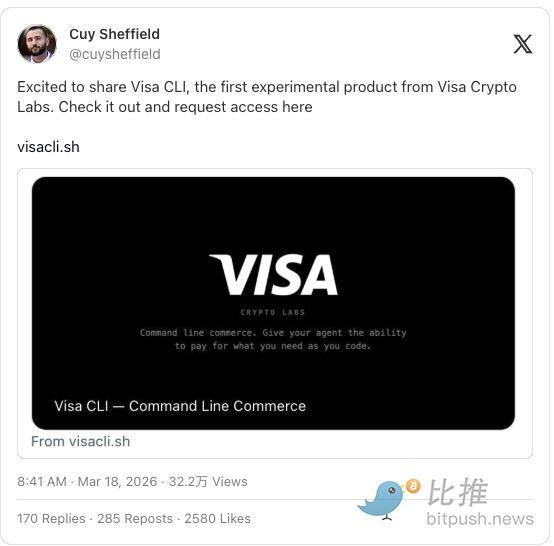
Cuy Sheffield (@cuysheffield)
"Excited to share Visa CLI, the first experimental product from Visa Crypto Labs. Check it out and apply for access here: visacli.sh"
— March 18, 2026
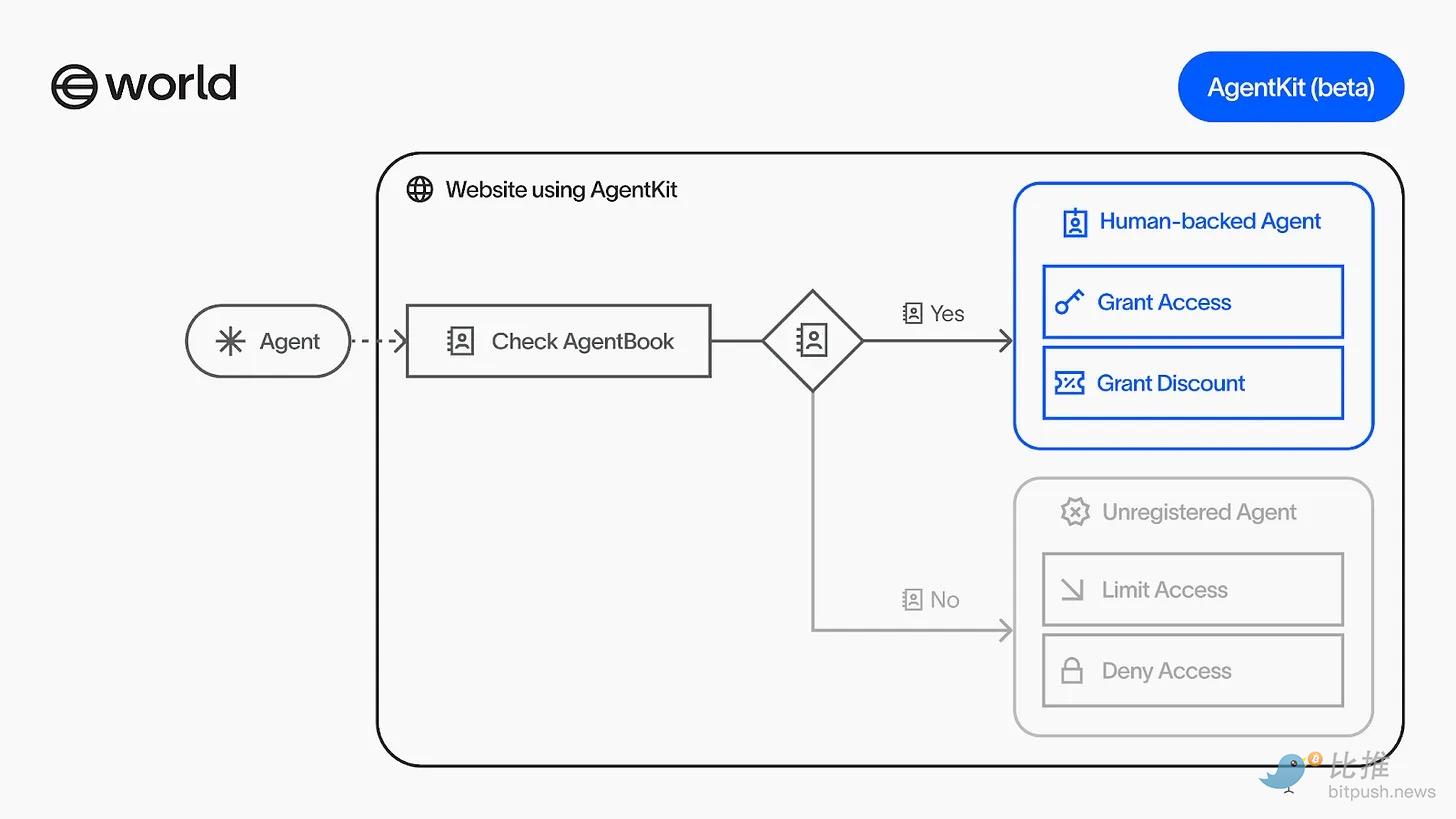
Mastercard agreed to acquire stablecoin infrastructure startup BVNK for $1.8 billion. Circle launched Nanopayments on testnet: sub-cent, gas-free USDC transactions designed for agents to pay for per-call APIs, no accounts or credentials needed. Sam Altman's World project (formerly Worldcoin) launched AgentKit, allowing agents to carry cryptographic credentials proving they represent a real human, and integrated directly into Coinbase's payment rails, enabling platforms to verify agent identity without hindering legitimate commerce.
What happened this week, in my view, is a race by companies to become the "new Visa" before Visa realizes what it has lost.
The Obvious Paradox
Now, one thing that hasn't been articulated clearly enough is that Visa is not sitting idly by.
It's involved in Tempo's Machine Payments Protocol, it formed Visa Crypto Labs, its head of crypto business explained in Fortune how agents could use the card rails via new standards. Mastercard spent $1.8 billion on stablecoin infrastructure. Stripe acquired Bridge and Privy. The existing giants understand this shift and are trying to position themselves before the new infrastructure fully arrives.
Visa's argument is: it can extend its own rails to cover these agent transactions before agent-driven commerce establishes new paths that make Visa irrelevant.
This argument is not obviously wrong. Stripe processed $1.9 trillion in total payment volume in 2025, up 34% year-over-year. These companies are not shrinking. The channel advantage of card networks is not easily replicated. I admit I'm a bit afraid to say this out loud because historically, whenever someone makes this argument, a new product is released that makes the speaker look like a fool.
So, the flaw in the argument is this: Visa's channel advantage is built on merchant relationships and consumer trust. Merchants accept Visa because consumers carry Visa; consumers carry Visa because merchants accept it. The entire flywheel spins on the premise of that "human" in the transaction loop. Once agents become the primary buyers in a significant category of commerce, the flywheel slows down. Agents have no brand loyalty and no wallet. They have a budget and an instruction. Whichever path is cheapest and fastest wins their business, every single time, with zero switching cost.
I want to accurately describe our current state because the narrative is often ahead of the data.
Despite the ecosystem around the x402 protocol being valued at roughly $7 billion, on-chain data shows it processed only about $28,000 per day last week, most of it from testing rather than real commercial transactions. This number is completely off the scale compared to what Visa processes daily.
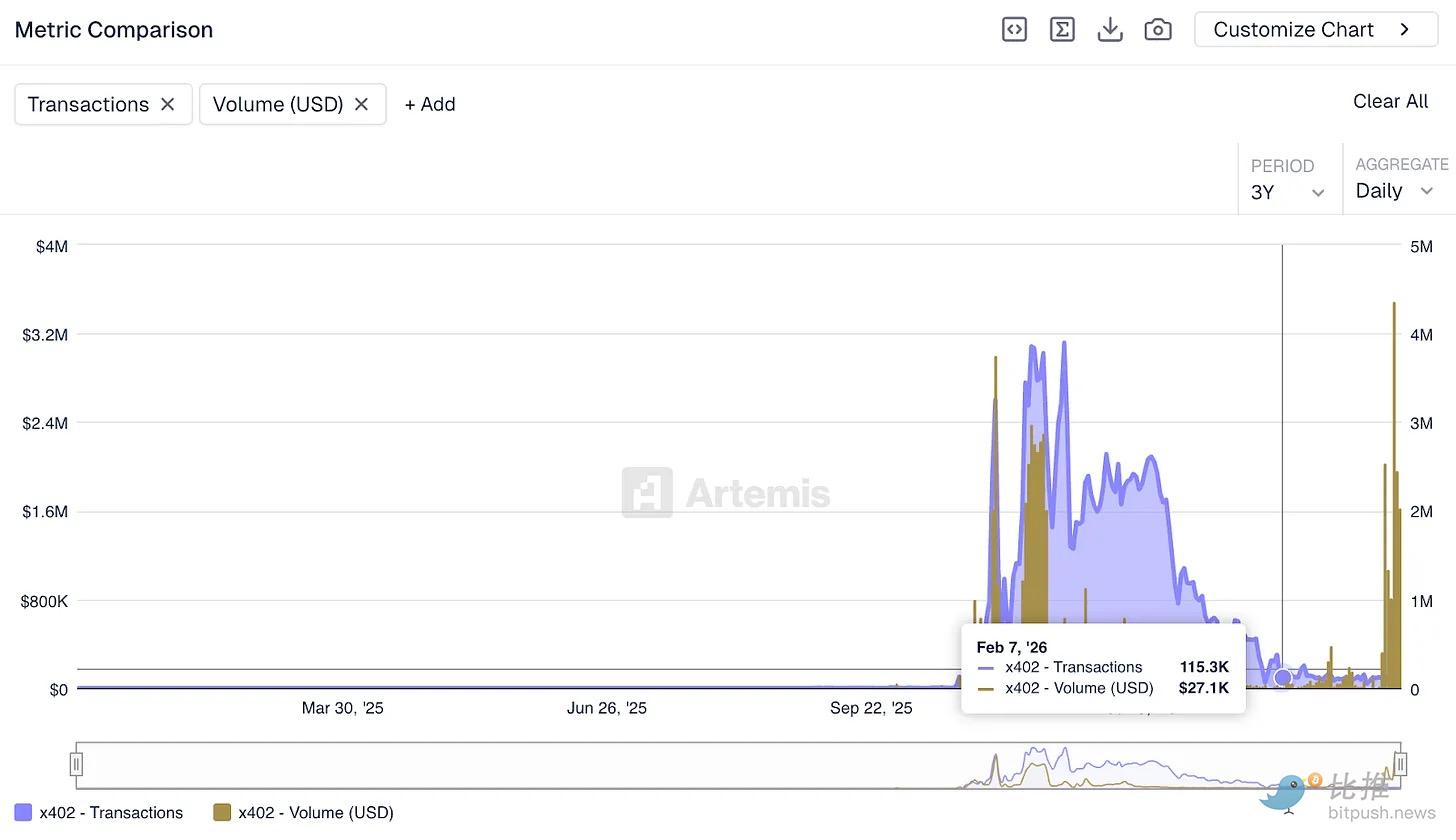
@artemisanalytics
x402 transaction count has surpassed 50 million. The transaction amounts are tiny, but the number of transactions indicates the infrastructure is being used, and developers are building on it. The merchant side (service providers accepting agent payments) is growing. This is what a nascent payment network looks like.
McKinsey predicts that by 2030, AI agents could mediate $3 trillion to $5 trillion in global consumer commerce. This estimate may be correct or overly optimistic. What is indisputable is that agent-driven commerce is not yet at scale. The merchants building agent-native services, the enterprises deploying agents as primary purchasers, and the transaction volume that could truly put pressure on the existing fee economy are all still under construction.
The reason Citrini's report spooked the market is that it simulated a plausible sequence of events. Mastercard's Q1 2027 earnings won't list "agent-driven price optimization" as the reason for slowing volume. Not yet.
This disruption will first happen in the realm of micropayments for AI infrastructure, not ordinary consumer commerce.
An agent completing a research task might call hundreds of specialized data APIs in one session. Each call costs just a fraction of a cent. Over a week, these calls might generate $40 in revenue for the service developer. Card networks cannot handle this kind of transaction—the minimum transaction cost (economic model) doesn't work, the merchant onboarding process doesn't work, the fee structure doesn't work. This type of commerce could never have run on Visa's rails from the start. It needs something entirely new, and x402, Nanopayments, and Tempo are building it.
The disruption of consumer commerce, according to Citrini's model, even if it happens, is for later. It requires agents to take on a significant portion of discretionary spending, which in turn requires consumers to trust agents to make purchasing decisions they currently make themselves.
Visa is being disrupted by a better customer—one that has zero need for everything Visa once prided itself on. That 2-3% interchange fee isn't a transaction tax; it's a tax on human irrationality. Agents are perfectly rational.
How do I know this will work? Because Visa spent $1.8 billion this week to make sure it doesn't get left behind.
Twitter:https://twitter.com/BitpushNewsCN
Bitpush TG Discussion Group:https://t.me/BitPushCommunity
Bitpush TG Subscription: https://t.me/bitpush




















