Viewing Crypto × AI from the Primary Market: An Experiment in Tokenization Illusion

marsbitPublished on 2026-02-12Last updated on 2026-02-12

Abstract

This article analyzes the convergence of cryptocurrency and artificial intelligence (AI), critiquing the prevailing trend of "tokenization illusion" in Crypto × AI projects. Initially, the discussion highlights Vitalik Buterin's earlier skepticism toward Crypto-Helps-AI initiatives—such as tokenizing computing power, data, and AI models—which often lack sustainable product-market fit. These efforts face issues like unreliable compute services, low-quality data supply, and the non-scarce nature of AI models. The author also questions the practicality of verifiable inference (e.g., ZKML), arguing it addresses non-existent threats, as AI errors typically stem from design flaws rather than malicious tampering. Buterin’s updated perspective now balances both AI-Helps-Crypto and Crypto-Helps-AI, focusing on four key areas: using Ethereum for trustless AI interactions and economic layers for AI agents, and leveraging AI for smart contract auditing, prediction markets, and DAO governance. The conclusion emphasizes a more mature, integrated approach beyond mere tokenization, hoping for tangible progress in the coming years.

Author:Lao Bai

After two years, V God has posted on Twitter again, and I will follow up on the research report from two years ago, even the timing is exactly the same, February 10th. (Related reading: ABCDE: Sorting Out AI+Crypto from a Primary Market Perspective)
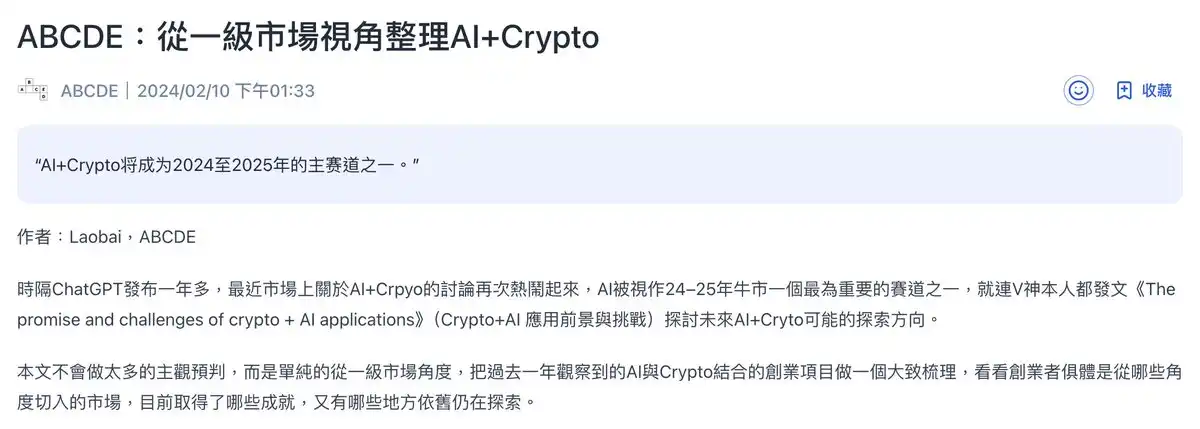
Two years ago, V God actually implicitly expressed that he was not very optimistic about the various popular Crypto Helps AI trends at the time. The three popular trends in the circle back then were computing power assetization, data assetization, and model assetization. My research report two years ago mainly discussed the phenomena and doubts observed in the primary market regarding these three trends. From V God's perspective, he was more optimistic about AI Helps Crypto.

The examples he gave at the time were:

  • AI as a participant in the game;
  • AI as the game interface;
  • AI as the game rules;
  • AI as the game objective;

Over the past two years, we have made many attempts in Crypto Helps AI, but with little effect. Many sectors and projects ended up - issuing a token and that's it, without real commercial PMF (Product-Market Fit). I call this the "Tokenization Illusion".

1. Computing Power Assetization - Most cannot provide commercial-grade SLA, are unstable, and frequently go offline. They can only handle simple small and medium model inference tasks, mostly serving niche markets. Revenue is not linked to the token......

2. Data Assetization - High friction on the supply side (retail users), low willingness, high uncertainty. The demand side (enterprises) needs structured, context-dependent, professional data suppliers with trust and legal liability. DAO-based Web3 project parties find it difficult to provide this.

3. Model Assetization - Models themselves are non-scarce, replicable, fine-tunable, rapidly depreciating process assets, not final-state assets. Hugging Face itself is a collaboration and dissemination platform, more like GitHub for ML, not an App Store for models. Therefore, so-called "decentralized Hugging Face" projects aiming to tokenize models have mostly ended in failure.

Additionally, over these two years, we have tried various forms of "verifiable inference," which is a typical story of looking for a nail to hit with a hammer. From ZKML to OPML to Gaming Theory, etc., even EigenLayer shifted its Restaking narrative to one based on Verifiable AI.

But it's basically similar to what happened in the Restaking sector - few AVSs (Actively Validated Services) are willing to pay continuously for extra verifiable security.

Similarly, verifiable inference is mostly verifying "things that no one really needs verified." The threat model on the demand side is extremely vague - who exactly are we protecting against?

AI output mistakes (model capability issues) are far more common than AI output being maliciously tampered with (adversarial problems). The various security incidents on OpenClaw and Moltbook some time ago showed that the real problems come from:

  • Wrong strategy design
  • Excessive permissions granted
  • Unclear boundaries
  • Unexpected interactions from tool combinations
  • ...

Almost none of the imagined nails like "model tampering" or "malicious rewriting of the inference process" exist.

I posted this picture last year, not sure if any old-timers remember.
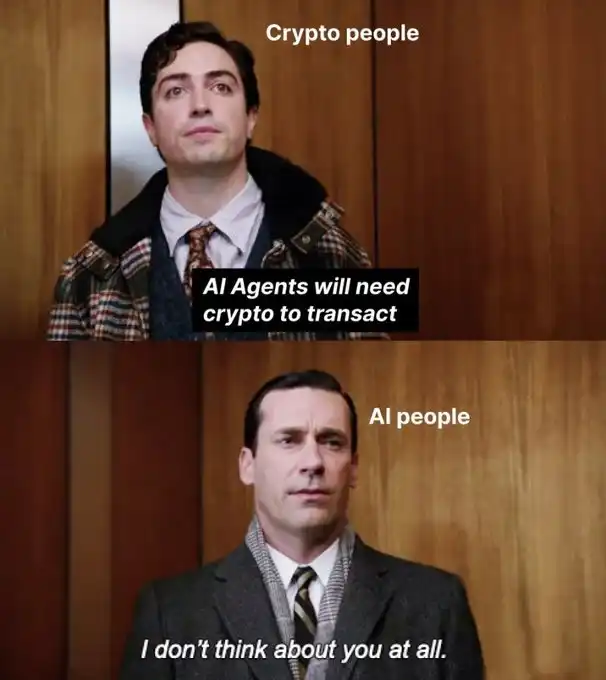
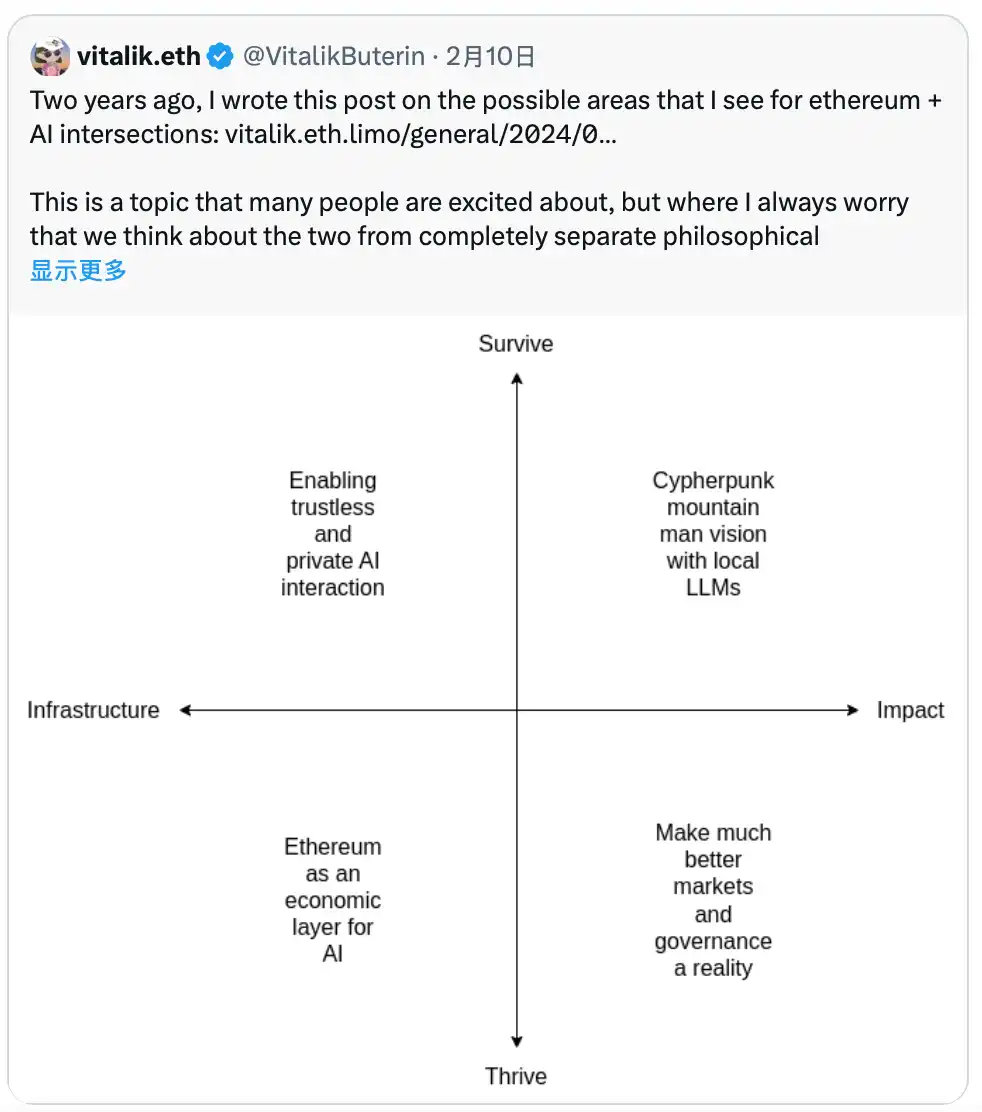
The ideas V God presented this time are明显 more mature than two years ago, also due to the progress we've made in privacy, X402, ERC8004, prediction markets, and other directions.

It can be seen that the four quadrants he divided this time, half belong to AI Helps Crypto, and the other half belong to Crypto Helps AI, no longer明显偏向 the former as it was two years ago.

Top left and bottom left - Utilizing Ethereum's decentralization and transparency to solve AI's trust and economic collaboration problems

1.Enabling trustless and private AI interaction (Infrastructure + Survival): Using technologies like ZK, FHE to ensure the privacy and verifiability of AI interactions (not sure if the verifiable inference I mentioned earlier counts).

2. Ethereum as an economic layer for AI (Infrastructure + Prosperity): Enabling AI agents (Agents) to conduct economic payments, hire other robots, pay deposits, or establish reputation systems through Ethereum, thereby building a decentralized AI architecture rather than being limited to a single giant platform.

Top right and bottom right - Utilizing AI's intelligent capabilities to optimize the user experience, efficiency, and governance of the crypto ecosystem:

3. Cypherpunk mountain man vision with local LLMs (Impact + Survival): AI as the user's "shield" and interface. For example, local LLMs (Large Language Models) can automatically audit smart contracts, verify transactions, reduce reliance on centralized front-end pages, and protect individual digital sovereignty.

4. Make much better markets and governance a reality (Impact + Prosperity): AI deeply participates in Prediction Markets and DAO governance. AI can act as an efficient participant, amplifying human judgment by processing information on a large scale, solving various market and governance problems such as insufficient human attention, high decision-making costs, information overload, and voting apathy.

Previously, we were疯狂 wanting Crypto to Help AI, while V God stood on the other side. Now we finally meet in the middle,只是 it seems to have little to do with various XX tokenizations or so-called AI Layer1s. I hope that when we look back at today's post two years from now, there will be some new directions and surprises.
Trending Cryptos

Related Questions

QWhat are the three main areas of 'Crypto Helps AI' that the author identified as largely ineffective, leading to a 'tokenization illusion'?

AThe three main areas are: 1) Compute power assetization - often unable to provide commercial-grade SLA, unstable, and unable to handle complex tasks. 2) Data assetization - high friction on the supply side (retail users) and inability to meet the demand for structured, context-dependent data from professional suppliers. 3) Model assetization - models are non-scarce, replicable, and depreciate quickly, making tokenization attempts largely unsuccessful.

QAccording to the article, what is the primary issue with 'verifiable inference' projects like ZKML and OPML?

AThe primary issue is that they are a solution in search of a problem ('a typical story of using a hammer to find a nail'). The demand-side threat model is extremely vague, as they are verifying 'things that no one really needs to be verified.' Real-world AI security problems stem from strategy errors, excessive permissions, and tool interactions, not from the imagined problem of 'model tampering' or 'malicious rewriting of the inference process.'

QHow has Vitalik Buterin's (V神) perspective on the relationship between AI and Crypto evolved from two years ago to now, as described in the article?

ATwo years ago, Vitalik was more skeptical of 'Crypto Helps AI' and was more optimistic about 'AI Helps Crypto.' His current perspective, as outlined in his new post, is more balanced. He now presents four quadrants, with half belonging to 'AI Helps Crypto' and the other half to 'Crypto Helps AI,' indicating a more mature and integrated view of how the two fields can mutually benefit each other.

QWhat are the two key ideas in the 'Crypto Helps AI' quadrant of Vitalik's new framework?

AThe two key ideas are: 1) Enabling trustless and private AI interaction: Using technologies like ZK and FHE to ensure the privacy and verifiability of AI interactions. 2) Ethereum as an economic layer for AI: Allowing AI agents to conduct economic payments, hire other bots, post collateral, and build a reputation system on Ethereum, enabling a decentralized AI architecture.

QWhat are the two key ideas in the 'AI Helps Crypto' quadrant of Vitalik's new framework?

AThe two key ideas are: 1) Cypherpunk vision with local LLMs: Using AI, specifically local Large Language Models, as a 'shield' and interface for users to audit smart contracts and verify transactions, reducing reliance on centralized front-ends. 2) Making better markets and governance a reality: Using AI to participate deeply in prediction markets and DAO governance, processing information at scale to amplify human judgment and solve issues like voter apathy and information overload.

Related Reads

As Consensus Accelerates, What Are Young Investors Betting On?

Title: As Consensus Forms Faster, What Are Young Investors Betting On? In the rapid evolution of tech investment, a new generation of young investors is navigating a landscape where AI, robotics, commercial aerospace, and quantum computing are advancing simultaneously. Traditional investment logic based on financial models is giving way to a need for deep technical understanding and the ability to act before industry consensus forms. An analysis of trends from the "WAIC FUTURE TECH" list of young investment leaders reveals key shifts in focus. The first major trend is the movement of AI from the digital screen into the physical world. Investment is shifting from large language models and chatbots towards embodied AI, robotics, AI hardware, and edge computing. While demonstrations generate excitement, the real challenge lies in achieving scalable, reliable, and cost-effective delivery in complex real-world environments like factories and logistics. Success depends not just on algorithms but on the integration of sensors, actuators, and control systems. Second, the competitive focus for large models is moving beyond raw capability toward building an "intelligence flywheel." The goal is to create self-reinforcing systems where user interaction generates data, improving the model, which in turn enhances the user experience and attracts more engagement. Companies that successfully embed AI into workflows to create these closed-loop systems can build lasting value that isn't easily erased by the next model upgrade. Third, facing a potential bottleneck in high-quality human-generated data, investors are looking at new underlying technologies. Reinforcement learning and self-play, as demonstrated by AlphaGo Zero, offer paths for AI to generate its own experience. Scientific foundation models, which aim to build general AI capabilities for fields like life sciences and materials discovery, represent a non-consensus direction that could unlock new frontiers of knowledge and data. Finally, in deep-tech areas like quantum computing, commercial aerospace, and space-based infrastructure, patient capital is essential. These fields have long, uncertain development and validation cycles involving complex engineering, supply chains, and regulations. Investment here requires a long-term view, focusing on foundational team capabilities and the eventual emergence of market demand, even if commercial returns are distant. Collectively, these trends illustrate how young investors are adapting to a new era. They are learning to make earlier, technically-informed judgments, balance hype with real-world viability, and provide the patient capital needed to build the deep-tech foundations of the future.

marsbit6m ago

As Consensus Accelerates, What Are Young Investors Betting On?

marsbit6m ago

Can Japan Buy Growth with AI? Will the Bond Market Believe It?

Japan's cabinet has introduced the 2026 Basic Policy on Economic and Fiscal Management and Reform, shifting its primary fiscal target. The new framework moves away from the traditional annual primary balance goal and instead prioritizes a stable reduction of the debt-to-GDP ratio. This change is tied to a strategy of increased "responsible proactive fiscal" spending, aiming to boost long-term growth through investments in strategic sectors like AI, semiconductors, energy, and robotics. The government estimates total public and private investment in 62 key technologies could exceed 370 trillion yen by 2040. The market reaction has been mixed and cautious. While equity markets may respond to policy signals, bond markets are focused on fiscal credibility. Concerns center on whether the weakening of the clear primary balance anchor could lead to looser fiscal discipline. If investors doubt that these strategic investments will generate sufficient productivity gains, tax revenue, and nominal growth to outpace rising interest costs, they may demand higher yields on Japanese Government Bonds (JGBs). Recent volatility in the yen and JGB yields, with the 10-year yield briefly reaching 2.9%, reflects this skepticism. The success of this new framework hinges on two factors: whether Japan can achieve a nominal growth rate consistently higher than its long-term interest rates, and whether future budgets demonstrate disciplined control over bond issuance. The government's narrative is that strategic investment is essential to break Japan's cycle of low growth, aging, and labor shortages. However, the bond market will continuously assess the credibility of this plan, pricing the risk that it may represent fiscal expansion rather than a viable growth strategy.

marsbit43m ago

Can Japan Buy Growth with AI? Will the Bond Market Believe It?

marsbit43m ago

Misjudged A-Shares: Resilience, Expectations, and Confidence

China's A-share market recently faced selling pressure, especially in tech sectors, initially triggered by a global tech sell-off that began in South Korea. However, the article argues this is a case of "mistaken injury" and highlights the market's underlying resilience. This resilience stems from three main pillars: **1) Tech Sector Fundamentals:** Unlike Korea's market dominated by a few memory chip stocks, China's tech sector is diversified across computing, communications, electronics, and semiconductors, supported by dual narratives of global AI supply chains and domestic substitution. Core areas like optical modules and fiber optics continue to show strong earnings growth. **2) "National Team" Support:** State-backed institutions and large corporations have made significant market purchases and announced buybacks, providing liquidity and signaling confidence. This is seen as a stabilizing policy signal, often associated with market bottoms. **3) Broader Market Pillars:** Other major sectors are showing endogenous recovery momentum. Consumer stocks benefit from stabilizing CPI and signs of sector recovery (e.g., liquor price hikes). Cyclical sectors like aluminum have high earnings, potential price increases due to tight supply, and low valuations. The financial sector offers stable dividends and low valuations. The conclusion is that the sell-off was driven by external contagion, not a collapse in fundamentals. With strong policy support and recovering momentum across key sectors, the A-share market possesses the toughness to regain stability.

marsbit1h ago

Misjudged A-Shares: Resilience, Expectations, and Confidence

marsbit1h ago

Trading

Spot

Hot Articles

Discussions

Welcome to the HTX Community. Here, you can stay informed about the latest platform developments and gain access to professional market insights. Users' opinions on the price of AI (AI) are presented below.

活动图片















