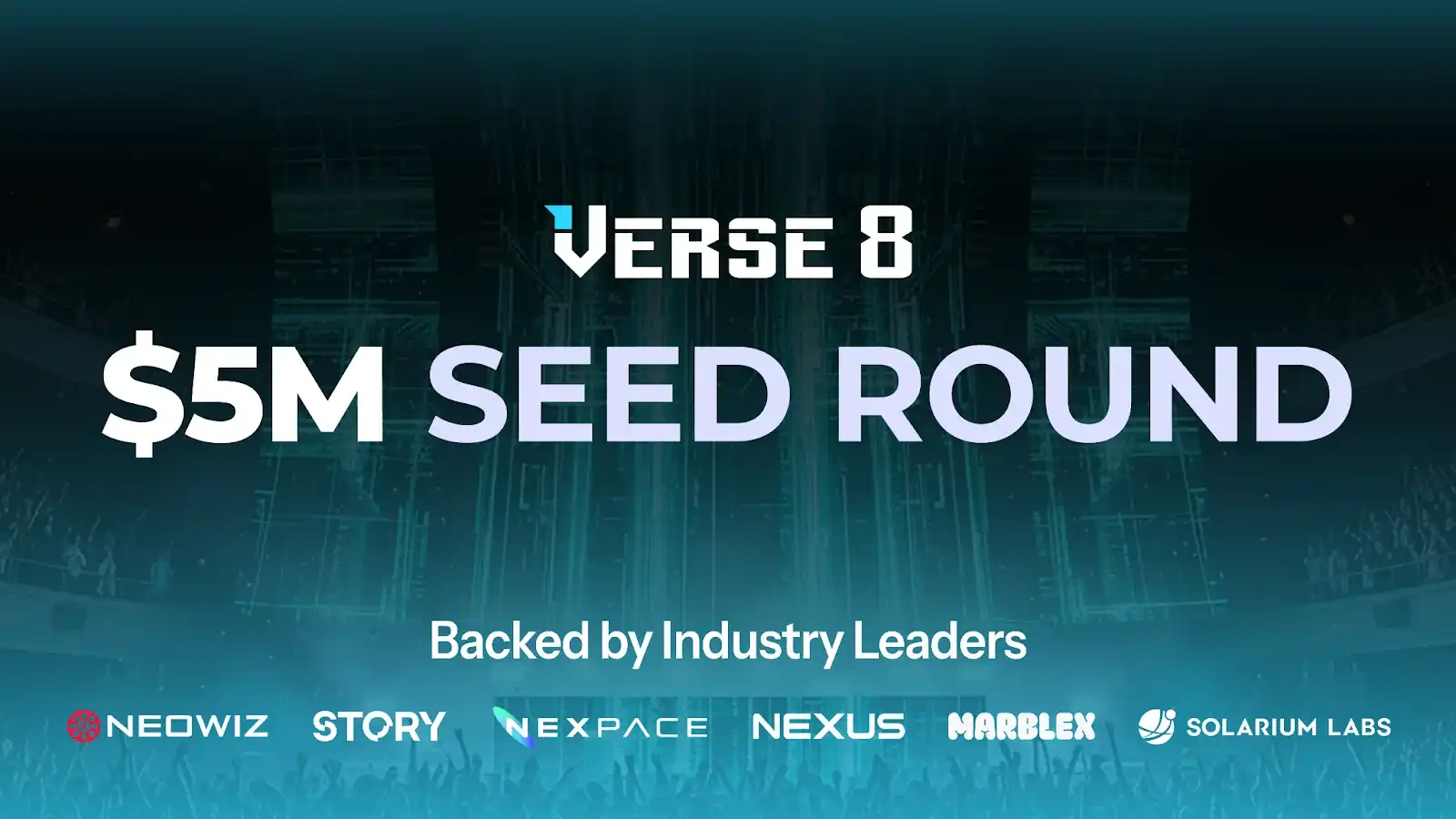
Verse8 Completes $5 Million Seed Funding Round to Accelerate AI-Driven Game Creation

marsbitPublished on 2026-03-26Last updated on 2026-03-26

Abstract

Verse8, an AI-native platform that enables creators to instantly turn ideas into playable games, has raised $5 million in seed funding. The round was co-led by Story Foundation, NEXPACE (Nexon’s Web3 arm), Neowiz, MARBLEX (Netmarble’s Web3 arm), Solarium Labs, and NEXUS, with participation from other investors in gaming, media, and tech. The funds will accelerate development of Verse8’s core AI systems, expand creator onboarding and incentive programs, and enhance its publishing and distribution infrastructure. Since its launch in July 2024, the platform has attracted over 3.5 million monthly active users and more than 5,000 active creators who have generated 25,000 games. Using natural language prompts, users can create fully playable multiplayer games within minutes, eliminating the need for coding, game engines, or large teams. Co-founded by JC Kim and Kevin Lee, Verse8 aims to democratize interactive content creation. The platform automates art, code, design, and QA, while integrating with Story for on-chain ownership, licensing, and distribution, allowing creators to retain attribution and monetize their work. Advised by Jake Song, co-founder of Nexon, Verse8 is positioned at the forefront of a new AI-native, creator-led era in interactive media.

Verse8, an AI-native platform that enables creators to instantly turn ideas into playable games, today announced the completion of a $5 million seed funding round. This round was co-led by Story Foundation, NEXPACE (Nexon's Web3 division), Neowiz, MARBLEX (Netmarble's Web3 division), Solarium Labs, and NEXUS, with participation from multiple investors in the gaming, media, and technology sectors.

The new funds will be used to advance Verse8's core AI systems, expand creator onboarding and incentive programs, and enhance its publishing and distribution infrastructure.

This funding round comes at a critical inflection point for interactive media development. Generative AI is significantly reducing the cost and complexity of content creation; however, the creation of interactive experiences remains constrained by lengthy development cycles, large teams, and centralized studios. While billions of people worldwide create videos, music, and images, only a tiny fraction possess the skills and tools to make games. Verse8 was built to meet this inflection point, aiming to enable anyone to create real-time, multiplayer games.

Verse8 allows creators to use natural language prompts to generate fully playable multiplayer games within minutes, with no need for coding, installing engines, or assembling large production teams. A simple idea can become a real-time interactive experience, instantly deployed and accessible to players globally.

Since its launch in July 2024, the platform has attracted over 3.5 million monthly active users for game creation and play, with more than 5,000 active creators who have generated 25,000 games.

Verse8 was co-founded by JC Kim and Kevin Lee, seasoned entrepreneurs with deep experience in blockchain gaming, platform building, and strategic investment. Their backgrounds include pioneering blockchain business at LINE, successfully founding and exiting startups, and deploying over $200 million in game investments, which has positioned Verse8 to focus on speed, accessibility, and creative iteration from the outset.

Jake Song, renowned creator of Korea's iconic "Lineage" series and co-founder of Nexon, will serve as a core advisor, providing strategic guidance for Verse8's AI-driven gaming platform.

Reimagining the Creation of Interactive Media

Today's game development is capital- and labor-intensive. Production often requires lengthy cycles, multidisciplinary teams, and budgets reaching tens of millions of dollars, concentrating creative and economic power in the hands of a few studios. Verse8 dramatically lowers these barriers by enabling creators to turn text prompts into real-time, shared game worlds within minutes, facilitating large-scale experimentation and creativity.

"Globally, only about 3 million creators are making interactive content, with the top 20 studios controlling 70% of the output," said Kevin Lee, CEO of Verse8. "Verse8 is changing this landscape. By compressing the tools of a full game studio into a single prompt, we empower all creators to engage in interactive creation. This funding allows us to deepen our technology and expand an ecosystem where creativity builds cumulatively rather than starting from scratch."

S.Y. Lee, Co-founder and CEO of Story, stated: "AI is reducing the cost of creation for all media formats, but games have been the final frontier. Verse8 is tackling the hardest part of this problem—compressing months of development and millions of dollars in funding into minutes of natural language prompts, and doing so from day one in a way that coordinates creators, IP holders, and distribution channels. We believe this marks the beginning of a new creative stack for interactive media, with Verse8 at its center."

Verse8 automates art, code, design, and quality assurance while supporting continuous iteration and deployment. Through integration with Story, it provides on-chain ownership, licensing, and distribution, enabling creators to retain attribution, earn revenue, and safely remix existing IP.

Verse8 believes this approach lays the foundation for a new category of creator-led, AI-native interactive media, with games representing the first scalable application in a broader shift in how digital content is created, owned, and distributed.

About Verse8

Verse8 is an AI-native creation and publishing platform that allows anyone to turn ideas into interactive games and stories. By combining generative AI, integrated game engines, and on-chain ownership, Verse8 lowers the barrier to interactive creation and supports a new generation of creator-led digital worlds. The platform was developed by Planetarium Labs in collaboration with Jake Song, leveraging deep gaming expertise and strategic partnerships to deliver high-fidelity interactive experiences at scale.


Trending Cryptos

Related Questions

QWhat is Verse8 and what recent milestone did it achieve?

AVerse8 is an AI-native platform that enables creators to instantly turn ideas into playable games. It recently announced the completion of a $5 million seed funding round.

QWhich companies co-led the seed funding round for Verse8?

AThe seed funding round was co-led by Story Foundation, NEXPACE (Nexon's Web3 division), Neowiz, MARBLEX (Netmarble's Web3 division), Solarium Labs, and NEXUS.

QHow does Verse8's platform work for creators?

AVerse8 allows creators to use natural language prompts to generate fully playable multiplayer games in minutes, with no need for coding, installing engines, or large production teams.

QWhat are some key user metrics for Verse8 since its launch in July 2024?

ASince its launch in July 2024, the platform has over 3.5 million monthly active users for game creation and play, more than 5,000 active creators, and has generated 25,000 games.

QWho is a key advisor to Verse8 and what is his background?

AJake Song, the creator of Nexon's iconic 'Lineage' series and a co-founder of Nexon, is a core advisor providing strategic guidance for Verse8's AI-driven game platform.

Related Reads

L2 'Recalibration': When L1 Becomes Its Own Rollup, What Is Ethereum's Endgame?

The article discusses the evolving relationship between Ethereum's Layer 1 (L1) and Layer 2 (L2) solutions, moving beyond the initial "L2 for scaling" model. As Ethereum L1 itself scales (increasing Gas Limit, statelessness, zkEVM), the unique value proposition of L2s shifts from merely providing cheap execution to offering differentiated features like application-specific optimization, privacy, and flexible governance. The piece explores three key themes: 1. **L2's New Role:** L2s are transitioning from a pure scaling technology to a spectrum of execution environments with varying degrees of security inheritance from Ethereum L1. 2. **Interoperability as State Trust:** Solving L2 fragmentation is less about cross-chain bridges and more about enabling faster, trust-minimized state verification between environments. This involves initiatives like faster L1 finality, intent-based architectures (Open Intents Framework), and native account abstraction. 3. **Blurring Layers:** With the potential integration of zk-proofs into L1 validation (making L1 akin to its own "Rollup") and the concept of "Native Rollups," the rigid boundary between L1 and L2 may fade. The future could be a unified system with multiple execution domains (for DeFi, gaming, privacy, etc.) sharing a common security, settlement, and state framework. In conclusion, Ethereum's goal is not to abandon L2s or re-centralize everything on L1, but to re-integrate the fragmented user experience—liquidity, accounts, applications—while preserving the scaling benefits of a multi-environment ecosystem. The endgame is a cohesive "one chain" feeling for users, powered by diverse but securely interconnected execution layers.

marsbit37m ago

L2 'Recalibration': When L1 Becomes Its Own Rollup, What Is Ethereum's Endgame?

marsbit37m ago

Trading

Spot

Hot Articles

Discussions

Welcome to the HTX Community. Here, you can stay informed about the latest platform developments and gain access to professional market insights. Users' opinions on the price of AI (AI) are presented below.

活动图片