US lawmakers push to fix staking ‘double taxation’ before 2026

cointelegraphPublished on 2025-12-22Last updated on 2025-12-22

Abstract

A bipartisan group of 18 U.S. lawmakers is urging the Internal Revenue Service (IRS) to revise crypto staking tax laws before 2026. In a letter led by Republican Mike Carey, they argue the current rules result in "double taxation" by taxing staking rewards both when received and again when sold. They propose taxing rewards only at the time of sale to reflect the staker's actual economic gain. The lawmakers claim the existing policy discourages participation in staking, which is essential for blockchain security and U.S. leadership in digital assets. Separately, representatives Miller and Horsford introduced a draft proposal to exempt small stablecoin transactions from capital gains taxes and allow a deferral option for staking and mining income recognition for up to five years.

A group of 18 bipartisan US House lawmakers is pushing the country’s tax agency to review its rules on crypto staking taxes before the start of 2026.

In a letter sent to Internal Revenue Service acting commissioner Scott Bessent on Friday, the lawmakers, led by Republican Mike Carey, asked for a review and update guidance on "burdensome" crypto staking tax laws.

“This letter is simply requesting fair tax treatment for digital assets and ending the double taxation of staking rewards is a big step in the right direction,” Carey said.

The letter calls for taxes from staking rewards to be applied at the time of sale, so that “stakers are taxed based on a correct statement of their actual economic gain.”
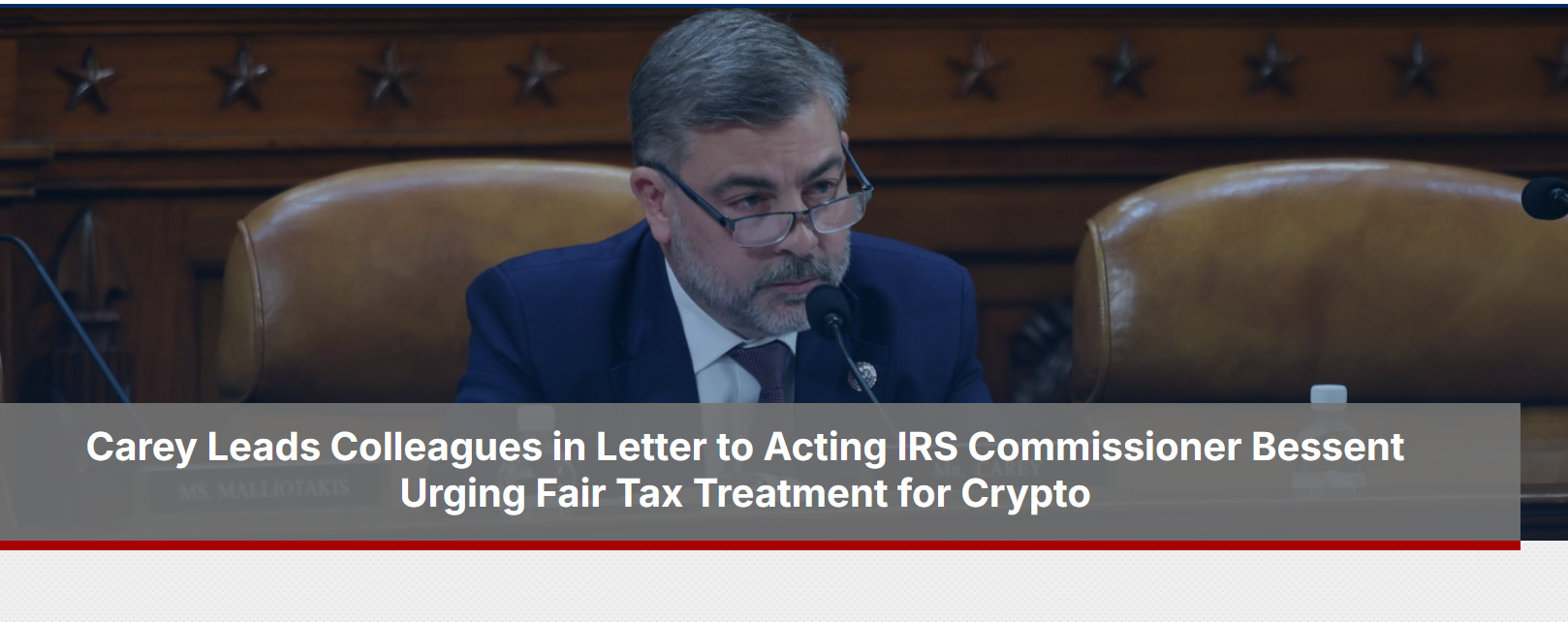
Mike Carey is leading lawmakers to change crypto staking tax rules. Source: Mike Carey

The lawmakers argued that the current laws, which see stakers taxed upon receiving rewards and again when selling them, are hindering participation in the staking market, when the laws should be designed to support a fundamental part of certain blockchains.

Related: Crypto community ‘very sorry’ over Senator Lummis' reelection decision

“Millions of Americans own tokens on these networks. Network security — and American leadership — requires those taxpayers to stake those tokens, but today the administrative burden and prospect of over taxation discourages that participation,” the lawmakers wrote.

The letter concludes by asking if there are any administrative barriers to updating the guidance before the end of the year, and asserts that they should be changed to support the current administration’s goal of “strengthening U.S. leadership in digital asset innovation.”

Not the only push for changes to crypto tax rules

On Saturday, House representatives Max Miller and Steven Horsford also introduced a discussion draft aiming to ease the tax obligations on crypto users by exempting small stablecoin transactions from capital gains taxes and offering a deferral option for staking and mining rewards.

In terms of staking, the reps went a slightly different route by opting for a referral option as opposed to a complete change in the current laws.

The proposal outlines that taxpayers would be allowed to elect to defer income recognition on staking or mining rewards for up to five years, rather than being taxed immediately after receiving them.

Magazine: 11 critical moments in Ethereum’s history that made it the No.2 blockchain

Trending Cryptos

Related Questions

QWhat is the main issue that US lawmakers are addressing regarding crypto staking taxes?

AUS lawmakers are pushing to fix the 'double taxation' issue where stakers are taxed both when they receive staking rewards and again when they sell them.

QWho is leading the bipartisan group of lawmakers in sending the letter to the IRS?

ARepublican Mike Carey is leading the group of 18 bipartisan US House lawmakers.

QWhat specific request did the lawmakers make in their letter to the IRS regarding the timing of taxation?

AThe lawmakers requested that taxes from staking rewards be applied at the time of sale, rather than upon receipt, to reflect the staker's actual economic gain.

QWhat is one of the arguments made by the lawmakers about the current staking tax rules?

AThe lawmakers argued that the current tax rules are hindering participation in the staking market and discouraging network security, which is a fundamental part of certain blockchains.

QWhat alternative proposal was introduced by House representatives Max Miller and Steven Horsford for staking and mining rewards?

AThey introduced a discussion draft proposing that taxpayers be allowed to elect to defer income recognition on staking or mining rewards for up to five years, instead of being taxed immediately.

Related Reads

Mass Production Timelines Shift Collectively, Is Glass Substrate Facing Its First Major Test?

The article discusses the shift in the glass substrate industry from initial announcements to practical delivery and reliability testing. In mid-to-late 2026, key developments include Intel and Lens Technology advancing AI-era glass substrate packaging cooperation, Avaco launching a TGV pilot line in South Korea, and reports that Samsung Electro-Mechanics is facing delays, potentially pushing mass production beyond 2028. The core challenge has moved from material comparisons to rigorous customer reliability certifications, focusing on thermal cycling, humidity resistance, and stable electrical performance post-processing. Samsung Electro-Mechanics' reported delay, linked to client sample reliability bottlenecks, reflects a broader industry trend where timelines are being adjusted. Other players like SKC/Absolics, LG Innotek, and DNP are also targeting initial supply systems or pilot lines between 2027-2028, with mainstream adoption potentially post-2030. The delays highlight that the current hurdle is supply-side technical maturity—particularly achieving stable yields and passing client certifications—rather than a lack of demand driven by AI and HPC. The collaboration between Intel and Lens Technology focuses on establishing design and verification standards. Meanwhile, Japanese firms like Shinko Electric and DNP are progressing with multi-layer wiring and stress control. Chinese panel makers, led by BOE, are rapidly entering with automated pilot lines and customer testing. On the material side, companies like Corning are exploring glass substrates for co-packaged optics (CPO), potentially offering an earlier application path than core substrates. Ultimately, the central barrier is TGV (Through Glass Via) yield, currently around 60-70%, lower than organic substrates, with higher costs due to glass brittleness and process complexity. The industry's current phase represents its first major test in transitioning from lab R&D to volume manufacturing, with success hinging on overcoming these yield and certification challenges.

marsbit9m ago

Mass Production Timelines Shift Collectively, Is Glass Substrate Facing Its First Major Test?

marsbit9m ago

Crypto Bull Is Back, Which Assets Bounced the Hardest?

The cryptocurrency market experienced a significant surge last week, with Bitcoin rallying over 26% to nearly $79,500, its strongest weekly gain since March 2023, fueling discussions of a renewed bull market. This rebound highlighted several key market dynamics. First, short-term directional shifts are increasingly tied to U.S. policy cycles. The rally was driven by two major catalysts: the U.S. Treasury's announcement to increase long-term bond buybacks, easing macro liquidity pressures, and former President Trump's push for clearer crypto legislation, boosting regulatory certainty and risk appetite. Second, Bitcoin spot ETFs solidified their role as a leading market indicator. In the week ending August 21, U.S. Bitcoin and Ethereum spot ETFs saw a combined net inflow of $2.6 billion, the highest since October 2025, signaling strong institutional re-entry. Third, the rally followed a clear capital rotation pattern: Bitcoin's breakout ignited broader gains, with Ethereum (up nearly 30%), major altcoins, and meme coins sequentially posting larger percentage increases. Analysis of the top performers among the top 50 altcoins by market cap revealed the week's biggest gainers: ENA (Ethena) led with a 100.75% surge, fueled by a Coinbase partnership. It was followed by PUMP (Pump.fun, up 88-99%), STX (Stacks, up 82-94%), TRUMP (Official Trump, up 79-91%), and ZEC (Zcash, up 75.15%), which uniquely reached a new all-time high. Meme coins like BOME on Solana also saw explosive gains, exemplifying the high-risk, high-reward sentiment. The rally illustrated a clear path: Bitcoin set the stage, major coins like Ethereum led the charge, and altcoins/meme coins delivered the most explosive returns, mapping the gradient of returning market enthusiasm.

marsbit22m ago

Crypto Bull Is Back, Which Assets Bounced the Hardest?

marsbit22m ago

Wuhan is About to Witness Its Largest IPO in History

Wuhan is poised for its largest-ever IPO as Yangtze Memory Technologies Co., Ltd. (YMTC) has officially applied for a listing on the Shanghai Stock Exchange's STAR Market, seeking to raise 33 billion yuan. The domestic leader in 3D NAND flash memory chips completed its IPO辅导 (tutoring) process in a record three months, with market expectations valuing the company at 300 billion yuan or higher. YMTC's roots trace back to 2006 with the founding of Wuhan Xinxin. After surviving the global financial crisis and periods of operational difficulty, the company was formally established in 2016 through a joint investment involving Tsinghua Unigroup, the National Integrated Circuit Industry Investment Fund (the "Big Fund"), and local Hubei government funds. With a distinct "national team" background, its major shareholders include provincial and municipal state-owned assets committees and the Big Fund. Based in Wuhan's Optics Valley (East Lake High-tech Development Zone), YMTC's potential listing highlights the region's rise as a tech hub. Optics Valley is already home to 72 listed companies and has ambitious plans to exceed 100 by 2030. The zone recently established four industry-focused母基金 (mother funds) totaling 18 billion yuan to further boost sectors like integrated circuits and optoelectronics. YMTC's IPO would complete the "Optics Valley Seven Stars," a group of leading local optoelectronic and communication giants.

marsbit22m ago

Wuhan is About to Witness Its Largest IPO in History

marsbit22m ago

Trading

Spot

Hot Articles

How to Buy PUSH

Welcome to HTX.com! We've made purchasing Push Protocol (PUSH) simple and convenient. Follow our step-by-step guide to embark on your crypto journey.Step 1: Create Your HTX AccountUse your email or phone number to sign up for a free account on HTX. Experience a hassle-free registration journey and unlock all features.Get My AccountStep 2: Go to Buy Crypto and Choose Your Payment MethodCredit/Debit Card: Use your Visa or Mastercard to buy Push Protocol (PUSH) instantly.Balance: Use funds from your HTX account balance to trade seamlessly.Third Parties: We've added popular payment methods such as Google Pay and Apple Pay to enhance convenience.P2P: Trade directly with other users on HTX.Over-the-Counter (OTC): We offer tailor-made services and competitive exchange rates for traders.Step 3: Store Your Push Protocol (PUSH)After purchasing your Push Protocol (PUSH), store it in your HTX account. Alternatively, you can send it elsewhere via blockchain transfer or use it to trade other cryptocurrencies.Step 4: Trade Push Protocol (PUSH)Easily trade Push Protocol (PUSH) on HTX's spot market. Simply access your account, select your trading pair, execute your trades, and monitor in real-time. We offer a user-friendly experience for both beginners and seasoned traders.

4.3k Total ViewsPublished 2024.03.29Updated 2026.06.02

How to Buy PUSH

Discussions

Welcome to the HTX Community. Here, you can stay informed about the latest platform developments and gain access to professional market insights. Users' opinions on the price of PUSH (PUSH) are presented below.

活动图片