Two Ethereum "Whales" Sell $63 Million in Assets Amid Intensifying Selling Pressure

cryptonews.ruPublished on 2026-08-21Last updated on 2026-08-21

Abstract

Two major "whale" entities sold a combined $63 million worth of Ethereum (ETH) and staked ETH (stETH) on Friday amid ongoing market selling pressure. Blockchain analytics platform Lookonchain reported that a large investor known as "7 Siblings" sold 14,000 ETH for $32.85 million. This entity, tracked since 2024, typically buys ETH during sharp declines and takes profits through coordinated large transfers. At its peak, this wallet held assets worth approximately $2.8 billion in ETH. Separately, wallet 0xFD10 sold 11,252 stETH and 1,824 ETH for a combined $30.78 million. Unlike 7 Siblings, this wallet's market exit motives are unclear. These sales occurred as ETH traded near $2,350. The report notes a broader trend of large ETH holders selling during the 2026 rally, viewing price stability as an opportunity to reduce positions. Despite the sales, 7 Siblings remains a major known ETH holder, and its past behavior suggests further large transactions are possible if prices move significantly. A sustained break below $2,300 could refocus attention on the $2,000 zone, while a bounce would indicate the sales were routine profit-taking.

Blockchain analytics platform Lookonchain reported that a major investor, known as "7 Siblings," sold 14,000 $ETH for $32.85 million at an average price of $2,346. This account has been tracked by on-chain market analysts since 2024 due to its characteristic pattern: buying $ETH during sharp declines and then taking profits through large, coordinated transfers.
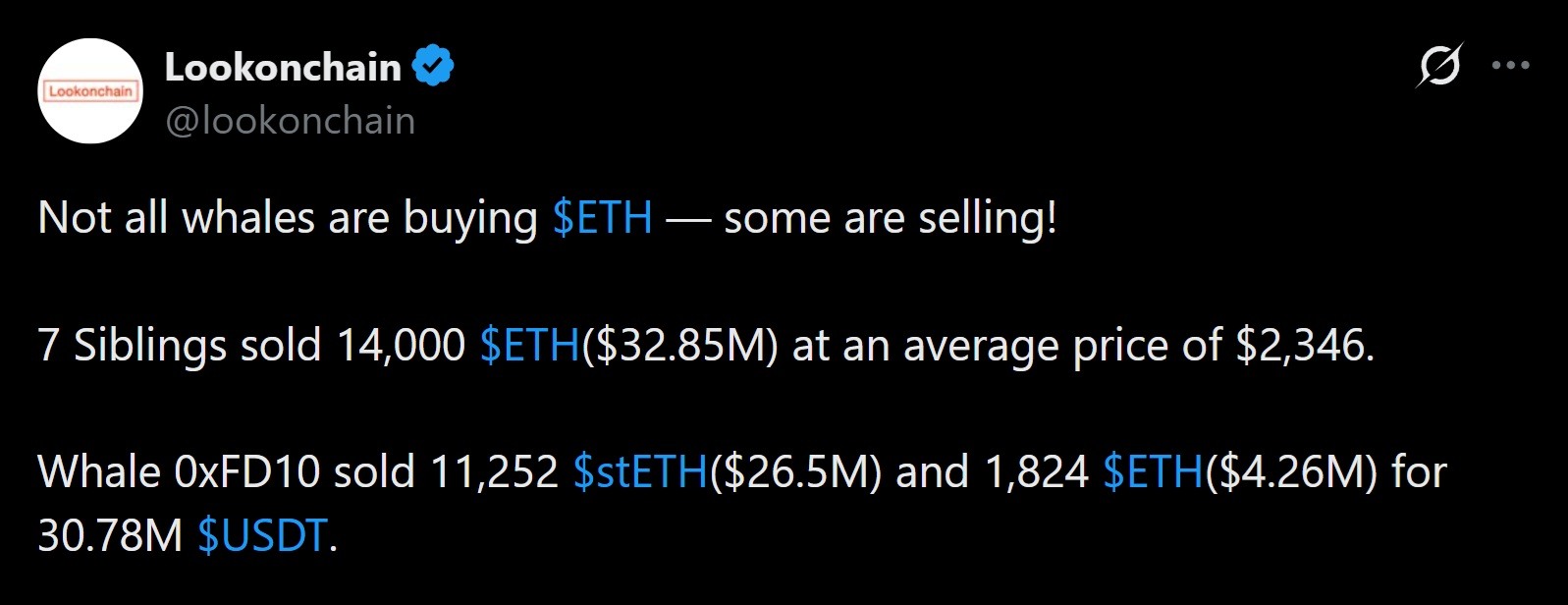
Image Source: X

At its peak, this entity's assets were valued at approximately 1.15 million $ETH worth about $2.8 billion, although its position has fluctuated significantly as the wallet shifted between accumulation and distribution phases. In August 2025, this organization was recognized as an "Ethereum billionaire" after transferring $47 million worth of $ETH to a new wallet and then selling most of it within minutes.

Friday's sale fits the same pattern, with the swing trader apparently locking in decent profits rather than fully exiting the position (at least, based on this entity's trading history).

Second "Whale" Joins the Exit

A few hours later, another wallet, 0xFD10, sold 11,252 stETH for $26.5 million and an additional 1,824 $ETH for $4.26 million, resulting in total proceeds of $30.78 million in USDT. Staked ether (stETH) is a liquid staking token representing $ETH staked with Lido Finance, the largest Ethereum staking protocol, which can be traded or used in decentralized finance (DeFi) while the underlying $ETH remains locked.
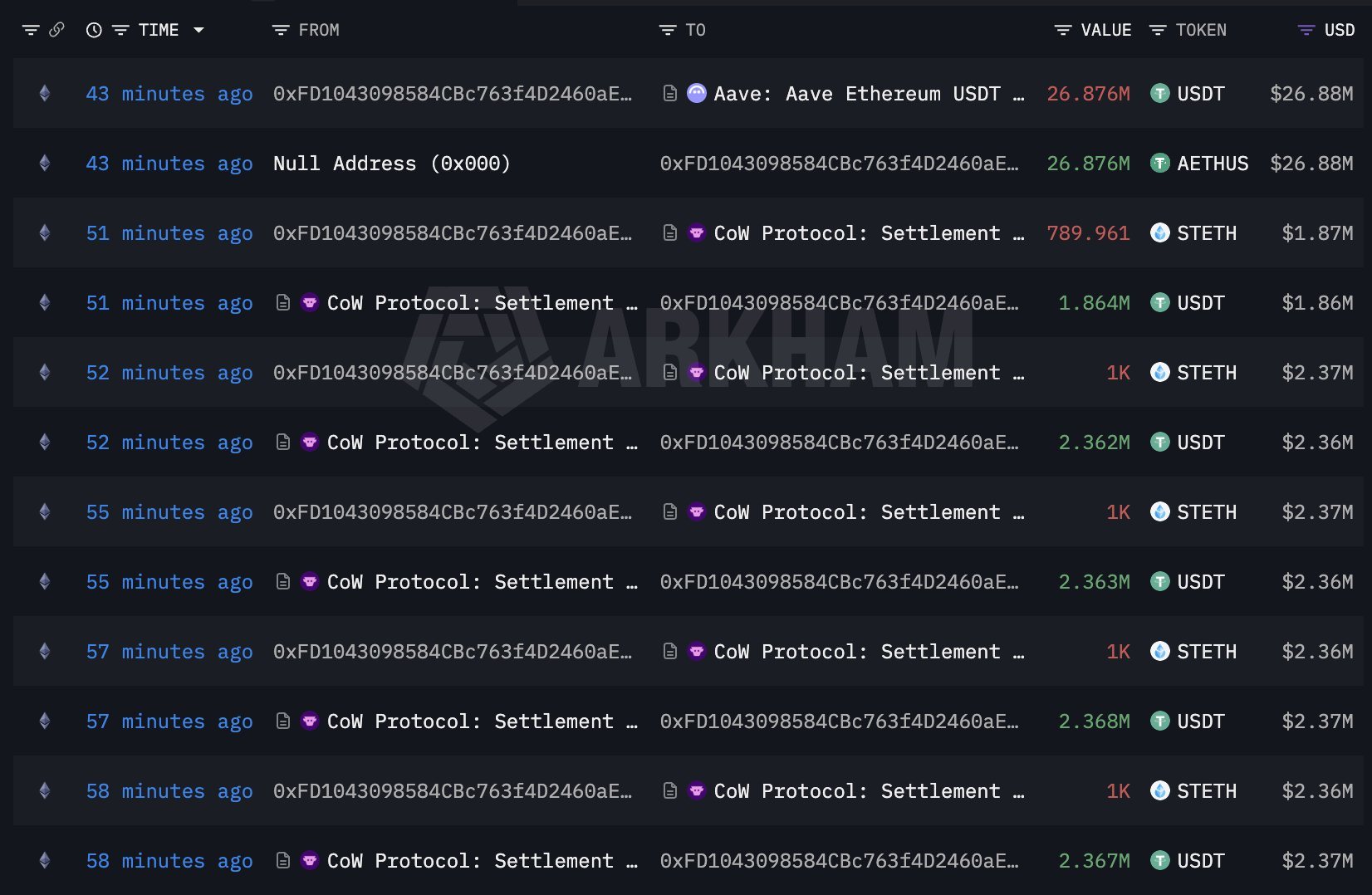
Image Source: Arkham Intelligence

Unlike 7 Siblings, which has a long history of public trading, the 0xFD10 wallet has not been extensively analyzed by on-chain analytics platforms before, and the motives for its market exit remain unclear.

Following the sales, $ETH continued trading around the $2,350 mark, a sharp jump from its price just hours earlier when it traded at $2,286.60. The average selling price indicated in transactions from both wallets ranged from $2,334 to $2,354 per coin.

Broader Selling Trend

Bitcoin.com News recently reported that another major Ethereum holder capitulated after three years of staking, incurring losses exceeding $19 million on one position earlier this month. Other large holders have also been cashing out during the 2026 rally, including one wallet that sold 55,000 $ETH and 9,442 wstETH for a total of $136 million in May.

All these actions appear to indicate that both long-term holders and swing traders view the rally and local price stability as opportunities to reduce positions, even though some of these same entities have historically bought coins back during subsequent dips.

Despite Friday's sale, 7 Siblings remains one of the largest known $ETH-holding wallets, and its past behavior suggests that if the price of $ETH diverges sharply from current levels, further large transactions in either direction are likely.

Finally, a significant break below the $2,300 level amid continued selling by "whales" would bring the $2,000 zone back into focus. However, a sustained bounce would suggest that Friday's sales were merely profit-taking rather than the start of a deeper distribution phase.

end-content

Trending Cryptos

Related Questions

QAccording to the article, who sold 14,000 ETH for $32.85 million and what is their known trading pattern?

AAccording to the article, a large investor known as '7 Siblings' sold 14,000 ETH for $32.85 million. Their known pattern is buying ETH during sharp price declines and then taking profits through large, coordinated transfers.

QWhat did the second major wallet, identified as 0xFD10, sell and for what total amount in USDT?

AThe second major wallet, 0xFD10, sold 11,252 stETH and 1,824 ETH, resulting in total proceeds of 30.78 million USDT.

QWhat is stETH as described in the article, and how does it relate to Lido Finance?

AAs described in the article, stETH (staked ether) is a liquid staking token representing ETH staked in Lido Finance, the largest Ethereum staking protocol. It can be traded or used in DeFi while the underlying ETH remains locked.

QWhat broader market trend do the sales by these large holders ('whales') indicate, according to the analysis in the article?

AAccording to the article's analysis, these sales indicate that both long-term holders and swing traders are viewing price rallies and local price stability as opportunities to reduce their positions, even though some have historically bought back coins during subsequent declines.

QWhat price level for ETH would bring the $2,000 zone back into focus, and what would a sustained rebound suggest about the recent sales?

AA significant break below the $2,300 level amid ongoing whale sales would bring the $2,000 zone back into focus. A sustained rebound would suggest the recent sales were ordinary profit-taking rather than the start of a deeper distribution phase.

Related Reads

Haiwei Huaxin's Official Seal Seized by Over a Hundred People, High-Stakes Corporate Battle's 'Nuclear Deterrence' in Action Again

On August 18th, Haowei Huaxin, a semiconductor firm specializing in gallium arsenide and gallium nitride wafers, reported that over a hundred individuals forcibly entered its offices and seized the company's official seals from a safe, including the corporate, contract, and party committee seals. The incident is the latest escalation in a protracted control dispute. Haowei Huaxin, established in 2010, was originally a joint venture. Control became contested after 2021 when Zhenwei Financial Holding injected capital, becoming the largest shareholder (34.01%), while former parent Haite High-Tech's stake was diluted to 33.79%. An agreed-upon governance structure collapsed, leading to mutual accusations. Haite claimed it was locked out of the subsidiary's premises, while also alleging improper management like livestock being kept on the chip fabrication site. After state-owned Qingdao Haiyue Holdings took over Zhenwei's stake in 2023, Haite accused it of illegally seizing control. Despite Haite winning several legal battles in 2024-2026, which affirmed its rights to nominate directors and the chairman, it failed to regain physical control or recover the seals. The stakes are high: market valuations for Haite's stake in Haowei Huaxin are estimated between 3.7 to 5 billion USD, yet it is only valued at about 83 million USD on Haite's books. Losing control effectively jeopardizes a significant portion of Haite's value. In response to the seal seizure, Haite framed it as a "shareholder rights protection" action agreed upon by five shareholders. This mirrors a pattern in Chinese corporate disputes where seizing physical seals becomes a tactic to paralyze the opponent's daily operations, seen in past conflicts at companies like Dangdang and Bitmain. However, such actions don't resolve underlying ownership issues; the opposing party can report the seals stolen, declare them void, and apply for new ones, albeit with significant delay. The incident underscores how fragile corporate governance can devolve into physical confrontations over symbols of authority, with control ultimately determined by law and shareholding, not possession of a seal.

marsbit14m ago

Haiwei Huaxin's Official Seal Seized by Over a Hundred People, High-Stakes Corporate Battle's 'Nuclear Deterrence' in Action Again

marsbit14m ago

Bernstein Interprets MRNA's 177% Surge: What's Fundamentals and What's Hype?

Bernstein's analysis of Moderna's 177% stock surge following positive Phase 3 results for its individualized neoantigen therapy (INT) in melanoma distinguishes fundamental drivers from market speculation. The clinical breakthrough is real: the INTerpath-001 trial met its primary and key secondary endpoints, providing crucial validation for mRNA technology in oncology beyond infectious diseases. However, Bernstein argues the magnitude of the stock move cannot be justified by this single trial's fundamentals alone. The surge was amplified by three key factors: 1) A re-rating of Moderna's mRNA platform potential for expansion into other cancers, 2) A massive short squeeze, given ~15% of shares were sold short pre-announcement, and 3) The compelling "cancer vaccine" narrative that fueled broader investor enthusiasm. While the melanoma success is significant, Bernstein cautions that replication in lung, kidney, and bladder cancers—which have different immunogenicity—is not guaranteed. Furthermore, INT's commercial model faces challenges: it's a personalized treatment, not a mass-market vaccine, implying higher production costs and potential margin pressures despite a projected multi-billion dollar peak sales opportunity. The report also notes sector rotation, with some funds moving from crowded AI/semiconductor trades into defensive healthcare stocks, adding further momentum. In conclusion, Bernstein maintains a "Market-Perform" rating and a $45 price target, far below the post-surge price. It views the current valuation as pricing in an optimistic multi-cancer platform success and efficient commercialization that are yet to be proven. The clinical inflection point is clear, but the earnings inflection point awaits validation across future trials and commercial execution.

marsbit14m ago

Bernstein Interprets MRNA's 177% Surge: What's Fundamentals and What's Hype?

marsbit14m ago

MSX US Stock Daily Observation: Alibaba FY2027 Q1 Earnings: AI Cloud Revenue Growth Hits Record High, AI Cloud Achieves Profitable Closed Loop

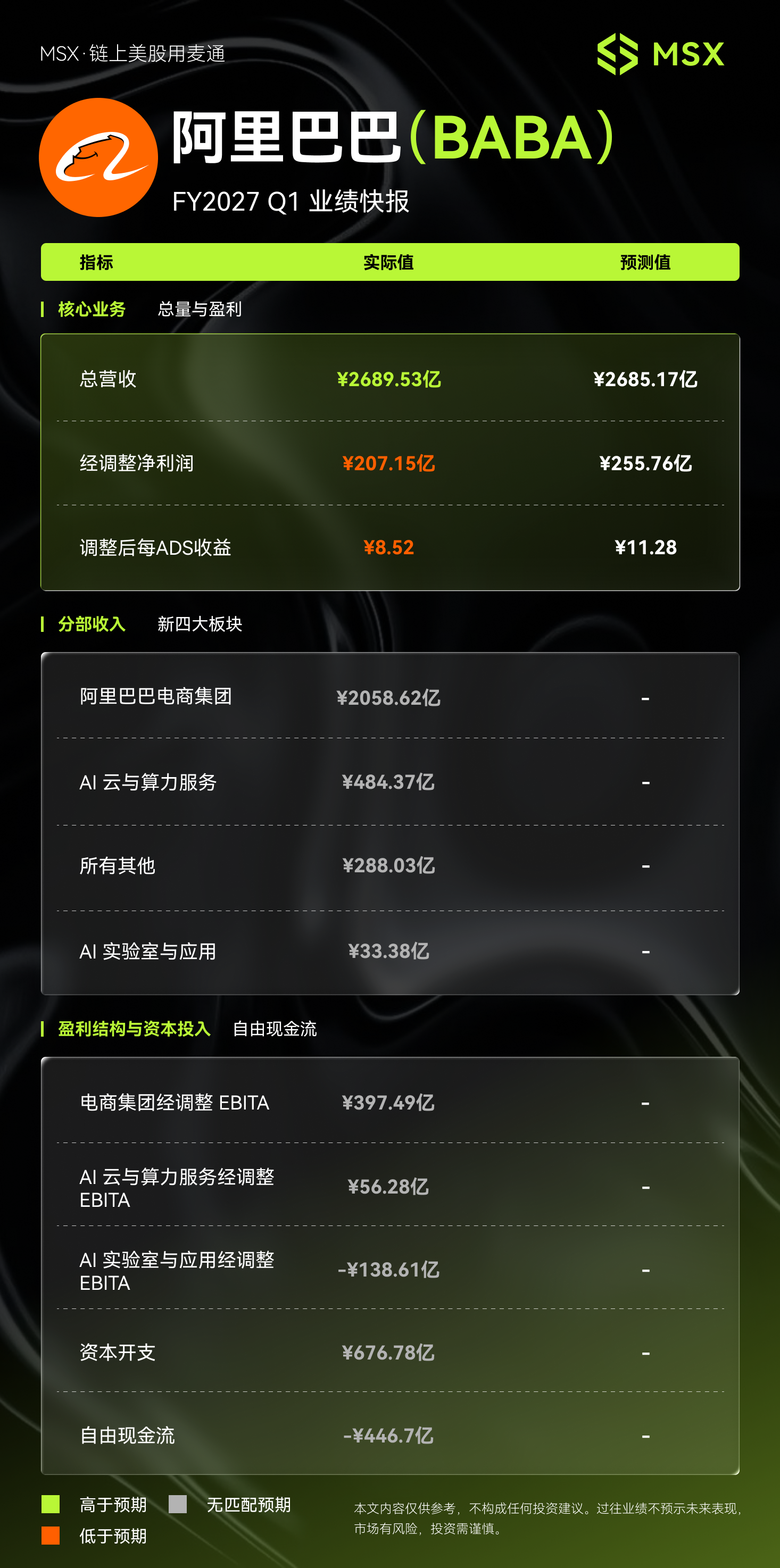
**MSX Daily US Stock Watch: Alibaba FY2027 Q1 Earnings – AI Cloud Revenue Hits Record Growth, Achieves Profitability Milestone** Alibaba's Q1 FY2027 revenue slightly exceeded expectations at 268.9B yuan (+9% YoY). However, adjusted net profit of 20.7B yuan (-38% YoY) and adjusted EPS missed consensus significantly. This shortfall was primarily driven by increased AI investments and two one-time items: a 5.5B euro provision for an EU Digital Services Act fine and 4.46B yuan in goodwill impairment. The restructured business segments showed clear divergence. The standout performer was the AI Cloud & Computing Services unit, with revenue surging 45% YoY to 48.44B yuan. Crucially, its adjusted EBITA jumped 133% YoY to 5.63B yuan, with margins expanding to 12%, signaling a profitable commercial loop for AI infrastructure. Within the Commerce Group, revenue growth was mixed: China Local Services (instant retail) grew 45% to 53.3B yuan, largely offsetting an 8% decline in Traditional China Commerce (110.9B yuan). International commerce revenue fell 1%. Despite this, the Commerce Group's adjusted EBITA dipped only 1% YoY to 39.75B yuan. A key area to watch is cash flow. Capital expenditures soared 75% YoY to 67.68B yuan, turning free cash flow to a net outflow of 44.67B yuan. However, operating cash flow remained positive and grew 11% YoY to 22.95B yuan, indicating the cash burn is a strategic choice for AI capacity build-out rather than operational weakness. In summary, while headline profits were pressured by heavy AI spending and one-off charges, the core takeaway is the emerging profitability of the AI Cloud business. The success of Alibaba's current investment cycle hinges on whether the profit improvement in AI Cloud can outpace the depreciation costs of its massive computing infrastructure expansion.

Odaily星球日报49m ago

MSX US Stock Daily Observation: Alibaba FY2027 Q1 Earnings: AI Cloud Revenue Growth Hits Record High, AI Cloud Achieves Profitable Closed Loop

Odaily星球日报49m ago

Trading

Spot

Hot Articles

Discussions

Welcome to the HTX Community. Here, you can stay informed about the latest platform developments and gain access to professional market insights. Users' opinions on the price of ETH (ETH) are presented below.

活动图片