Cardano Foundation Drafts Dijkstra Upgrade For Smart Contract Execution

bitcoinistPublished on 2026-08-21Last updated on 2026-08-21

Abstract

The Cardano Foundation has released a draft Cardano Improvement Proposal (CIP) called "Dijkstra," which proposes changes to enhance smart contract execution pathways and computational efficiency on the network. The proposal is currently in the discussion phase and is not active on the Cardano mainnet; it must progress through community review and refinement before potential implementation. Dijkstra addresses a core long-term challenge for Cardano: improving developer experience and smart contract performance without compromising its methodical, research-driven design philosophy. Enhanced execution efficiency could reduce computational friction, enabling developers to build more scalable and complex decentralized applications (dApps). This is seen as crucial for Cardano's competitiveness in a crowded smart contract market that includes rivals like Ethereum, Solana, and Avalanche. The publication of the CIP draft marks the start of a community evaluation process. Developers will assess its technical merits, potential trade-offs, and alignment with Cardano's broader roadmap. While the outcome is not guaranteed, the proposal signals ongoing work to strengthen Cardano's application layer for the future. The article emphasizes that the technical development story holds more significance than short-term market price movements.

The Cardano Foundation has published a new Cardano Improvement Proposal draft called Dijkstra, outlining changes aimed at improving smart contract execution pathways and compute efficiency.

The proposal is still in draft form. It is not live on Cardano mainnet. It is not confirmed as an activated upgrade. That distinction matters because protocol proposals often move through several stages before they affect users.

Still, the Dijkstra draft is worth watching because it touches one of Cardano’s most important long-term questions: how the network improves developer experience and smart contract performance without compromising its design philosophy.

TL;DR

  • The Cardano Foundation has posted a Dijkstra CIP draft.
  • The proposal targets smart contract execution and compute efficiency.
  • It is still under discussion and should not be treated as live.

Why Dijkstra Matters

Smart contract performance is central to Cardano’s competitiveness.

The network has always taken a more research-heavy and deliberate approach than many rivals. That has helped Cardano build a strong community around formal methods and careful design, but it has also attracted criticism when development feels slower than faster-moving ecosystems.

A proposal targeting execution pathways is therefore important.

If Dijkstra can reduce compute friction or improve how smart contracts run, it could help developers build more efficient applications.

The practical impact will depend on the final design and implementation.

A CIP Is A Starting Point

Cardano Improvement Proposals are part of the network’s development process.

They give the community a way to discuss, refine, and evaluate changes before they become part of the live system. That makes the publication of a draft meaningful, but not final.

A draft can change. It can stall. It can be merged into a broader upgrade path. It can require more research or implementation work.

So the correct framing is that Dijkstra is now part of Cardano’s development conversation.

It is not already reshaping the network today.

Compute Efficiency Is A Developer Issue

Users may not care about execution pathways, but developers do.

If smart contracts consume too much compute or are difficult to optimize, applications become harder to build and scale. Better execution efficiency can support more complex DeFi products, better user experience, and lower operational friction.

That matters in a competitive smart-contract market.

Cardano is not only competing with Ethereum. It is also competing with Solana, Sui, Avalanche, BNB Chain, and other ecosystems trying to attract developers.

Every improvement to smart contract performance helps the network make its case.

Avoiding The Price Trap

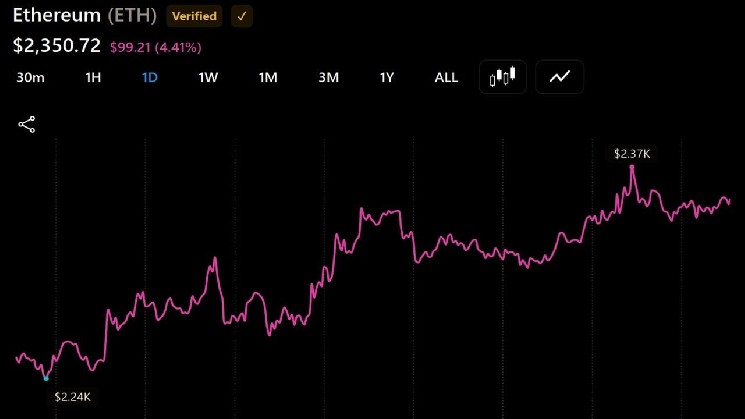
The discovery trail included ADA price weakness, but the more important story is technical.

Protocol development should not be reduced to whether ADA is up or down on the day. Price may influence sentiment, but it does not define whether a CIP matters.

The Dijkstra draft deserves attention because it may affect Cardano’s application layer over time.

That is more durable than a short-term price move.

What Comes Next

The next step is community and developer review.

Cardano builders will need to evaluate whether the proposal achieves its goals, what trade-offs it introduces, and how it fits into the broader roadmap. If it advances, implementation and testing will become the next milestones.

For now, Dijkstra gives Cardano another technical upgrade path to watch.

It is early, but it signals continued work on making Cardano’s smart contract layer more efficient and competitive.

This article is based on the Cardano Foundation’s public Dijkstra CIP draft.

This article was written by the News Desk and edited by Samuel Rae.

This report is based on information released in disclosures at primary source documentation.

Trending Cryptos

Related Questions

QWhat is the main goal of the proposed Dijkstra upgrade for Cardano?

AThe main goal of the proposed Dijkstra upgrade is to improve Cardano's smart contract execution pathways and computational efficiency.

QWhat is the current status of the Dijkstra proposal, and what does that status mean?

AThe Dijkstra proposal is currently in draft form as a Cardano Improvement Proposal (CIP). This means it is under community discussion and review, and is not live on the Cardano mainnet or confirmed as an activated upgrade.

QAccording to the article, why is improving smart contract performance important for Cardano's competitiveness?

AImproving smart contract performance is important for Cardano's competitiveness because it helps attract developers by making it easier to build and scale efficient, complex applications. This is crucial as Cardano competes with other smart contract platforms like Ethereum, Solana, Sui, Avalanche, and BNB Chain.

QWhat are Cardano Improvement Proposals (CIPs), and what role do they play in the network's development?

ACardano Improvement Proposals (CIPs) are part of Cardano's development process. They provide a structured way for the community to discuss, refine, and evaluate potential changes to the network before they are implemented on the live system.

QWhat does the article say is the 'next step' for the Dijkstra draft proposal?

AThe next step for the Dijkstra draft proposal is community and developer review. Builders will evaluate whether it achieves its goals, what trade-offs it introduces, and how it fits into the broader Cardano roadmap.

Related Reads

Haiwei Huaxin's Official Seal Seized by Over a Hundred People, High-Stakes Corporate Battle's 'Nuclear Deterrence' in Action Again

On August 18th, Haowei Huaxin, a semiconductor firm specializing in gallium arsenide and gallium nitride wafers, reported that over a hundred individuals forcibly entered its offices and seized the company's official seals from a safe, including the corporate, contract, and party committee seals. The incident is the latest escalation in a protracted control dispute. Haowei Huaxin, established in 2010, was originally a joint venture. Control became contested after 2021 when Zhenwei Financial Holding injected capital, becoming the largest shareholder (34.01%), while former parent Haite High-Tech's stake was diluted to 33.79%. An agreed-upon governance structure collapsed, leading to mutual accusations. Haite claimed it was locked out of the subsidiary's premises, while also alleging improper management like livestock being kept on the chip fabrication site. After state-owned Qingdao Haiyue Holdings took over Zhenwei's stake in 2023, Haite accused it of illegally seizing control. Despite Haite winning several legal battles in 2024-2026, which affirmed its rights to nominate directors and the chairman, it failed to regain physical control or recover the seals. The stakes are high: market valuations for Haite's stake in Haowei Huaxin are estimated between 3.7 to 5 billion USD, yet it is only valued at about 83 million USD on Haite's books. Losing control effectively jeopardizes a significant portion of Haite's value. In response to the seal seizure, Haite framed it as a "shareholder rights protection" action agreed upon by five shareholders. This mirrors a pattern in Chinese corporate disputes where seizing physical seals becomes a tactic to paralyze the opponent's daily operations, seen in past conflicts at companies like Dangdang and Bitmain. However, such actions don't resolve underlying ownership issues; the opposing party can report the seals stolen, declare them void, and apply for new ones, albeit with significant delay. The incident underscores how fragile corporate governance can devolve into physical confrontations over symbols of authority, with control ultimately determined by law and shareholding, not possession of a seal.

marsbit13m ago

Haiwei Huaxin's Official Seal Seized by Over a Hundred People, High-Stakes Corporate Battle's 'Nuclear Deterrence' in Action Again

marsbit13m ago

Bernstein Interprets MRNA's 177% Surge: What's Fundamentals and What's Hype?

Bernstein's analysis of Moderna's 177% stock surge following positive Phase 3 results for its individualized neoantigen therapy (INT) in melanoma distinguishes fundamental drivers from market speculation. The clinical breakthrough is real: the INTerpath-001 trial met its primary and key secondary endpoints, providing crucial validation for mRNA technology in oncology beyond infectious diseases. However, Bernstein argues the magnitude of the stock move cannot be justified by this single trial's fundamentals alone. The surge was amplified by three key factors: 1) A re-rating of Moderna's mRNA platform potential for expansion into other cancers, 2) A massive short squeeze, given ~15% of shares were sold short pre-announcement, and 3) The compelling "cancer vaccine" narrative that fueled broader investor enthusiasm. While the melanoma success is significant, Bernstein cautions that replication in lung, kidney, and bladder cancers—which have different immunogenicity—is not guaranteed. Furthermore, INT's commercial model faces challenges: it's a personalized treatment, not a mass-market vaccine, implying higher production costs and potential margin pressures despite a projected multi-billion dollar peak sales opportunity. The report also notes sector rotation, with some funds moving from crowded AI/semiconductor trades into defensive healthcare stocks, adding further momentum. In conclusion, Bernstein maintains a "Market-Perform" rating and a $45 price target, far below the post-surge price. It views the current valuation as pricing in an optimistic multi-cancer platform success and efficient commercialization that are yet to be proven. The clinical inflection point is clear, but the earnings inflection point awaits validation across future trials and commercial execution.

marsbit14m ago

Bernstein Interprets MRNA's 177% Surge: What's Fundamentals and What's Hype?

marsbit14m ago

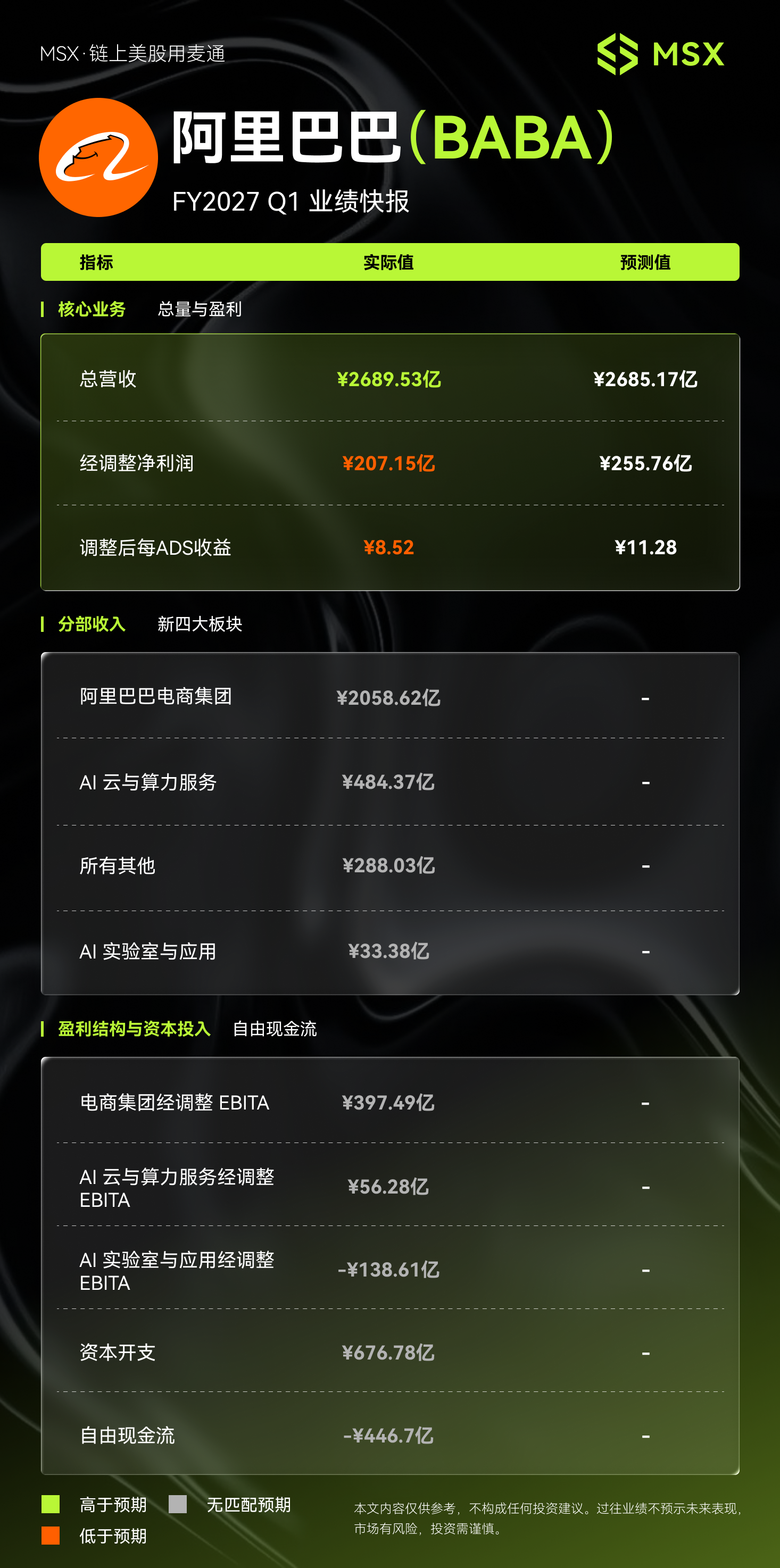
MSX US Stock Daily Observation: Alibaba FY2027 Q1 Earnings: AI Cloud Revenue Growth Hits Record High, AI Cloud Achieves Profitable Closed Loop

**MSX Daily US Stock Watch: Alibaba FY2027 Q1 Earnings – AI Cloud Revenue Hits Record Growth, Achieves Profitability Milestone** Alibaba's Q1 FY2027 revenue slightly exceeded expectations at 268.9B yuan (+9% YoY). However, adjusted net profit of 20.7B yuan (-38% YoY) and adjusted EPS missed consensus significantly. This shortfall was primarily driven by increased AI investments and two one-time items: a 5.5B euro provision for an EU Digital Services Act fine and 4.46B yuan in goodwill impairment. The restructured business segments showed clear divergence. The standout performer was the AI Cloud & Computing Services unit, with revenue surging 45% YoY to 48.44B yuan. Crucially, its adjusted EBITA jumped 133% YoY to 5.63B yuan, with margins expanding to 12%, signaling a profitable commercial loop for AI infrastructure. Within the Commerce Group, revenue growth was mixed: China Local Services (instant retail) grew 45% to 53.3B yuan, largely offsetting an 8% decline in Traditional China Commerce (110.9B yuan). International commerce revenue fell 1%. Despite this, the Commerce Group's adjusted EBITA dipped only 1% YoY to 39.75B yuan. A key area to watch is cash flow. Capital expenditures soared 75% YoY to 67.68B yuan, turning free cash flow to a net outflow of 44.67B yuan. However, operating cash flow remained positive and grew 11% YoY to 22.95B yuan, indicating the cash burn is a strategic choice for AI capacity build-out rather than operational weakness. In summary, while headline profits were pressured by heavy AI spending and one-off charges, the core takeaway is the emerging profitability of the AI Cloud business. The success of Alibaba's current investment cycle hinges on whether the profit improvement in AI Cloud can outpace the depreciation costs of its massive computing infrastructure expansion.

Odaily星球日报48m ago

MSX US Stock Daily Observation: Alibaba FY2027 Q1 Earnings: AI Cloud Revenue Growth Hits Record High, AI Cloud Achieves Profitable Closed Loop

Odaily星球日报48m ago

Trading

Spot

Hot Articles

Discussions

Welcome to the HTX Community. Here, you can stay informed about the latest platform developments and gain access to professional market insights. Users' opinions on the price of ADA (ADA) are presented below.

活动图片