
Trading Moment: AI Panic Escalates Ahead of CPI, Bitcoin Grinds Bottom in Volatility, Unlikely to Repeat 'Spring Festival Rally'

marsbitPublished on 2026-02-13Last updated on 2026-02-13

Abstract

Market Summary: AI Panic Deepens Ahead of CPI, Bitcoin Grinds Near Bottom, “Spring Festival Rally” Unlikely Macro markets are gripped by an AI-driven confidence crisis, shifting from “AI frenzy” to “AI panic.” This triggered a broad sell-off, erasing $1 trillion from U.S. stock market value. Major indices fell sharply, with tech giants like Apple and Amazon leading losses. The fear spread beyond software to sectors like commercial real estate and logistics, causing significant stock declines. This panic sparked a liquidity crunch, even dragging down safe-havens gold and silver. All eyes are on the upcoming U.S. CPI data for clues on the Fed's rate path. Bitcoin is struggling in a $60k-$72k range, facing heavy selling pressure above $82k. Analysts suggest a prolonged consolidation is likely without a major catalyst, with a strong structural bottom estimated between $52k-$58k. Predictions for a cycle bottom vary, with some targeting $40k-$50k by late 2026. Ethereum shows relative weakness, trading below $2,000 and its $3,500 average cost basis. Technical analysis points to potential further declines, with pessimistic targets as low as $1,006, though some see a bullish wedge pattern forming. Solana also faces pressure, with key support at $60. A broader altcoin downturn is noted, with a view that 99% may never reclaim all-time highs. Key data shows the market in "Extreme Fear" (index: 9). Bitcoin and Ethereum ETFs saw significant outflows. Today's focus is on the U.S. January...

Daily key market data review and trend analysis, produced by PANews.

1. Market Observation

The current macro market is experiencing a profound confidence crisis triggered by AI, with the narrative shifting from "AI狂热" (AI狂热) to "AI恐慌" (AI panic). Investors are no longer focusing on who will benefit, but are panicking about which industries will be disrupted and replaced. Financial markets faced a broad sell-off on Thursday, with US stock market capitalization evaporating by $1 trillion. Cisco plummeted 12% after issuing weak margin guidance. The Nasdaq fell sharply by over 2%, the S&P 500 dropped 1.57%, falling below its 50-day moving average, and the Dow Jones lost the 50,000 point mark. The Magnificent Seven tech stocks all closed lower, with Apple down over 5%, losing about $202 billion in market cap in a single day. After falling for eight consecutive days, Amazon officially entered a technical bear market on Thursday, down 21.4% from its high. The industry expects Nvidia's earnings report on February 25th to be a key catalyst for the AI sector.

The "existential anxiety" brought by AI is spreading from software stocks to broader industries. Following sectors like SaaS, insurance, and wealth management, commercial real estate and logistics have become the latest victims. Companies like CBRE and JLL fell over 25%, with commercial real estate stocks down over 25% in two days. Logistics giant CH Robinson plunged 14.5%, as investors worry that AI automation will compress commissions and replace parts of the business.
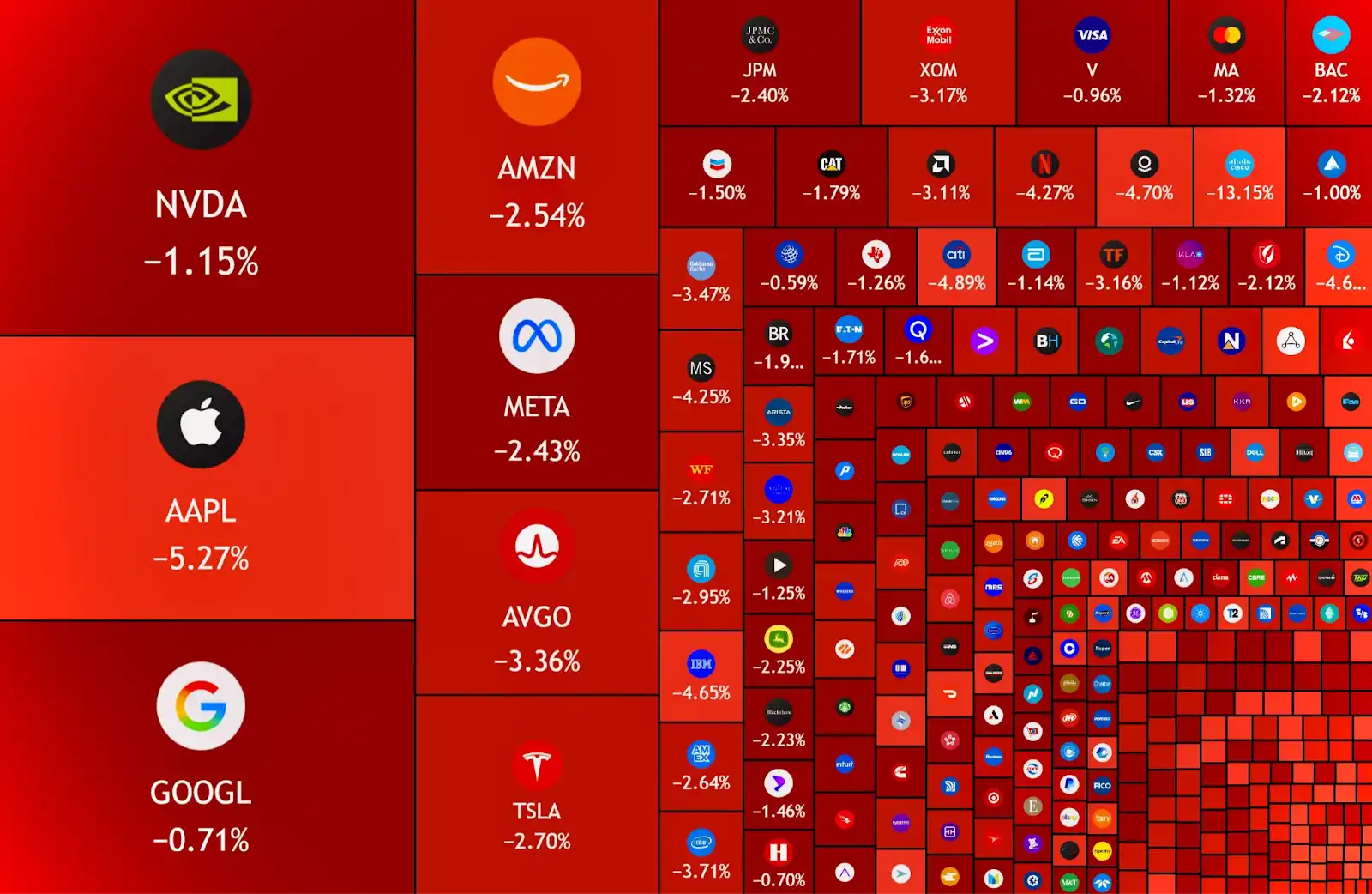
This panic has triggered a liquidity crunch, causing even safe-haven assets like gold and silver to be affected. Spot gold plunged over $200 intraday, closing down over 3% and losing the $5000 level. Silver crashed about 11% to around $75. Funds flowed into US Treasuries for safety, with the 10-year Treasury yield falling back to around 4.100%. Additionally, today is the last day for US stocks before the Spring Festival. Market focus is firmly on the CPI data expected to be 2.5%, released tonight, to find clues about the Fed's interest rate path amidst the turmoil. The market currently普遍预期 (普遍预期) a rate cut in July.

Bitcoin is currently struggling to fluctuate within the range of $60,000 to $72,000, constrained by heavy supply pressure above in the $82,000 to $97,000 range. On-chain analytics firm Glassnode points out that the market is caught between the "Realized Mean" of approximately $79,200 and the "Realized Price" of about $55,000. Without an extreme catalyst, it could experience a prolonged consolidation. A FLAME LABS research report further analyzes that the shutdown price for S19 series miners is $75k-$85k, for the S21 series it's $69k-$74k, while the $52k-$58k range汇集了 (concentrates) the 200-week moving average and the miner shutdown price defense line, forming a highly confident structural bottom, although the extreme physical bottom for S23 models is as low as $44k. Analysts like Tony Research and Titan of Crypto predict the bottom might arrive in Q4 2026 or October, with target prices looking at $40k-$50k; Rekt Capital warns that failure to reclaim the 200-week EMA (around $68.3k) could lead to bearish acceleration, while William Clemente and Frank A. Fetter believe the Mayer Multiple indicator shows the current period is a historical buying zone. Astronomer and Altcoin Sherpa are focusing on the effectiveness of the $60k-$65k support.

Ethereum performance is relatively weak, failing to maintain a price above $2000, touching a low of $1745. Bloomberg analyst James Seyffart pointed out that ETH ETF holders are in a worse position than Bitcoin's, as the current price is far below the average cost basis of around $3500. Technically, Man of Bitcoin believes ETH is in a downward B wave, with key support at $1832; a break below could see a drop to $1600. Lennaert Snyder also holds a bearish view, targeting $1866; StefanB is more pessimistic, predicting this decline is too sharp for a V-shaped recovery, with a bottom possibly in April next year, potentially as low as the $1006 to $1333 range. However, not all views are so bearish. Analyst Rod points out that the price is forming a bullish falling wedge pattern, with a short-term target of $2250. Cointelegraph analysis suggests institutional demand and resilience in on-chain metrics could support a rebound to $2400.

Solana is also under significant pressure. Analysts like Fade and Altcoin Sherpa warn it is in a late-cycle correction phase; a break below the key $60 support could lead to a further pullback to $50 or lower. For the entire altcoin market, analyst Inmortal believes that due to extreme capital fragmentation, 99% of altcoins may never reach new all-time highs again. Regarding meme coins, GEM DETECTER data shows that last month, among 180,000 traders on the PumpFun platform, 99% made profits of less than $500, and 42% were in a loss-making state. Furthermore, as one of the market barometers, Coinbase's Q4 earnings report showed that despite a 156% increase in annual trading volume, the company reported a net loss of $667 million due to high operating expenses and investment losses, putting pressure on its stock price. Simultaneously, its CEO Brian Armstrong has sold over $550 million worth of company stock in the past nine months, further dampening market confidence.

2. Key Data (As of 13:00 HKT, February 13)

(Data source: CoinAnk, Upbit, SoSoValue, CoinMarketCap)

  • Bitcoin: $66,256 (Year-to-date -24.33%), Daily Spot Volume $46.81B

  • Ethereum: $1,933 (Year-to-date -34.83%), Daily Spot Volume $19.09B

  • Fear & Greed Index: 9 (Extreme Fear)

  • Average GAS: BTC: 10.06 sat/vB, ETH: 0.35 Gwei

  • Market Dominance: BTC 58.9%, ETH 10.5%

  • Upbit 24h Trading Volume Ranking: XRP, BTC, BERA, ME, ETH

  • 24h BTC Long/Short Ratio: 48.95% / 51.05%

  • Sector Performance: Crypto market generally down, GameFi, Meme, AI sectors all fell over 2%

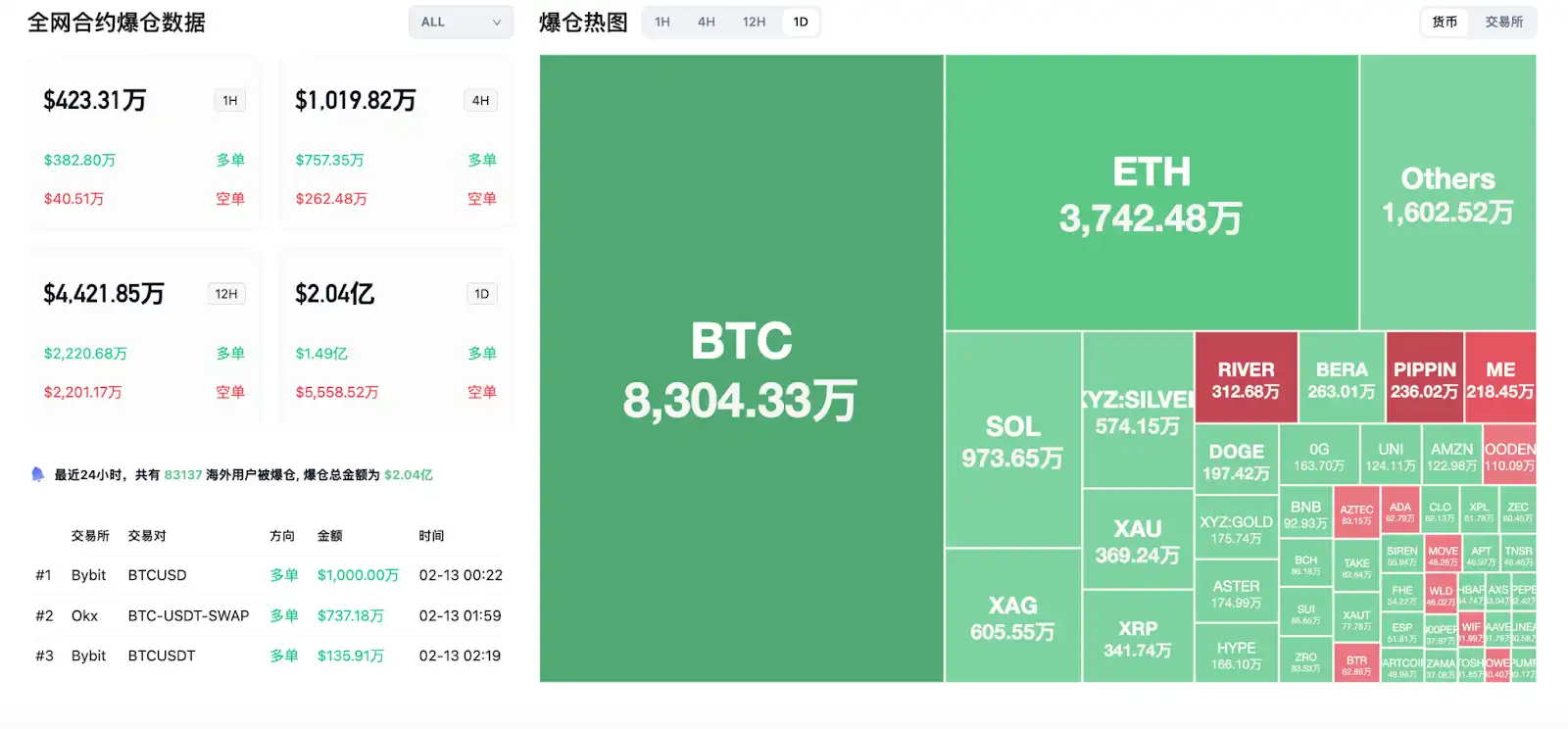
24h Liquidation Data: 83,137 people liquidated globally, Total liquidation amount $204 million,其中 (of which) BTC liquidation $83.04 million, ETH liquidation $37.42 million, SOL liquidation $9.73 million
3. ETF Flows (As of February 12)

  • Bitcoin ETF: -$410 million

  • Ethereum ETF: -$113 million

  • SOL ETF: +$2.7041 million

4. Today's Outlook

  • US Labor Department: Nonfarm Payrolls to be released on February 11, CPI data changed to February 13

  • Binance will delist ACA, CHESS, DATA, DF, GHST, NKN spot trading pairs on February 13

  • FTX: Next distribution registration date is February 14, disputed claim reserve reduced by $2.2 billion for distribution

  • Caixin: Asset disposal for the 60,000 Bitcoin Qian Zhimin money laundering case is deadlocked, hearing scheduled for February 16

  • US Jan CPI YoY: Previous 2.7%, Expected 2.5% (21:30, February 13)

  • HKEX, South Korea, US, Vietnam and other exchanges closed for Spring Festival (February 16)

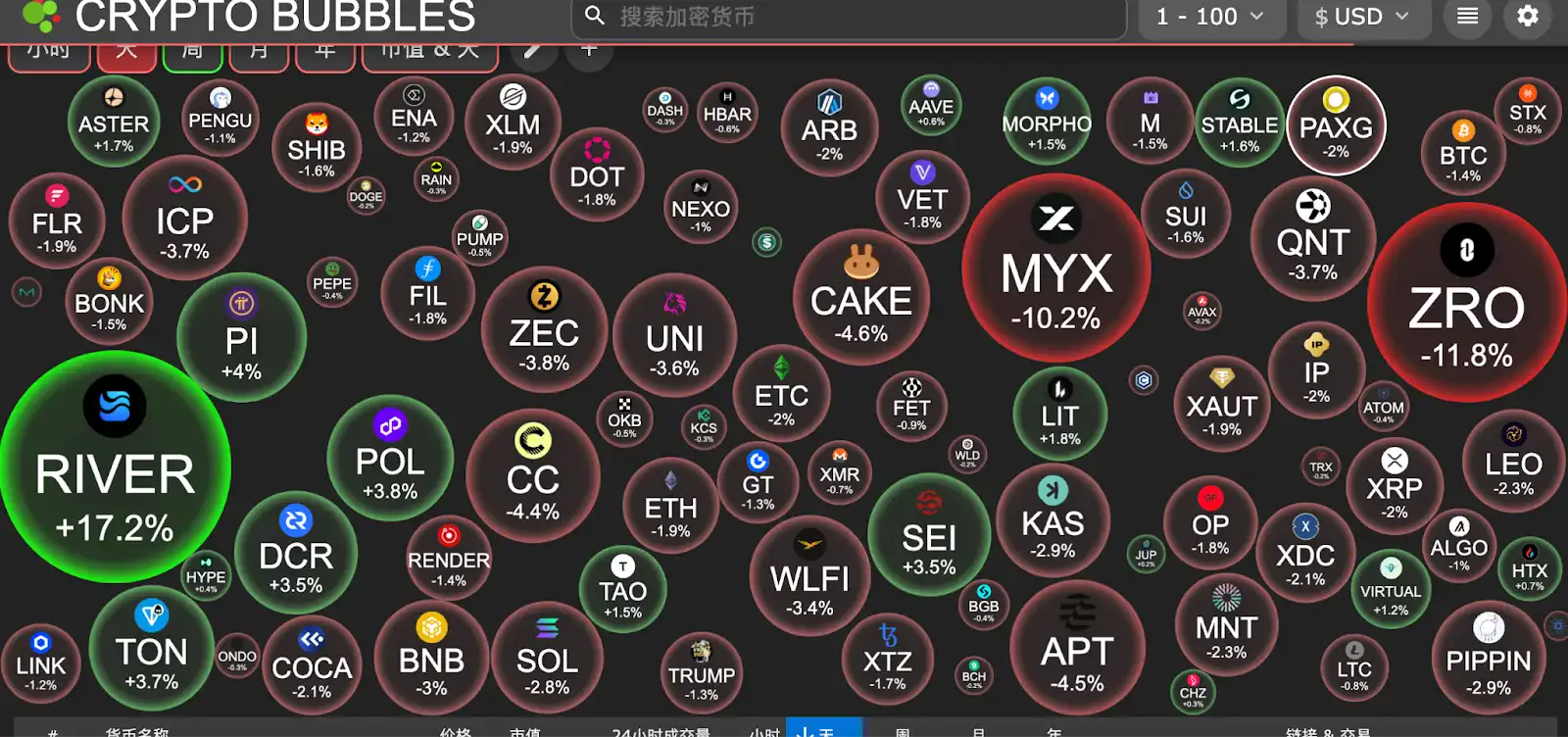
Today's top gainers among top 100 coins by market cap: River up 17.2%, Pi Network up 4%, POL (formerly MATIC) up 3.8%, Toncoin up 3.7%, Sei up 3.5%.
5. Hot News

  • Coinbase announces additional purchase of $39 million worth of Bitcoin

  • Aave Labs proposes transferring 100% of protocol revenue to DAO in exchange for operational funding

  • Coinbase Q4 Earnings: Net loss $667 million, revenue down 20%

  • Lighter reaches USDC deposit revenue sharing agreement with Circle

  • Bhutan government sends 100 BTC worth $6.77 million to QCP Capital

  • Coinbase CEO sells approximately $550 million in Coinbase stock over the past year

  • Binance confirms SAFU fund completed purchase of final batch of 4,545 BTC, total BTC holdings now 15,000

  • Ethereum Holdings Report: Over 60% of total supply held in ETH2 deposit contract, Rain Lohmus is the largest individual holder

  • Alameda bankruptcy estate distributes over $15 million worth of SOL to creditors

Trending Cryptos

Related Questions

QWhat is the current market sentiment shift regarding AI, and what impact did it have on the stock market?

AThe market sentiment has shifted from 'AI frenzy' to 'AI panic', with investors fearing which industries will be disrupted and replaced. This triggered a broad market selloff, erasing $1 trillion in US stock market value, with major indices like the Nasdaq and S&P 500 falling significantly.

QWhat is the key price range Bitcoin is currently struggling within, and what are the major resistance and support levels mentioned?

ABitcoin is struggling within the range of $60,000 to $72,000. It faces heavy supply pressure above $82,000 to $97,000. Key support levels are identified around the $55,000 'Realized Price' and the $52,000-$58,000 range, which includes the 200-week moving average and miner shutdown prices.

QHow did Ethereum perform relative to Bitcoin, and what was a key concern raised by a Bloomberg analyst?

AEthereum performed relatively weaker, failing to hold above $2,000 and touching a low of $1,745. Bloomberg analyst James Seyffart pointed out that ETH ETF holders are in a worse position than Bitcoin's, as the current price is far below the average cost basis of around $3,500.

QWhat was the overall flow for Bitcoin and Ethereum ETFs as of February 12th?

AAs of February 12th, Bitcoin ETFs saw a net outflow of $410 million, while Ethereum ETFs saw a net outflow of $113 million.

QWhat major economic event is the market focused on, and what is the expectation for the Federal Reserve's interest rate path?

AThe market is focused on the upcoming US CPI (Consumer Price Index) data. The expectation for the CPI is 2.5%. The market widely anticipates that the Federal Reserve will not cut interest rates until July.

Related Reads

From South Korea to the United States: Blue-Collar Jobs Are Becoming Increasingly Popular, Thanks to AI

AI is reshaping the labor market's value proposition. The traditional four-year college degree is losing its appeal as a guaranteed career path, while skilled blue-collar trades like electricians, welders, and plumbers are experiencing historic demand and wage premiums. This shift is driven by dual pressures: AI's displacement of certain white-collar roles and a booming need for physical infrastructure and data center construction. Data confirms the trend. In the U.S., vocational school revenue surged, and a significant portion of recent layoffs are AI-related. Surveys show a majority of Gen Z adults plan to pursue blue-collar work, citing better job security against AI automation. Vocational education interest has exploded recently. Experts cite a psychological shift as younger generations seek tangible, AI-resistant careers and avoid high student debt. In many cases, salaries for skilled trades now match or exceed those requiring a bachelor's degree. In South Korea, semiconductor vocational high schools boast near-total employment, with graduates securing high-paying roles at companies like Samsung. The shortage is structural, exacerbated by a retiring baby boomer workforce and massive infrastructure projects. Companies like JPMorgan Chase, Meta, and Lowe's are investing heavily in training programs. However, overcoming historical stigma and a "perception gap" around trade careers remains a key challenge to closing the talent gap.

marsbit19m ago

From South Korea to the United States: Blue-Collar Jobs Are Becoming Increasingly Popular, Thanks to AI

marsbit19m ago

Qualcomm: AI Hype Subsides, When Will Smartphones Emerge from the Gloom?

Qualcomm reported its Q3 FY2026 results (ending June 2026), with revenue of $9.95B, down 4% YoY but above expectations. Gross margin declined to 53.1%, pressured by rising costs across manufacturing and memory. Key business segments showed mixed performance: Handset revenue fell 19.6% YoY to $5.09B, dragged by an 11% decline in non-Apple Android shipments and weaker high-end mix. Conversely, Automotive revenue surged 61% to $1.59B, and IoT grew 9% to $1.83B. Core operating profit dropped 41% YoY due to margin compression and higher expenses. Management's Q4 FY2026 guidance projects revenue of $9.7B-$10.5B, in line with consensus, but Non-GAAP EPS guidance of $2.05-$2.25 fell short of expectations. Amidst persistent weakness in its core handset market, Qualcomm is pursuing growth in AI, focusing on Edge AI (smartphones, PCs, automotive) and Data Center AI. Its data center strategy includes four pillars: AI accelerators (e.g., AI200), commercial CPUs (Dragonfly C1000), custom silicon, and connectivity solutions. While these initiatives initially boosted its stock, concerns over AI capital expenditure sustainability have since erased those gains. The company targets $5B in data center revenue for FY2027 and $15B for FY2029. The report concludes that with the traditional handset business still under pressure, the data center opportunity is currently viewed as a longer-term option, and a more conservative valuation based on core operations may be warranted until AI contributions materialize.

marsbit23m ago

Qualcomm: AI Hype Subsides, When Will Smartphones Emerge from the Gloom?

marsbit23m ago

From TPU to Self-Evolving Agents: How Jeff Dean Predicts the Next Step in AI

At the 2026 YC Startup School, Jeff Dean outlined his vision for AI's next phase, shifting focus from simply scaling models to building intelligent, autonomous systems. He believes AI's progress is no longer just about creating smarter models, but about integrating them into systems capable of long-term, iterative work, automated experimentation, and continuous learning. This evolution moves the competition from "who has the bigger model" to "who can best organize intelligence." Dean suggests AI capabilities are now comparable to a junior engineer, enabling the automation of complex workflows. However, the true challenge and opportunity lie in managing these AI "workers" at scale. He emphasizes the importance of **context engineering**—structuring tools, memory, and feedback loops—over raw model power. For startups, this means building deep expertise in niche domains where general models currently fail (near 0-1% success rates), leveraging proprietary data, specialized tools, and domain-specific evaluators. A recurring theme is re-examining fundamental constraints. Dean's past work, like moving Google's search index to memory or creating the TPU, stemmed from questioning outdated assumptions about hardware and cost. He sees similar inflection points today, particularly in **specialized inference hardware** to drastically reduce latency and energy consumption for real-time Agent operation. Notably, he points out that in modern AI systems, the dominant cost is often not computation but **data movement**. Reliable, long-running Agents require robust system design, borrowing concepts from distributed computing like checkpointing, state management, and parallel exploration to handle failures and maintain progress over days or weeks. As AI automates execution, the scarcest human skills will shift to **defining clear specifications**, **judging what problems are worth solving** (taste), and designing effective feedback loops. Ultimately, Dean's framework prioritizes understanding the problem deeply, identifying the true bottlenecks, and systematically building closed-loop systems where AI can not only perform tasks but also improve AI itself.

marsbit24m ago

From TPU to Self-Evolving Agents: How Jeff Dean Predicts the Next Step in AI

marsbit24m ago

Trading

Spot

Hot Articles

Discussions

Welcome to the HTX Community. Here, you can stay informed about the latest platform developments and gain access to professional market insights. Users' opinions on the price of AI (AI) are presented below.

活动图片















