Top 10 AI Models Speak Out: What Do Crypto Users Care About Most in 2025?

比推Published on 2025-12-24Last updated on 2025-12-24

Abstract

This article summarizes the top concerns of cryptocurrency users in 2025, as predicted by 10 major AI models. The models were asked to identify the three most common questions users would have about crypto in 2025, with instructions to avoid real-time searches and base answers on long-term discussion patterns. The responses, while varied, cluster around three core themes: market cycles, profit opportunities, and risk management. Key recurring questions include: - The current market phase (bull or bear) and how long it will last. - Bitcoin's price trajectory post-halving and the market's peak. - Where to find profitable opportunities (alpha) and the best assets or sectors to invest in (e.g., RWA, AI+Crypto, L2s, Solana). - The impact of regulatory changes and ETF approvals on the market and asset safety. - How to identify scams, assess project legitimacy, and securely store assets. - Practical on-chain concerns like avoiding MEV and setting slippage. The analysis notes that the models' different focuses reflect their design and user base. For instance, ChatGPT framed questions around a structured narrative of market anxiety, while Kimi addressed granular technical issues. More capable models tended to provide sharper, more specific questions, while others fell back on broader, common themes. Overall, the collective output reveals a user mindset focused on first gauging market trends, then seeking alpha, and finally mitigating risks.

Author: WuBlockchain

Original Title: What Are Crypto Users Most Concerned About in 2025? Answers from 10 AI Models Vary


What are crypto users most concerned about in 2025? We conducted a user survey using AI models by asking the same question to different large models: "What are the three most frequently asked questions about cryptocurrencies in 2025?"

To minimize homogenized answers due to real-time retrieval and considering that large models generally cannot and are not allowed to provide verifiable statistics or disclosures of their training data, we added a note to the question: "Please do not perform real-time searches or cite specific articles; answer based solely on your understanding of long-term discussion patterns."
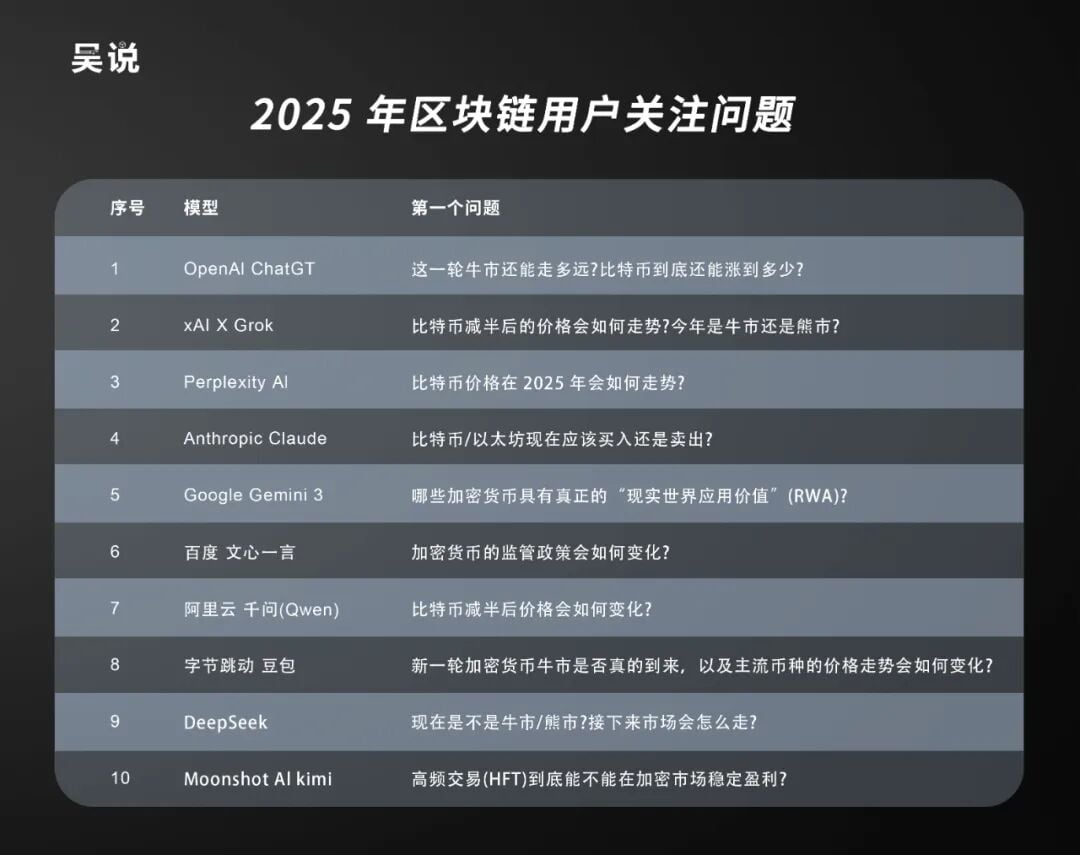
ChatGPT

1. How much further can this bull run go? Has Bitcoin already peaked?

2. Is there still genuine Alpha in this market cycle, and how can ordinary users make money?

3. Do current hot projects or sectors have long-term viability, or are they structurally exploitative?

X Grok

1. Is the market in a bull or bear phase after the Bitcoin halving?

2. What are the most promising crypto assets or sectors to invest in for 2025?

3. How are Ethereum spot ETFs performing, and what is the inflow of institutional funds?

Perplexity AI

1. How might Bitcoin's price evolve in 2025?

2. How to identify and avoid cryptocurrency-related scams?

3. How will ETF and regulatory developments impact the crypto market?

Claude

1. Is now the right time to buy or sell Bitcoin or Ethereum?

2. Is a particular crypto project a scam, and is it trustworthy?

3. How should new users start investing in cryptocurrencies and manage risks?

Gemini 3

1. Which crypto projects have real-world application value (RWA)?

2. How will current and future regulatory policies affect personal asset security?

3. Among Ethereum L2, Solana, and AI+Crypto, which technological path is likely to emerge as the ultimate winner?

DeepSeek

1. Is the current market in a bull or bear phase?

2. Which crypto sectors or assets show the most potential in 2025?

3. How will changes in regulatory policies impact asset security and investment decisions?

Douban

1. Has a new cryptocurrency bull market arrived?

2. How will changes in regulatory policies across countries affect ordinary investors?

3. What does the Bitcoin halving trend mean for retail investment strategies?

Qianwen

1. How will Bitcoin's price trend evolve after the halving?

2. Have Ethereum and mainstream public chains achieved substantive breakthroughs in practical applications?

3. How will regulatory policies in various countries affect the legitimate use of cryptocurrencies?

Wenxin Yiyan

1. How will global cryptocurrency regulatory policies change?

2. Do Bitcoin and mainstream crypto assets have long-term investment value?

3. Can real-world application scenarios for cryptocurrencies truly be realized?

Kimi

1. Can retail investors achieve stable profits through high-frequency trading in the crypto market?

2. What is the safest way to store private keys and wallet assets?

3. How should slippage be set in on-chain transactions to avoid MEV losses?

Summary

The reason these models provide slightly different "top three questions" may relate to their respective positioning and contexts. ChatGPT seems to adopt a trader's perspective, framing the discussion as a structured chain of anxieties: "How much longer will the cycle last — Is Alpha still available — Is there structural exploitation?" Grok aligns more with social media hotspots, focusing on narratives like halving, bull/bear markets, and ETF fund flows. Perplexity's style resembles a retrieval-based summary, concentrating on price trends, scam prevention, and ETF/regulatory progress. Claude is more cautious, emphasizing timing for buying/selling, project trustworthiness, and risk management for newcomers. Gemini leans more toward industry and technological routes, focusing on RWA, regulatory impacts on asset security, and the "final choice" among L2/Solana/AI. Chinese models overall focus more on cycles, halving, and regulation—the "most hardcore deterministic variables." Kimi is an exception, delving into on-chain execution details (wallet security, slippage/MEV, HFT), resembling real friction points from high-frequency on-chain users.

Another minor but noteworthy possibility is that model capability differences also affect the "sharpness" of outputs. More capable models tend to frame the same topic more specifically and systematically; conversely, weaker models are more likely to fall back on "price/regulation/scams"—these broad, common expressions—making answers appear more similar and offering less incremental information. This factor may not be the main cause, but in macro open-ended questions, it could amplify the perception of homogeneity.

Overall, these questions highly concentrate on three core themes: cycle positioning, profit pathways, and risk boundaries. The crypto market's notable features are high volatility and strong narrative drive, so "which phase of the bull/bear market are we in?" almost determines all subsequent user actions (holding, selling, switching positions, leveraging, or exiting). As the market matures and becomes more crowded, users quickly shift from "is there an opportunity?" to "where is the opportunity, and can I still capture it?" Thus, Alpha, sector selection, and institutional funds (ETFs) naturally become high-frequency topics. Meanwhile, scams, project credibility, asset security, and regulatory compliance reflect that crypto users are long situated in a "high-reward/high-uncertainty" environment: chasing returns while fearing pitfalls, ultimately forming a typical behavioral structure—first assess the trend, then seek opportunities, and finally control risks.


Twitter:https://twitter.com/BitpushNewsCN

Bitpush TG Discussion Group:https://t.me/BitPushCommunity

Bitpush TG Subscription: https://t.me/bitpush

Original link:https://www.bitpush.news/articles/7598042

Related Questions

QWhat are the three main themes that the top 10 AI models predict cryptocurrency users will care most about in 2025?

AThe three main themes are market cycle position (bull or bear market), profit opportunities (where to find alpha and viable investment paths), and risk boundaries (security, scams, and regulatory impacts).

QWhich AI model focused on questions about technical execution details like wallet security and MEV avoidance?

AKimi focused on technical execution details, including questions about secure wallet storage, avoiding MEV through slippage settings, and the feasibility of stable profits through high-frequency trading.

QHow did the Chinese-language models (like Douban and Qwen) differ in their focus compared to some Western models?

AChinese-language models concentrated more on cyclical trends, halving events, and regulatory policies, which are seen as 'hardcore deterministic variables,' whereas some Western models like Gemini 3 explored more technical and industry-focused questions such as real-world asset (RWA) value and technology roadmaps.

QWhat methodological step was taken to reduce answer homogeneity among the AI models in this survey?

AThe models were instructed not to perform real-time searches or cite specific articles and to base their answers solely on their understanding of long-term discussion patterns to minimize homogenized results from web retrieval.

QAccording to the summary, what underlying user behavior structure is reflected in the questions generated by the AI models?

AThe questions reflect a typical user behavior structure: first assessing market trends, then searching for profit opportunities, and finally focusing on risk control, driven by the high-reward yet high-uncertainty nature of cryptocurrency investments.

Related Reads

Only a 50% Chance of Passing This Year, Can the CLARITY Bill Succeed Before the Midterm Elections?

The CLARITY Act, which passed the House in July 2025 with strong bipartisan support (294-134), faces a critical juncture in the Senate. The Senate Banking Committee is expected to hold a markup soon, but key issues remain unresolved, including stablecoin yield provisions, DeFi regulations, and securing full Republican committee support. Other contentious points involve the Blockchain Regulatory Certainty Act (BRCA), ethics amendments for government officials, and SEC-related matters. The legislative calendar is tight, with limited time before the midterm elections. If the committee markup is delayed beyond mid-May, the chances of passage in 2026 drop significantly. Senator Cynthia Lummis has warned that failure this year could delay comprehensive crypto market structure legislation until 2030 or later. Galaxy estimates the probability of the CLARITY Act becoming law in 2026 is only about 50%. The bill provides crucial regulatory clarity by defining jurisdictional boundaries between the SEC and CFTC, establishing a path for decentralization, and bringing digital commodity intermediaries under federal regulation. Its passage is seen as vital before potential power shifts in the next Congress, which could bring less favorable leadership to key committees. The timeline is compressed, and the bill must compete for floor time with other priorities like Iran authorization and DHS appropriations. Key hurdles include finalizing the stablecoin yield compromise text, addressing law enforcement concerns about BRCA, and navigating political dynamics around SEC nominations. The outcome of the Banking Committee markup and the level of bipartisan support will be critical indicators of its future success.

marsbit1m ago

Only a 50% Chance of Passing This Year, Can the CLARITY Bill Succeed Before the Midterm Elections?

marsbit1m ago

Only a 50% Chance of Passing This Year, Can the CLARITY Bill Succeed Before the Midterm Elections?

The CLARITY Act, which passed the U.S. House in July 2025 with strong bipartisan support (294-134), faces a critical juncture in the Senate. The Senate Banking Committee is expected to hold a markup soon, but key issues remain unresolved, including stablecoin yield provisions, DeFi regulations, and securing full Republican committee support. Additional challenges involve the Blockchain Regulatory Certainty Act (BRCA), ethics amendments for government officials, and SEC-related concerns. Galaxy estimates only a 50% chance of the bill becoming law in 2026. The tight legislative calendar, competing priorities like Iran military authorization and DHS appropriations, and the impending midterm elections create significant time pressure. If the bill is not passed before the new Congress convenes in 2027, comprehensive crypto market structure legislation could be delayed until 2030 or later, especially if leadership changes result in less favorable committee chairs. The act provides crucial regulatory clarity by defining the jurisdictional boundaries between the SEC and CFTC, establishing a path for decentralized networks to be classified as non-securities, and bringing digital commodity intermediaries under federal regulation. The outcome of ongoing Senate negotiations, particularly the release of revised text on stablecoin yields, will be a key indicator of its future prospects.

Odaily星球日报11m ago

Only a 50% Chance of Passing This Year, Can the CLARITY Bill Succeed Before the Midterm Elections?

Odaily星球日报11m ago

Four-Dimensional Resonance: Hong Kong Web3 Carnival Sub-Forum Co-Creates Blueprint for Global Financial New Infrastructure

The "Four-Dimensional Resonance: 2026 Global Financial New Infrastructure" forum, a core event of the Hong Kong Web3 Festival, was successfully held at the Hong Kong Convention and Exhibition Centre. Co-hosted by Web3Labs and DeShang Singularity Tech, with joint support from Bitroot, Injective, Microsoft, and Z Oracle, the event gathered policymakers, industry leaders, and investors to explore the integration and innovation of global financial infrastructure, focusing on RWA, AI, DeFi, and compliant payments. Policy speakers, including Hong Kong Legislative Council Member Mr. Wu Jiezhuang, South Korean National Assembly Member Mr. Min Byung-duk, and ACED Chairman Mr. Yun Seok-hun, emphasized the importance of cross-border regulatory collaboration and an open policy environment for fintech innovation. Web3Labs CEO Caspar and DeShang Singularity Tech CEO Chang Shuai highlighted Hong Kong’s role as a financial innovation center and the approaching "singularity moment" for global financial infrastructure. Technical insights were shared by MagnetX, Bitroot, Microsoft, and Injective on topics including AI Agent economies, the evolution of public blockchains, and AI’s transformative role in finance. Key partnerships and initiatives were launched: - GWDC 2026 Korea collaboration between Hong Kong and South Korea. - A strategic agreement between Web3Labs and Microsoft. - The launch of a public anti-fraud alliance by Z Oracle and partners. - The "Injective Rising Star" program to support AI and Web3 projects. Panel discussions delved into AI-driven smart payments, compliant cross-border transactions, and the fusion of RWA and DeFi. Participants agreed that integrating RWA with DeFi is crucial for the next stage of financial infrastructure, enabling a shift from physical to digital finance. The forum underscored Hong Kong’s pivotal role in advancing a globalized and sustainable Asian fintech ecosystem.

marsbit19m ago

Four-Dimensional Resonance: Hong Kong Web3 Carnival Sub-Forum Co-Creates Blueprint for Global Financial New Infrastructure

marsbit19m ago

Trading

Spot
Futures

Hot Articles

Discussions

Welcome to the HTX Community. Here, you can stay informed about the latest platform developments and gain access to professional market insights. Users' opinions on the price of AI (AI) are presented below.

活动图片