Tokenized US Treasurys surge 50x since 2024, marking shift toward on-chain finance

cointelegraphPublished on 2025-12-22Last updated on 2025-12-22

Abstract

Tokenized US Treasurys have experienced explosive growth, surging 50x from under $200 million in January 2024 to nearly $7 billion by late 2025. This rapid expansion is driven by rising institutional demand for on-chain yield and marks a significant shift toward blockchain-based finance. BlackRock's USD Institutional Digital Liquidity Fund (BUIDL) leads this market with almost $2 billion in assets, offering daily yield accrual and on-chain settlement. Other key products include offerings from Circle, Superstate, and Ondo Finance. Tokenized Treasury bills are becoming a crucial gateway for institutional DeFi adoption, combining the safety of US government debt with the efficiency of blockchain settlement. They are increasingly used for collateral management, margining, and improving capital efficiency.

Tokenized US Treasurys have emerged as one of the fastest-growing segments of the real-world asset (RWA) market, with data pointing to 50x growth in less than two years amid rising institutional demand for on-chain yield.

Data from Token Terminal shows that the combined market capitalization of tokenized US Treasury products has exploded from well under $200 million in January 2024 to almost $7 billion in late 2025. The growth underscores the rapid acceleration of onchain adoption for government-backed debt instruments.
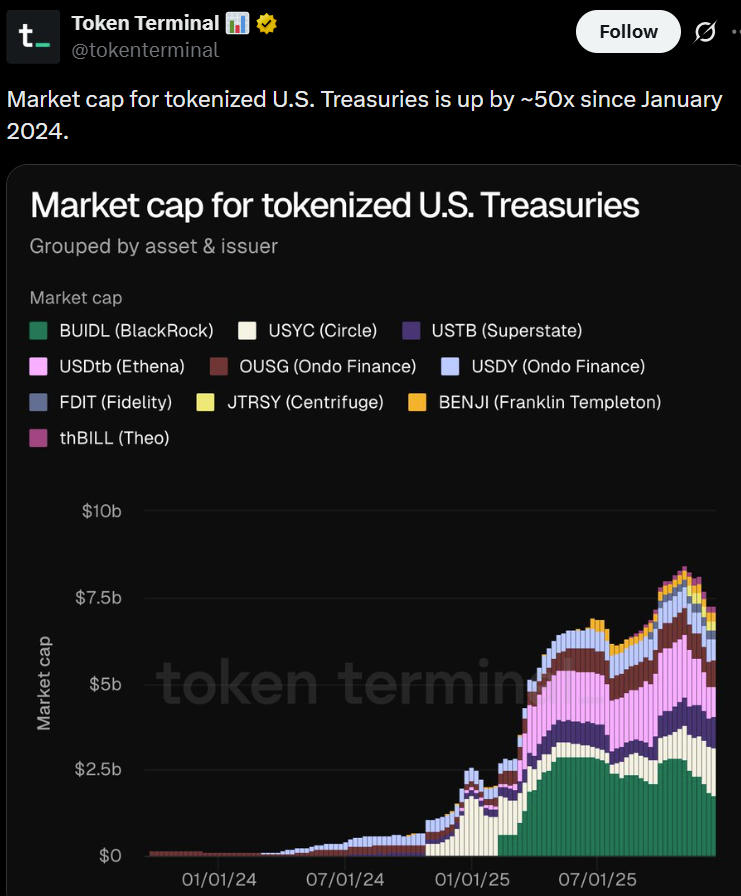
Source: Token Terminal

At the center of this expansion is BlackRock’s USD Institutional Digital Liquidity Fund (BUIDL), which is widely regarded as the flagship product of the tokenized Treasury market.

The blockchain-based fund provides investors with exposure to short-term US Treasurys while offering daily yield accrual and onchain settlement. Industry data shows that BUIDL has amassed close to $2 billion in assets under management.

Other prominent offerings include USD Coin Yield (USYC) from Circle, US Treasury Bill Token (USTB) from Superstate and Ondo Short-Term US Government Bond Fund (OUSG) from Ondo Finance.

Each product offers tokenized access to US government debt through regulated fund structures, reflecting a broader push to bring traditional fixed-income instruments onto blockchain rails.

Related: Goldman Sachs, BNY to offer tokenized money market funds for clients

Tokenized Treasury bills emerge as a key gateway to institutional DeFi

US Treasury bills are particularly well-suited for tokenization, as they combine the safety of US government backing with the efficiency of blockchain-based settlement, creating a regulated gateway into decentralized finance (DeFi) markets.

As Cointelegraph has reported, institutional adoption of tokenized Treasury bills is gaining traction, particularly for use in settlement and margining. Traditional financial institutions are using tokenized government debt to improve capital efficiency while maintaining exposure to low-risk assets.

DBS, Southeast Asia’s largest financial institution by assets, was among the first major lenders to test tokenized funds, including blockchain-based Treasury products. The bank has piloted tokenized money market funds and government securities as part of broader efforts to use onchain assets for collateral management and settlement.

Tokenized Treasury bills have grown in tandem with other onchain assets, contributing to the rapid evolution of the tokenization market. RedStone data shows that private credit has been the fastest-growing segment, buoyed by yields that exceed those of traditional investment vehicles.


Related: New protocol targets redemption delays in $20B tokenized market

Trending Cryptos

Related Questions

QWhat is the reported growth rate of the tokenized US Treasurys market since January 2024, according to Token Terminal?

AThe market has experienced 50x growth, surging from well under $200 million in January 2024 to almost $7 billion in late 2025.

QWhich fund is considered the flagship product of the tokenized Treasury market and how much in assets has it amassed?

ABlackRock’s USD Institutional Digital Liquidity Fund (BUIDL) is the flagship product, and it has amassed close to $2 billion in assets under management.

QName three other prominent tokenized US Treasury products mentioned besides BlackRock's BUIDL.

AThe other prominent products are USD Coin Yield (USYC) from Circle, US Treasury Bill Token (USTB) from Superstate, and Ondo Short-Term US Government Bond Fund (OUSG) from Ondo Finance.

QWhy are US Treasury bills described as being particularly well-suited for tokenization?

AThey combine the safety of US government backing with the efficiency of blockchain-based settlement, creating a regulated gateway into decentralized finance (DeFi) markets.

QWhich major Southeast Asian financial institution was mentioned as an early tester of tokenized funds, including Treasury products?

ADBS, Southeast Asia’s largest financial institution by assets, was among the first major lenders to test tokenized funds.

Related Reads

The "Impossible Triad" Is Fundamentally a Pseudo-Problem

The article argues that blockchain's fundamental limitation is not the scalability trilemma (decentralization, scalability, security), which has been largely solved, but the lack of **privacy** and, until recently, clear **legitimacy**. Blockchain is described as a slow, expensive, globally shared computer whose core value is censorship resistance and verifiability. While ideal for native digital assets like money (e.g., stablecoins), its default transparency acts as a **tax**, exposing all transactions and enabling MEV extraction, which deters serious institutional capital. Simultaneously, its permissionless nature created regulatory ambiguity. The piece contends that **privacy** is the missing critical feature. It rejects the false choice between total transparency and complete anonymity. Modern cryptography (like zero-knowledge proofs) enables **compliant privacy**: users can prove facts (solvency, KYC status, compliance) without revealing the underlying sensitive data (specific holdings, identities). This preserves auditability for regulators and eliminates the leak of financial information. With recent regulatory progress (e.g., the GENIUS Act) addressing legitimacy, adding default, provably compliant privacy becomes a pure upgrade. It transforms blockchain from a costly, public ledger into a confidential settlement layer, finally bridging the gap to mainstream institutional and individual adoption of on-chain finance.

链捕手10h ago

The "Impossible Triad" Is Fundamentally a Pseudo-Problem

链捕手10h ago

Optical Chips: Collective Capacity Expansion

The global optical chip industry is experiencing a massive wave of expansion driven by surging AI data center demand. Major players across the US, Japan, Europe, and China are aggressively investing to ramp up production capacity. In the US, Coherent is expanding its 6-inch Indium Phosphide (InP) semiconductor fab in Texas, supported by CHIPS Act funding and a $2 billion strategic investment from NVIDIA. Lumentum is building a new factory for InP optical devices, and Nokia is scaling its advanced photonic chip packaging and testing capabilities. NVIDIA's investments aim to secure future supply of critical lasers and optical interconnect products for AI infrastructure. Japan's JX Advanced Metals, a leading InP substrate supplier, plans a multi-billion yen investment to increase its capacity 7-10 times, strengthening its grip on the crucial upstream materials market. In Europe, IQE and Tower Semiconductor settled a patent dispute and signed a multi-year InP epitaxial wafer supply agreement, highlighting that next-generation silicon photonics platforms will integrate high-performance InP components. STMicroelectronics and Sivers Semiconductors are also expanding silicon photonics production and partnerships. China is rapidly building out its domestic supply chain. Dongshan Precision's subsidiary, Source Photonics, announced a $12 billion project to expand optical chip and module production. Companies like Sanan Optoelectronics and Yunnan Germanium are scaling up InP chip manufacturing and substrate production, moving towards vertical integration from materials to modules. While debate continues around the exact future architecture—whether CPO (Co-Packaged Optics), NPO, or pluggables will dominate—analysts like Morgan Stanley argue the underlying driver is unchangeable: the explosive growth in bandwidth demand. This will inevitably increase the volume of optical engines, lasers, and related content per GPU, regardless of the final technical path. The competition for "more light" in the AI era has intensified into a global, full-chain capacity race.

marsbit13h ago

Optical Chips: Collective Capacity Expansion

marsbit13h ago

Stablecoins Finally Find Real Yield: An In-Depth Look at On-Chain Reinsurance Re | A Conversation with Re Founder Karan Saroya

Stablecoin Real Yield Found: A Deep Dive into On-Chain Reinsurance with Re's Karan Saroya As stablecoin supply exceeds $170 billion, the search for sustainable, non-speculative yield intensifies. Re, an on-chain reinsurance platform, provides an answer: connecting stablecoin capital to the trillion-dollar traditional reinsurance market. Re operates as a regulated reinsurer, accepting stablecoin deposits as collateral to back US insurance companies. These insurers pay premiums, generating yield that flows back to on-chain depositors. Currently supporting 35 insurers and underwriting $500 million, Re projects scaling to over $1 billion soon. Key insights from a Bankless podcast with founder Karan Saroya and investor Avichal of Electric Capital: 1. **Uncorrelated, Real-World Yield:** Re offers stablecoin holders access to reinsurance returns (targeting 12-14%+), an asset class entirely separate from crypto or equity markets. 2. **Operational Efficiency via Smart Contracts:** Re replaces traditional, labor-intensive capital fundraising with smart contracts, allowing a ~12-person team to compete with industry giants. 3. **Regulatory Leverage:** For every $1 of collateral, regulations allow backing $5-7 in written premiums. This leverage amplifies returns from the underlying risk-free rate. 4. **DeFi Integration:** Depositors receive receipt tokens, which can be used in protocols like Morpho for "looping," potentially pushing yields to 18-20%+. 5. **The "DeFi Mullet" Model:** A compliant front-end (regulated reinsurer) paired with a decentralized back-end (smart contracts, DeFi capital markets). 6. **RE Governance Token:** Modeled on Lloyd's of London, the token governs the central capital pool's allocation, counterparty acceptance, and parameters. 7. **Real Economic Impact:** Capital funds real-world productivity (factories, clinics, businesses) via insurance, moving beyond crypto's internal loops. The discussion highlights a pivotal moment: DeFi's supply-side infrastructure is now met by real demand for productive yield, potentially kickstarting a flywheel where vast on-chain stablecoin capital seeks these real-world returns.

链捕手14h ago

Stablecoins Finally Find Real Yield: An In-Depth Look at On-Chain Reinsurance Re | A Conversation with Re Founder Karan Saroya

链捕手14h ago

Trading

Spot
Futures

Hot Articles

How to Buy US

Welcome to HTX.com! We've made purchasing Talus Network (US) simple and convenient. Follow our step-by-step guide to embark on your crypto journey.Step 1: Create Your HTX AccountUse your email or phone number to sign up for a free account on HTX. Experience a hassle-free registration journey and unlock all features.Get My AccountStep 2: Go to Buy Crypto and Choose Your Payment MethodCredit/Debit Card: Use your Visa or Mastercard to buy Talus Network (US) instantly.Balance: Use funds from your HTX account balance to trade seamlessly.Third Parties: We've added popular payment methods such as Google Pay and Apple Pay to enhance convenience.P2P: Trade directly with other users on HTX.Over-the-Counter (OTC): We offer tailor-made services and competitive exchange rates for traders.Step 3: Store Your Talus Network (US)After purchasing your Talus Network (US), store it in your HTX account. Alternatively, you can send it elsewhere via blockchain transfer or use it to trade other cryptocurrencies.Step 4: Trade Talus Network (US)Easily trade Talus Network (US) on HTX's spot market. Simply access your account, select your trading pair, execute your trades, and monitor in real-time. We offer a user-friendly experience for both beginners and seasoned traders.

4.9k Total ViewsPublished 2025.12.11Updated 2026.06.02

How to Buy US

Discussions

Welcome to the HTX Community. Here, you can stay informed about the latest platform developments and gain access to professional market insights. Users' opinions on the price of US (US) are presented below.

活动图片