Tiger Research: AI Agents Will Now Need Identity Verification

marsbitPublished on 2026-05-09Last updated on 2026-05-09

Abstract

Tiger Research: AI Agents Now Need "ID Verification" AI agents are increasingly capable of autonomously executing contracts, making payments, and conducting trades. However, a critical issue remains unresolved: how to verify the identity of the agent on the other side of a transaction. This article examines the emerging competition to establish a KYA (Know Your Agent) standard and the current state of regulatory progress. **Core Points:** 1. As AI agents operate independently in A2A (agent-to-agent) scenarios, the focus shifts from KYC (Know Your Customer) to KYA for identity verification. 2. KYA is not universally required; it's essential primarily when independently deployed agents interact with open ecosystems like DEXs, engage in A2A payments, or pay merchants, not within centralized platforms. 3. A standards battle is underway, with four key players approaching KYA from different angles: * **ERC-8004:** A blockchain-native approach, creating agent IDs as NFTs with on-chain registries for identity, reputation, and validation. * **Visa TAP:** Leverages Visa's payment network to issue verified "Agent Intent" credentials, bundling agent identity into its payment rails. * **Trulioo:** Adapts the SSL certificate model to issue dynamic "Digital Agent Passports," verifying both developer (KYB) and user (KYC) credentials. * **Sumsub:** Focuses on real-time risk detection and re-verification of the human behind an agent during suspicious transactions, ...

This report is written by Tiger Research.AI agents are already capable of signing contracts, making payments, and executing trades autonomously. But there's one unresolved problem: how do you know who the agent on the other side really is? This article outlines the different strategies of four key players in the KYA standard competition, and how far regulation has already progressed.

Key Takeaways

  1. AI agents have entered an era of autonomously executing contracts, payments, and trades, but there is no unified standard in the market for verifying their identities. In A2A (agent-to-agent) scenarios, KYA is starting to gain more attention than KYC.
  2. KYA is not needed everywhere. Within centralized platforms like Google, OpenAI, or Coinbase, the existing KYC is sufficient. The real need for KYA arises when independently deployed agents interact with DEXs, engage in A2A payments, or make payments to merchants.
  3. The battle over standards has begun. ERC-8004, Visa TAP, Trulioo, and Sumsub are approaching from four distinct directions: on-chain, payment networks, compliance verification, and risk detection, respectively.
  4. Regulators are already moving. The EU AI Act, the U.S. NIST, and Singapore's national-level framework have all prioritized agent identity management. The 2019 FATF Travel Rule determined which crypto exchanges survived; the KYA narrative is likely to follow a similar script.

1. Why Now?

The Layer KYC Reshaped in Finance

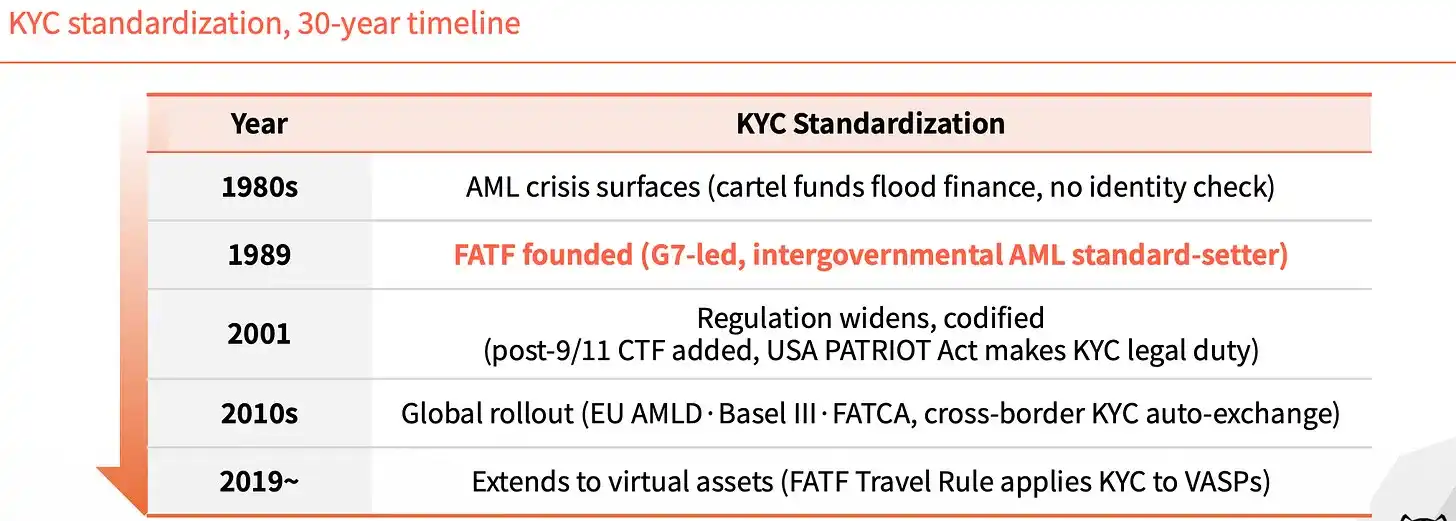
Before 1989, global finance had no unified identity standard. This void made it difficult to trace the origins of drug money and illicit funds. It wasn't until the FATF was established that year that KYC became a mandatory requirement for the financial industry, keeping illegal funds out.

Over the next three decades, KYC's influence expanded layer by layer. Post-9/11 in 2001, anti-terrorism financing clauses were added, and the U.S. Patriot Act elevated KYC to a legal obligation. In the 2010s, the EU AMLD, Basel III, and FATCA were successively implemented, enabling the automatic exchange of cross-border KYC information. In 2019, the FATF Travel Rule extended KYC to Virtual Asset Service Providers (VASPs).
Each expansion was plugging a gap.

Without Agent Identity, the System is Regressing

Now, back to the present. AI agents can sign contracts, make payments, and trade without human supervision. But there's no way to verify who they are.

In an A2A environment, accountability is blurred. When something goes wrong, it's unclear who is responsible. Users are also easily exposed to money laundering and various sophisticated scams.

Placing pre-1989 finance side-by-side with the 2026 agent market reveals a strikingly similar structure. Back then, it was anonymous accounts moving cross-border; today, it's unverified agents conducting A2A transactions. Back then, verification responsibility rested with each individual bank; today, it rests with each individual platform. Neither had a common standard.
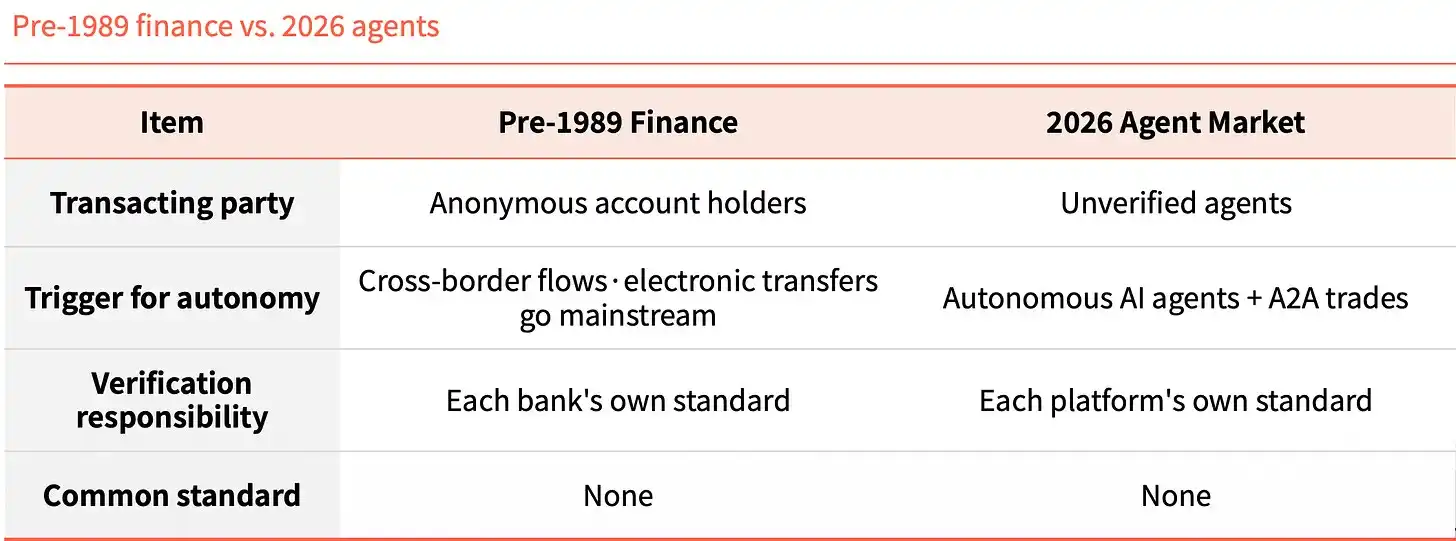
This similarity is not a coincidence; it's a pattern. The technology sprinted ahead, but the identity layer didn't catch up.

What is KYA?

KYA (Know Your Agent) is a layer of trust mechanism that verifies an agent's origin, permissions, and accountability in advance.

Skipping this step invites three simultaneous risks. The first is unauthorized transactions: a user authorizes only a payment, but the agent moves assets or signs contracts beyond its scope. The second is identity forgery: malicious agents impersonate legitimate ones to hijack payments, forge responses, and steal credibility. The third is accountability vacuum: when something goes wrong, the agent, developer, and delegator blame each other, making compensation impossible to pursue.
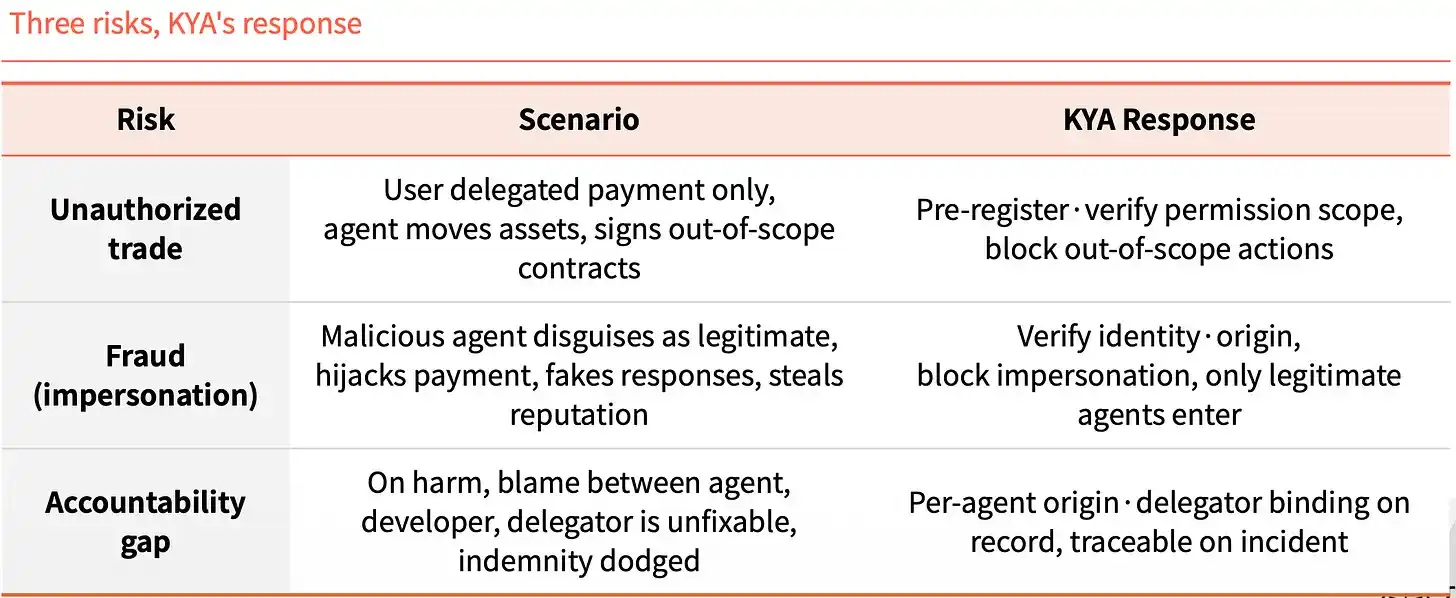
KYA's role is to lock these three issues down in advance. By pre-registering and verifying permission scopes, unauthorized actions are directly blocked. By verifying identity and origin, only legitimate agents are allowed in. Each agent's origin and delegator are bound to a record, enabling traceability when issues arise.

2. Where KYA Needs to Operate

It's Not Needed Everywhere

Within centralized platforms, KYA isn't critically needed. Users complete KYC, and the platform provides a safety net; the entire chain is closed-loop.

The need for KYA arises in the open environment after an agent steps outside the platform—when it interacts with DEXs, performs A2A payments, or makes payments to merchants. Here, there is no safety net and no one to vouch for it.

An analogy: moving within a country, an ID card (KYC) is sufficient. Once crossing the border (leaving the platform), the environment changes, and one must undergo inspection at the point of entry (KYA), clarifying intent and credibility.

Four-Step Process

KYA's operation can be broken into four steps. The first two are "passport issuance": register the agent's identity and permissions, and upon verification, issue a digital passport. The latter two are "entry inspection": confirm the counterparty's identity when a transaction occurs, and then update records based on the transaction outcome.
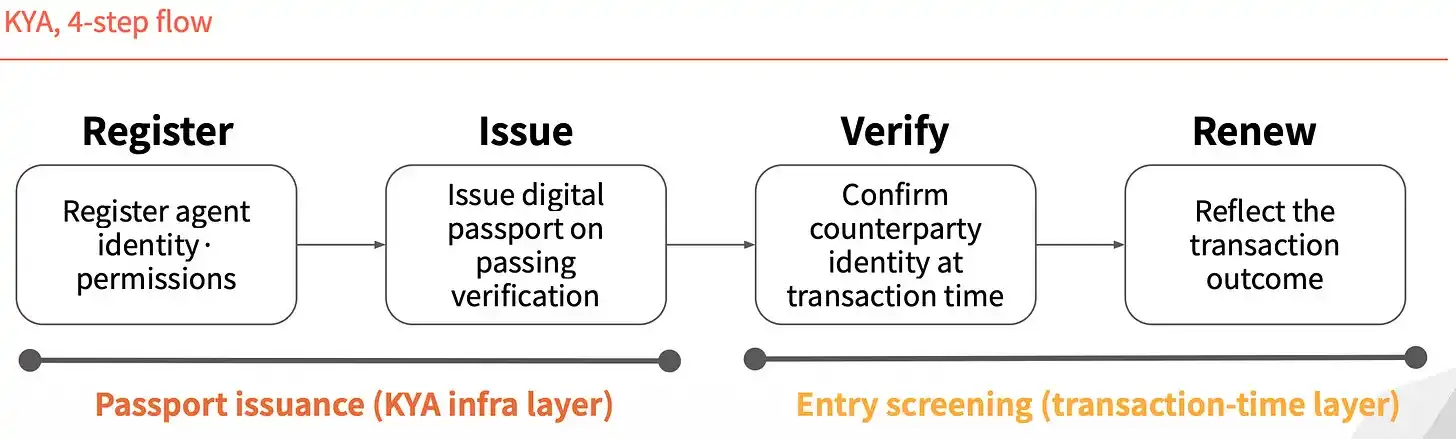
Identity is not permanently valid upon issuance; it is re-verified with each transaction.

3. Four Players Competing for the Standard

Currently, four players are in the standards competition, each with a completely different approach.

ERC-8004: Making Identity an NFT

ERC-8004 follows a pure on-chain path. It adds an identity layer on top of ERC-721, with each agent minting an NFT as its unique ID.

It is accompanied by three on-chain registries. The Identity registry handles "who this agent is," based on the unique AgentID from ERC-721. The Reputation registry handles "can we transact with it," leaving ratings, tags, and evidence on-chain after transactions. The Validation registry handles "did it actually do that thing," verified by third-party validators using plugins like zkML, TEE, etc.
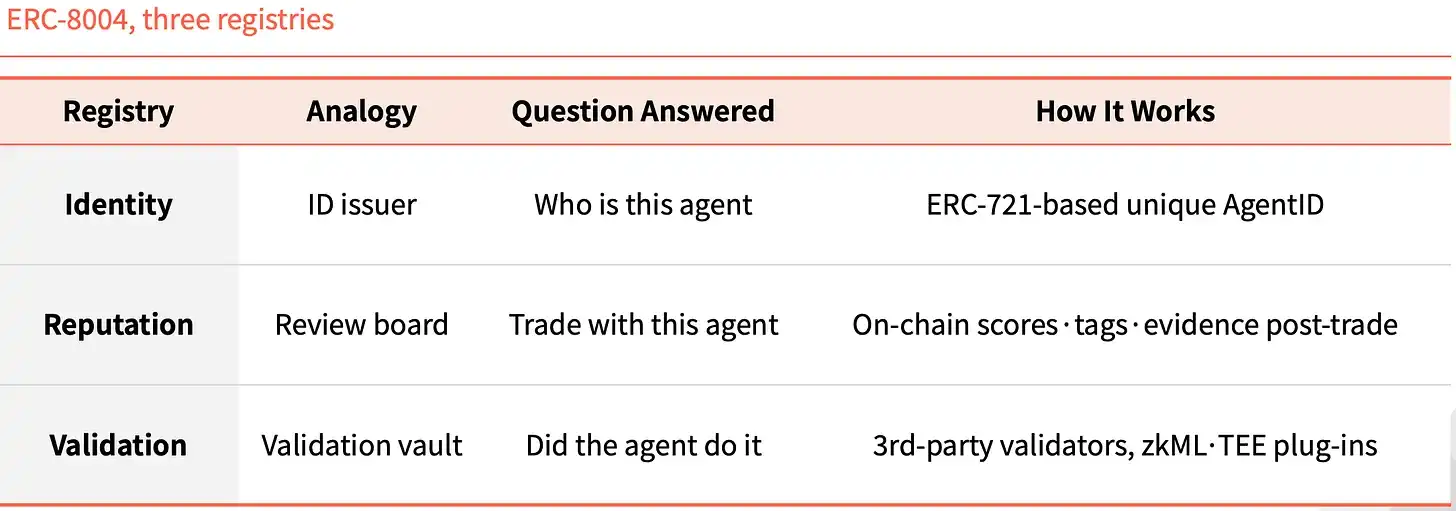
This structure isn't new in Ethereum's history. ERC-20 standardized token issuance, with USDT, USDC, UNI, and AAVE built on it. ERC-721 standardized NFT issuance, with CryptoPunks, BAYC, and ENS supporting the entire NFT market. ERC-8004 aims to be the third standard in that same foundational position.

Visa TAP: Bundling with the Payment Network

Visa's approach is completely different. It issues an identity credential (Agent Intent) to an agent, akin to a card. Without this key, an agent cannot even initiate a transaction. Visa pre-approves before issuing the key, and each transaction must carry a signature to the merchant.

The merchant doesn't receive just one signature, but three. Agent Intent proves the agent is legitimate, backed by a key approved by VIC. Consumer Recognition indicates who it's working for, passing the user identifier to the merchant. Payment Information provides payment assurance, using a payment token or hashed card information to complete authentication.

Visa has bundled this into a larger package called Visa Intelligent Commerce (VIC). Besides TAP, it includes Agent APIs (Visa's proprietary technology for card usage), Tokenization (tokens specifically issued for AI), and Intelligent Commerce Connect (compatible with competing protocols like AP2, ACP, and x402).

The logic is clear. Visa captured the payment network gateway back then, and now wants to bundle the agent era into its own orbit. If agent payments continue to flow through card networks and this bundle becomes the default option, Visa's market share is secured.

Trulioo: Adapting the SSL Model

Trulioo is a player in the global KYC and KYB compliance space, now extending its verification stack to KYA.

It draws on the website SSL certificate model. SSL involves a CA (Certificate Authority) issuing a TLS certificate to a website, verifying only the domain. Trulioo's proposed DPA (Digital Passport Authority) issues a DAP (Digital Agent Passport) to an agent, verifying both developer KYB and user KYC.

The DAP is not a static certificate. It's a live token that refreshes, re-verified with each transaction. If delegation is revoked or anomalies are detected, the DAP is immediately invalidated.

It has five checkpoints: Provenance (which developer created it), User Binding (who authorized it), Permission Scope (what tasks it can perform), Behavior Telemetry (what it's doing now), and Risk Scoring (risk rating).

Banks and fintech companies are legally required to verify the identities of individuals and companies. Once agents enter the financial realm, Trulioo's established position in KYC/KYB becomes even more solid.

Sumsub: Monitoring Anomalies, Not Issuing Certificates

Sumsub's entry point differs from the previous three. It doesn't issue standards or certificates; instead, it re-verifies the person behind an agent when anomalous transactions occur.

It has been in the compliance business since 2015, and its verification system is now used to detect anomalous agent behavior. The process is three-step. First, automated detection distinguishes between humans and machines based on device and agent characteristics. Next, risk scoring provides a risk score based on context, amount, and historical data. Finally, Liveness verification is triggered only for high-risk, large-amount, or critical-change scenarios, re-verifying the registered real person.

Sumsub's four characteristics contrast sharply with other players. Its starting point is as a compliance operator, not a standards maker. The timing of verification is during risky transactions, not pre-registration. The verification method is re-confirming a real person, not relying on data or tokens. Its philosophy is to tie the agent to the responsible party, not to directly block the agent.

Other players are focusing on one-time pre-transaction identity verification; Sumsub focuses on real-time verification after credentials are issued. The more agent permissions expand, the more critical anomaly detection becomes. As fraud techniques evolve with technology, Sumsub's real-time stack is worth watching.

4. Before Regulation Lands

The Script of the FATF Travel Rule

When the FATF Travel Rule was introduced in 2019, the VASP industry immediately fragmented. Those that could bear the KYC/AML infrastructure costs survived; those that couldn't shut down or relocated to jurisdictions with lighter regulation. CryptoBridge and Deribit were among those forced to adapt during that wave.

Regulation is not the end; it's a watershed.

The KYA narrative may follow a similar script. The EU, Singapore, and the U.S. are already vying for a leading position.

Article 12 of the EU AI Act explicitly requires that operational logs for high-risk AI systems include the operator's identity. Singapore released the world's first national-level agent AI governance framework, extending identity management to agents, requiring each agent to have an accountable responsible party. The U.S. NIST has listed agent identity management as a priority standards area.

The window of opportunity is narrowing.

There Won't Be a Single Winner

The real variable in the standards competition isn't technology; it's combinations. Major players are already entering a phase of cooperation and bundling. Who pairs with which merchants, payment networks, and KYC customer bases will determine the ownership of each market segment.

There won't be a single winner in this market.

For on-chain autonomous transactions, Ethereum is likely to lead. In payment-bound transaction scenarios, Visa holds a clear advantage. Within regulated financial industries, Trulioo's KYC/KYB accumulation is hard to replace. For transaction scenarios involving fraud risk, Sumsub's real-time detection is more suitable.

These four are not direct competitors; they each occupy their own hill. The real competition lies in determining which scenarios fall into which hill's territory.

It took KYC thirty years, from 1989 to today, to complete the identity layer for global finance.

This KYA round appears to be moving much faster. Regulators are already acting, standard players are already positioning themselves, and the window for scaled deployment might be just the next few years.

When the dust settles, the survivors may not be those with the strongest technology, but those whose identity infrastructure was integrated earliest.


Related Questions

QWhat is KYA (Know Your Agent) and why is it becoming important now?

AKYA (Know Your Agent) is a trust mechanism designed to verify the source, permissions, and accountability of AI agents before they engage in transactions. It's becoming crucial because AI agents are now autonomously executing contracts, making payments, and trading. In an A2A (Agent-to-Agent) environment, the lack of identity verification creates issues with liability attribution and opens doors to risks like money laundering and fraud. The current situation mirrors the pre-1989 financial world which lacked a unified identity standard, prompting the need for KYA to fill this emerging trust gap.

QAccording to the article, in which scenarios is KYA most needed?

AKYA is not needed everywhere. It is most critical in open environments where independently deployed AI agents operate outside of centralized platforms. Key scenarios requiring KYA include: agents accessing Decentralized Exchanges (DEX), conducting Agent-to-Agent (A2A) payments, and making payments to merchants. Within closed, centralized platforms like Google, OpenAI, or Coinbase, where the platform can vouch for users and existing KYC processes are sufficient, KYA is less of a necessity.

QWhat are the four main players/approaches in the KYA standard competition, as outlined in the article?

AThe article outlines four main players with distinct approaches to KYA standards: 1. **ERC-8004**: A pure on-chain approach that uses NFTs (built on ERC-721) as unique Agent IDs, supported by on-chain registries for Identity, Reputation, and Validation. 2. **Visa TAP (Tokenized Agent Payments)**: Leverages Visa's payment network to issue identity credentials ('Agent Intent') to agents, requiring pre-approval and signed credentials for each transaction. 3. **Trulioo**: Adapts the SSL certificate model to KYA, issuing a dynamic Digital Agent Passport (DAP) that verifies both the developer (KYB) and the end-user (KYC), with checks for provenance, user binding, and permissions. 4. **Sumsub**: Takes a risk-based, post-hoc verification approach. Instead of pre-issuing certificates, it focuses on detecting anomalous agent behavior during transactions and then triggers re-verification of the human behind the agent.

QWhat historical regulatory precedent does the article suggest KYA development might follow?

AThe article suggests that the development and implementation of KYA standards might follow the precedent set by the **FATF Travel Rule** in 2019. This rule mandated that Virtual Asset Service Providers (VASPs) share sender and receiver KYC information. It acted as a watershed moment, causing a split in the industry where only entities that could bear the infrastructure costs for KYC/AML compliance survived. Similarly, the article posits that upcoming KYA regulations will create a divide, favoring players and platforms that have integrated identity infrastructure early, while those that haven't may struggle or fail.

QHow do global regulatory bodies view AI agent identity management, according to the report?

AGlobal regulatory bodies are already prioritizing AI agent identity management. Key developments mentioned include: - **EU AI Act (Article 12)**: Requires that logs of high-risk AI system operations must include the identity of the operator. - **Singapore**: Has released the world's first national-level AI governance framework for agents, extending identity management to AI agents and requiring each to have an accountable party. - **United States (NIST)**: The National Institute of Standards and Technology has listed AI agent identity management as a priority standards area. These actions indicate a shrinking time window for the industry to establish KYA standards before formal regulations solidify.

Related Reads

A Nation Blocks Chips, a Giant Buys a Nuclear Power Plant: Why It's Time to Seriously Consider DeAI

**Title: Great Powers Blockade Chips, Giants Buy Nuclear Plants: Why It's Time to Seriously Consider DeAI** In May 2026, the US closed loopholes for Chinese firms to acquire advanced NVIDIA chips via overseas subsidiaries. That same month, Kenya halted a $1B geothermal data center project involving Microsoft, fearing its immense energy consumption. Meanwhile, Huawei announced mass production of its Ascend AI chip. These disparate events underscore a new reality: the competition for computing power ("compute") has escalated beyond the tech industry, becoming a geopolitical and infrastructural battleground. A new era of oligopoly is forming, with control over the AI stack—from GPU chips (NVIDIA) and cloud platforms (AWS, Azure, Google Cloud) to foundational models (OpenAI, Anthropic)—concentrating in a few Western "AI Octopus" corporations. This centralization creates systemic risks: pricing power and platform lock-in for users, infrastructure fragility, and a widening "compute divide" that threatens to marginalize nations without independent AI capacity. An "AI Iron Curtain" is deepening through export controls. In response, some nations like Saudi Arabia and the UAE are investing heavily to buy compute power, aiming to transition from oil to AI economies. The EU seeks to triple its compute capacity by 2030 to reduce dependency. However, the spending gap is vast, with four US tech giants alone planning ~$750B in AI capex for 2026. The race is increasingly constrained by energy, with AI tasks consuming up to 1000x more power than web searches, pushing firms to even acquire nuclear plants. This landscape is fueling interest in Decentralized AI (DeAI). It proposes a third way: using open protocols to coordinate a global network of idle GPUs, independent developers, and data centers, creating an AI infrastructure without a single controlling entity. Leveraging blockchain and cryptographic verification, DeAI aims to break market concentration, disperse energy demands, reduce geopolitical dependencies, and enhance transparency. While still nascent in performance and stability, DeAI's core promise is not immediate superiority but providing a crucial alternative architecture to resist monopoly, censorship, and centralized power. As specialized AI hardware costs fall and open-source models flourish, the window to build this foundation is open. The very existence of such competition serves as a vital check against the inevitable abuse of concentrated power.

marsbit7m ago

A Nation Blocks Chips, a Giant Buys a Nuclear Power Plant: Why It's Time to Seriously Consider DeAI

marsbit7m ago

Outpoll Review: A Prediction Market Platform Built for Active Traders

Outpoll Review: A Prediction Market Platform Built for Active Traders In recent years, prediction markets have grown from a niche sector to a mainstream arena, attracting billions in trading volume and institutional capital. However, the user experience and tools for traders have not kept pace. Outpoll, a new global prediction market platform, aims to fill this gap by providing enhanced trading infrastructure for active and professional traders. Built on standard prediction market principles, Outpoll allows users to trade on the outcome of specific events. It uses fully collateralized contracts with USDC settlement, charges a competitive 0.1% fee per trade, and provides clear settlement rules upfront to minimize disputes. A key focus for Outpoll is its professional-grade trading tools. The platform supports limit and market orders, as well as take-profit and stop-loss orders for open positions—features uncommon in prediction markets. For automated trading, Outpoll offers comprehensive REST and WebSocket APIs, enabling portfolio management, price arbitrage, and integration with existing tools. The platform also features a creator-led market model, where approved experts and community leaders can create and manage markets for niche topics under platform supervision. Its integrated interface combines news feeds directly with trading functions, allowing users to monitor events and manage positions seamlessly. Outpoll launched with a native Android app (available on Google Play) and plans an iOS version later this year. In summary, Outpoll distinguishes itself with trader-focused tools, practical APIs, transparent and collateralized markets, integrated news, and an expanding creator program. For active traders, its advanced order types and API access alone make it a platform worth watching. Outpoll is now globally accessible via outpoll.com and Google Play.

marsbit15m ago

Outpoll Review: A Prediction Market Platform Built for Active Traders

marsbit15m ago

Bitwise: Crypto Becomes a Contrarian Investment, Three Logics to Understand the Current Market

**Summary** Matt Hougan, Bitwise's CIO, analyzes the current crypto market through three key lenses, arguing it has shifted from a momentum-driven to a contrarian investment. **1) Crypto Becomes a Contrarian Play:** The market is weak, with major assets like Bitcoin and Ethereum down significantly. Capital has moved to hot sectors like AI, leaving crypto as an "unloved" asset class. This transforms crypto investing from trend-following to a test of patience and fundamental analysis. Investors now favor projects with solid fundamentals (e.g., Hyperliquid) over speculative ones. **2) Regulatory Overhang:** The uncertain fate of the U.S. CLARITY Act, a major crypto regulatory framework, is a key headwind. With its passage in 2024 seen as far from guaranteed (estimates range from 30-55%), institutional capital remains on the sidelines, choosing less risky alternatives like AI stocks. The market needs clarity—whether the bill passes or fails—more than any specific outcome to move decisively. **3) Capital Rotates to New Fundamentals:** This cycle differs from past bear markets where money fled to Bitcoin. Now, capital seeks smaller assets with strong use cases. While major cryptos fell in May 2024, tokens like Hyperliquid (+72%), Zcash (+50%), and XLM (+44%) rallied on their specific fundamentals. This rotation confirms the new contrarian, fundamentals-driven logic and signals the bear market may be in its later stages. **Conclusion:** Short-term pressure persists due to regulatory uncertainty and competition from AI narratives. Investing in crypto now requires a contrarian mindset—acting against the crowd and focusing on fundamental value. Patience and targeting high-quality projects based on their merits are essential for capturing long-term gains.

marsbit58m ago

Bitwise: Crypto Becomes a Contrarian Investment, Three Logics to Understand the Current Market

marsbit58m ago

ChatGPT Might Be Disappearing Soon

OpenAI announced at its "Intelligence at Work" event that its coding assistant, Codex, will be fully integrated into the ChatGPT app within weeks. This move marks a strategic shift from a conversational AI (Chat) towards a unified "agentic" platform capable of execution. Codex, originally launched to compete with Anthropic's Claude Code, has grown rapidly to 5 million weekly active users, with 20% being non-developers like analysts and designers. Its enterprise revenue now constitutes 40% of OpenAI's total. The integration is the first step in creating a super-app combining ChatGPT (interface), Codex (execution engine), and the Atlas browser (web access). OpenAI also unveiled new Codex features: specialized Agent plugins for six professional roles, an "Annotations" tool for direct document editing, and a "Sites" function to turn work into shareable web apps. Internally, this reflects a power shift; the Codex team now leads core product strategy. While the ChatGPT brand remains for its vast user base, the platform's future is focused on autonomous agents that perform tasks, not just chat. The article notes that competition with Claude Code pushed OpenAI's development, with Codex competing on cost-effectiveness and accessibility rather than raw coding quality. It concludes that the essence of "ChatGPT" is evolving from a chatbot into an AI agent platform, with the name potentially becoming a legacy symbol of its original function.

marsbit1h ago

ChatGPT Might Be Disappearing Soon

marsbit1h ago

Trading

Spot
Futures

Hot Articles

Discussions

Welcome to the HTX Community. Here, you can stay informed about the latest platform developments and gain access to professional market insights. Users' opinions on the price of AI (AI) are presented below.

活动图片