This Could Be the AI-Powered Siri We Get

marsbitPublished on 2026-05-29Last updated on 2026-05-29

Abstract

Apple is set to unveil a major overhaul of Siri at its upcoming WWDC event, marking its most significant update since the AI assistant's debut in 2011. Faced with criticism for lagging behind competitors like ChatGPT and Google Gemini, the new Siri will feature a completely redesigned interface with a dark theme and chatbot-style interaction, deeply integrated with the Dynamic Island. Key upgrades include persistent conversation memory, addressing a long-standing user complaint. Most notably, Apple will reportedly allow third-party AI models, such as Google Gemini and Anthropic's Claude, to be integrated directly into Siri, transforming it into an AI model distribution platform. This strategic shift positions iOS not as having the single best AI model, but as the best platform for accessing and utilizing various AI models through superior system-level integration. Apple's approach leverages its strengths in hardware-software integration, privacy, and access to user data (contacts, calendar, photos) to create a differentiated experience, even while potentially relying on external infrastructure like Google's for some queries. This move represents a calculated bet that the ultimate AI advantage lies not in having the most powerful model, but in which system can integrate and utilize AI most seamlessly for the user. The success of this strategy will be tested by whether the new Siri can win back users who have grown accustomed to more advanced standalone AI tools.

Once again, Apple's WWDC is just around the corner. For Apple, the most important thing is not just the farewell speech by 'old leader' Tim Cook, but the urgent need to answer the world's expectations for 'AI'.

Apple must confront its most embarrassing question of the past three years—why does the world's most expensive smartphone come with the dumbest AI assistant?

On May 28th local time, ten days before the event, foreign media provided a glimpse of the answer.

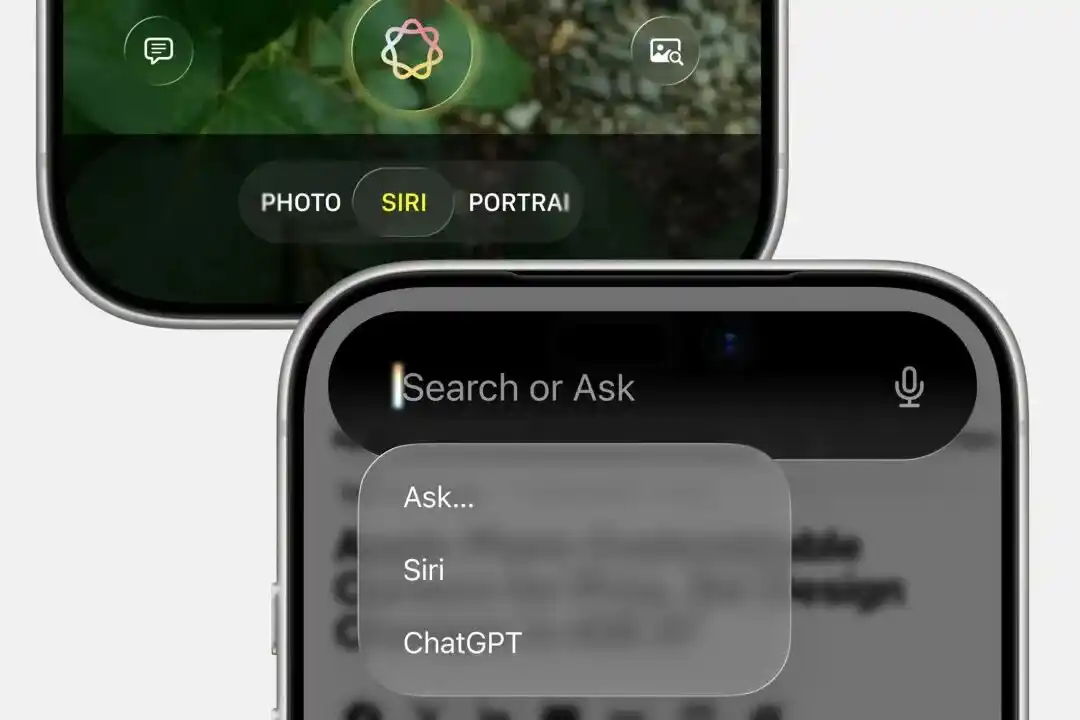
Reportedly, the scale of this Siri revamp is unprecedented since Siri's debut with the iPhone 4S in 2011. The new interface adopts a dark color scheme, is rebuilt with a chatbot interaction paradigm, and is deeply integrated with the Dynamic Island.

More crucially, Apple will allow users to directly 'plug in' Google's Gemini and Anthropic's Claude into the Siri experience—Siri is set to become a distribution platform for AI models.

Everyone will wonder, what will Siri infused with AI actually look like?

01. A Complete Interface Overhaul

According to a Bloomberg report, the new version of Siri has several core changes. Looking at them together reveals Apple's complete logic.
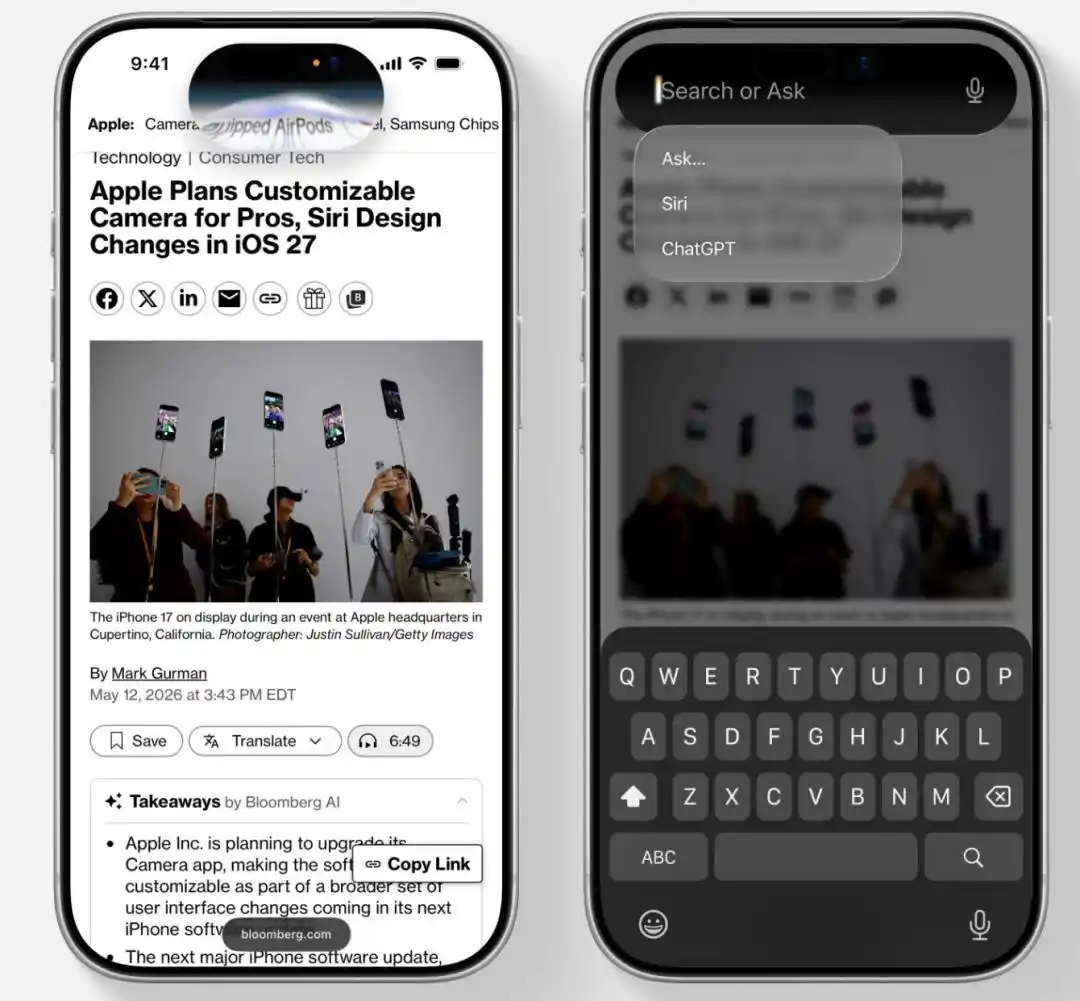
Possible Siri and Dynamic Island fusion interaction | Image source: Instagram

The first is a complete interface rebuild. A chatbot-style interaction interface, dark color scheme, Dynamic Island integration—Siri transforms from a 'pop-up layer' into an independent application experience entry point. This is more than a visual upgrade; it importantly implies that Apple wants users to treat Siri as a tool they 'actively use', not a voice command line occasionally summoned.

The second is conversational persistence. For years, one of the biggest pain points of talking to Siri was its lack of memory. Every wake-up started from zero—no context, no continuity. The new Siri reportedly fixes this issue—it sounds like a small thing, but it's the foundational condition for the 'assistant' feeling to be valid.

The third, and most noteworthy, is the 'Extensions framework'—allowing third-party AI models to plug into Siri.

The deeper implication of this design is that Apple is no longer taking 'building the best AI model' as its sole path, but rather repositioning iOS as 'the platform for the best AI models to compete'. Just as the App Store doesn't require Apple to develop all apps itself, the new Siri ecosystem doesn't need Apple to outperform everyone in model capabilities—it just needs to bring in all the models and retain users through system-level integration.

Put simply, Apple is fighting the 'model' war with a 'platform' logic.

02. Siri's Three Years of Debt

To understand the weight of this revamp, one must first understand how passive Apple has been in recent years.

In 2023, ChatGPT burst onto the scene, redefining 'conversational AI'. In 2024, Google embedded Gemini into Android, and Samsung turned AI features into selling points. The entire industry accelerated at a breakneck pace, and what was Siri doing? It was still misunderstanding user commands, still interpreting 'set an alarm for 8 AM tomorrow' as opening the alarm app.

Apple, of course, hasn't been idle. At WWDC 2024, Apple Intelligence debuted with great fanfare, promising a host of deeply integrated AI features. But the reality is that many features were either delayed, available only in specific regions, or their actual experience fell far short of the on-stage demos. A long-time Apple tech analyst bluntly stated, 'This doesn't feel like a finished comeback; it feels more like Apple finally arrived at the AI race—only to find itself still in mid-development.'

After three years of accumulated disparity, Apple desperately needs a true turnaround victory.

Two days ago, Apple quietly launched the subdomain genai.apple.com. This small move created significant ripples in tech circles—many interpreted it as a signal that Apple is making final public relations preparations for this WWDC's 'AI transformation'.

03. The Must-Answer Conundrum

But there is a paradox here, already being discussed by many media outlets.

One of Apple's long-standing core moats is privacy. 'Your data is processed only on your device' is Apple's core promise to users and the reason for architectures like Private Cloud Compute.

Now, to make Siri more powerful, Apple is planning to introduce Google's infrastructure to handle some AI queries.

This isn't a technical problem; it's a trust problem.
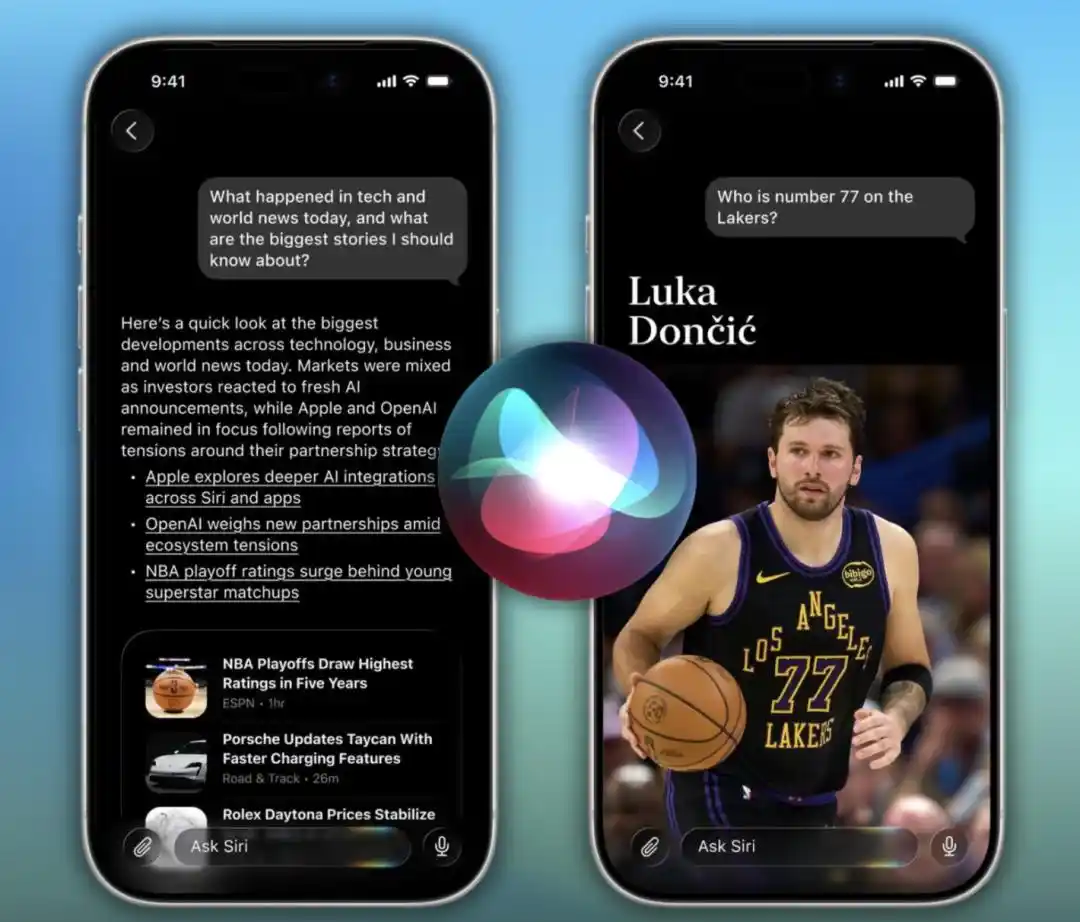
Possible Siri Q&A interface | Image source: Instagram

When Apple personally breaks the red line of 'only using its own computing infrastructure', its privacy promise to users is no longer absolute. Users can, of course, choose not to use the Google Gemini integration, but 'can choose not to use' and 'doesn't touch by default' are two entirely different things. How Apple explains this shift to users during the keynote will be one of the most-watched details on June 8th.

Furthermore, there's an even more fundamental question. A user on Reddit asked a simple but pointed question—if the Claude inside Siri offers the same experience as using Claude directly, why would I use a shelled version?

Apple must provide a compelling answer, and currently, there seems to be only one candidate—system-level integration: an AI that can access contacts, calendar, photos, health data is a completely different experience from an AI that runs in isolation.

This is Apple's last and most important bargaining chip.

While there is much criticism of Apple's AI pace, a counter-narrative is also circulating—maybe Apple is slow because it's waiting for others to step on the landmines first.

Over the past two years, OpenAI, Google, and Meta have invested hundreds of billions of dollars in data centers, chips, and model training, raising concerns about an AI bubble. In contrast, Apple's strategy seems to be: don't rush to build the 'strongest model', but once the track stabilizes, use its core strength of 'system integration' to catch up from behind.

To some extent, the iOS 27 layout is fulfilling this logic. Don't compete head-on in model capability, but bring in both Gemini and Claude, then build differentiated experience moats using capabilities Android cannot replicate, like the Dynamic Island, personal data permissions, and on-device processing.

This isn't a hasty catch-up by a laggard; it's a calculated bet.

The bet is: the endgame of AI is not about whose model is strongest, but whose system uses models most seamlessly.

On June 8th, Apple will present its complete answer. Whether Siri can truly impress users already accustomed to ChatGPT and Gemini will be the real test of this high-stakes gamble.

Fifteen years later, Siri owes its users an explanation.

*Cover image source: Instagram

This article is from the WeChat public account "GeekPark" (ID: geekpark), author: Hua Lin Wu Wang


Related Questions

QWhat is the most significant change to Siri's interface according to the article?

AThe most significant change is a complete rebuild of Siri's interface, adopting a chatbot-style interactive interface with a dark color scheme and deep integration with Dynamic Island. This transforms Siri from a pop-up layer into an independent application experience entry point.

QWhat is one of the biggest historical shortcomings of Siri that the new version aims to fix?

AOne of the biggest historical shortcomings is Siri's lack of conversational persistence. Siri did not remember context from previous interactions, forcing users to start from scratch with each new request. The new version reportedly fixes this by introducing memory and continuity to conversations.

QHow is Apple's strategy for the new Siri described in relation to competing AI models?

AApple's strategy is described as positioning iOS as a 'platform for the best AI models to compete.' Instead of solely trying to build the best AI model itself, Apple is introducing an 'Extensions framework' to allow third-party AI models like Google Gemini and Anthropic's Claude to be integrated into Siri. This approach uses a 'channel' logic to compete in the 'model' war.

QWhat privacy paradox does Apple face with the new Siri, according to the article?

AApple faces the paradox of needing to utilize external AI infrastructure, like Google's, to enhance Siri's capabilities, which may conflict with its long-standing core promise of user privacy that emphasizes on-device data processing. This move challenges Apple's principle of 'only using its own computing infrastructure' and raises a user trust issue that Apple must address.

QWhat is described as Apple's 'final and most important chip' in creating a differentiated AI experience?

AApple's 'final and most important chip' is its system-level integration. The ability of its AI to access and utilize personal data from contacts, calendar, photos, and health data—coupled with features like Dynamic Island and on-device processing—creates a fundamentally different experience compared to isolated AI models, which Android cannot easily replicate.

Related Reads

Why More AI Agents Does Not Equal Higher Productivity?

Editor's Note: As AI Agents become cheaper and easier to use, a new constraint emerges: the cost isn't in launching more Agents, but in the human attention required to manage, judge, and integrate their outputs. This hidden cost is called the "orchestration tax." The article argues that a developer's cognitive bandwidth is the key bottleneck—a serial, non-parallelizable resource akin to a Global Interpreter Lock (GIL). While many Agents can run concurrently, their results ultimately require human judgment for review, conflict resolution, and final integration. Therefore, more Agents don't automatically mean higher productivity; they can simply create longer queues, lead to cognitive fatigue, and create the illusion of busyness without real output. The core solution is to design workflows around this scarce human attention. Key strategies include: scaling the number of Agents to match review capacity (not UI capacity), categorizing tasks (delegating independent ones, keeping complex judgment-heavy ones serial), batch reviewing results to minimize context-switching costs, automating verifiable checks to reserve human judgment for critical decisions, and protecting focused, uninterrupted thinking time. Ultimately, the critical skill is not launching many Agents, but architecting systems that respect the fundamental limit of human attention. Unpaid "orchestration tax" accumulates as both technical and cognitive debt, undermining system understanding and quality. True productivity comes from thoughtfully managing the single-threaded resource—your focus.

marsbit1h ago

Why More AI Agents Does Not Equal Higher Productivity?

marsbit1h ago

Three Years Later: Looking Back at My Predictions About ChatGPT in 2023

Three Years Later: Revisiting My 2023 Predictions on ChatGPT In March 2023, shortly after ChatGPT's launch, I made 20 predictions about its future. Now, in mid-2026, I've used AI agents to fact-check each one against the latest data. Overall, most major directional forecasts were correct, with only one outright error (incorrectly stating GPT-4 had 100 trillion parameters). Key successes included predicting that RAG and retrieval architectures would become the standard for handling knowledge and hallucinations, that natural language interfaces (LUI) would create a massive new industry layer beyond the models themselves, and that China would develop viable large language models, significantly closing the performance gap with Western counterparts within about three years. Predictions about the absence of mass unemployment, the rise of a new "robot network" for agent communication, and ChatGPT not possessing consciousness also held true in their core arguments. However, the "devil was in the details." Errors frequently involved specific numbers, timelines, or overlooking distributional effects. I tended to overestimate the speed of adoption (e.g., for agent networks) while underestimating the ultimate scale of capabilities or costs (e.g., AI winning IMO gold without tools, or the extreme capital required for frontier models). Other misjudgments included: underestimating how AI would reinforce, not dissolve, information filter bubbles; incorrectly assuming AI-generated content would easily circumvent copyright (it has instead triggered record-breaking settlements); and misidentifying where value would be captured (it accrued overwhelmingly to the compute layer, like Nvidia, not just the application or model layers). Key lessons from reviewing these predictions are: 1) Directional and mechanistic insights are far more reliable than precise numbers or absolute statements. 2) There's a consistent bias to overestimate short-term speed but underestimate long-term magnitude. 3) Errors often lie in missing distributional impacts within a generally correct aggregate trend. 4) Predictions phrased with nuance and caveats aged the best. 5) Some fundamental debates (e.g., on machine consciousness or the ultimate value chain) remain unresolved even after three years. This exercise is less about scoring the past and more about establishing rules for clearer thinking about the next three years of AI.

marsbit7h ago

Three Years Later: Looking Back at My Predictions About ChatGPT in 2023

marsbit7h ago

Three Years Later: Looking Back on My 2023 Predictions for ChatGPT

Looking Back After Three Years: Revisiting My 2023 Predictions on ChatGPT In March 2023, shortly after ChatGPT's debut and before GPT-4's release, I made over twenty predictions about AI's future based on limited information and intuition. Now, in May 2026, I revisited those forecasts using an AI-driven analysis with 41 Opus 4.8 agents to cross-reference them with the latest data. The assessment used symbols: ✅ Correct, 🟢 Mostly Correct, 🟡 Partially Correct, ❌ Incorrect. Overall, the directional judgments held up well, with only one major factual error regarding GPT-4's rumored parameter size (incorrectly cited as 100T). However, nuances and degrees of accuracy revealed more. **What Was Largely Correct:** Predictions about mechanisms and directions proved accurate. The rise of RAG (Retrieval-Augmented Generation) as the standard architecture for combating AI hallucination was confirmed, as was the transformative potential of LUI (Language User Interface) in creating a new industry layer atop GUIs. The emergence of "robot networks" (agent-to-agent communication protocols) and China's rapid catch-up in developing capable large models (closing the performance gap with top models to ~2.7%) were also on point. The analysis affirmed that LLMs lack consciousness and that the Turing Test merely measures perceived intelligence. **What Was Off Target:** Errors often involved specific numbers, over-optimistic timelines, or misjudged distributions. The prediction that value would primarily accrue to the application layer was half-right but missed NVIDIA's dominance as the profitable infrastructure layer. Forecasts about AI circumventing copyright issues and fostering a "global common ground" by averaging human viewpoints were incorrect; instead, major copyright settlements occurred and AI personalization is increasing. Estimates for model training costs ("$5-10 billion cap") were significantly off, underestimating frontier costs and overestimating replication costs. The notion that LLMs could never do complex math without tools was disproven by later models winning IMO gold. **Key Patterns from the Review:** 1. **Direction over precision:** Judgments about mechanisms and trends were more reliable than specific numbers or definitive statements. 2. **Timing bias:** There was a tendency to overestimate short-term speed but underestimate long-term magnitude and transformation. 3. **The distribution blind spot:** Aggregate-level correctness often masked uneven impacts (e.g., on young professionals' employment). 4. **The value of qualifiers:** Predictions framed with caution (e.g., "reportedly," "for now," "prototype in 2-3 years") aged better. 5. **Some debates continue:** Issues like the nature of "emergent abilities" or machine consciousness remain unresolved. This three-year review highlights that while seeing the big picture is crucial, humility regarding specifics, timelines, and disparate impacts is essential for future forecasting.

链捕手10h ago

Three Years Later: Looking Back on My 2023 Predictions for ChatGPT

链捕手10h ago

AI Bubble Warning: AI Investments Are Negative Returns for Most Tech Giants

The article issues a stark warning about a potential AI investment bubble. It notes that while the AI boom shares similarities with the TMT bubble of the late 1990s, its scale is vastly larger, currently driving 93% of U.S. GDP growth. Major hyperscale cloud providers like Microsoft, Alphabet, Amazon, Meta, and Oracle are planning to invest trillions in AI data centers over the coming years. However, calculations based on analyst projections for 2025-2030 reveal a concerning math problem: expected capital expenditure growth far outpaces projected revenue growth. Even under an extremely optimistic scenario of zero costs, the implied return on investment for most of these tech giants (except Amazon) is deeply negative. This suggests that the current trajectory could lead to one of history's largest shareholder value destruction events. The piece outlines two potential escapes: AI generating vastly more revenue than currently anticipated—a near-impossible task—or a significant cutback in the planned investment splurge. The latter scenario could trigger a domino effect, severely impacting the entire tech supply chain (from Nvidia to TSMC), potentially pushing the U.S. economy into recession, and causing a major stock market downturn. The author suggests upcoming high-profile IPOs by companies like OpenAI and Anthropic might represent a transfer of risk from early investors to public market participants. While the peak of the hype cycle might sustain investment through 2026, the fundamental financial dilemma remains unresolved, setting the stage for a potential market correction in 2027 or 2028, similar to the years following Alan Greenspan's "irrational exuberance" warning.

marsbit11h ago

AI Bubble Warning: AI Investments Are Negative Returns for Most Tech Giants

marsbit11h ago

Trading

Spot
Futures

Hot Articles

Discussions

Welcome to the HTX Community. Here, you can stay informed about the latest platform developments and gain access to professional market insights. Users' opinions on the price of AI (AI) are presented below.

活动图片














