The Robinhood Stock Tokens You Bought Are Just Debts from Jersey Island

Foresight NewsPublished on 2026-07-07Last updated on 2026-07-07

Abstract

The Robinhood stock tokens you buy are essentially debt securities issued by a shell company in Jersey, not real equity. These tokens merely track stock prices like NVIDIA or Apple but grant no shareholder rights like voting or dividends. If the underlying company fails, you have no claim on its assets. Instead, you hold a debt instrument from Robinhood Assets (Jersey) Limited, which promises returns based on stock performance. If this Jersey entity goes bankrupt, you become an unsecured creditor. This complex structure stems from Robinhood's past crisis during the 2021 GameStop short squeeze, where T+2 settlement caused liquidity issues. The blockchain-based tokens enable instant settlement, theoretically preventing such trading halts. The product is classified by the SEC as a "linked security" or structured note, carrying counterparty risk not borne by actual shareholders. It is available globally but excluded from the US, UK, and other major markets, while Robinhood offers a fully compliant, asset-backed token model in Europe under MiFID II. The system relies on oracles for pricing, which poses risks like manipulation and faulty liquidations seen in DeFi exploits. Robinhood profits from spreads and aims to become a full-chain settlement layer. Meanwhile, competitors like Ondo have launched SEC-registered, fully compliant equity tokens in the US with actual voting rights and dividends. Robinhood’s Jersey debt model appears as a transitional, regulatory-arbitrage product, ...


Written by: Thejaswini M A

Compiled by: Luffy, Foresight News


Operating illegal private gambling in barbershops has been against the law for a hundred years. But once run by the state, it becomes a legal lottery. How can one monetize a product that is legally prohibited from direct sale? Capital always flows towards channels that exploit loopholes in the rules.


Last week, Robinhood CEO Vlad Tenev officially launched the company's public chain and stock tokens at a release event themed "The World is Flat." The theme sounds clever, but the so-called stock assets users buy are essentially "castles in the air."


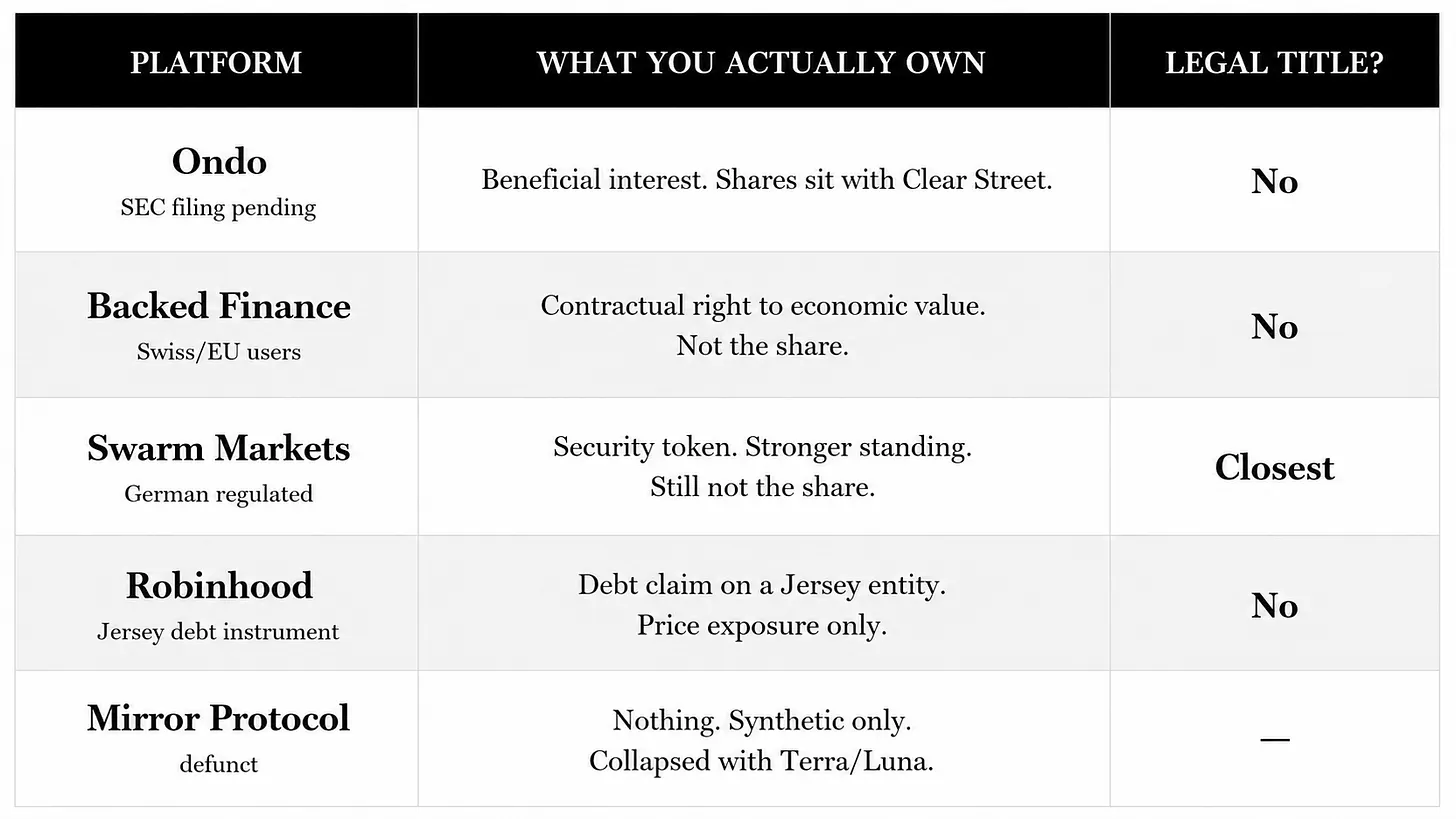
When you buy an Nvidia stock token, you can only track the price fluctuation of Nvidia stock, without enjoying any shareholder legal rights. Once Nvidia collapses operationally, you have no claim on the company's assets. The tokenization model inherently carries such risks. Ondo has already submitted relevant filings to the U.S. SEC, but related regulatory plans remain unresolved.


The truth about Robinhood's product is: what you are buying is not equity, but debt securities.


These debt securities are issued by Robinhood Assets (Jersey) Limited. Users are essentially lending money to this shell company located on the tax haven island in the English Channel. This shell company then pays you returns based on the rise and fall of the corresponding stock price.


Looking back to the June 2025 event in Cannes, Robinhood, to promote the product, distributed free private company stock tokens for OpenAI and SpaceX to European users to attract traffic. Equity in these companies is not publicly available, and ordinary investors have no normal channels to subscribe. After seeing tokens misusing its name, OpenAI publicly issued a risk warning, stating it never authorized the circulation of such assets; OpenAI co-founder Elon Musk directly called such tokens fakes. At that time, Robinhood CEO Tenev also personally admitted that such tokens are, strictly speaking, not equity; they only allow users to gain price exposure.


Since direct equity tokens are possible, why package them as debt and issue them through a Jersey Island shell company? The answer lies within the regulatory rules of the U.S. SEC. Equity represents ownership in a company, enjoying shareholder rights such as voting, dividends, and claims on assets in liquidation. Debt is an obligation the company owes you, where creditors do not possess ownership of the company.


Robinhood stock tokens are "equity-like debt instruments." Holders are not the legal shareholders of the listed company. Even if you buy an Nvidia token, Nvidia itself is completely unaware of your existence.


What you actually hold is a debt certificate issued by the Jersey shell company, which promises to settle returns with you based on, say, Apple's stock price. If Apple's stock price rises 20%, the company pays a corresponding 20% return. However, if this Jersey shell company goes bankrupt, you become merely an ordinary creditor, waiting in line for liquidation repayments. The real Apple stock held by the shell company might cover your claim, or it might be insufficient, ultimately resulting in a total loss of principal, all depending on the complex bankruptcy liquidation process.


If Apple itself declares bankruptcy, your situation becomes even more passive: you don't hold Apple stock; you only hold a debt instrument pegged to Apple's stock price. The underlying asset's value drops to zero, rendering the debt worthless.


The root of Robinhood's effort to design this complex structure can be traced back to the company's most devastating crisis: the January 2021 GameStop short squeeze. A large number of retail investors rushed to buy the stock, but Robinhood directly shut down the buy button. The U.S. stock market's T+2 settlement mechanism caused the platform to face a margin shortfall of tens of billions of dollars, unable to meet clearing guarantee requirements, forcing an emergency trading restriction. Many retail investors felt abandoned by the platform. Congress specifically subpoenaed Tenev for questioning, and the brand's trust has never fully recovered since.


Five years later, this token product is seen as Tenev's solution: blockchain enables second-level settlement, completely abolishing the T+2 settlement cycle, no longer generating huge margin call demands, and theoretically never needing to shut down the buy button again. Since early 2026, he has continuously promoted this logic externally. Robinhood also submitted a 42-page token asset regulatory proposal to the SEC back in 2025, advocating for dedicated industry rules.


In January 2026, three divisions of the SEC jointly issued guidance on the classification of token securities, categorizing such products into two types. First, Native Equity Tokens: Companies directly tokenize their own stock on-chain, and holders possess full shareholder rights. Second, Linked Securities: Third parties issue tokens that simulate stock prices, without carrying any shareholder legal rights or responsibilities. The SEC explicitly stated that such products can be packaged as structured notes (debt products), where holders bear counterparty risks that ordinary shareholders do not face. If the issuer goes bankrupt, all losses are borne by the investors themselves.


In March of the same year, the SEC and the U.S. Commodity Futures Trading Commission (CFTC) jointly announced maintaining the classification and regulatory framework issued in January unchanged. Robinhood deliberately chose to issue the second type—Linked Securities—from Jersey Island, precisely to sidestep regulatory red lines.


The regulatory document also mentioned a similar product: security-based swap contracts, which are essentially over-the-counter bets on stock prices. However, federal regulations strictly limit participation to qualified institutions and high-net-worth professional investors; ordinary retail investors cannot purchase them.


Debt-based structured notes have no investor threshold restrictions, allowing even a 19-year-old with only $10 to participate. Robinhood ultimately chose this packaging model with the broadest audience and the least regulatory resistance.


At the same time, U.S. domestic users are completely excluded. The stock tokens are open to over 120 countries worldwide, with the United States, Canada, the United Kingdom, Switzerland, and the UAE not within the service scope.


The European market adopts a different compliance structure. The classic stock tokens launched in Cannes in 2025 comply with EU MiFID II regulations, issued by Robinhood's European entity, with tokens backed 1:1 by real stocks held in custody. The number of underlying assets has now expanded from 200 to over 2,000, with entry possible with as little as 1 Euro. This means Robinhood can indeed offer compliant real-stock tokens in Europe; the Jersey debt structure is an active choice.


This model heavily relies on the transparent pricing logic of public markets. Only publicly traded companies like U.S. stocks with real-time trading have fair market prices. For private, unlisted companies like Anthropic and OpenAI, there is no publicly traded price. Token valuation can only rely on subjective institutional estimates, with no obligation for the companies to disclose externally, making risks entirely uncontrollable.


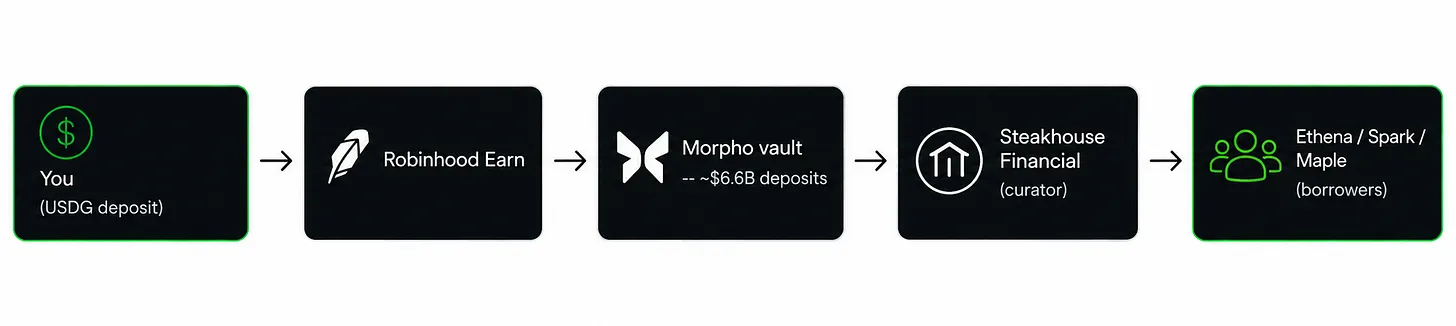
Additionally, Robinhood's separate Robinhood Earn product independently offers a 7% annualized yield, available only to U.S. users. Users lend the stablecoin USDG, with funds first flowing into a Morpho lending vault operated by Steakhouse Financial, then distributed to various DeFi protocols like Ethena and Maple. The Morpho vault deposit size is about $6.6 billion, with yields floating based on market lending demand.


Robinhood has insured smart contract theft with London's Lloyd's, but the policy does not cover the risk of yield dropping to zero. When market lending demand shrinks, yields will decline alongside money market fund rates. User funds pass through multiple intermediaries: Robinhood, Steakhouse, Morpho. Once USDG depegs or a large-scale borrower default occurs, insurance cannot cover it at all. These are common causes of principal loss in such products.


Tokens are stored on-chain and support staking and lending, seemingly convenient. However, smart contracts cannot directly read stock prices and must rely on oracles for price feeds. If an oracle feeds false prices, the contract will incorrectly liquidate user assets or issue loans improperly. From 2024 to 2025, oracle price manipulation was a core method for large DeFi thefts, causing losses of tens of millions of dollars for numerous projects.


Within the entire product ecosystem, the only orthodox, full-voting-right equity is Robinhood's own stock, HOOD, traded on traditional Nasdaq channels. The platform keeps the real equity for itself.


The underlying business logic is clear. Robinhood earns a spread on every token transaction; the public chain belongs to itself. The overseas new business can continuously beautify the financial reports of the listed company, all without being constrained by U.S. domestic regulations. A token business without actual equity has lower regulatory costs and cleaner profits.


The Robinhood Chain is built on the Arbitrum Orbit network, using ETH to pay Gas fees. It has not issued a native platform token, avoiding token speculation risks, and the platform does not need to profit from a native token. The company's long-term plan is to build a one-stop settlement channel, enabling 7x24 on-chain trading for stocks, ETFs, stablecoins, commodity perpetual contracts, and future private equity. Robinhood was originally just an order routing intermediary. If the plan materializes, it will combine the functions of an exchange and a clearinghouse.


Objectively speaking, current regulatory rules are rapidly evolving. The new SEC Chairman Atkins has overturned the previous "sue first, regulate later" approach and is drafting an innovative regulatory sandbox exemption bill. The "CLARITY Act" has been submitted to the Senate for review since June. Once enacted, the regulatory gray area Robinhood currently occupies will continue to narrow.


This playbook is already familiar in the industry. Coinbase and Kraken expanded their businesses early in regulatory gaps, then strengthened compliance qualifications after regulations detailed and industry demand was validated. The current Jersey debt tokens are more like a transitional, semi-finished product for Robinhood.


Just two days before Robinhood's stock token launch, on July 2nd, Ondo launched compliant tokenized stocks on Ethereum, issued through an SEC-registered transfer agent. The tokens are fully backed by real stocks held in custody, with holders enjoying on-chain voting rights, covering over 250 companies. Coinbase simultaneously listed the product, allowing U.S. users to trade legally, with dividends distributed directly to user accounts.


Operating a fully compliant model in the U.S. costs more and is subject to regulatory constraints throughout. Robinhood already bears these compliance costs in Europe. Therefore, the Jersey Island debt structure is a choice by Robinhood. In the future, either regulations will force a product upgrade, or competitors will launch U.S.-compliant real-stock tokens to steal customers.


First capture the market, then wait for regulations to mature—this is Robinhood's strategy.

Trending Cryptos

Related Questions

QWhat is the fundamental nature of the Robinhood stock tokens discussed in the article?

AThey are not actual equities or ownership stakes in the underlying companies. They are debt instruments (structured notes) issued by Robinhood Assets (Jersey) Limited, a shell company in a tax haven. Holders are creditors who receive payments based on the price movements of the referenced stocks but have none of the legal rights of a shareholder.

QWhy does Robinhood use a complex Jersey-based shell company structure for its stock tokens instead of offering direct equity tokens?

ATo navigate U.S. SEC regulations. The SEC has classified tokenized securities, and Robinhood's product falls under 'Linked Securities,' which track a stock's price without granting ownership rights. Structuring them as debt from a Jersey entity allows Robinhood to avoid stricter U.S. regulations that apply to equity securities and security-based swaps, enabling them to offer the product to retail investors globally (excluding the U.S. and several other countries) with lower regulatory hurdles.

QWhat are the key risks for investors holding Robinhood's stock tokens, according to the article?

AInvestors face significant counterparty and structural risks: 1) If the Jersey issuer goes bankrupt, token holders become unsecured creditors in a liquidation process, risking total loss. 2) If the underlying company (e.g., Apple) goes bankrupt, the debt instrument's value is tied to that stock, so it could become worthless. 3) There is no direct recourse to the actual company's assets. 4) The structure relies on oracles for pricing, which could be manipulated, leading to faulty liquidations.

QHow does the article contrast Robinhood's approach with a compliant alternative like Ondo's product?

AOndo's product, launched on Ethereum and listed on Coinbase, is a compliant equity token registered with the SEC. It is backed 1:1 by real, custodied stocks, and token holders possess full shareholder rights, including voting and receiving dividends. This contrasts with Robinhood's debt-based tokens, which offer no ownership rights and are issued from an offshore entity to sidestep the higher costs and regulatory scrutiny of the U.S. compliant model that Robinhood itself uses for its European customers.

QWhat historical event does the article link to Robinhood's motivation for developing its blockchain-based trading system?

AThe GameStop short squeeze crisis of January 2021. During that event, Robinhood faced a massive liquidity shortfall due to the T+2 settlement cycle and was forced to restrict buying. The blockchain system with near-instant settlement is presented as CEO Vlad Tenev's solution to eliminate such settlement risks and theoretically prevent future trading halts, aiming to restore trust after the significant brand damage from that incident.

Related Reads

Goldman Sachs Research Report Analysis: Circle and USDC Are Moving Beyond the Crypto World, Cross-Border Payments and AI Agents Become New Battlegrounds

Goldman Sachs published a summary of its meeting with Circle Internet Group (issuer of USDC) on July 5th. The core takeaway is that stablecoins, led by USDC, are evolving from a crypto-native tool into foundational infrastructure for traditional finance and the AI economy. USDC's use cases are rapidly expanding beyond crypto trading into cross-border payments, e-commerce, capital market settlements, and notably, payments for AI agents. Circle's management emphasized that stablecoin growth is now decoupled from crypto market cycles, driven by this diversification. They outlined five key application layers and highlighted USDC's network effects, global liquidity depth, and regulatory compliance as competitive moats. Circle distinguishes USDC from bank-issued tokenized deposits, arguing the former is an open, internet-native system without bank credit risk. Strategically, Circle is building a broader fintech platform with its Arc Layer 1 blockchain, the Circle Payments Network for cross-border transfers, and an "Agentic Stack" to serve AI agent economies, where USDC already dominates. Regarding regulation, Circle views potential U.S. legislation like the CLARITY Act as a catalyst for growth rather than a constraint, expecting it to encourage broader institutional adoption and active usage. Goldman Sachs maintains a Neutral rating on Circle with a $96 price target, noting the company's shift from a pure stablecoin issuer to a financial infrastructure provider. Key risks include competition from USDT and potential earnings pressure from declining interest rates on its reserve assets.

marsbit41m ago

Goldman Sachs Research Report Analysis: Circle and USDC Are Moving Beyond the Crypto World, Cross-Border Payments and AI Agents Become New Battlegrounds

marsbit41m ago

Trading

Spot

Hot Articles

What is DOGE M

Doge Matrix ($doge m): The New Breed of Community-Driven Cryptocurrency Introduction In the ever-evolving landscape of cryptocurrency, new projects constantly emerge, each aiming to capture the interest of investors and enthusiasts alike. One of the latest entrants to this domain is Doge Matrix, represented by the ticker symbol $doge m. This project has attracted attention thanks to its roots in the popular meme culture surrounding Dogecoin, establishing its place within the web3 space. This article aims to provide a comprehensive analysis of Doge Matrix, covering its overview, creator, investors, functionality, timeline, and notable aspects. What is Doge Matrix ($doge m)? Doge Matrix is a community-driven cryptocurrency project that seemingly builds upon the widespread appeal of Dogecoin, a digital currency known for its Shiba Inu mascot and its meme origins. While the overarching objectives of Doge Matrix are not extensively defined, it is characterised by a commitment to harnessing community involvement and support. Unlike traditional cryptocurrencies that often emphasise utility or intrinsic value through underlying technologies, Doge Matrix positions itself within a space that embraces the cultural phenomenon of cryptocurrencies, particularly appealing to those who resonate with the ethos of meme-based assets. Drawing on the strengths of the Dogecoin community, Doge Matrix operates as part of a broader ecosystem, inviting participation and engagement from users who share an interest in cryptocurrency and the digital landscape. Who is the Creator of Doge Matrix ($doge m)? The identity of the creator of Doge Matrix remains unknown. This lack of transparency is not an uncommon occurrence in the cryptocurrency space, where some projects are launched without revealing the identities of their founders. The absence of information regarding the founding team can raise questions among potential investors about the project’s accountability and direction. Who are the Investors of Doge Matrix ($doge m)? As it stands, there is no publicly available information detailing the investors or investment foundations that back Doge Matrix. The project appears to rely primarily on community support rather than institutional investment. This model aligns with the community-driven nature of the initiative, fostering an environment where the direction of the project is shaped by its participants rather than being dictated by a select few financial backers. How Does Doge Matrix ($doge m) Work? The specifics regarding the operational mechanisms of Doge Matrix are somewhat vague, reflecting a broader trend of projects in the meme coin space where innovative functionalities are not always clearly articulated. Nonetheless, Doge Matrix seems designed to tap into the existing cryptocurrency ecosystem by encouraging user participation while tapping into the familiar cultural references associated with Dogecoin. Its potentially unique characteristics derive from community interactions rather than technological advancements, emphasising shared experiences and collaboration among token holders. While the exact innovations have not been explicitly outlined, the project appears to create a space where community members can engage, share ideas, and propel the project's potential forward. Timeline of Doge Matrix ($doge m) Reflecting on the project’s timeline reveals notable events that have defined its journey thus far: November 25, 2024: Doge Matrix reached its all-time high value, marking a significant milestone in its early history. January 1, 2025: Conversely, Doge Matrix hit its all-time low value, illustrating the volatility often associated with cryptocurrencies, especially in the early stages of a project's lifecycle. Ongoing: The project continues to be actively traded and supported by its community, although specific future milestones or objectives have yet to be disclosed. Key Points About Doge Matrix ($doge m) Community Focus At the heart of Doge Matrix is a commitment to community engagement. The project thrives on the premise of collaboration and shared objectives among its members, emphasising the importance of collective effort. Unlike centralised projects that often have a defined leadership structure, Doge Matrix at present showcases a more fluid approach to governance, where every community member's voice matters. Volatility The cryptocurrency market is notorious for its volatility, and Doge Matrix is no exception. Its price history reflects significant fluctuations between high and low values, which is typical of many new cryptocurrencies but underscores the risks associated with investment in emerging tokens. Lack of Detailed Information One of the most striking features about Doge Matrix is the scarcity of detailed information regarding its technological underpinnings and operational mechanisms. This ambiguity necessitates that potential investors conduct thorough due diligence before engaging with the project. Conclusion In summary, Doge Matrix ($doge m) illustrates a new wave of cryptocurrency projects that lean heavily on community engagement and cultural relevance. While lacking in certain specifics—such as clear leadership, defined objectives, and detailed functionality—the project has managed to generate interest within the crypto community, leveraging the established appeal of meme culture. As with any investment in the cryptocurrency space, understanding the inherent risks and conducting comprehensive research is essential for potential participants. Doge Matrix stands as a reminder of the dynamic, sometimes unpredictable nature of the crypto industry, marked by constant evolution and enthusiasm for community-driven initiatives.

551 Total ViewsPublished 2025.02.03Updated 2025.02.03

What is DOGE M

What is $M

Understanding Mantis ($M): A New Era in Cross-Chain Interoperability In the continually evolving landscape of Web3 and cryptocurrency, new projects strive to offer innovative solutions aimed at enhancing the user experience and expanding functional possibilities within the decentralised financial ecosystem. One such project garnering attention is Mantis ($M), a pioneering protocol founded on the principles of cross-chain interoperability and intent-based settlements. This article delves into the essential aspects of Mantis, including its core functionality, creators, investment backing, innovative features, and critical milestones. What is Mantis ($M)? Mantis is described as a multi-domain intent settlement protocol that simplifies cross-chain interactions, enabling users to execute complex financial transactions across various blockchain platforms seamlessly. The protocol operates through three primary layers: Intent Expression: Users can articulate their transaction goals using natural language facilitated by the DISE LLM, an advanced AI language model. For instance, a user might express a desire to swap Ethereum (ETH) for Solana (SOL) with a specific slippage tolerance of 1%. Execution: This layer employs a network of solvers that compete to fulfil user intents. Transactions are executed using mechanisms such as Coincidence of Wants (CoWs) and Order Flow Auctions (OFAs), which ensure that user demands are met optimally. Settlement: Leveraging the Inter-Blockchain Communication (IBC) protocol, Mantis enables atomic cross-chain transactions, allowing users to operate across various supported chains, including Ethereum, Solana, and Cosmos. Mantis is engineered to introduce native yield generation for idle assets, employing cryptographic proofs to maintain the integrity of transactions throughout the entire process. Creators & Development Team Mantis was conceived by the Composable Foundation, a research-driven organisation notable for its emphasis on blockchain interoperability solutions. This foundation collaborates with esteemed academic institutions, including Harvard University and the University of Lisbon, contributing to extensive research and development efforts that inform Mantis's architecture and functionality. The Composable Foundation’s commitment to fostering innovation in the blockchain space positions Mantis as a robust solution for the growing demand for interoperability among multiple blockchain networks. Investors & Backing While specific details about individual investors have not been publicly disclosed, Mantis enjoys substantial backing from various entities, including: Ecosystem grants from IBC-enabled chains, which support the protocol's growth and integration within decentralised finance ecosystems. Strategic partnerships with infrastructure providers that enhance Mantis's network capabilities and deployment strategies. Funding through the Composable Foundation's treasury, ensuring sustained financial support for ongoing development and operational costs. These collaborative efforts reflect a consensus among stakeholders about the importance of enhancing cross-chain functionality and the potential utility of Mantis's infrastructural innovations. Key Innovations Mantis sets itself apart through several pioneering innovations that enhance its functionality and utility: Chain-Agnostic Intents: Users can initiate transactions from any supported chain while settling on another. This flexibility empowers users, driving increased interaction among different platforms. AI-Powered Interface: The integration of DISE LLM allows users to conduct complex DeFi operations using natural language, thereby simplifying interactions and making blockchain technology accessible to a broader audience. Cross-Domain MEV Capture: Mantis creates an internal market for maximal extractable value (MEV) through competitions among solvers. This innovative approach allows for greater efficiency and value extraction in complex transactions. Modular Settlement Layer: The protocol supports various verification methods, including zero-knowledge proofs and optimistic rollups, providing a versatile framework that can adapt to emerging blockchain technologies. Historical Timeline Mantis's development is marked by several critical milestones that chart its trajectory and growth: | Year | Milestone | |————|————————————————————————-| | 2022 | Initial concept development within the Composable Foundation's research division. | | Q3 2024 | Launch of the testnet with bridging capabilities between Solana and Ethereum. | | Q1 2025 | Anticipated Token Generation Event (TGE) alongside the mainnet launch. | | Q2 2025 | Expected integration of DISE LLM and expansion of cross-chain capabilities. | | 2025 H2 | Planned support for over 15 chains through further IBC upgrades. | This timeline outlines Mantis's evolution, from conceptual discussions to active implementation and future growth phases. Ecosystem Growth Strategy Mantis's strategy for ecosystem growth includes several initiatives designed to encourage user participation and developer engagement: Credits System: Users can earn protocol credits by providing liquidity and engaging in referral programmes. These credits are redeemable for incentives in the future, fostering a robust user community. Modular Software Development Kit (SDK): This toolkit empowers developers to create applications based on intent-driven models utilising Mantis's infrastructure, thus promoting innovation within its ecosystem. Governance Model: As the protocol matures, $M token holders will have a voice in protocol governance, allowing them to vote on proposed upgrades and changes, thereby enhancing community engagement and decentralisation. Mantis represents a significant advancement in the realm of cross-chain architecture. By seamlessly integrating advanced AI algorithms with a robust settlement framework, Mantis seeks to tackle the problems of fragmentation within multi-chain ecosystems. Its innovative approach prioritises improved user experiences while adhering to the foundational principles of decentralisation and security, setting a new standard for the future interoperability of blockchain technologies. As Mantis continues its journey of growth and implementation, it promises to be a project to watch closely in the competitive landscape of Web3 and decentralised finance. With its focus on crossing boundaries and elevating user engagement, Mantis is poised to be an integral part of the future developments in the cryptocurrency space.

73 Total ViewsPublished 2025.03.18Updated 2025.03.18

What is $M

Discussions

Welcome to the HTX Community. Here, you can stay informed about the latest platform developments and gain access to professional market insights. Users' opinions on the price of M (M) are presented below.

活动图片