Goldman Sachs Research Report Analysis: Circle and USDC Are Moving Beyond the Crypto World, Cross-Border Payments and AI Agents Become New Battlegrounds

marsbitPublished on 2026-07-07Last updated on 2026-07-07

Abstract

Goldman Sachs published a summary of its meeting with Circle Internet Group (issuer of USDC) on July 5th. The core takeaway is that stablecoins, led by USDC, are evolving from a crypto-native tool into foundational infrastructure for traditional finance and the AI economy. USDC's use cases are rapidly expanding beyond crypto trading into cross-border payments, e-commerce, capital market settlements, and notably, payments for AI agents. Circle's management emphasized that stablecoin growth is now decoupled from crypto market cycles, driven by this diversification. They outlined five key application layers and highlighted USDC's network effects, global liquidity depth, and regulatory compliance as competitive moats. Circle distinguishes USDC from bank-issued tokenized deposits, arguing the former is an open, internet-native system without bank credit risk. Strategically, Circle is building a broader fintech platform with its Arc Layer 1 blockchain, the Circle Payments Network for cross-border transfers, and an "Agentic Stack" to serve AI agent economies, where USDC already dominates. Regarding regulation, Circle views potential U.S. legislation like the CLARITY Act as a catalyst for growth rather than a constraint, expecting it to encourage broader institutional adoption and active usage. Goldman Sachs maintains a Neutral rating on Circle with a $96 price target, noting the company's shift from a pure stablecoin issuer to a financial infrastructure provider. Key risks inclu...

Written by: Rita

Tidal Guide Introduction

Goldman Sachs released the management meeting notes for Circle Internet Group (CRCL.US) on July 5th. Circle is the issuer of USDC. The core message of this meeting is: Stablecoins are transitioning from being peripheral tools in the crypto world to becoming infrastructure for traditional finance and the AI economy. USDC's use cases are rapidly expanding, extending from crypto trading to cross-border payments, consumer e-commerce, capital market settlements, and even AI agent payments. Goldman Sachs rates Circle as Neutral with a target price of $96. The current stock price is $64.62, implying an upside potential of approximately 48.6%.

Stablecoin Growth Has Decoupled from the Crypto Market Cycle

Circle management repeatedly emphasized a key judgment during the meeting: stablecoin growth has decoupled from the fluctuations of the crypto market. Over the past few quarters, while crypto market trading volume and prices have trended downwards, the market capitalization and transaction volume of stablecoins have continued to rise.

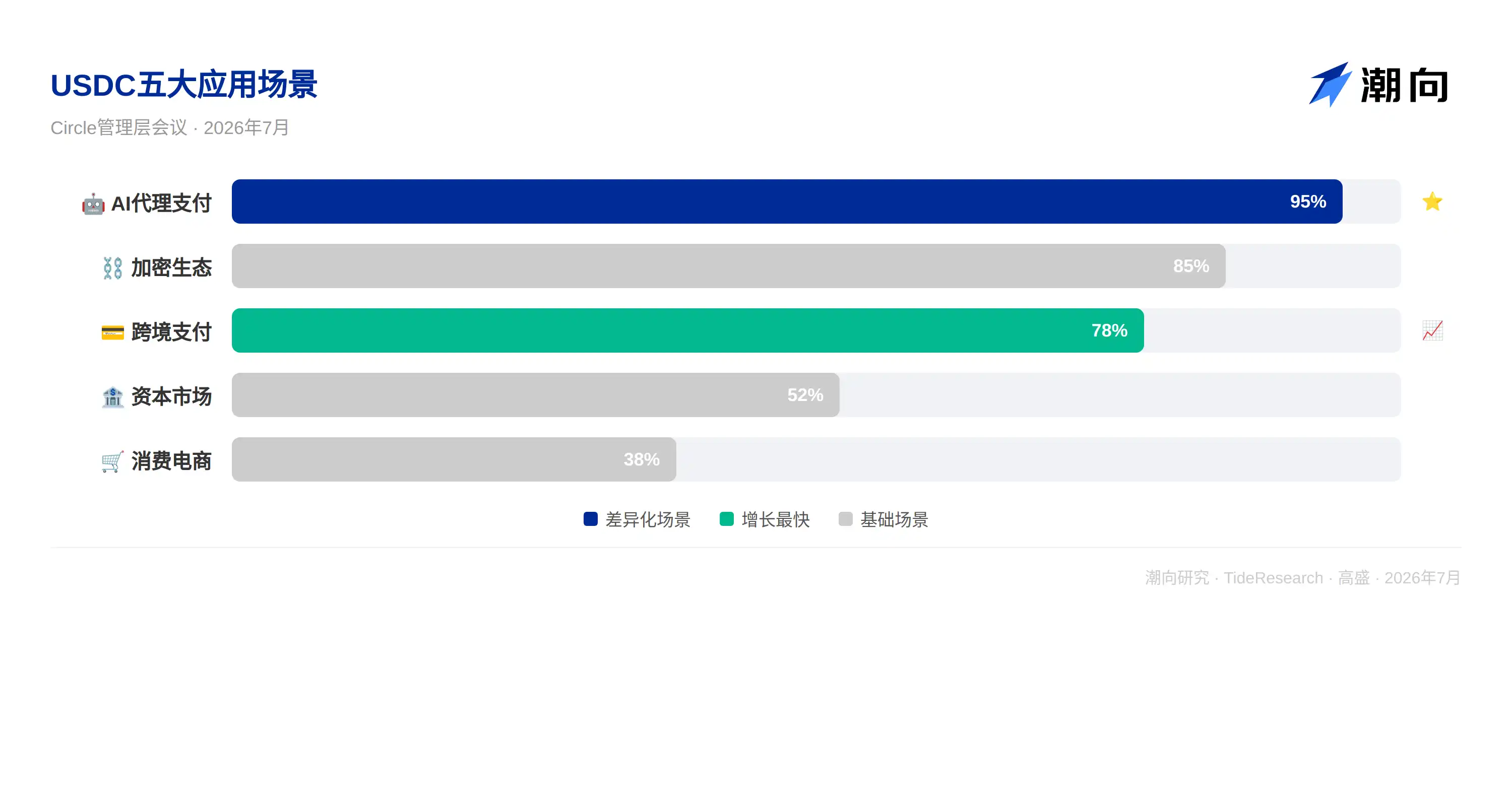
The reason lies in the diversification of use cases. Circle categorizes USDC's application scenarios into five tiers, covering the full spectrum from the crypto ecosystem to AI agent payments.

The crypto ecosystem is USDC's foundation, with continuous expansion of liquidity through partnerships with rapidly growing platforms like Hyperliquid.

Cross-border payments and treasury management are currently the fastest-growing segments. USDC's instant settlement and extremely low transaction costs are transforming traditional bilateral cross-border payment processes. Circle noted that demand for USD stablecoins is particularly strong in emerging markets, representing a trend of "digital dollarization," where people use USDC as a substitute for local currency or unreliable banking systems.

Consumer and e-commerce use cases are also taking shape. Major e-commerce platforms like Stripe and Shopify have begun supporting USDC payments, allowing users to directly choose USDC at checkout. Stablecoin-linked credit cards are also emerging, enabling users to hold and spend stablecoins.

Breakthroughs in capital markets are even more critical. Circle sees the potential for USDC as collateral for derivatives and a settlement currency. The recent CFTC approval allowing Futures Commission Merchants to treat specific stablecoins as readily marketable collateral is a significant institutional catalyst. The tokenization of real-world assets is also expanding USDC's application scenarios, as stablecoins are the natural cash settlement tool for on-chain transactions.

The most emphasized differentiated scenario by Circle is AI agent payments. AI agents are autonomously executing economic activities. x402 is currently a leading agent payment protocol, with USDC accounting for approximately 99% of all transactions on that protocol. AI agents require atomic settlement and extremely low transaction costs, making stablecoins the most suitable payment tool.
USDC's Competitive Moat is Network Effects

Management believes that stablecoins are a classic network effects business. The USDC network is a public, internet-native financial infrastructure that anyone can access—individuals, businesses, and developers alike.

Circle outlined three major competitive advantages for USDC.
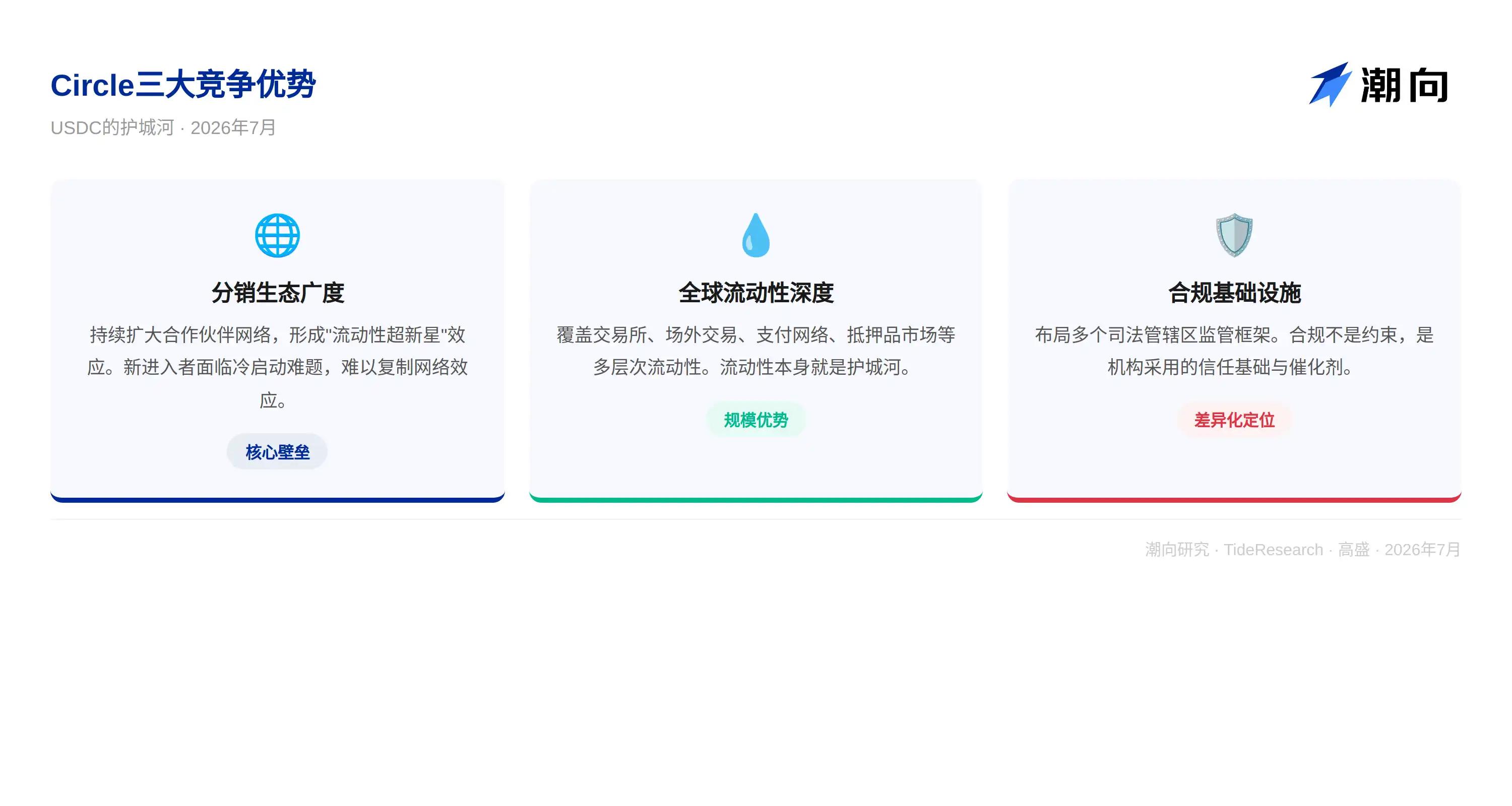
First, the breadth of distribution and platform ecosystems. USDC strengthens liquidity by continuously adding partners, creating a "liquidity supernova" effect. New stablecoin entrants find it difficult to replicate this network effect due to the cold start problem: no liquidity without users, and no users without liquidity.

Second, global liquidity depth. USDC has deep liquidity across exchanges, over-the-counter markets, payment networks, and collateral markets. This depth itself is a moat.

Third, compliance infrastructure. USDC has regulatory arrangements across multiple jurisdictions. Management views this as a key driver for institutional adoption, not a constraint.

Regarding competition, Circle distinguishes between two types of opponents. One is tokenized deposits, which are digital deposit certificates issued by banks. Circle argues that stablecoins have advantages over tokenized deposits because they are open, interoperable, carry no bank credit risk, and are fully reserved. The other is new stablecoin competitors. Circle expects more new stablecoins to emerge, but they lack the network effects Circle has accumulated over more than a decade.

The Difference Between Tokenized Deposits and Stablecoins is Structural

Circle believes the difference between stablecoins and tokenized deposits is structural, not merely a matter of who arrived first.

Stablecoins constitute an open, public, internet-native financial system accessible to anyone, with liquidity flowing freely across platforms. Tokenized deposits are more like an extension of the banking system, likely confined within a single bank or consortium ecosystem. These are two completely different architectures: stablecoins are internet-native, while tokenized deposits represent a digital upgrade of the banking system.

Another key difference is credit risk. Stablecoins are fully reserved, digital cash with no credit risk. Tokenized deposits are essentially liabilities of a bank, carrying bank credit risk. In Circle's view, this difference is fundamental.

Circle's Three Strategic Products Aim to Turn Stablecoins into an Operating System

Circle is not just a stablecoin issuer; it is positioning itself as an internet-native financial platform. Management emphasized three strategic products during the meeting.

Arc is Circle's in-house developed Layer 1 public blockchain, positioned as a comprehensive financial operating system aimed at enhancing liquidity and interoperability, particularly for attracting traditional financial institutions.

Circle Payments Network (CPN) is the cross-border payment product, enabling faster and more efficient cross-border payments through blockchain settlement. Institutional adoption is growing.

Agentic Stack is the product line for AI agents, with the goal of maintaining USDC's dominant share in AI-related economic activities. Given that USDC already accounts for roughly 99% of transaction volume on the x402 protocol, the first-mover advantage in this space is evident.

Regulation is a Catalyst, Not a Constraint

The market has long been concerned that stablecoin regulation might constrain Circle's business model, but Circle management offered a completely opposite interpretation. They believe that if market structure legislation like the CLARITY Act passes, it will serve as a catalyst for USDC growth, not a business constraint. The reasons are threefold: The bill allows issuers to continue incentivizing distribution through revenue sharing, enabling Circle to keep expanding its partner network; The bill could unlock institution-grade crypto adoption, leading to greater stablecoin usage; The bill encourages usage-based reward mechanisms over passive holding, which would promote active use of USDC and reduce idle accumulation.

Tidal Guide Perspective

Goldman Sachs rates Circle as Neutral, but the notes themselves reveal a lot. Circle is successfully expanding USDC from a crypto trading tool into internet-native financial infrastructure, which is the right direction.

It's worth questioning how deep Circle's moat really is. Network effects do exist, but USDC's biggest competitor, USDT, still leads in stablecoin market capitalization. The compliance advantage Circle relies on is seen as a weakness by crypto purists: transparency means being subject to regulation, and regulation means the potential for freezing assets. Circle's institutional positioning is a double-edged sword.

Another point worth noting is Goldman Sachs' valuation framework. The $96 target price corresponds to a 35x P/E ratio, but Circle's current profitability heavily depends on interest income from reserve assets. If interest rates decline, Circle's profits would be directly pressured. This risk is only briefly mentioned in the notes, but its actual impact on valuation could be greater than that of regulation.
Disclaimer

This article is Tidal Guide Research's compilation and interpretation of a third-party securities firm research report. The ratings, target prices, profit forecasts, and related judgments cited herein are the views of that firm's analysts, representing only the stance of their affiliated institution. They do not represent the views of Tidal Guide Research and do not constitute any investment advice.

The market carries risks, and decisions should be made independently. This article should not serve as the basis for buying or selling any securities.


Trending Cryptos

Related Questions

QAccording to Goldman Sachs' research note, what is the core message from the Circle management meeting?

AThe core message is that stablecoins, specifically USDC, are transitioning from a peripheral tool in the crypto world to becoming infrastructure for traditional finance and the AI economy. Its use cases are rapidly expanding beyond crypto trading into areas like cross-border payments, e-commerce, capital market settlements, and AI agent payments.

QWhat are the five key application layers or use cases for USDC as outlined by Circle's management?

AThe five layers are: 1) The crypto ecosystem (as its fundamental base), 2) Cross-border payments and treasury management, 3) Consumer e-commerce payments, 4) Capital markets (as collateral and settlement currency), and 5) AI agent payments, which is emphasized as a key differentiating scenario.

QWhat does Circle identify as the primary competitive moat for USDC in the stablecoin market?

ACircle identifies network effects as the primary competitive moat. This is built upon the breadth of its distribution and platform ecosystem (liquidity), the depth of its global liquidity, and its established compliance infrastructure across multiple jurisdictions.

QHow does Circle's view of regulation, such as the potential CLARITY Act, differ from typical market concerns?

ACircle views regulation as a potential catalyst for growth, not a constraint. They argue that legislation like the CLARITY Act would allow them to continue incentivizing distribution partners, could unlock institutional crypto adoption (increasing stablecoin usage), and would encourage reward mechanisms based on active use rather than passive holding.

QWhat is the 'tidal direction perspective' or key risk flagged in the article regarding Circle's business model and valuation?

AA key risk noted is that Circle's current profitability is highly dependent on interest income from its reserve assets. If interest rates decline, the company's profits could be directly pressured, which poses a significant risk to its valuation that may be larger than regulatory concerns.

Related Reads

The Robinhood Stock Tokens You Bought Are Just Debts from Jersey Island

The Robinhood stock tokens you buy are essentially debt securities issued by a shell company in Jersey, not real equity. These tokens merely track stock prices like NVIDIA or Apple but grant no shareholder rights like voting or dividends. If the underlying company fails, you have no claim on its assets. Instead, you hold a debt instrument from Robinhood Assets (Jersey) Limited, which promises returns based on stock performance. If this Jersey entity goes bankrupt, you become an unsecured creditor. This complex structure stems from Robinhood's past crisis during the 2021 GameStop short squeeze, where T+2 settlement caused liquidity issues. The blockchain-based tokens enable instant settlement, theoretically preventing such trading halts. The product is classified by the SEC as a "linked security" or structured note, carrying counterparty risk not borne by actual shareholders. It is available globally but excluded from the US, UK, and other major markets, while Robinhood offers a fully compliant, asset-backed token model in Europe under MiFID II. The system relies on oracles for pricing, which poses risks like manipulation and faulty liquidations seen in DeFi exploits. Robinhood profits from spreads and aims to become a full-chain settlement layer. Meanwhile, competitors like Ondo have launched SEC-registered, fully compliant equity tokens in the US with actual voting rights and dividends. Robinhood’s Jersey debt model appears as a transitional, regulatory-arbitrage product, aiming to capture market share ahead of future regulatory clarity.

Foresight News1h ago

The Robinhood Stock Tokens You Bought Are Just Debts from Jersey Island

Foresight News1h ago

Trading

Spot

Hot Articles

What is USDC(WORMHOLE)

USD Coin (Wormhole): A Comprehensive Overview Introduction In the rapidly evolving world of cryptocurrencies, USD Coin (Wormhole), referred to as $USDC(Wormhole), stands out as a pioneering solution within the DeFi (Decentralized Finance) landscape. Operating on several blockchain platforms, including Solana, USD Coin (Wormhole) is more than just a digital representation of the United States dollar. It embodies the innovative spirit of modern finance, enabling seamless cross-chain transactions and enhanced interoperability among diverse blockchain ecosystems through the advanced Wormhole protocol. What is USD Coin (Wormhole)? USD Coin (Wormhole) is a tokenized version of the US dollar designed to facilitate frictionless transactions across different blockchain networks. Its primary aim is to bolster liquidity and enhance the functionality of the DeFi ecosystem. By leveraging the Wormhole protocol, which establishes a robust cross-chain communication network, users can effortlessly transfer USDC tokens across various platforms. This cross-chain capability marks a significant advancement in cryptocurrency use, promoting a more interconnected and efficient ecosystem where assets can flow freely between different blockchains. The value proposition of USD Coin (Wormhole) lies not only in its stability, being pegged to the US dollar, but also in its ability to bridge gaps between disparate blockchain environments. This innovative approach fosters a greater level of participation among users and developers, paving the way for new and exciting applications within decentralized finance. Who is the creator of USD Coin (Wormhole)? The origins of USD Coin (Wormhole) are intricately tied to the Wormhole network, which was developed by Jump Crypto. While specific individual creators are not prominently documented, Jump Crypto is notable for its involvement in advancing blockchain technology and supporting its applications in finance. By creating the Wormhole network, Jump Crypto has played a vital role in promoting cross-chain asset transfers, enhancing the efficiency and diversity of cryptocurrency usage. Who are the investors of USD Coin (Wormhole)? The success of USD Coin (Wormhole) is supported by investments from several notable funds and organizations within the cryptocurrency realm. Key investors include: Coinbase Ventures: A prominent venture capital arm backed by one of the leading cryptocurrency exchanges in the industry, Coinbase Ventures provides essential capital and strategic support to promising blockchain projects. Arrington XRP Capital: Specializing in digital assets, Arrington XRP Capital recognizes the potential of innovative projects like USD Coin (Wormhole) and has invested accordingly to back its development. Jump Trading: As the parent organization of Jump Crypto, Jump Trading brings not only investment but a wealth of expertise in trading technology and market dynamics to bolster the Wormhole project. How Does USD Coin (Wormhole) Work? The operational framework of USD Coin (Wormhole) is intricately designed to facilitate effective cross-chain transactions, maximizing security and efficiency. Here’s a simplified overview of how it functions: Asset Locking: When a user wishes to transfer USDC from one blockchain to another, they first lock their tokens on the source blockchain. This process ensures that the assets are secure and are set to be either burned or moved later. Token Minting: After the tokens are locked, an equivalent amount of USDC is minted on the destination blockchain. This provides the user with access to their funds on a new platform, reflecting the flexibility that the Wormhole protocol enables. Cross-Chain Transfer: The Wormhole protocol efficiently facilitates the entire transfer process. It ensures that once the USDC is minted on the destination chain, the equivalent tokens are burned on the source chain. The result is a seamless transfer of value between two distinct blockchain environments. This cross-chain methodology ensures that transactions remain secure and transparent, significantly enhancing liquidity within the different DeFi ecosystems. Timeline of USD Coin (Wormhole) Understanding the evolution of USD Coin (Wormhole) provides vital context for its significance in the cryptocurrency arena. Here’s a timeline highlighting important milestones in the project’s history: 2021: The Wormhole project is launched, establishing a framework for cross-chain asset transfers and setting the stage for the development of USD Coin (Wormhole). 2022: The Wormhole network experiences a significant challenge with a security breach that results in a $325 million theft. However, the incident is later addressed and refunded by Jump Crypto, showcasing the project’s commitment to security and transparency. 2023: USD Coin (Wormhole) integrates with Circle’s Cross-Chain Transfer Protocol (CCTP), enhancing its capabilities for cross-chain transfers and further solidifying its place within the DeFi ecosystem. 2024: Ongoing development and expansion of the Wormhole network continue, aimed at increasing the utility and reach of USD Coin (Wormhole) as well as enhancing its operational framework. Key Features The success of USD Coin (Wormhole) can be attributed to several key features that differentiate it from other cryptocurrency offerings: Cross-Chain Interoperability At the core of USD Coin (Wormhole) is its ability to facilitate seamless transfers across multiple blockchain networks. This interoperability serves as a cornerstone for decentralized finance, allowing various platforms to interact with each other, thereby accelerating the evolution of financial services. Security Wormhole employs a well-designed Guardian Network comprised of node validators that ensure secure cross-chain transactions. This collective oversight minimizes the risk of fraud and provides users with confidence that their assets are protected during cross-chain transfers. Liquidity Enhancement By enabling USDC to circulate freely across different blockchains, USD Coin (Wormhole) enhances liquidity in the DeFi ecosystem. This increased liquidity can foster more efficient trading, contribute to better pricing strategies, and improve the overall market dynamics encompassing various digital assets. Conclusion USD Coin (Wormhole) is a pivotal innovation in the blockchain space, reinforcing the capabilities of decentralized finance (DeFi) and establishing a more connected financial ecosystem. With its robust framework for cross-chain transactions, security features, and strong backing from reputable investors, USD Coin (Wormhole) is positioned to play a key role in the future of cryptocurrency. As the digital finance landscape continues to evolve, USD Coin (Wormhole) not only embraces the future of interconnectivity among blockchain networks but also reaffirms the power of tokenization and blockchain technology in transforming how we perceive and utilize value in a digital world. By navigating the complexities of cross-chain functionality, it demonstrates a sophisticated approach to enabling financial inclusivity and innovation in the world of cryptocurrencies.

1.3k Total ViewsPublished 2024.04.01Updated 2024.12.03

What is USDC(WORMHOLE)

What is $USDC

Classic USDC: A Comprehensive Overview Introduction to Classic USDC In the rapidly evolving landscape of the cryptocurrency market, stablecoins have emerged as critical components, particularly in providing stability amid the volatility that characterizes digital assets. One such project is Classic USDC, a digital currency initiative that aims to deliver a stable and reliable medium of exchange. By maintaining a 1:1 peg with the US dollar, Classic USDC strives to offer users a dependable digital asset, equipped for various applications within the web3 and cryptocurrency ecosystems. What is Classic USDC? Classic USDC is fundamentally a stablecoin, which is a type of cryptocurrency designed to minimize the price volatility typically seen in the digital asset market. Specifically, Classic USDC aspires to represent the value of the US dollar closely, ensuring that users can leverage this digital currency for transactions, savings, and other financial activities without the fear of sudden price fluctuations that can otherwise plague many cryptocurrencies. The primary aim of Classic USDC is to provide a reliable and trustworthy digital equivalent of the US dollar, designed for seamless integration into a wide range of web3 applications, decentralized finance (DeFi) platforms, and other crypto-related financial systems. By delivering a stable digital currency, Classic USDC seeks to facilitate everyday commerce, make blockchain technology more user-friendly, and encourage the adoption of cryptocurrencies for mainstream usage. Creator of Classic USDC The identity of the creator or the development team behind Classic USDC remains largely unknown, and the lack of transparency has led to a degree of uncertainty regarding the project’s origins. While many cryptocurrency initiatives prominently showcase their founders and development teams, Classic USDC does not provide clear information about its creators, which poses challenges for potential users or investors weighing the project's credibility and reliability. Investors of Classic USDC Alongside the ambiguity surrounding its creators, Classic USDC also lacks specificity with regards to its investors. The financial backing of a project can often lend it credibility and stabilize its operations; however, the absence of documented investment foundations or organizations supporting Classic USDC raises questions about its funding structure. This lack of clarity could potentially hinder stakeholder confidence in the project. How Does Classic USDC Work? The operational mechanics of Classic USDC rely heavily on its reserve system, which is fundamental to the underpinnings of any stablecoin. Classic USDC undertakes to maintain a reserve of assets that directly correspond to the value of the digital currency in circulation. Specifically, for every Classic USDC token issued, an equivalent amount of backing assets is retained in reserve, whether in cash or near-cash equivalents. This strategy is designed to uphold the value of Classic USDC, offering reassurance to users that redeeming their tokens for US dollars is feasible at any time. This reserve structure aims to enhance the stability and reliability of Classic USDC, positioning it as a secure alternative in the cryptocurrency market. By ensuring that the value of Classic USDC is consistently correlated with the US dollar, the project aspires to engender trust among users who may be wary of the broader market dynamics. Timeline of Classic USDC The history of Classic USDC is marked by several key milestones that reflect its journey and evolution within the cryptocurrency ecosystem: 2021: The inception of Classic USDC is noted, introducing a new digital currency option designed for stability. During this year, the first records of the token’s activity surfaced and its initial price levels were established. 2024: Classic USDC begins to experience notable price fluctuations, as the crypto market overall grapples with various trends and user sentiment. Predictions regarding its future potential emerge, indicating a strong interest from market observers and analysts who foresee growth opportunities. Future Projections Experts speculate that Classic USDC may reach higher levels of adoption and stability in the years to come, with potential further developments anticipated around 2025 and 2026. However, these projections should be approached with cautious optimism, as the cryptocurrency market is inherently unpredictable, and various external factors may influence the trajectory of Classic USDC. Key Points About Classic USDC Stability: Classic USDC’s core proposition revolves around providing a digital currency that parallels the value of the US dollar, thereby ensuring stability in an often volatile marketplace. Reserve System: The project’s commitment to maintaining a reserve of assets to back its value underscores its reliability and operational soundness. Web3 and Crypto Integration: Classic USDC is engineered to facilitate easy integration within various applications, aiming to enhance the user experience and broaden the acceptance of cryptocurrency in everyday transactions. Future Growth Potential: While still emerging, Classic USDC holds prospective avenues for growth as awareness and utilization of stablecoins increases in the web3 and crypto contexts. Conclusion Classic USDC presents itself as a notable stablecoin initiative within the cryptocurrency sphere, striving to provide users with a reliable digital currency that embodies the stability of the US dollar. Despite uncertainties regarding its creators and financial backing, the underpinning principles of Classic USDC—centered on reserve-backed assurances—endeavour to position it as a trustworthy option for individuals and businesses navigating the digital economy. With an eye towards the future, market analysts are keen to observe how Classic USDC evolves in response to the shifting dynamics of the cryptocurrency landscape, potentially establishing itself as a significant player in the realm of stablecoins.

699 Total ViewsPublished 2024.05.01Updated 2024.12.03

What is $USDC

Discussions

Welcome to the HTX Community. Here, you can stay informed about the latest platform developments and gain access to professional market insights. Users' opinions on the price of USDC (USDC) are presented below.

活动图片