The Most Centralized Giant in the Crypto World Starts Selling the 'Decentralized AI' Dream

比推Published on 2026-01-05Last updated on 2026-01-05

Abstract

Tether, the highly centralized issuer of the USDT stablecoin, reported $13 billion in profit in 2024—far exceeding the combined revenues and losses of major AI firms like OpenAI and Anthropic. With only 150 employees, Tether earns primarily by investing user funds in U.S. Treasury bonds, profiting from the interest without paying users any yield. Now, Tether is aggressively investing in AI. It loaned over $600 million to Northern Data, Europe’s largest GPU cloud provider with over 10,000 Nvidia H100 GPUs. It also released QVAC Genesis, a massive open-source AI training dataset, and acquired Blackrock Neurotech, a brain-computer interface company, for $200 million. Total AI-related investments approach $1 billion, with potential additional deals in robotics sector. Despite its centralized control over USDT reserves and lack of external audits, Tether promotes a “decentralized AI” vision—advocating for local AI operation and individual data ownership. Critics find this ironic, given Tether’s opaque governance. Tether’s move into AI may stem from concerns over declining Treasury yields and a desire to position itself as a tech innovator. Unlike AI startups burning billions without clear profitability, Tether uses stablecoin profits to fund speculative AI bets—insulating itself from sector risks while gaining influence. The article suggests that in 2026, the best business model in AI might be not doing AI at all, but rather funding it with profits from a separate, lucrative ve...

Author: Curry, Deep Tide TechFlow

Original Title: The AI Industry Welcomes a Cash-Rich Tether


Tether earned $13 billion in 2024.

You might not have a clear idea of this number. Let me put it another way: OpenAI had $3.7 billion in revenue in 2024 but lost $5 billion. Anthropic had $1 billion in revenue and also lost $5 billion.

The combined losses of these two legitimate AI companies are still less than what Tether earned in a year.

Tether has 150 employees, while OpenAI has over 3,000. The per capita output difference is roughly:

60 times.

How does Tether make money? When you buy 1 USDT, they take $1 and use it to buy U.S. Treasury bonds. The interest from the bonds goes to them, not you.

The essence of this business is that Tether doesn't pay interest. Banks pay interest on savings, but Tether doesn't. You hold USDT, and you get zero interest. They use your money to buy U.S. Treasury bonds and earned $7 billion in interest in 2024 alone.

150 people managing over $130 billion in Treasury bonds, doing nothing, and the interest just rolls in.

Who wouldn't want to lie back with a business like this?

But with so much money, it has to be spent. Tether has chosen a direction:

AI.

And they’re not just casually investing in a few projects to tick a box.

First, computing power.

Running AI requires GPUs—the more, the better, and the more expensive, the better. Tether loaned over $600 million to a German company called Northern Data.

What does this company do?

It’s Europe’s largest GPU cloud service provider. They have over 10,000 Nvidia H100 GPUs—the same ones OpenAI used to train GPT, each costing $20,000 to $30,000.

The cluster formed by these GPUs ranks 26th in the global TOP500 supercomputer list. With this $600 million investment, Tether essentially bought an AI training base in Europe.

Next, data.

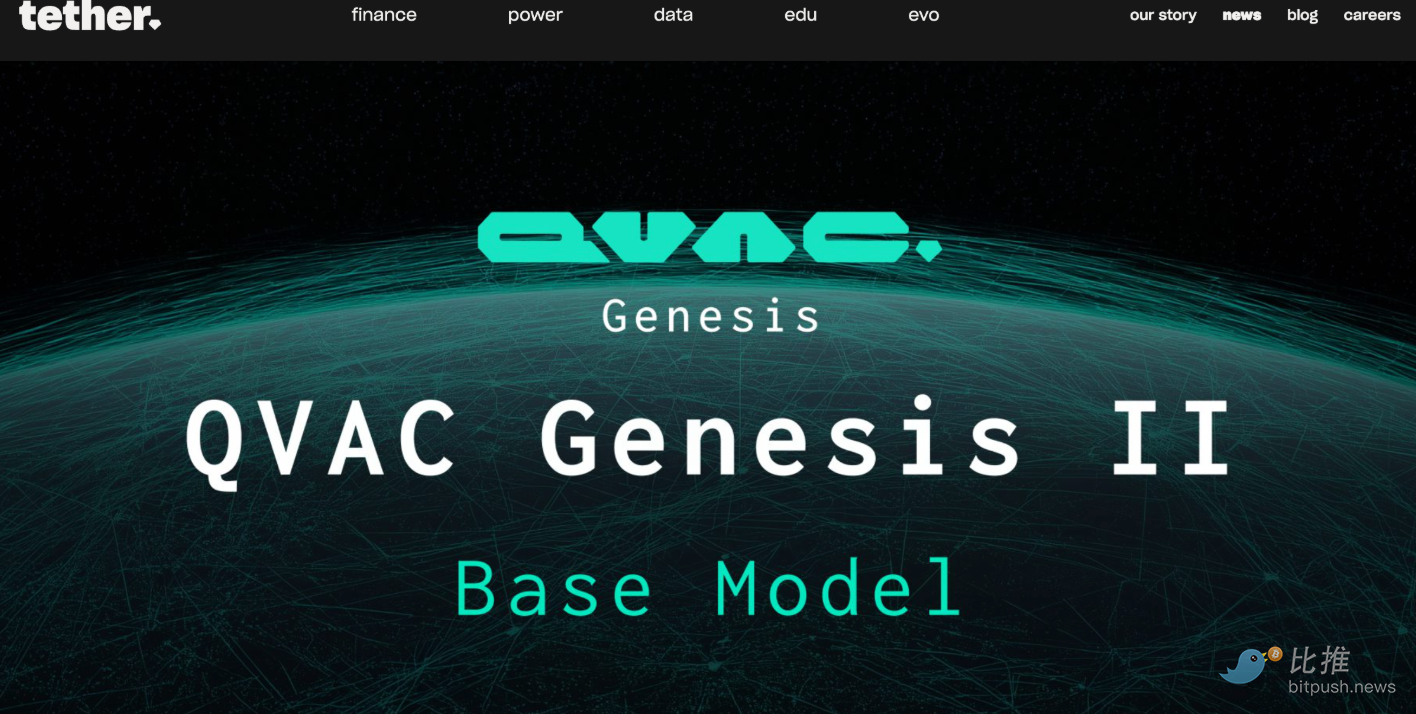
Training AI requires feeding it data. Last week, Tether released a dataset called QVAC Genesis, covering 19 disciplines including mathematics, physics, chemistry, and computer science. They claim it’s the world’s largest open-source AI training dataset.

Keep in mind that OpenAI and Anthropic’s training data are not public. Tether is releasing theirs for free, available to anyone.
Then comes the even more sci-fi part.

In April 2024, Tether spent $200 million to acquire a company called Blackrock Neurotech. The name includes "Blackrock," but it has no relation to the asset management giant BlackRock.

This company works on brain-computer interfaces. They implant chips into human brains, allowing paralyzed individuals to type with their thoughts, control wheelchairs, and operate robotic arms. It sounds like science fiction, but they’ve been doing it since 2008—eight years before Musk’s Neuralink.

How impressive is this company?

Out of the 35 people worldwide who have brain-computer interface chips implanted, 31 use Blackrock’s technology. In 2016, a fully paralyzed patient used their device to control a robotic arm and fist-bump Obama. The chip implanted in the sensory cortex allowed him to "feel" the president’s hand.

Last year, this brain-computer interface company enabled an ALS patient to "speak" again. The chip in his brain translated his thoughts into speech at a rate of 62 words per minute.

Tether spent $200 million to become the majority shareholder of this company.

Combined, Tether has invested nearly $1 billion in AI-related fields. Rumor has it they’re also negotiating with a German robotics company, offering $1.2 billion. If that deal goes through, their total investment could reach $2 billion.

What does this mean?

Anthropic raised $3.5 billion in funding in 2024. Tether’s investment alone is almost half of what a top-tier AI company raised in a year.

OpenAI spent $6.7 billion on R&D in the first half of 2025. Tether, with just a fraction of its profits, can play the role of a major investor in the AI world.

Why is a stablecoin company getting into AI?

We think there are two possibilities.

The first is anxiety. The Fed is cutting interest rates, and Treasury yields are falling. In 2024, they earned $7 billion in interest just by lying back. From 2025 onward, it might not be so easy. Even money-printing machines need new stories.

The second is ambition. The whole world is talking about AI—investors, media, politicians. If you say you’re a stablecoin company, no one pays attention. But if you say you’re working on AI, brain-computer interfaces, and humanoid robots, then you’re:

A tech leader.

The most amusing part?

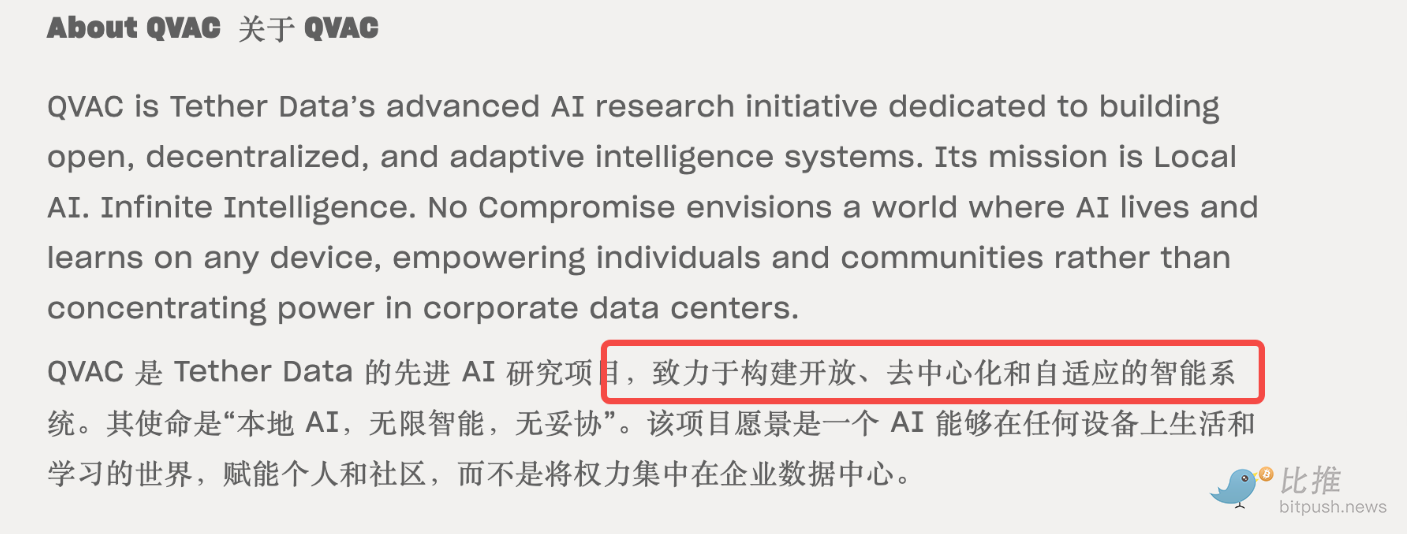
Tether’s slogan for its AI endeavors is "decentralization," "local operation," and "returning intelligence to individuals."
But Tether itself is the most centralized company in the crypto world.

They decide how many coins to issue, how much reserve capital to hold. In ten years of operation, they’ve never been audited. Only they know where users’ money is.

Now, this company wants to teach the world what "decentralized AI" means.

It’s a bit like a casino owner offering classes on how to quit gambling.

Not that it’s impossible.

After all, OpenAI is still losing money and isn’t expected to break even until 2029. Anthropic is in a similar situation, aiming for 2028. Sam Altman is fundraising everywhere, and Dario Amodei is doing the same. The two companies have lost a combined $10 billion and are still telling stories to investors.

Tether doesn’t need to tell stories. The money is already in their pocket.

What’s the biggest challenge in the entire AI industry? The business model.

How to make money? No one knows. When will it make money? No one knows. Can it make money? No one knows.

Tether doesn’t have this problem. Their business model is:

Not doing AI.

They use the money earned from stablecoins to invest in AI. If the investment succeeds, it’s foresight. If it fails, it’s a learning expense. Either way, it doesn’t affect their core business.

Those doing AI are losing money; those not doing AI are making money. Those doing AI are fundraising; those not doing AI are investing.

The best AI business model in 2026 might just be not doing AI.

First, get your money-printing machine in order.


Original link:https://www.bitpush.news/articles/7600174

Related Questions

QHow much profit did Tether make in 2024, and how does it compare to major AI companies like OpenAI and Anthropic?

ATether made a profit of $13 billion in 2024. In comparison, OpenAI had revenue of $3.7 billion but lost $5 billion, while Anthropic had revenue of $1 billion and also lost $5 billion. Combined, the losses of these two major AI companies were less than Tether's profit.

QWhat is Tether's core business model that generates such significant profits?

ATether's core business model involves issuing the USDT stablecoin. When users buy 1 USDT, Tether receives 1 US dollar and uses it to purchase U.S. Treasury bonds. The interest earned on these bonds is kept by Tether, as they do not pay any interest to USDT holders. In 2024, Tether earned $7 billion in interest from this strategy.

QWhat are some key AI-related investments Tether has made, and what is their significance?

ATether has made several significant AI-related investments, including a $600 million+ loan to Northern Data, Europe's largest GPU cloud service provider with over 10,000 Nvidia H100 GPUs. They also released the QVAC Genesis dataset, claimed to be the world's largest open-source AI training data, and acquired Blackrock Neurotech, a brain-computer interface company, for $200 million. Their total AI investments approach $1 billion, with potential additional deals like a $1.2 billion German robotics company.

QWhy is Tether, a centralized stablecoin company, investing in AI and promoting 'decentralized AI'?

ATether is investing in AI likely for two reasons: anxiety over declining U.S. Treasury yields threatening their profit model, and ambition to position themselves as a tech leader in the booming AI field. Despite being a highly centralized company (controlling USDT issuance and reserves without audits), they promote 'decentralized AI' as a strategic narrative to gain relevance and influence in the tech industry.

QWhat ironic contrast does the article highlight about Tether's role in the AI industry?

AThe article highlights the irony that Tether, which profits massively from its stablecoin business without engaging in AI development, is investing in AI while major AI companies like OpenAI and Anthropic are losing billions. Tether doesn't face the AI industry's core problem of finding a sustainable business model; instead, it uses its stablecoin profits to fund AI ventures, making 'not doing AI' a profitable strategy to finance AI investments.

Related Reads

SpaceX, OpenAI, Anthropic: The Three AI Giants Racing for IPO, Which One Is Worth Betting On?

SpaceX, OpenAI, and Anthropic are poised for historic IPOs within weeks, potentially raising a combined $180 billion—a sum exceeding the entire internet bubble's fundraising. The hosts of the Limitless Podcast argue this isn't just individual company financing but an unprecedented capital concentration for AI infrastructure, driven by an insatiable need for compute, data centers, power, and chips. SpaceX's IPO is notable for reportedly changing market index rules to allow faster inclusion, potentially funneling trillions in passive retirement funds into its stock, despite its unproven space-based data center business model. In contrast, Anthropic demonstrates explosive growth, with ARR reportedly hitting $45 billion and approaching profitability, fueled by strong enterprise adoption of products like Claude Code. Google's separate $80 billion raise highlights the immense capital pressure, even for giants. The discussion acknowledges bubble risks but leans optimistic. The hosts contend the massive spending is building essential physical infrastructure for the next technological era. A key bottleneck isn't capital but the real-world limits of chip manufacturing and construction speed. As long as demand for AI compute outstrips supply, this investment cycle represents a foundational build-out rather than a purely financial bubble. All three companies are seen as foundational bets on the future, with Anthropic often cited as the most immediately compelling due to its proven revenue trajectory.

marsbitJust now

SpaceX, OpenAI, Anthropic: The Three AI Giants Racing for IPO, Which One Is Worth Betting On?

marsbitJust now

From 'Old Guys' to 'New Favorites': How AI Is Revaluing Old Infrastructure from Dell to Nokia?

From "Vintage Tech" to "New AI Darlings": How AI Revalues Old Infrastructure One year ago, tech giants like Dell, Nokia, Cisco, and Western Data were seen as slow-growth, low-valuation stories, far from the AI spotlight dominated by players like Nvidia. Now, these legacy tech stocks are gaining market attention, sparking debate on whether this is genuine industry revaluation or a temporary narrative. As AI moves from model parameters to real-world data centers, the market is recognizing companies with proven delivery and infrastructure capabilities. This shift marks a change in the AI investment thesis: from pure model and GPU focus to the complex systems engineering required for deployment. Companies like Dell, HPE, and Corning are being revalued not for being "sexy" AI innovators, but for their decades of accumulated expertise in supply chains, enterprise delivery, and infrastructure—assets that have become critical in the AI buildout phase. The revaluation is unfolding across three key infrastructure lines: 1. **Servers & System Integration:** Dell and HPE are emerging as crucial system integrators or "general contractors" for AI data centers, translating GPU orders into complete, deployable server racks integrated with power, cooling, and networking. 2. **Networking & Connectivity:** AI's scale demands robust high-speed connections. Corning (fiber optics), Nokia (AI-RAN, 6G), and Cisco (data center switches) are gaining importance for enabling efficient data transfer within and between AI clusters. 3. **Storage:** Beyond high-speed memory (HBM/DRAM), the AI data explosion is driving demand for high-capacity hard drives (HDDs) from companies like Western Digital and Seagate to handle training data, logs, and cold storage cost-effectively. For this revaluation to be substantive and not just a narrative, three criteria are key: 1) Concrete AI-related order and revenue growth (e.g., Dell's AI server sales), 2) Upward revisions to company financial guidance, and 3) Sustainable improvements in profit quality, not just top-line revenue spikes. In essence, AI's transition to a real construction phase is re-pricing "old assets" against "new demand." The opportunity, however, is selective. Only those legacy firms that are demonstrably integrated into the capital expenditure chains of data center and enterprise AI deployment are likely to experience a true "logic re-rating" rather than just a temporary valuation bounce.

marsbit6m ago

From 'Old Guys' to 'New Favorites': How AI Is Revaluing Old Infrastructure from Dell to Nokia?

marsbit6m ago

The Merger of Codex and ChatGPT Marks the Beginning of a Major Reshuffle in Programming Tools

OpenAI is shifting its strategic focus from ChatGPT to Codex, merging them along with the browser tool Atlas into a unified desktop super-app. This move signals an internal belief that Codex, originally a programming tool, represents the next evolution of AI more than conversational models like ChatGPT. Over the past year, Codex's weekly active users have surged past 5 million. The key distinction is that while ChatGPT answers questions, Codex executes tasks. Enterprises increasingly value this ability to get work done over simply receiving advice. Consequently, Codex is attracting professionals beyond developers, including analysts, bankers, marketers, and product managers. OpenAI's reorganization and increased investment in Codex stem from recognizing that the future of AI competition lies in execution capabilities, not just conversation. The company is launching role-specific plugins (e.g., for data analysis, sales, design) to transform Codex into a broad knowledge work platform that automates and redefines white-collar workflows. Beyond being a tool, Codex reflects OpenAI's ambition to redefine software. New features like "Sites"—which generates interactive websites from documents—and collaborative "Annotations" aim to create a paradigm where the AI understands the goal and handles the tools and steps, functioning more like a digital colleague than traditional software. The ultimate goal is a unified experience where the user cares only about the completed task.

marsbit15m ago

The Merger of Codex and ChatGPT Marks the Beginning of a Major Reshuffle in Programming Tools

marsbit15m ago

Interpreting Investment Opportunities in the Age of Great Navigation, Invesco Great Wall Fund Releases '2026 Report on Chinese Enterprises Going Global'

Invesco Great Wall Fund has released its "2026 China Corporate Globalization Report," titled "The 'Great Navigation Era' of Chinese Enterprises." The report analyzes the new trends and investment opportunities as Chinese companies expand globally, moving from simple product exports to comprehensive overseas operations involving services, branding, and local production. Driven by factors like trade friction, the pursuit of higher profit margins abroad, and policy support, globalization is becoming essential for Chinese companies. The report outlines an evolution: from early product export ("Globalization 1.0") to the current "Globalization 2.0," characterized by overseas capacity, capital goods investment, consumer brand expansion, and service exports. Chinese firms' competitive advantages are highlighted, including a vast engineer talent pool, low-cost and robust infrastructure, and complete industrial clusters. Specific sectors with significant出海 potential are identified: * **Capital Goods** (e.g., engineering machinery, power equipment): Benefiting from global demand, especially in Belt & Road markets and the AI-driven power grid upgrade cycle. * **Consumer Brands**: Transitioning from cost to brand advantage, leveraging供应链 efficiency. * **Technology & Innovation**: Including AI applications, optical modules within global tech supply chains, and new energy vehicles focusing on local production. * **Pharmaceuticals**: Chinese biotech firms are becoming preferred partners for global pharma, with potential for breakthrough drugs in areas like oncology and weight loss. The report concludes that corporate globalization represents a sustained, core theme for China's capital markets, though companies must navigate challenges like geopolitics and localization.

marsbit28m ago

Interpreting Investment Opportunities in the Age of Great Navigation, Invesco Great Wall Fund Releases '2026 Report on Chinese Enterprises Going Global'

marsbit28m ago

Trading

Spot
Futures

Hot Articles

Discussions

Welcome to the HTX Community. Here, you can stay informed about the latest platform developments and gain access to professional market insights. Users' opinions on the price of AI (AI) are presented below.

活动图片















