The Day CZ Missed the Best Investment of His Life, Crypto Missed AI

Odaily星球日报Published on 2026-02-09Last updated on 2026-02-09

Abstract

CZ, the founder of Binance, famously sold his Shanghai apartment in 2014 to buy Bitcoin—a move that would have yielded nearly $190 million at its peak. But an even bigger opportunity came years later, one that he ultimately walked away from. In November 2021, amid a liquidity crisis at FTX, Binance signed a non-binding letter of intent to acquire the rival exchange. The deal fell through within days, accelerating FTX’s collapse. Unbeknownst to many, FTX held a hidden gem in its portfolio: a $500 million lead investment in AI startup Anthropic, acquired in April 2021 for a 13.56% stake (later diluted to 7.84%). At the time, AI had not yet entered its explosive growth phase. But after the launch of ChatGPT and the rise of Anthropic’s Claude models, the company’s valuation soared. Recent reports suggest Anthropic is raising funds at a valuation as high as $350 billion. At that level, FTX’s stake would have been worth approximately $27.44 billion—more than enough to cover the exchange’s infamous shortfall. After FTX’s bankruptcy, its Anthropic shares were sold off in court-approved transactions totaling over $1.3 billion to traditional financial firms and Abu Dhabi-based investors—not to crypto companies. The article reflects on what could have been: had CZ acquired FTX, or had SBF held on, a major crypto-native entity could have held influence in one of AI’s top firms, potentially fostering deeper integration between crypto and AI. Instead, that opportunity slipped into trad...

Original | Odaily Planet Daily (@OdailyChina)

Author | Azuma (@azuma_eth)
In 2014, just one year after being introduced to the concept of cryptocurrency, CZ made the most daring investment of his life — he sold his apartment in Shanghai and "all-in" on approximately 1,500 BTC at a three-digit price. Twelve years later, if CZ had never sold, this investment could have yielded hundreds of millions of dollars in profits (peak returns of approximately $189 million).

Compared to his subsequent achievements of founding Binance and rising to become the industry leader, the returns from this investment are insignificant to CZ. But from an external perspective, this idealistic "all-or-nothing" move remains one of CZ's most talked-about actions.

Yet, it is lamentable that even someone as resolute and decisive as CZ once missed, in a highly dramatic fashion, an investment with potential profits a hundred times greater than "selling a house to buy Bitcoin."

Rewind 1555 Days: That Aborted Acquisition

November 9, 2021, was a sleepless night for the cryptocurrency industry.

Just the day before, the then high-flying FTX suspended withdrawals due to a liquidity crisis. Panic quickly spread through the community, and the damp smell of an impending storm began to permeate the market... The rest of the story is well-known: FTX collapsed, triggering a domino effect that plunged the market into a prolonged winter lasting several years.

In a parallel universe, the story could have taken a different turn. In the early hours of November 9, SBF and CZ issued statements announcing that FTX had preliminarily reached an acquisition agreement with Binance.
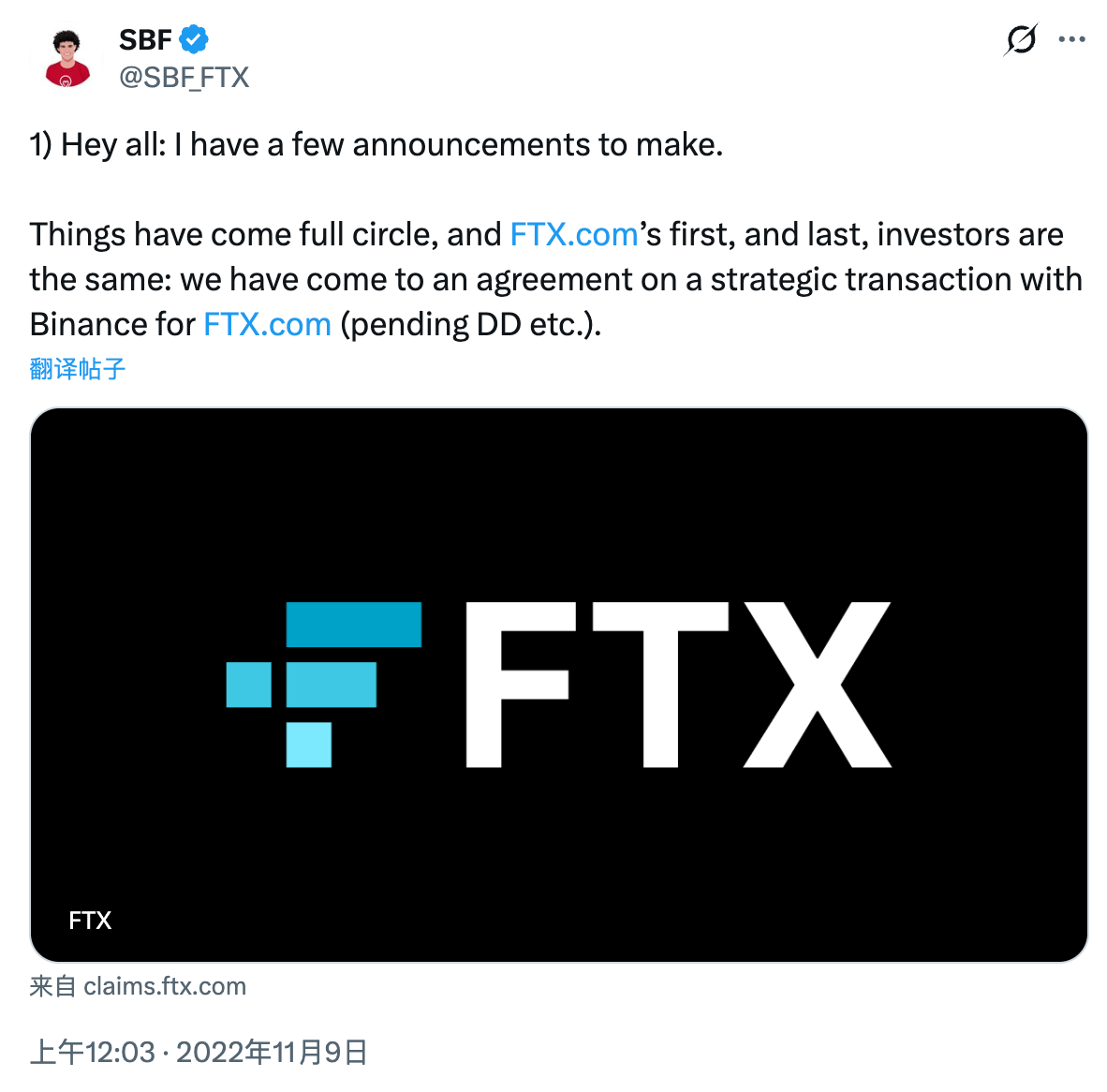
SBF: Hey everyone, I have some news to share. Things have come full circle. FTX's first and last investors are the same — we have reached a strategic transaction agreement with Binance (pending due diligence).
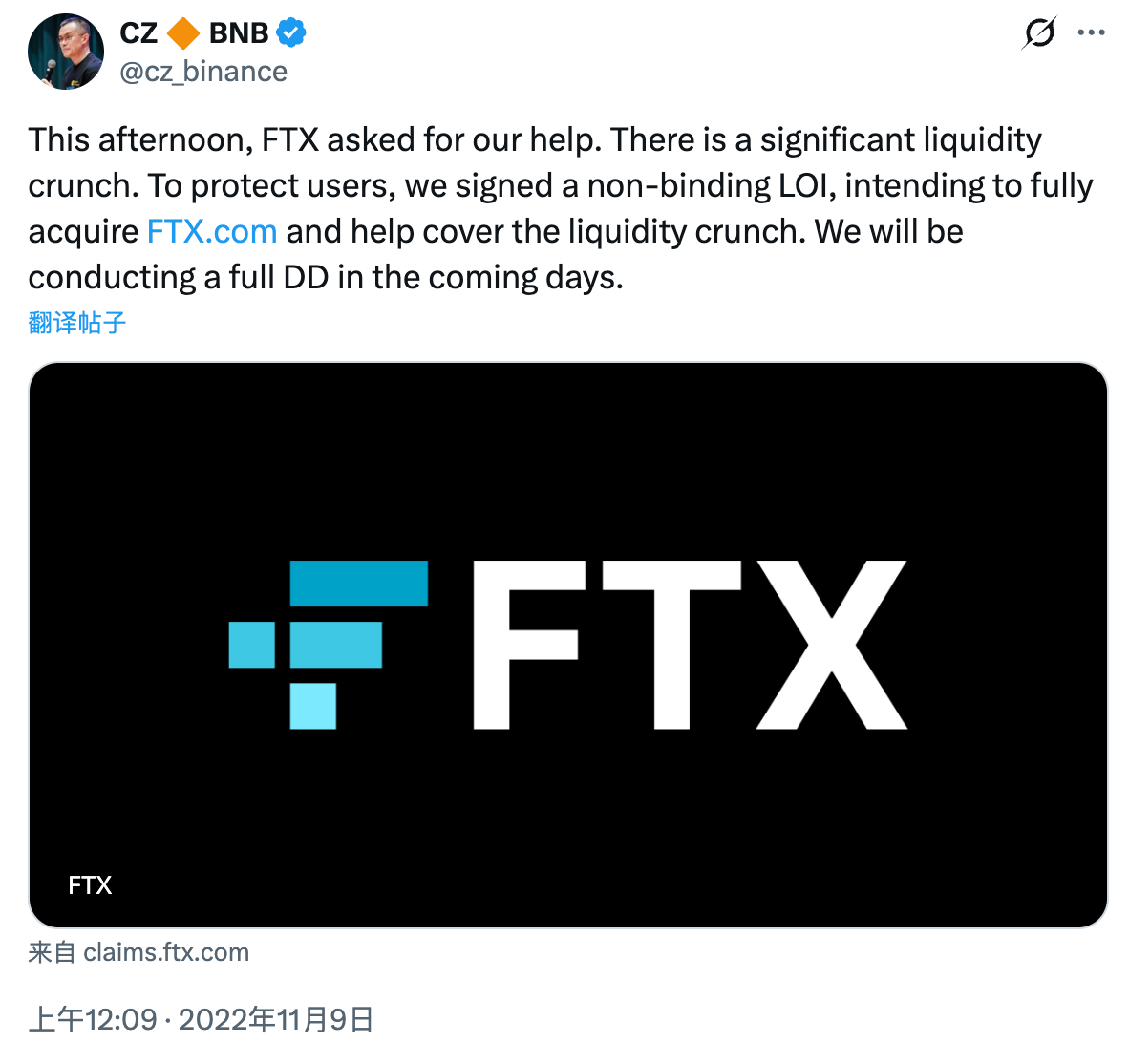
CZ: This afternoon, FTX asked us for help. The exchange is currently facing a severe liquidity crunch. To protect users, we signed a non-binding Letter of Intent, intending to fully acquire FTX to help address the liquidity crisis. We will conduct full due diligence in the coming days.

However, the acquisition ultimately fell through. Just one day later, Binance officially announced it was abandoning the acquisition, citing "issues beyond our control," which became the final straw that broke FTX's back.

Did CZ ever seriously consider acquiring FTX? Was the hastily concluded acquisition farce a genuine attempt to help or merely a ploy to gauge the opponent's "health bar"? This may forever remain a mystery. From the outcome, CZ personally defeated his biggest competitor at the time, solidifying Binance's position as the industry's top player.

But no one could have predicted that a seemingly insignificant "side bet" in FTX's asset portfolio at the time would rapidly appreciate in value over the next few years, now worth far more than the sum of all other assets involved in that aborted acquisition.

From a "Side Bet" to the Center of AI

In April 2022 (the official announcement date; the deal was actually completed in 2021), FTX made its most important investment in the AI field — leading a $580 million funding round for AI startup Anthropic with a $500 million investment, initially acquiring a 13.56% equity stake, which was later diluted to 7.84% as Anthropic completed multiple funding rounds.
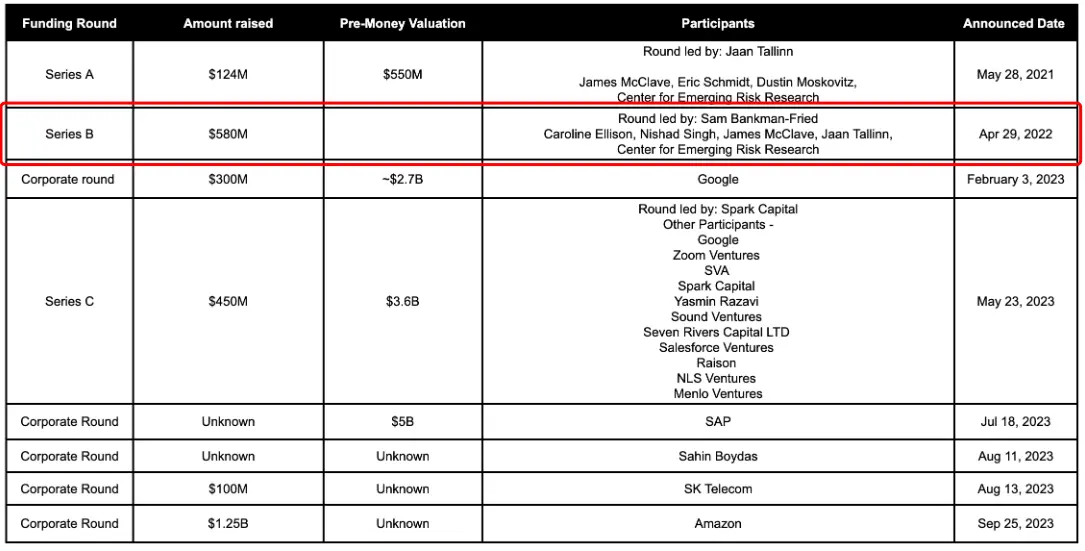
That was an era when AI's potential had not yet exploded. Just six months later (in late November 2022, the same month FTX collapsed), OpenAI's ChatGPT was released, irreversibly ushering the world into the "Age of Exploration" for AI. Anthropic, with its Claude series of products (especially the programming-oriented Claude Code), repeatedly amazed the world, gradually becoming one of the most prominent companies in the AI era.

As Claude continued to evolve, Anthropic's valuation also soared. Capital frantically waved cash, desperate to secure a spot on Anthropic's journey to an IPO. The latest market rumor is that Anthropic is in the final stages of a new large funding round, expected to exceed $20 billion (originally planned to raise $10 billion, but investor demand far exceeded expectations, potentially doubling the final amount), with a valuation possibly as high as $350 billion. The deal could be completed as early as this week.

At the latest valuation of $350 billion, FTX's former stake in Anthropic would be worth approximately $27.44 billion, enough to cover the reserve shortfall that led to its bankruptcy multiple times over... But history has already happened, and the outcome is set.

It's hard not to acknowledge that SBF was a rare venture capital genius (besides Anthropic, he also invested in the now-hot Cursor in its seed round), but he was clearly not a qualified business operator, especially lacking in risk control. CZ's profile is the opposite: he is an absolute master at operating a business, and Binance's dominance is inseparable from his many correct strategic decisions. But CZ often admits he is not a traditional investor solely pursuing returns; he doesn't trade cryptocurrencies and prefers to be a builder in the industry.

A Messy Ending: This Should Have Been the Best Intersection of Crypto and AI

You might wonder, what happened to those FTX shares in the end?

The outcome is straightforward. After FTX's bankruptcy, all assets, including the Anthropic equity, were handled by the FTX bankruptcy estate. In February 2024, the court approved the estate's request to sell these shares; in March and June of the same year, the FTX estate sold 29.5 million shares for $884 million and 15 million shares for $450 million, respectively, totaling over $1.3 billion in sales.
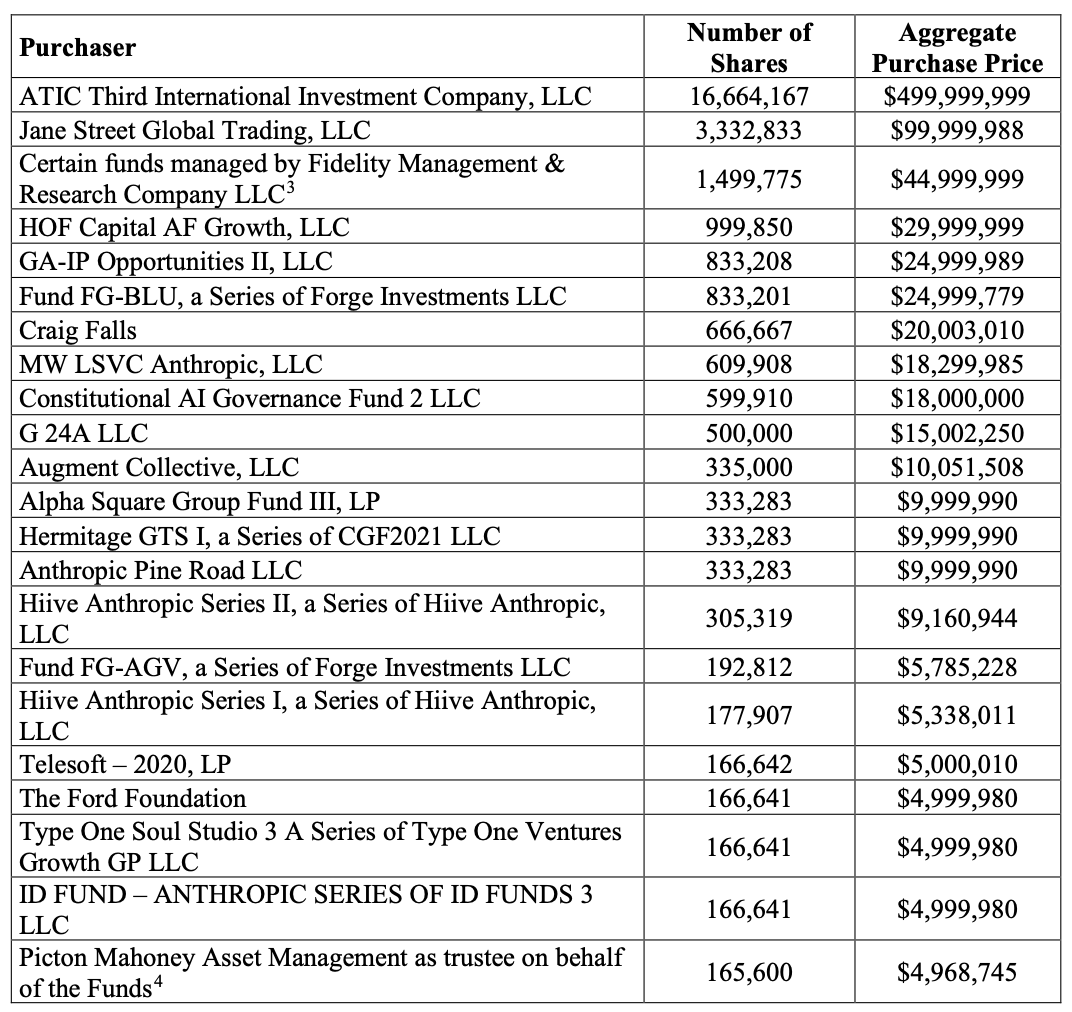
As for the buyers of these shares, they were primarily ATIC Third International Investment from Abu Dhabi, and traditional financial institutions from Wall Street like Jane Street and Fidelity. In other words, no crypto companies got a piece of the pie.

Whether these shares were deliberately sold cheaply or if there was利益输送 (benefit transfer) under the guise of bankruptcy liquidation is no longer important to the crypto industry.

This should have been the best intersection of Crypto and AI. In another timeline, whether these shares were held by SBF or CZ, if the leading enterprises of the crypto world had some influence in the development of the most successful company in the AI world, there could have been more innovative attempts around Crypto + AI, leading to unexpected fruits.

The one slapping his thigh in regret isn't just CZ.

Related Questions

QWhat was the potential return on CZ's investment if he had not sold the 1500 BTC he bought in 2014?

AThe peak return would have been approximately $189 million.

QWhy did Binance ultimately abandon the acquisition of FTX in November 2021?

ABinance cited that the issues at FTX were 'beyond their control or ability to help' after conducting due diligence.

QWhat was the significance of FTX's investment in Anthropic, and how much was the initial investment?

AFTX invested $500 million to lead a $580 million funding round in Anthropic, acquiring an initial 13.56% stake, which was later diluted to 7.84%.

QWhat is the current estimated valuation of Anthropic, and what is the value of FTX's former stake at that valuation?

AAnthropic's latest estimated valuation is $350 billion, making FTX's former 7.84% stake worth approximately $27.44 billion.

QWho ended up purchasing the Anthropic股权 (shares) from the bankruptcy estate of FTX, and for how much?

AThe shares were sold to traditional financial institutions, including ATIC Third International Investment from Abu Dhabi, Jane Street, and Fidelity, for a total of over $1.3 billion in two separate transactions ($884 million and $450 million).

Related Reads

Vitalik: We Need to Create Sanctuaries, Not Fight AI

In a recent interview, Vitalik Buterin, founder of Ethereum, addresses the central anxiety of the AI era. He argues the primary risk isn't AI's intelligence, but human passivity—ceding decisions, privacy, and agency to centralized systems or "super AIs" for a sense of "disempowering safety." His solution is not to fight AI, but to build "sanctuary technologies." These are optional, non-totalizing spaces that protect users while preserving their sovereignty and privacy. Ethereum is presented as a prime example, offering a parallel financial system one can freely choose, not a fix for the old one. Reflecting on his journey from a 19-year-old on "autopilot" to an active "pilot," Vitalik notes the world reinvents itself every 5-10 years. To keep up, individuals must actively pilot their lives, not be passive passengers. He stresses that active learning vastly outperforms passive learning, even with equal time invested. His practical advice for builders and individuals in the AI age includes: periodically forcing oneself to do tasks manually to keep the mind engaged; prioritizing active learning and verification over outsourcing answers; building tools that help retain human agency; not outsourcing all strategic thinking to AI; and preserving serendipity through real-world interactions. Ultimately, Buterin redefines Ethereum/crypto's role: not to win against or fix the old world, but to provide a free, optional alternative. The core message is that as AI grows more powerful, the truly scarce resource will be proactive humans who retain their sovereignty, privacy, and capacity for independent thought. The era demands not less tool use, but more intentional and active use of technology.

链捕手2h ago

Vitalik: We Need to Create Sanctuaries, Not Fight AI

链捕手2h ago

Conversation with Patagon Founder: Revealing the Inside Story of Anthropic's Secondary Market

**Summary: Inside Anthropic's Massive, Opaque Secondary Market** In a revealing interview, Patagon founder Dio Casares pulls back the curtain on the booming, high-risk secondary market for shares in companies like Anthropic. This private market, fueled by companies staying private longer and massive funding rounds, is estimated to involve hundreds of billions of dollars. Casares distinguishes between two types of "secondary" trading: 1. **Company-approved SPV (Special Purpose Vehicle) sales:** Where new capital flows into the company, often facilitated by select private equity firms. Anthropic supports this to manage liquidity and pre-IPO selling pressure. 2. **The "gray" market:** Platforms like Hive and Forge that match buyers and sellers, often creating pricing confusion and competing with official funding rounds. These intermediaries are widely disliked by companies. The market structure is complex and fragmented, relying heavily on personal connections. Brokers connect buyers and sellers, often layering multiple SPVs to pool capital, with single transaction fees as high as 10%. Strikingly, some finance professionals earn more from this trading than from their primary investment roles. **Key risks highlighted include:** * **High Fraud Rates:** An estimated 10-20% of transactions involve fake stock certificates or sellers who take payment without having the shares. * **Complex, Risky Structures:** Nested SPVs, "forward contracts" on employee equity, and tokenized private equity create layers of opacity. This is exemplified by a recent incident where an xAI employee's shares were revoked after an espionage allegation, leaving buyers empty-handed. * **Post-IPO "Settlement Hell":** After an IPO, delays in distributing shares through multiple SPV layers and decisions by fund managers to hold onto shares could trigger years of lawsuits as downstream investors are locked out. **For small investors** holding positions through tokenized vehicles or layered SPVs, it's often impossible to verify the underlying asset. Casares advises caution: if the investment feels wrong, consider exiting. As the private market now surpasses IPO fundraising, this "wild west" ecosystem faces a looming reckoning. While it will likely professionalize, the post-IPO period for a company like Anthropic could unleash a wave of disputes, exposing the vulnerabilities built into this frenzied, largely unregulated marketplace.

marsbit4h ago

Conversation with Patagon Founder: Revealing the Inside Story of Anthropic's Secondary Market

marsbit4h ago

Trading

Spot
Futures

Hot Articles

Discussions

Welcome to the HTX Community. Here, you can stay informed about the latest platform developments and gain access to professional market insights. Users' opinions on the price of AI (AI) are presented below.

活动图片















