Weekly Token Unlocks: PYTH Unlocks Tokens Up to 37% of Circulating Supply

marsbitPublished on 2026-05-17Last updated on 2026-05-17

Abstract

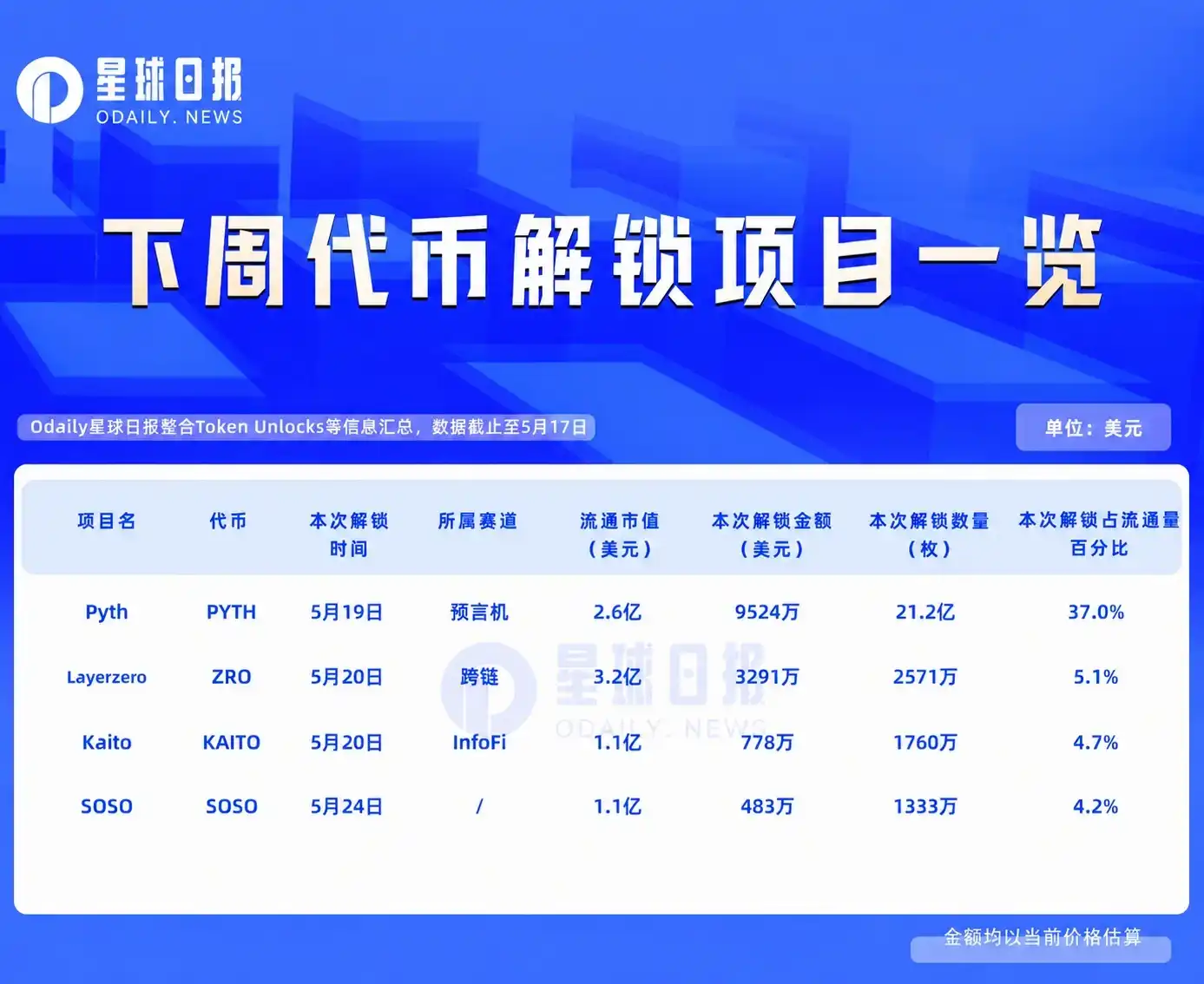
This week's major token unlocks feature three notable projects, each releasing a significant number of tokens into circulation. **Pyth Network** is set for the largest unlock, releasing 2.12 billion PYTH tokens valued at approximately $95.24 million. This amount represents a substantial portion of its circulating supply. Pyth is a decentralized oracle network providing real-time financial market data for DeFi applications. **LayerZero** will unlock 25.71 million ZRO tokens, worth around $32.91 million. LayerZero is a full-chain interoperability protocol designed for secure and configurable cross-chain messaging. **Kaito** will release 17.6 million KAI tokens, with an estimated value of $7.78 million. Kaito is an AI-driven platform that aggregates and analyzes fragmented Web3 information from various sources like social media and governance forums. Each project section includes links to their official Twitter and website, along with a chart depicting their specific token release schedule.

Pyth

Project Twitter: https://twitter.com/PythNetwork

Project Website: https://pyth.network/

Tokens Unlocked This Time: 2.12 billion

Value Unlocked This Time: Approximately $95.24 million

Pyth Network is a decentralized oracle project, providing real-time and accurate financial market data covering DEXs, derivatives, DeFi lending, stablecoins, synthetic assets, etc. It aims to enhance the functionality and reliability of decentralized finance (DeFi) applications.

Specific release schedule is as follows:
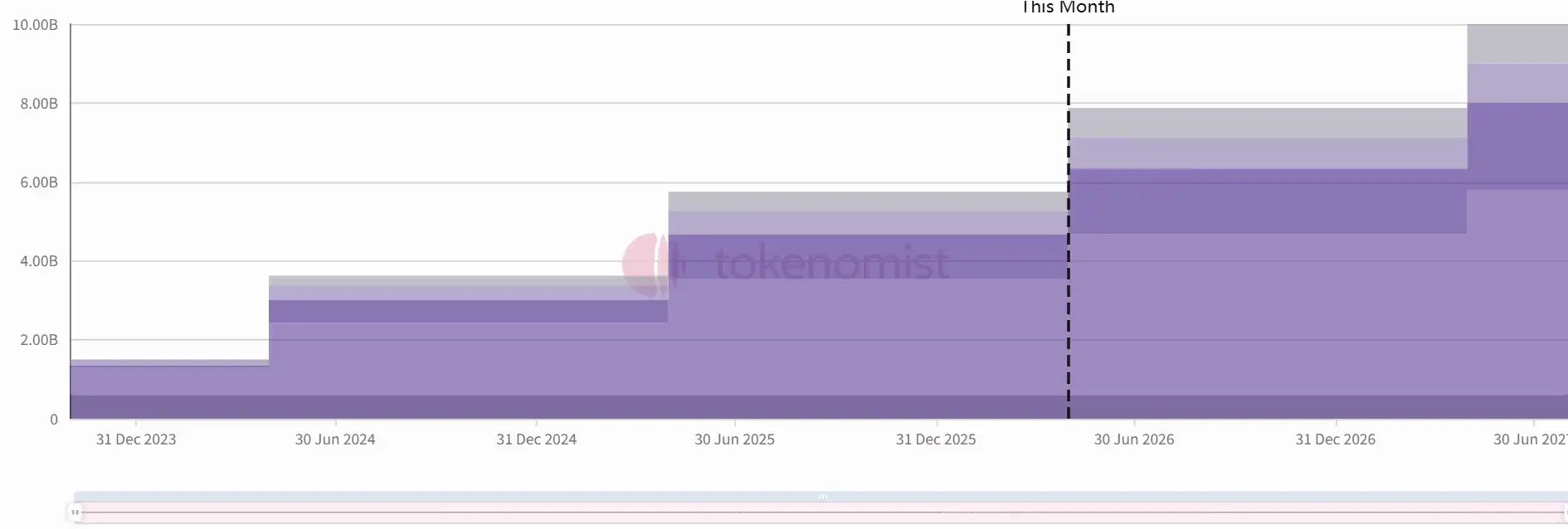
Layerzero

Project Twitter: https://x.com/LayerZero_Core

Project Website: https://layerzero.network/

Tokens Unlocked This Time: 25.71 million

Value Unlocked This Time: Approximately $32.91 million

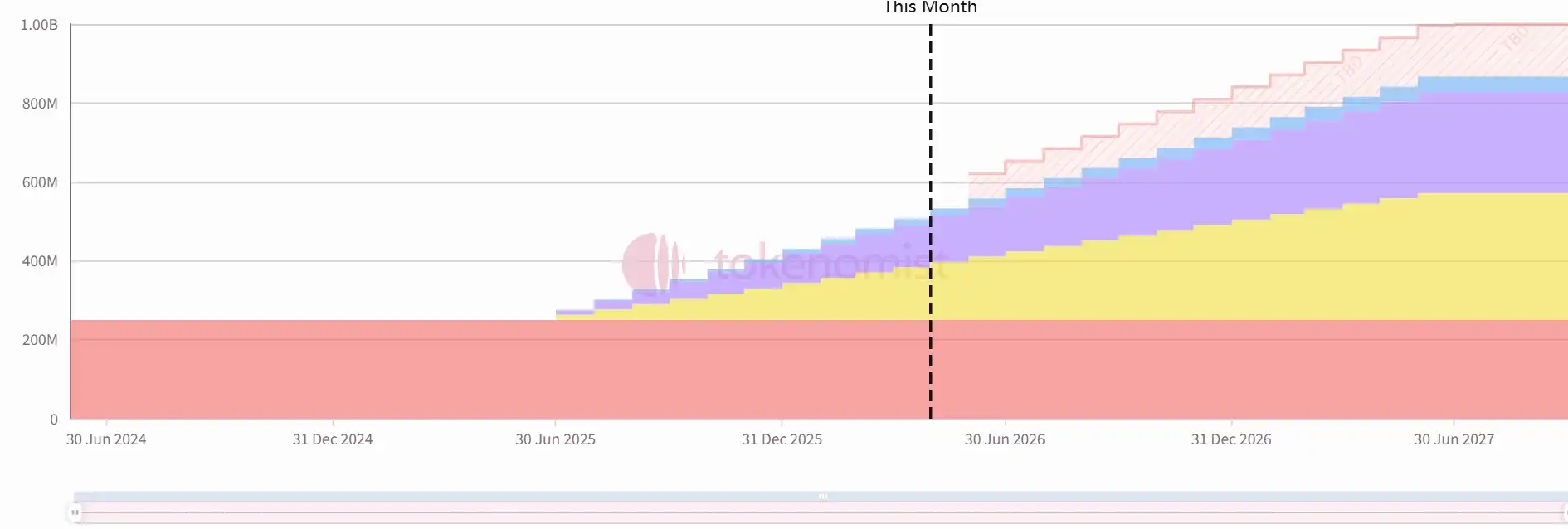
LayerZero is an omnichain interoperability protocol designed for lightweight message passing across chains. LayerZero provides trusted and guaranteed message delivery with configurable trustlessness.

Specific release schedule is as follows:
Kaito

Project Twitter: https://x.com/KaitoAI

Project Website: https://www.kaito.ai/

Tokens Unlocked This Time: 17.60 million

Value Unlocked This Time: Approximately $7.78 million

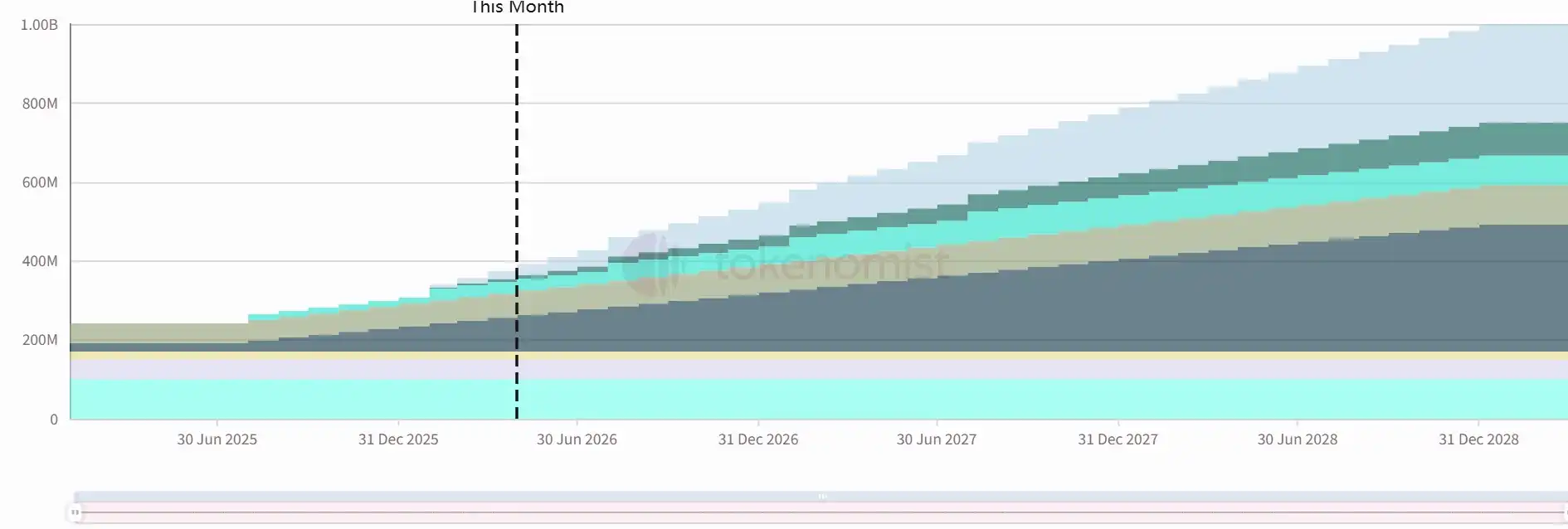
Kaito is an AI-driven Web3 information platform aimed at solving the issue of fragmented information in the crypto industry. By aggregating data from social media, governance forums, and other sources, Kaito uses AI technology to provide real-time search, sentiment analysis, and trend tracking.

Specific release schedule is as follows:
Related Questions

QWhat percentage of the circulating supply does PYTH unlock represent according to the article?

A37% of the circulating supply.

QWhat is the primary function of the Pyth Network described in the article?

AIt is a decentralized oracle project that provides real-time, precise financial market data to enhance the functionality and reliability of DeFi applications.

QHow many tokens is LayerZero scheduled to unlock in this event?

A25.71 million tokens.

QWhat is the core purpose of the Kaito project as mentioned in the text?

AKaito is an AI-driven Web3 information platform that aims to solve information fragmentation in the crypto industry by aggregating data sources and providing real-time search, sentiment analysis, and trend tracking.

QWhat is the approximate USD value of the Pyth token unlock mentioned in the article?

AApproximately $95.24 million.

Related Reads

From a $300 Million Valuation to a 'Fire Sale' at Tens of Millions: What Happened to Messari?

On June 12, leading crypto data and capital markets platform Blockworks announced its acquisition of competitor Messari for over $10 million. This price represents a significant discount from Messari's 2022 valuation peak of approximately $300 million, highlighting the survival pressures faced by high-valuation startups during the bear market and a consolidation wave in data infrastructure. Blockworks, founded in 2018, began as a media and events company but has pivoted to focus on institutional-grade data, investor relations, and compliance tools. Its recent Series A extension round, valuing the company at $192 million, aimed to fund this shift and strategic acquisitions like this one. Messari, also founded in 2018, grew as a go-to platform for professional crypto research and data, raising a $35 million Series B at its $300 million valuation in late 2022. However, the prolonged bear market and subsequent internal changes, including founder Ryan Selkis's departure in 2024, increased operational pressures. The acquisition integrates Messari's extensive data platform and API capabilities with Blockworks's strengths in issuer-side disclosure, investor relations, and compliance workflows. The combined entity aims to build a unified "system of record" for the on-chain market. This reflects a broader industry trend where high-quality, structured data is becoming critical for institutional adoption, AI agents, and creating data moats akin to traditional financial platforms like Bloomberg. The deal exemplifies how market consolidation is reshaping the fragmented crypto data landscape.

marsbit12m ago

From a $300 Million Valuation to a 'Fire Sale' at Tens of Millions: What Happened to Messari?

marsbit12m ago

If the AI Bubble Is Already Bursting, Who Will Truly Survive?

If the AI Bubble is Bursting, Who Will Remain? The debate over an AI bubble is intensifying, with figures like Ray Dalio warning of high levels and Jensen Huang seeing immense, early-stage opportunity. Both views hold truth: a speculative bubble in capital markets likely exists, mirroring the dot-com era, but the underlying technological shift is real and transformative. History shows that while bubbles burst—wiping out overvalued companies and speculative capital—they often leave behind critical physical and digital infrastructure. The dot-com bust, for instance, eliminated many firms but left the global fiber optic networks and data centers that enabled the rise of Amazon, Netflix, and cloud computing. Today's massive AI infrastructure investments (projected at trillions by 2030) in data centers, power, cooling, and GPUs may follow a similar path, creating the foundation for future applications. A key divergence from past bubbles is the "Jevons Paradox" effect in AI. As the cost of AI inference has plummeted by over 99.7% since 2023, enterprise spending on AI has skyrocketed. Cheap "tokens" have unlocked vast, previously uneconomical use cases, moving AI from simple chatbots into core business workflows—code generation, legal document review, scientific simulation, and financial analysis. The market is now in a phase of self-correction, weeding out superficial "API-wrapper" startups, but this cleansing process strengthens the ecosystem. The long-term trajectory is clear. The value is gradually shifting from capital expenditure (CapEx) on hardware to operational expenditure (OpEx) on transformative applications. As AI becomes a utility, the winners will be firms that deeply integrate it to solve vertical industry problems in law, healthcare, finance, and manufacturing. The泡沫 will recede, but the foundational shift towards an AI-powered era across all sectors is irreversible. The underlying productive force of AI contains no bubble.

marsbit44m ago

If the AI Bubble Is Already Bursting, Who Will Truly Survive?

marsbit44m ago

If the AI Bubble Is Already Bursting, Who Will Truly Remain?

**Summary: If the AI Bubble is Bursting, What Will Remain?** The debate around an AI bubble is intensifying, with figures like Ray Dalio warning of high valuations while Jensen Huang sees immense opportunity. This echoes the dot-com bubble, which saw massive wealth destruction but ultimately left behind critical infrastructure like undersea cables and broadband, enabling future giants like Amazon and Netflix. Similarly, today's AI boom involves trillions invested in data centers, power, cooling, and GPUs, while application-layer revenue remains comparatively modest. This investment-disparity signals a bubble. However, the core technological progress is real and accelerating. AI inference costs have plummeted by over 99.7% since 2023, making intelligence increasingly cheap and accessible. This cost collapse is unlocking vast new demand. Instead of reducing spending, enterprises are tripling their AI cloud expenditure. Cheap "tokens" enable AI to move beyond simple chatbots into complex workflows—automating code writing, legal document review, financial analysis, and scientific research. This follows "Jevons's paradox": improved efficiency leads to greater total consumption. The market is now undergoing a necessary purification, weeding out "API-wrapper" startups with no real moat. The deeper evolution involves a shift from capital expenditure (CapEx) on infrastructure to operational expenditure (OpEx) on value-creation in applications. While hardware vendors currently profit most, long-term value will migrate to AI-native firms solving vertical industry problems. Ultimately, a market correction will cleanse speculative excess but will not reverse the AI+ trend. The massive physical and algorithmic infrastructure being built will endure, becoming a cheap, utility-like foundation. Just as the internet became indispensable to all industries post-2000, AI is poised to empower and redefine every sector, moving society irreversibly toward an intelligence-augmented era. The bubble may burst, but the underlying productive momentum is solid.

链捕手51m ago

If the AI Bubble Is Already Bursting, Who Will Truly Remain?

链捕手51m ago

Microsoft CEO: In the AI Era, How Do You Define a Company's Moat?

Microsoft CEO Satya Nadella argues that in the AI era, a company's true competitive edge, or "moat," is not determined by choosing the single most powerful model, but by its ability to build a continuous "learning loop." This system integrates and evolves by connecting human workflows, domain expertise, organizational judgment, and employee experience. He posits that future companies will accumulate two types of capital: Human Capital (employee knowledge, judgment, creativity) and "Token Capital" (a firm's own built and owned AI capabilities). Importantly, AI amplifies rather than devalues human capital. Human direction is essential to guide progress, as computational power alone is aimless. The core opportunity lies in creating a closed-loop system where human and token capital reinforce each other in a compound, self-improving cycle. A company must be able to preserve its unique institutional knowledge—its "company veteran" expertise—even if it switches underlying general-purpose AI models. This requires private evaluation benchmarks, reinforcement learning environments based on internal data, and queryable knowledge bases. Nadella warns against a future where economic value is concentrated by a few dominant models that commoditize entire industries' knowledge. Instead, the priority should be building a broad "frontier ecosystem" where every company, industry, and nation can own its learning loop. This allows organizations to retain control of their intellectual property, amplify employee capabilities, and ensure the economic value created by AI is captured within their own businesses and communities. True corporate sovereignty in the AI age comes from turning organizational knowledge into a compounding system that creates enduring, defensible value.

marsbit1h ago

Microsoft CEO: In the AI Era, How Do You Define a Company's Moat?

marsbit1h ago

Trading

Spot
Futures

Hot Articles

How to Buy PYTH

Welcome to HTX.com! We've made purchasing PYTH (Pyth) (PYTH) simple and convenient. Follow our step-by-step guide to embark on your crypto journey.Step 1: Create Your HTX AccountUse your email or phone number to sign up for a free account on HTX. Experience a hassle-free registration journey and unlock all features.Get My AccountStep 2: Go to Buy Crypto and Choose Your Payment MethodCredit/Debit Card: Use your Visa or Mastercard to buy PYTH (Pyth) (PYTH) instantly.Balance: Use funds from your HTX account balance to trade seamlessly.Third Parties: We've added popular payment methods such as Google Pay and Apple Pay to enhance convenience.P2P: Trade directly with other users on HTX.Over-the-Counter (OTC): We offer tailor-made services and competitive exchange rates for traders.Step 3: Store Your PYTH (Pyth) (PYTH)After purchasing your PYTH (Pyth) (PYTH), store it in your HTX account. Alternatively, you can send it elsewhere via blockchain transfer or use it to trade other cryptocurrencies.Step 4: Trade PYTH (Pyth) (PYTH)Easily trade PYTH (Pyth) (PYTH) on HTX's spot market. Simply access your account, select your trading pair, execute your trades, and monitor in real-time. We offer a user-friendly experience for both beginners and seasoned traders.

3.6k Total ViewsPublished 2024.03.29Updated 2026.06.02

How to Buy PYTH

Discussions

Welcome to the HTX Community. Here, you can stay informed about the latest platform developments and gain access to professional market insights. Users' opinions on the price of PYTH (PYTH) are presented below.

活动图片