# Airdrop Related Articles

HTX News Center provides the latest articles and in-depth analysis on "Airdrop", covering market trends, project updates, tech developments, and regulatory policies in the crypto industry.

Bitcoin's ECX Hard Fork to Introduce Three New Versions Throughout October

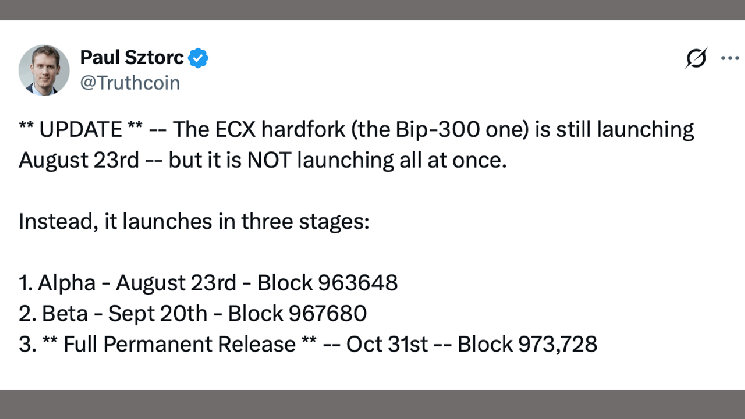
Bitcoin developer Paul Stortz, behind the Drivechain and BIP 300 proposals, has announced a hardfork for a new blockchain called ECX. Scheduled for October 31st (the 18th anniversary of the Bitcoin whitepaper), ECX will copy Bitcoin's full transaction history at a specific block height, crediting nearly all Bitcoin holders with an equal amount of ECX coins without altering the Bitcoin network itself. The launch will be executed in three phases. An "alpha" version is set for August 23rd (block 963,648), followed by a "beta" version on September 20th (block 967,680). The final mainnet launch is planned for October 31st (block 973,728). Coins accumulated during the alpha and beta phases can later be burned or swapped for real ECX. Stortz cites several reasons for the phased rollout: to address potential software bugs (including those possibly found by AI), allow an early market price to form for ECX before mining difficulty stabilizes, and let traders test and speculate. He described it as a "safety net" to manage any major issues and to demonstrate the chain's functionality. A key detail is that replay protection—a mechanism to prevent a transaction from being valid on both the Bitcoin and ECX chains—will remain optional, not automatic. The official ECX wallet software will apply this protection and warn users; Stortz warned that transactions ignoring this warning will be replayed on ECX, effectively tracking a user's spent bitcoins to their new owner unless a deliberate split is made. Stortz has given holders and exchanges 12 weeks from the alpha launch to prepare, during which they must decide on practical matters like running the wallet software to split their BTC and ECX holdings and how exchanges will credit the new asset to clients. The announcement comes as Bitcoin also faces another potential fork related to BIP-110.

cryptonews.ru08/08 22:14

Bitcoin's ECX Hard Fork to Introduce Three New Versions Throughout October

cryptonews.ru08/08 22:14

POAP Shuts Down: The Conclusion of an On-Chain Commemorative Badge Experiment

On August 3rd, POAP co-founder Isabel Gonzalez announced the platform's shutdown after over five years of operation. The service, which began phasing out in March by entering maintenance mode, will now cease entirely, though previously minted POAP badges remain viewable on-chain. POAP originated at the 2019 ETHDenver hackathon, where founder Patricio Worthalter distributed the first digital badges as on-chain proof of attendance. It gained significant traction during the 2021 NFT boom, becoming a staple for community events, conferences, and AMAs. POAPs evolved into a form of digital resume, used for gating access, airdrop whitelisting, and measuring DAO contributions. Major brands like Adidas and Porsche also adopted it for marketing. Despite securing a $10 million seed round in 2022 and amassing over 6.7 million minted badges by mid-2023, POAP struggled post-bull market. A shift to charging commercial clients in 2023 failed to ensure long-term sustainability. Gonzalez acknowledged the platform found a clear niche but no viable business model within it. POAP joins other discontinued NFT experiments, such as Starbucks' Odyssey, Meta's Instagram NFT features, and Reddit's Collectible Avatars. These projects shared a common flaw: treating blockchain as an end rather than a tool for genuinely needed solutions. POAP's story is particularly poignant—it wasn't speculative but faced a ceiling; the demand for digital mementos proved too niche to support a venture-backed company. The badges endure on the blockchain, but the platform behind them has departed.

marsbit08/04 09:48

POAP Shuts Down: The Conclusion of an On-Chain Commemorative Badge Experiment

marsbit08/04 09:48

Base Launches 'Human Verification', Is the Airdrop on the Agenda?

Base has launched "Base Verify Onchain," a new verification mechanism aimed at solving the problem of Sybil attacks and duplicate participation in on-chain activities like airdrops, rewards, voting, or minting. While blockchains can track wallet addresses, they cannot determine if multiple wallets belong to the same person. The system works by connecting off-chain identity verification with on-chain smart contract rules. Developers can set specific eligibility criteria in their contracts (e.g., requiring a verified X account or a Coinbase One membership). Users connect their wallet and sign a message, which is sent to Base Verify's off-chain service. This service checks if the user meets the pre-set conditions against verified credentials. If they do, it issues a short-lived cryptographic proof containing an identityHash. The application then submits this proof to the smart contract. The contract verifies the proof's validity, checks expiration, and crucially, uses the identityHash to ensure the same verified identity cannot participate more than once, even if using a different wallet address. This identityHash is unique per application contract, preventing cross-application tracking. Base Verify Onchain is positioned as a tool for reliably enforcing participation rules ("who" and "how many times") in specific on-chain scenarios. It is not a general identity system or KYC solution. Its announcement has sparked speculation about a potential future Base token airdrop, for which this tool could be used to prevent abuse. However, Base has previously stated that work on a network token is still in early exploration stages.

marsbit07/29 09:46

Base Launches 'Human Verification', Is the Airdrop on the Agenda?

marsbit07/29 09:46

The Most Difficult Thing to Predict on Polymarket Is... When the POLY Airdrop Will Happen

During the recent World Cup, Polymarket saw record-breaking activity, with its "World Cup winner" market reaching $4.32 billion in volume, making it the platform's highest-volume single prediction event ever. Over the six-week tournament, football markets amassed $85 billion in nominal trading volume, cementing sports as a major growth driver. Capitalizing on this surge in traffic, Polymarket quietly increased fees for its sports markets in early July. The taker fee multiplier was raised from 0.03 to 0.05, effectively raising maximum costs per trade by nearly 70% and moving sports out of its lowest fee tier. This follows a broader trend of the platform gradually expanding fee structures across various market categories since the start of the year to boost revenue. However, community focus is increasingly shifting from trading volumes to the long-awaited POLY token airdrop. Despite a senior executive confirming in late 2025 that a token and airdrop were planned for after U.S. market re-entry, no timeline has been provided. Recent actions, like an affiliated account deleting a potentially suggestive tweet and official help pages stating "no airdrop or token generation event has been announced," have fueled speculation and frustration. The community is divided on the reasons for the delay. Some believe Polymarket is waiting for a more favorable regulatory window in the U.S., while others speculate that the platform's strong organic growth and rising fee revenue have reduced the urgency to issue a token, potentially following a path similar to OpenSea. The prolonged uncertainty has led users to question not the *if*, but the *when*, of the POLY airdrop, turning it into one of the platform's most unpredictable events.

Odaily星球日报07/21 02:11

The Most Difficult Thing to Predict on Polymarket Is... When the POLY Airdrop Will Happen

Odaily星球日报07/21 02:11

活动图片