Black Whale Emerges, DeepSeek's Second Half Begins

marsbitPublished on 2026-08-13Last updated on 2026-08-13

Abstract

DeepSeek has unveiled its V4 Pro model and officially launched DeepSeek Harness, a developer-preview agent framework released as open-source under the MIT license. The article highlights that while model capabilities set the upper limit, the execution system (or "Harness") significantly determines real-world task success rates and cost efficiency, as demonstrated by tests where the same DeepSeek V4-Flash model performed differently across various harnesses. DeepSeek Harness is built on a "Everything is a plugin" philosophy using the Cordis system, allowing developers to modularly replace or extend core components like the model, tools, and UI without modifying the core code. It emphasizes full traceability with an append-only session log and is designed for stable, long-running tasks. Notably, it supports integration with nearly 40 external LLMs, including Kimi, OpenAI, and Anthropic, positioning itself not as a fixed agent but as a customizable platform. The release signals a strategic shift for DeepSeek from merely selling computational tokens (inference) to delivering actionable results (task completion). However, the v0.1 Harness faces challenges, including competing with established players like Claude Code, building a robust plugin ecosystem, and adapting to a potential "pay-for-result" business model. The article concludes that while both V4 Pro and Harness are early-stage with gaps to top models, DeepSeek's consistent direction is to make advanced AI capabilities af...

DeepSeek's Most Promising Project Takes the Stage, Everything is a Plugin. Harness isn't trying to imitate anyone, but to give the power of definition to the open-source community.

On the evening of August 13th, DeepSeek finally broke its silence, releasing two important pieces of information. First, the official version of DeepSeek V4 Pro was released, and simultaneously updated on the APP, web version, and API. Users can use the brand new V4 Pro official model by selecting "Expert Mode" via the APP or web interface; the API model name remains unchanged.

Second, the " DeepSeek Harness Team," with its black whale avatar, made its first post, announcing the official launch of the Harness Developer Preview version, open-sourced under the MIT license.

As previously teased, the V4 Pro official version and the self-developed Harness made a simultaneous debut. Since we have already focused on introducing V4 Pro before, this article will focus on analyzing why DeepSeek Harness is noteworthy.

And after today, whether DeepSeek will transform from a model company into a harder-to-define company.

01

The Same Model, A Different Shell Makes It Seem Like a Different Person

To understand why Harness is important, one must first grasp a counterintuitive fact: in the Agent era, what determines whether an AI can get work done is not just the model.

On August 6th and 11th, the agent tool company Composio conducted two experimental tests attempting to prove the value of Harness. Researchers connected the same DeepSeek V4-Flash model to eight different Harnesses—the execution systems wrapped around the model—and had them complete thirty multi-step tasks respectively. These tasks weren't simple Q&A; they required the Agent to access real applications like Gmail, Google Calendar, GitHub, Slack, call tools, and change application states. Each task was allowed to run for up to fifteen minutes, and success required passing all checks.
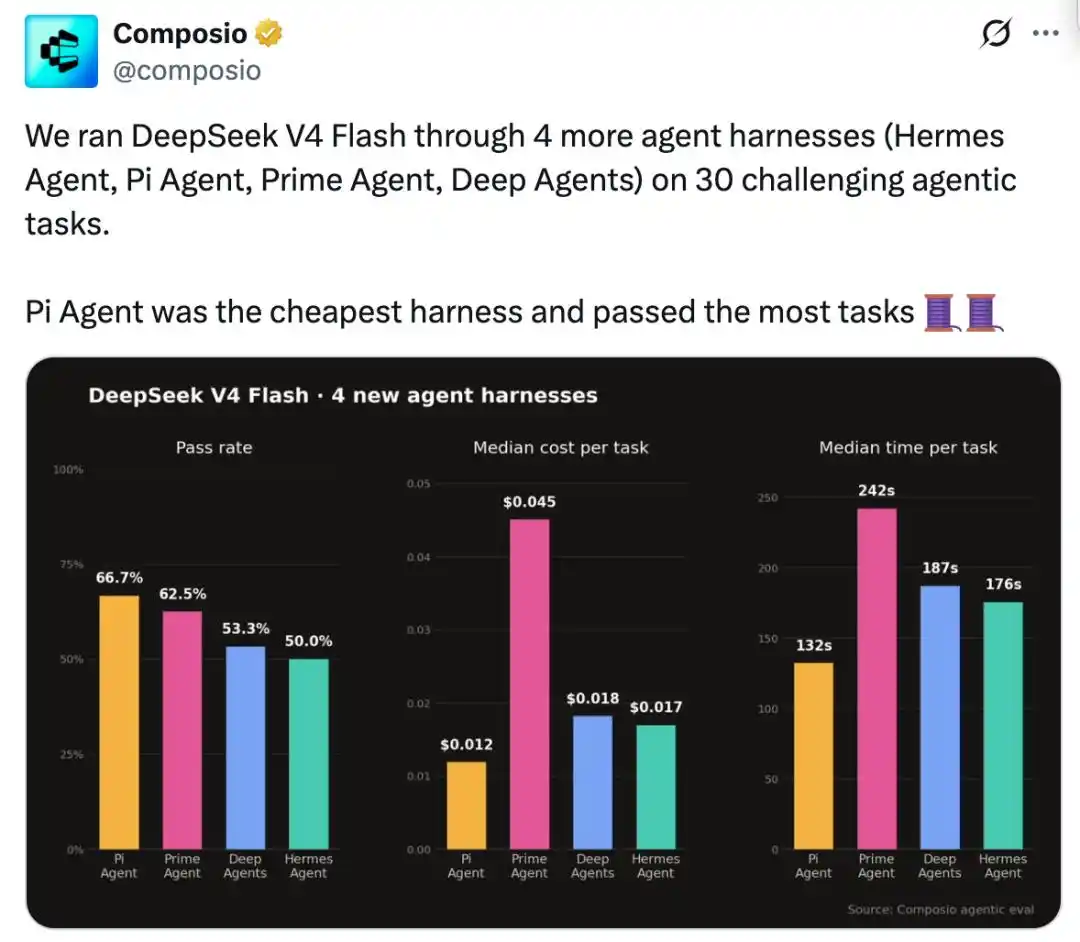
The gap was significant. The best performer, Pi Agent, passed twenty tasks; the worst, OpenCode, passed only fourteen. Out of 240 total runs across eight Harnesses, only 129 succeeded. Among the thirty tasks, only six were completed by all Harnesses. In terms of cost, for similarly completing sixteen tasks, the estimated cost per successful task for Claude Code, Codex, and DeepAgents was approximately $0.195, $0.081, and $0.045 respectively. For the same model, the difference was more than fourfold.
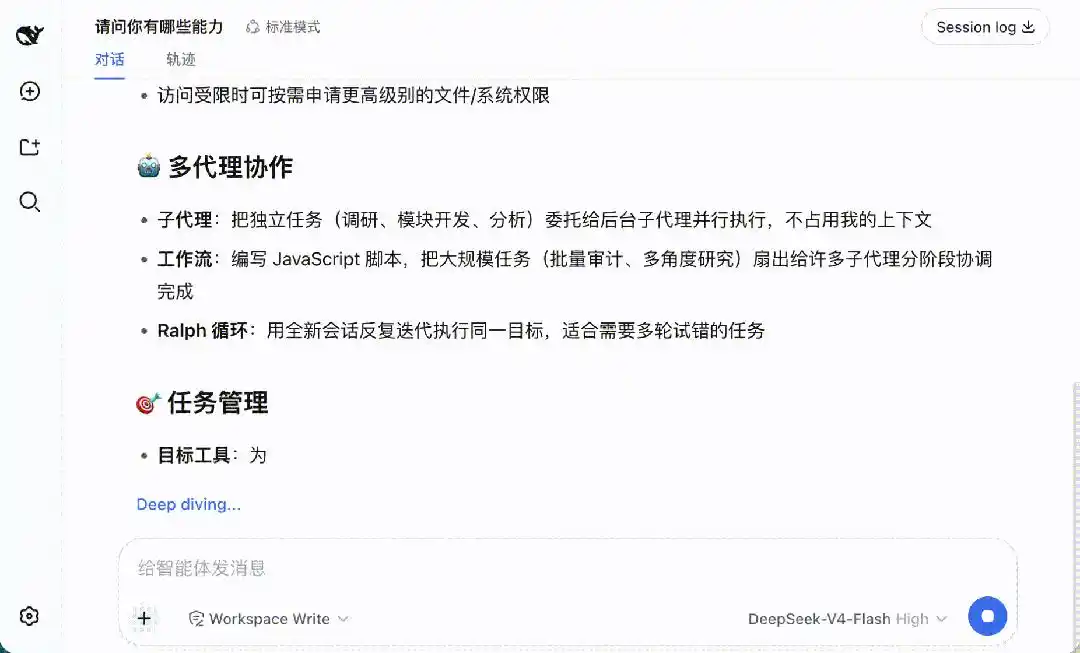
This means that the model sets the upper limit of capability, while the Harness determines how much of that ceiling is ultimately realized and at what cost. Throughout a long-running task, the execution system must constantly make judgments: what to keep and what to discard in the context, when to call which tool, whether to retry or change course when a tool fails, whether to trust the model's completion signal or verify it again. If any step is mishandled, even if the model has the right idea, it could fail at the last moment when actually modifying files or submitting code.

It's worth noting that this is one of the very few projects that DeepSeek opened for early closed beta since its rise to fame.

Several developers received Harness beta access before the official release. Some testers discovered that having the same V4-Flash model complete the same game within DeepSeek Harness, Reasonix, and Codex produced drastically different outcomes. This shows that when the model is identical, the tools, prompts, context organization, and execution strategies provided by the execution system can significantly alter the final product.

This is precisely why DeepSeek values its self-developed Harness. Internally, DeepSeek has believed that Agents need to solve the problem of continuous learning, ultimately enabling AI to accelerate AI R&D. Looking down this path, Harness is not just an add-on programming tool, but a workbench for models to enter real development tasks.

Furthermore, a company that built its foundation on low cost and model capability would find itself in a precarious position if task delivery, failure feedback, and developer interfaces remained long-term dependencies on others' systems. Even with a price advantage, it wouldn't control how many tokens a task ultimately burns, how many retries are needed, or when a task is truly considered complete.

02

Everything is a Plugin, DeepSeek Isn't a Replacement for Anyone

What exactly is Harness? The most convenient description in the market is " DeepSeek version of Claude Code." But those who have used the beta version generally find this label inaccurate.

According to DeepSeek 's official documentation, the core design philosophy of Harness is "Everything is a plugin." It is built on the Cordis plugin system. Models, tools, skills, sessions, sandboxes, storage, loops, schedulers, UI—all Agent capabilities are composed of plugins. Developers can select, replace, or extend any capability through configuration without modifying the Harness source code.
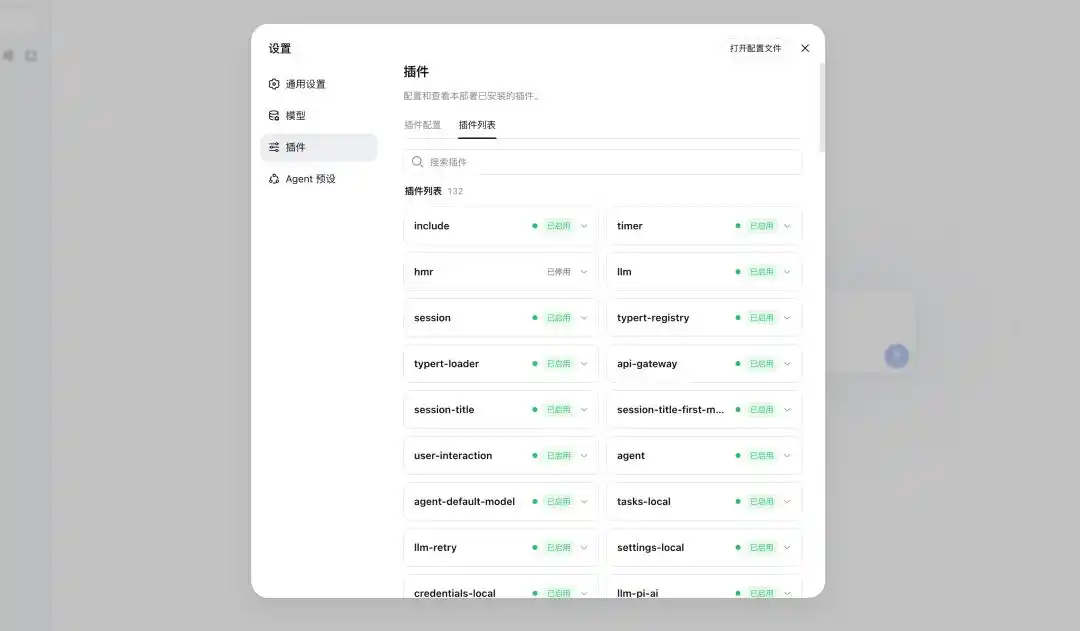
This is on a different scale from the usual understanding of plugins. VS Code plugins add features to the editor; Codex plugins add tools to the Agent. Harness plugins can replace the Agent's brain, toolbox, rules, even its entire interface.

According to multiple sources involved in the beta test, developers went wild with plugin-making during the beta period. "People aren't properly testing the beta anymore; they're running off to write plugins." Hundreds of plugins emerged within just a few days—some completely overhauled the work interface, while others implemented "cross-session long-term memory with background self-evolution" using pure plugins, enabling the model to periodically review its work records and compress temporary experiences into lasting knowledge.

Some also commented that open-source community governance might be another challenge DeepSeek will face next.

Another crucial design aspect is traceability. Harness uses an append-only session log. Everything the model sees—system prompts, chain-of-thought, tool calls and results, sub-Agent scheduling, every context injection—is fully recorded. Context compression does not delete the original history; it only changes what the model subsequently sees through replacement events. Developers can trace by source in the Trajectory view, supporting recovery, forking, retrieval, and replay. The official documentation summarizes this principle as "If the model saw it, it's recorded."

This reflects a typical systems engineering mindset. According to reports, DeepSeek Harness team leader Cui Tianyi graduated from Zhejiang University's Computer Science Department, worked at the quantitative trading firm Jane Street for nine years, and joined DeepSeek in March 2026, with Harness officially starting internal development in May. The core moat of high-frequency trading systems has never been about smarter strategies, but stable execution in extremely complex environments, exception handling, comprehensive log traceability, and controllable risk—exactly the missing piece for moving AI Agents from demos to production. One beta developer described its performance in long tasks as "steady as an old dog": tasks are automatically saved when interrupted, ready to resume next time without starting over.

It's worth noting that Harness hasn't confined itself within DeepSeek models' walled garden. It natively supports connecting to nearly 40 major models including Kimi , OpenAI, Anthropic, and Google. Perhaps others tend to build a ready-made Agent, but DeepSeek Harness is more like a set of components, allowing developers to decide for themselves what the Agent should be like and how it should work.

Of course, the official team remains clear-headed. The announcement states that, as an early preview version, "there are still many details to be improved and refined, and core plugins and basic APIs will also undergo rapid iteration." In fact, one of the media outlets involved in the beta, ifanr, marveled that it was hard to imagine the famously fast DeepSeek taking over half an hour to run a programming task. The v0.1 version number also indicates that this black whale has just surfaced, far from swimming freely.

03

From Selling Tokens to Delivering Results, the Ambition of the Black Whale

The emergence of Harness coincides with a shift in the entire AI industry.

Over the past few years, competition among large model companies has focused on parameter scale and benchmark scores. But entering 2026, the core capabilities of leading models have rapidly converged, gaps in single-turn QA have narrowed, while price wars have intensified. The ceiling for the pure token-selling business model has become clearly visible. The industry is gradually realizing that the core value of the AI industry lies not in model output, but in real-world application—with the same token consumption, idle chat yields minimal value, while fixing a bug or completing a feature development can create several times the commercial value.

DeepSeek 's new release signifies a move from selling compute power to delivering results. In the old model, customers paid based on token usage, regardless of whether the model actually solved the problem. In the new model, the anchor point for payment shifts from how much compute was consumed to what task was accomplished.

This DeepSeek Harness release is also highly praised by developers for another reason. DeepSeek does not define the Agent itself. Instead, it leverages the diffusion power of the open-source community to promote a Harness-based approach. This is a grander, yet more difficult, path.

Furthermore, Harness faces a mature market already validated by Claude Code and Codex, with the latter backed by the model iterations and commercial resources of Anthropic and OpenAI, holding a first-mover advantage. After open-sourcing, questions remain unanswered: whether the plugin ecosystem can spontaneously flourish, whether developers are willing to entrust production environments to a v0.1 version, and whether the domestic market's payment habits can support the new logic of "pay-per-result." DeepSeek itself has stated that core plugins and APIs will continue to evolve rapidly, meaning early adopters may bear the cost of interface changes.

On August 13th, releases happened on both sides of the Pacific. Elon Musk took the stage for Grok 4.6, calling it "intelligent, fast, and highly cost-effective" ; DeepSeek said nothing, just kept pushing updates.

Between the clamor and the silence lies a divergence of two business philosophies.

We want to call this DeepSeek 's "most promising project in history," not because it's the strongest today. V4 Pro still has gaps with SOTA models, Harness is only a v0.1 developer preview, market reaction to recent price adjustments needs observation, and ecosystem building is a long journey. Potential is potential precisely because it is not yet realized.

But if we stretch the timeline, from R1 to V4, from models to Harness, DeepSeek has taken each step in the same direction: compressing cutting-edge capabilities into affordable costs, then connecting affordable capabilities to implementable systems.

The black whale has surfaced. As for how far it can swim—that lies in a future belonging to the open-source community.

This article is from the WeChat public account "Phoenix Network Technology," author: Dale, editor: Dong Yuqing

Trending Cryptos

Related Questions

QAccording to the article, what is the key finding of Composio's experiments comparing different Agent execution systems (Harnesses) using the same DeepSeek model?

AThe key finding was that the choice of execution system significantly impacts the performance and cost of the same AI model. The experiments showed up to a fourfold difference in the cost per successful task completion when the same DeepSeek V4-Flash model was paired with different Harnesses.

QWhat is the core design philosophy of DeepSeek's newly released Harness system?

AThe core design philosophy is "Everything is a plugin." Harness is built on the Cordis plugin system, meaning all Agent capabilities—models, tools, skills, sessions, UI, etc.—are composed of interchangeable plugins, allowing developers to customize the system without modifying the core source code.

QWhy does the article suggest Harness is not simply a 'DeepSeek version of Claude Code'?

ABecause Harness is fundamentally a modular system of plugins where developers can define and configure the Agent's functionality, behavior, and interface. It's designed to be a flexible, foundational framework for building various Agents, not a single, pre-defined tool for coding tasks.

QWhat shift in the AI industry's business model does the article associate with the release of DeepSeek Harness?

AThe article associates it with a shift from selling computational power (tokens) to delivering results. The value proposition is moving from charging for model output volume to charging based on the completion and value of specific tasks (like bug fixes or feature development).

QWhat is the significance of the 'append-only' session log and 'Trajectory view' in the Harness system, according to the article?

AThe 'append-only' log ensures complete traceability and reproducibility. Every system prompt, chain-of-thought, tool call, and context injection is permanently recorded. The 'Trajectory view' allows developers to trace, restore, fork, and replay any step, providing crucial control and debugging capabilities for complex, long-running AI tasks.

Related Reads

GPT-5 Also Has Tip-of-the-Tongue Moments, Google Tested 4.5 Million Times: The Keys Are Lost

Google researchers have discovered that advanced AI models like GPT-5 and Gemini 3 experience a phenomenon akin to the human "tip-of-the-tongue" state, where they possess knowledge but fail to retrieve it. Their study, "Empty Shelves or Lost Keys?" (ICML 2026), introduces the "Knowledge Portrait" framework to analyze factual knowledge in models, distinguishing between failure to encode a fact versus failure to recall it. Testing on 13 models across 2.15 million queries from the WikiProfile benchmark revealed that state-of-the-art models successfully encode 95-98% of facts into their parameters. However, when asked directly, they fail to recall 26-34% of these known facts. Enabling chain-of-thought ("thinking") reasoning reduces this recall failure to 11-12%, recovering 40-65% of the previously unrecalled but encoded facts. The research identifies two key bottlenecks: recalling obscure ("long-tail") facts and answering reversed queries (e.g., "Who is Tom Cruise's mother?" vs. "Whose son is Tom Cruise?"). While scaling model size effectively reduces encoding failures, it does little to improve recall rates. In larger models, recall failure becomes the dominant source of factual errors, accounting for over 70% of mistakes in GPT-5.2. The findings suggest that for top models, the primary challenge is no longer storing knowledge but accessing it efficiently. Future accuracy gains may depend more on improved inference-time methods and "meta-cognitive" abilities, enabling models to recognize when they need to engage in deeper reasoning to retrieve information they already know.

marsbit19m ago

GPT-5 Also Has Tip-of-the-Tongue Moments, Google Tested 4.5 Million Times: The Keys Are Lost

marsbit19m ago

The Dollar is a Technology: Stablecoins Are Exporting U.S. Institutions to the World

This article argues that stablecoins and blockchain infrastructure are becoming a vehicle for exporting American financial systems globally. The core thesis is that the U.S. dollar, as a "technology," is increasingly embedded in blockchain rails, moving beyond a reserve currency to represent the institutional stability of the United States itself. The piece highlights three key areas where this is happening: 1. **Cross-border payments and trade finance:** Companies like Keyrails use stablecoins and blockchain to streamline and secure trade finance for emerging markets (e.g., Nigeria-China trade), offering faster, often cheaper dollar liquidity than traditional systems. 2. **Programmable collateral and credit:** Platforms like SemiLiquid allow institutions to use tokenized assets (e.g., treasuries, stocks) as "programmable collateral" for loans without moving them from custody, unlocking capital efficiency and improving transparency in institutional lending. 3. **Financing real-world assets:** Protocols like USD.AI create lending markets for productive, hard-to-finance assets like AI GPUs, connecting global stablecoin liquidity to physical capital. The author concludes that the true value of these new blockchain-based financial platforms lies not just in transaction volume, but in the deep, hard-to-replicate "context" (data, trust, operational knowledge) they build around specific economic activities like trade and asset finance. This represents crypto's evolution into an operating system for real-world capital formation, moving beyond speculation.

marsbit23m ago

The Dollar is a Technology: Stablecoins Are Exporting U.S. Institutions to the World

marsbit23m ago

Ethereum Glamsterdam Upgrade: Largest-Scale Underlying Restructuring Yet, Mainnet Date Still Undecided

The upcoming Ethereum "Glamsterdam" upgrade is viewed by core developers as the most significant protocol-level refactoring since The Merge, fundamentally altering how the network processes transactions and manages its state to advance L1 scaling. Its core goals are: accelerating processing via parallelization, increasing capacity, and enhancing sustainability through adjusted fees that better reflect long-term data storage costs. The upgrade features two headline proposals. First, **ePBS (EIP-7732)** on the consensus layer aims to formalize proposer-builder separation directly within the protocol, eliminating reliance on off-chain relayers. This built-in mechanism is designed to provide a more secure and efficient block production pipeline, extending the critical validation window to allow the network to handle more data, particularly for Layer2s. Second, **BALs (EIP-7928)** on the execution layer introduces block-level access lists. These lists specify the data each transaction will access beforehand, allowing the network to identify and safely execute non-conflicting transactions in parallel, rather than strictly sequentially. This also speeds up new node synchronization. Glamsterdam also includes配套 proposals to reprice storage costs (aiming for a predictable ~120 GiB annual state growth) and the cost of data-reading operations to better align with modern hardware costs and prevent spam. Regarding the timeline, the initial schedule targeting a mainnet activation on September 16, 2026, has likely been delayed. Following the launch of a new dedicated testnet (Plataberget), the deployments on the Sepolia and Holesky testnets are now expected in September, with the mainnet launch potentially pushed to Q4 2026 or later, as developers prioritize correctness over a fixed date.

marsbit23m ago

Ethereum Glamsterdam Upgrade: Largest-Scale Underlying Restructuring Yet, Mainnet Date Still Undecided

marsbit23m ago

Trading

Spot

Hot Articles

What is SONIC

Sonic: Pioneering the Future of Gaming in Web3 Introduction to Sonic In the ever-evolving landscape of Web3, the gaming industry stands out as one of the most dynamic and promising sectors. At the forefront of this revolution is Sonic, a project designed to amplify the gaming ecosystem on the Solana blockchain. Leveraging cutting-edge technology, Sonic aims to deliver an unparalleled gaming experience by efficiently processing millions of requests per second, ensuring that players enjoy seamless gameplay while maintaining low transaction costs. This article delves into the intricate details of Sonic, exploring its creators, funding sources, operational mechanics, and the timeline of significant events that have shaped its journey. What is Sonic? Sonic is an innovative layer-2 network that operates atop the Solana blockchain, specifically tailored to enhance the existing Solana gaming ecosystem. It accomplishes this through a customised, VM-agnostic game engine paired with a HyperGrid interpreter, facilitating sovereign game economies that roll up back to the Solana platform. The primary goals of Sonic include: Enhanced Gaming Experiences: Sonic is committed to offering lightning-fast on-chain gameplay, allowing players and developers to engage with games at previously unattainable speeds. Atomic Interoperability: This feature enables transactions to be executed within Sonic without the need to redeploy Solana programmes and accounts. This makes the process more efficient and directly benefits from Solana Layer1 services and liquidity. Seamless Deployment: Sonic allows developers to write for Ethereum Virtual Machine (EVM) based systems and execute them on Solana’s SVM infrastructure. This interoperability is crucial for attracting a broader range of dApps and decentralised applications to the platform. Support for Developers: By offering native composable gaming primitives and extensible data types - dining within the Entity-Component-System (ECS) framework - game creators can craft intricate business logic with ease. Overall, Sonic's unique approach not only caters to players but also provides an accessible and low-cost environment for developers to innovate and thrive. Creator of Sonic The information regarding the creator of Sonic is somewhat ambiguous. However, it is known that Sonic's SVM is owned by the company Mirror World. The absence of detailed information about the individuals behind Sonic reflects a common trend in several Web3 projects, where collective efforts and partnerships often overshadow individual contributions. Investors of Sonic Sonic has garnered considerable attention and support from various investors within the crypto and gaming sectors. Notably, the project raised an impressive $12 million during its Series A funding round. The round was led by BITKRAFT Ventures, with other notable investors including Galaxy, Okx Ventures, Interactive, Big Brain Holdings, and Mirana. This financial backing signifies the confidence that investment foundations have in Sonic’s potential to revolutionise the Web3 gaming landscape, further validating its innovative approaches and technologies. How Does Sonic Work? Sonic utilises the HyperGrid framework, a sophisticated parallel processing mechanism that enhances its scalability and customisability. Here are the core features that set Sonic apart: Lightning Speed at Low Costs: Sonic offers one of the fastest on-chain gaming experiences compared to other Layer-1 solutions, powered by the scalability of Solana’s virtual machine (SVM). Atomic Interoperability: Sonic enables transaction execution without redeployment of Solana programmes and accounts, effectively streamlining the interaction between users and the blockchain. EVM Compatibility: Developers can effortlessly migrate decentralised applications from EVM chains to the Solana environment using Sonic’s HyperGrid interpreter, increasing the accessibility and integration of various dApps. Ecosystem Support for Developers: By exposing native composable gaming primitives, Sonic facilitates a sandbox-like environment where developers can experiment and implement business logic, greatly enhancing the overall development experience. Monetisation Infrastructure: Sonic natively supports growth and monetisation efforts, providing frameworks for traffic generation, payments, and settlements, thereby ensuring that gaming projects are not only viable but also sustainable financially. Timeline of Sonic The evolution of Sonic has been marked by several key milestones. Below is a brief timeline highlighting critical events in the project's history: 2022: The Sonic cryptocurrency was officially launched, marking the beginning of its journey in the Web3 gaming arena. 2024: June: Sonic SVM successfully raised $12 million in a Series A funding round. This investment allowed Sonic to further develop its platform and expand its offerings. August: The launch of the Sonic Odyssey testnet provided users with the first opportunity to engage with the platform, offering interactive activities such as collecting rings—a nod to gaming nostalgia. October: SonicX, an innovative crypto game integrated with Solana, made its debut on TikTok, capturing the attention of over 120,000 users within a short span. This integration illustrated Sonic’s commitment to reaching a broader, global audience and showcased the potential of blockchain gaming. Key Points Sonic SVM is a revolutionary layer-2 network on Solana explicitly designed to enhance the GameFi landscape, demonstrating great potential for future development. HyperGrid Framework empowers Sonic by introducing horizontal scaling capabilities, ensuring that the network can handle the demands of Web3 gaming. Integration with Social Platforms: The successful launch of SonicX on TikTok displays Sonic’s strategy to leverage social media platforms to engage users, exponentially increasing the exposure and reach of its projects. Investment Confidence: The substantial funding from BITKRAFT Ventures, among others, emphasizes the robust backing Sonic has, paving the way for its ambitious future. In conclusion, Sonic encapsulates the essence of Web3 gaming innovation, striking a balance between cutting-edge technology, developer-centric tools, and community engagement. As the project continues to evolve, it is poised to redefine the gaming landscape, making it a notable entity for gamers and developers alike. As Sonic moves forward, it will undoubtedly attract greater interest and participation, solidifying its place within the broader narrative of blockchain gaming.

2.3k Total ViewsPublished 2024.04.04Updated 2024.12.03

What is SONIC

What is $S$

Understanding SPERO: A Comprehensive Overview Introduction to SPERO As the landscape of innovation continues to evolve, the emergence of web3 technologies and cryptocurrency projects plays a pivotal role in shaping the digital future. One project that has garnered attention in this dynamic field is SPERO, denoted as SPERO,$$s$. This article aims to gather and present detailed information about SPERO, to help enthusiasts and investors understand its foundations, objectives, and innovations within the web3 and crypto domains. What is SPERO,$$s$? SPERO,$$s$ is a unique project within the crypto space that seeks to leverage the principles of decentralisation and blockchain technology to create an ecosystem that promotes engagement, utility, and financial inclusion. The project is tailored to facilitate peer-to-peer interactions in new ways, providing users with innovative financial solutions and services. At its core, SPERO,$$s$ aims to empower individuals by providing tools and platforms that enhance user experience in the cryptocurrency space. This includes enabling more flexible transaction methods, fostering community-driven initiatives, and creating pathways for financial opportunities through decentralised applications (dApps). The underlying vision of SPERO,$$s$ revolves around inclusiveness, aiming to bridge gaps within traditional finance while harnessing the benefits of blockchain technology. Who is the Creator of SPERO,$$s$? The identity of the creator of SPERO,$$s$ remains somewhat obscure, as there are limited publicly available resources providing detailed background information on its founder(s). This lack of transparency can stem from the project's commitment to decentralisation—an ethos that many web3 projects share, prioritising collective contributions over individual recognition. By centring discussions around the community and its collective goals, SPERO,$$s$ embodies the essence of empowerment without singling out specific individuals. As such, understanding the ethos and mission of SPERO remains more important than identifying a singular creator. Who are the Investors of SPERO,$$s$? SPERO,$$s$ is supported by a diverse array of investors ranging from venture capitalists to angel investors dedicated to fostering innovation in the crypto sector. The focus of these investors generally aligns with SPERO's mission—prioritising projects that promise societal technological advancement, financial inclusivity, and decentralised governance. These investor foundations are typically interested in projects that not only offer innovative products but also contribute positively to the blockchain community and its ecosystems. The backing from these investors reinforces SPERO,$$s$ as a noteworthy contender in the rapidly evolving domain of crypto projects. How Does SPERO,$$s$ Work? SPERO,$$s$ employs a multi-faceted framework that distinguishes it from conventional cryptocurrency projects. Here are some of the key features that underline its uniqueness and innovation: Decentralised Governance: SPERO,$$s$ integrates decentralised governance models, empowering users to participate actively in decision-making processes regarding the project’s future. This approach fosters a sense of ownership and accountability among community members. Token Utility: SPERO,$$s$ utilises its own cryptocurrency token, designed to serve various functions within the ecosystem. These tokens enable transactions, rewards, and the facilitation of services offered on the platform, enhancing overall engagement and utility. Layered Architecture: The technical architecture of SPERO,$$s$ supports modularity and scalability, allowing for seamless integration of additional features and applications as the project evolves. This adaptability is paramount for sustaining relevance in the ever-changing crypto landscape. Community Engagement: The project emphasises community-driven initiatives, employing mechanisms that incentivise collaboration and feedback. By nurturing a strong community, SPERO,$$s$ can better address user needs and adapt to market trends. Focus on Inclusion: By offering low transaction fees and user-friendly interfaces, SPERO,$$s$ aims to attract a diverse user base, including individuals who may not previously have engaged in the crypto space. This commitment to inclusion aligns with its overarching mission of empowerment through accessibility. Timeline of SPERO,$$s$ Understanding a project's history provides crucial insights into its development trajectory and milestones. Below is a suggested timeline mapping significant events in the evolution of SPERO,$$s$: Conceptualisation and Ideation Phase: The initial ideas forming the basis of SPERO,$$s$ were conceived, aligning closely with the principles of decentralisation and community focus within the blockchain industry. Launch of Project Whitepaper: Following the conceptual phase, a comprehensive whitepaper detailing the vision, goals, and technological infrastructure of SPERO,$$s$ was released to garner community interest and feedback. Community Building and Early Engagements: Active outreach efforts were made to build a community of early adopters and potential investors, facilitating discussions around the project’s goals and garnering support. Token Generation Event: SPERO,$$s$ conducted a token generation event (TGE) to distribute its native tokens to early supporters and establish initial liquidity within the ecosystem. Launch of Initial dApp: The first decentralised application (dApp) associated with SPERO,$$s$ went live, allowing users to engage with the platform's core functionalities. Ongoing Development and Partnerships: Continuous updates and enhancements to the project's offerings, including strategic partnerships with other players in the blockchain space, have shaped SPERO,$$s$ into a competitive and evolving player in the crypto market. Conclusion SPERO,$$s$ stands as a testament to the potential of web3 and cryptocurrency to revolutionise financial systems and empower individuals. With a commitment to decentralised governance, community engagement, and innovatively designed functionalities, it paves the way toward a more inclusive financial landscape. As with any investment in the rapidly evolving crypto space, potential investors and users are encouraged to research thoroughly and engage thoughtfully with the ongoing developments within SPERO,$$s$. The project showcases the innovative spirit of the crypto industry, inviting further exploration into its myriad possibilities. While the journey of SPERO,$$s$ is still unfolding, its foundational principles may indeed influence the future of how we interact with technology, finance, and each other in interconnected digital ecosystems.

365 Total ViewsPublished 2024.12.17Updated 2024.12.17

What is $S$

What is AGENT S

Agent S: The Future of Autonomous Interaction in Web3 Introduction In the ever-evolving landscape of Web3 and cryptocurrency, innovations are constantly redefining how individuals interact with digital platforms. One such pioneering project, Agent S, promises to revolutionise human-computer interaction through its open agentic framework. By paving the way for autonomous interactions, Agent S aims to simplify complex tasks, offering transformative applications in artificial intelligence (AI). This detailed exploration will delve into the project's intricacies, its unique features, and the implications for the cryptocurrency domain. What is Agent S? Agent S stands as a groundbreaking open agentic framework, specifically designed to tackle three fundamental challenges in the automation of computer tasks: Acquiring Domain-Specific Knowledge: The framework intelligently learns from various external knowledge sources and internal experiences. This dual approach empowers it to build a rich repository of domain-specific knowledge, enhancing its performance in task execution. Planning Over Long Task Horizons: Agent S employs experience-augmented hierarchical planning, a strategic approach that facilitates efficient breakdown and execution of intricate tasks. This feature significantly enhances its ability to manage multiple subtasks efficiently and effectively. Handling Dynamic, Non-Uniform Interfaces: The project introduces the Agent-Computer Interface (ACI), an innovative solution that enhances the interaction between agents and users. Utilizing Multimodal Large Language Models (MLLMs), Agent S can navigate and manipulate diverse graphical user interfaces seamlessly. Through these pioneering features, Agent S provides a robust framework that addresses the complexities involved in automating human interaction with machines, setting the stage for myriad applications in AI and beyond. Who is the Creator of Agent S? While the concept of Agent S is fundamentally innovative, specific information about its creator remains elusive. The creator is currently unknown, which highlights either the nascent stage of the project or the strategic choice to keep founding members under wraps. Regardless of anonymity, the focus remains on the framework's capabilities and potential. Who are the Investors of Agent S? As Agent S is relatively new in the cryptographic ecosystem, detailed information regarding its investors and financial backers is not explicitly documented. The lack of publicly available insights into the investment foundations or organisations supporting the project raises questions about its funding structure and development roadmap. Understanding the backing is crucial for gauging the project's sustainability and potential market impact. How Does Agent S Work? At the core of Agent S lies cutting-edge technology that enables it to function effectively in diverse settings. Its operational model is built around several key features: Human-like Computer Interaction: The framework offers advanced AI planning, striving to make interactions with computers more intuitive. By mimicking human behaviour in tasks execution, it promises to elevate user experiences. Narrative Memory: Employed to leverage high-level experiences, Agent S utilises narrative memory to keep track of task histories, thereby enhancing its decision-making processes. Episodic Memory: This feature provides users with step-by-step guidance, allowing the framework to offer contextual support as tasks unfold. Support for OpenACI: With the ability to run locally, Agent S allows users to maintain control over their interactions and workflows, aligning with the decentralised ethos of Web3. Easy Integration with External APIs: Its versatility and compatibility with various AI platforms ensure that Agent S can fit seamlessly into existing technological ecosystems, making it an appealing choice for developers and organisations. These functionalities collectively contribute to Agent S's unique position within the crypto space, as it automates complex, multi-step tasks with minimal human intervention. As the project evolves, its potential applications in Web3 could redefine how digital interactions unfold. Timeline of Agent S The development and milestones of Agent S can be encapsulated in a timeline that highlights its significant events: September 27, 2024: The concept of Agent S was launched in a comprehensive research paper titled “An Open Agentic Framework that Uses Computers Like a Human,” showcasing the groundwork for the project. October 10, 2024: The research paper was made publicly available on arXiv, offering an in-depth exploration of the framework and its performance evaluation based on the OSWorld benchmark. October 12, 2024: A video presentation was released, providing a visual insight into the capabilities and features of Agent S, further engaging potential users and investors. These markers in the timeline not only illustrate the progress of Agent S but also indicate its commitment to transparency and community engagement. Key Points About Agent S As the Agent S framework continues to evolve, several key attributes stand out, underscoring its innovative nature and potential: Innovative Framework: Designed to provide an intuitive use of computers akin to human interaction, Agent S brings a novel approach to task automation. Autonomous Interaction: The ability to interact autonomously with computers through GUI signifies a leap towards more intelligent and efficient computing solutions. Complex Task Automation: With its robust methodology, it can automate complex, multi-step tasks, making processes faster and less error-prone. Continuous Improvement: The learning mechanisms enable Agent S to improve from past experiences, continually enhancing its performance and efficacy. Versatility: Its adaptability across different operating environments like OSWorld and WindowsAgentArena ensures that it can serve a broad range of applications. As Agent S positions itself in the Web3 and crypto landscape, its potential to enhance interaction capabilities and automate processes signifies a significant advancement in AI technologies. Through its innovative framework, Agent S exemplifies the future of digital interactions, promising a more seamless and efficient experience for users across various industries. Conclusion Agent S represents a bold leap forward in the marriage of AI and Web3, with the capacity to redefine how we interact with technology. While still in its early stages, the possibilities for its application are vast and compelling. Through its comprehensive framework addressing critical challenges, Agent S aims to bring autonomous interactions to the forefront of the digital experience. As we move deeper into the realms of cryptocurrency and decentralisation, projects like Agent S will undoubtedly play a crucial role in shaping the future of technology and human-computer collaboration.

1.0k Total ViewsPublished 2025.01.14Updated 2025.01.14

What is AGENT S

Discussions

Welcome to the HTX Community. Here, you can stay informed about the latest platform developments and gain access to professional market insights. Users' opinions on the price of S (S) are presented below.

活动图片