Author|Azuma(@azuma_eth)
On August 12, Beijing time, Hyperliquid founder Jeff Yan announced an update progress in the official Discord channel. Due to the original wording being overly technical, many people overlooked or underestimated the significance of this announcement.
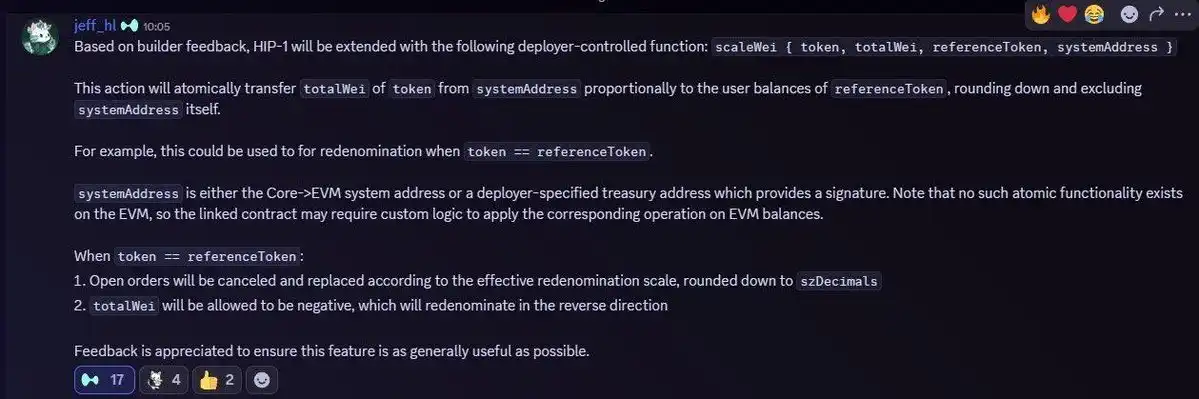
Literal Translation
Below is a direct translation of Jeff Yan's original statement.
- Based on Builder feedback, HIP-1 will add the following function controlled by the token deployer: scaleWei { token, totalWei, referenceToken, systemAddress }.
- This operation will automatically and proportionally transfer the totalWei of token from systemAddress to users based on their referenceToken balances. The calculation will round down and exclude the systemAddress itself. For example, when token == referenceToken, this function can be used for redenomination.
- systemAddress has two possibilities: Core → EVM's system address; or a Treasury address specified by the deployer capable of providing signatures. It is important to note that EVM itself does not have such atomic functionality. Therefore, if the relevant token also exists in the EVM environment, the corresponding smart contract may need to incorporate custom logic to synchronize this operation to the token balances on EVM.
- When token and referenceToken are the same token: All open orders will be canceled and then recreated according to the actual redenomination ratio, rounding down to meet szDecimals precision requirements; totalWei can be negative, enabling reverse redenomination.
- Feedback is welcome to ensure this functionality can meet practical usage needs as broadly as possible.
Obviously, without a basic understanding of smart contract concepts, it is difficult to comprehend what this Hyperliquid update truly means.
Simple Explanation
In simple terms, Hyperliquid is adding a previously uncommon capability to HIP-1 – enabling batch, programmatic adjustment of user assets directly at the "balance layer" of HyperCore.
The most important aspect here is not the function name scaleWei and its parameters, but what they can actually do.
Suppose there is a token A on Hyperliquid, with Alice holding 100, Bob holding 50, and Charlie holding 10. If an address holds 1600 of token B and uses A as the referenceToken, the system can automatically distribute these 1600 B tokens according to each person's proportion of A holdings.
The distribution would be:
- Alice, holding 62.5% of A, receives 1000 B;
- Bob, holding 31.25%, receives 500 B;
- Charlie, holding 6.25%, receives 100 B.
Users do not need to click Claim or individually call smart contracts; HyperCore can directly modify account balances according to the set rules.
If token == referenceToken, a "redenomination" will be executed, and the change is actually more intuitive.
For example, if a stock token originally had holdings of Alice 100 shares, Bob 50 shares, Charlie 10 shares, and undergoes a 1:10 stock split, the system can directly adjust the balances.
The holdings after adjustment would be:
- Alice holds 1000 shares;
- Bob holds 500 shares;
- Charlie holds 100 shares.
Each person's holding proportion remains unchanged, only the valuation unit changes. The reverse is also true.
Hyperliquid's update specifically considered open orders. If an asset undergoes a 1:10 stock split, a user's previously placed sell order for 100 shares obviously cannot remain unchanged, as the order quantity post-split would not match the new holding system. Therefore, the system will cancel the original orders and recreate them according to the new ratio, processing quantities with precision based on szDecimals. In other words, this effectively allows trading states like balances and orders to undergo redenomination together.
Understanding the update logic, what is the use of this "programmable capability at the balance layer"?
Application Scenarios
Currently, the content disclosed by Jeff Yan mainly describes the underlying capability of scaleWei, but around this capability, we can already glimpse several clear application directions for stock tokens.
Scenario 1: Dividends
Dividends are one of the most basic rights of traditional stocks. In traditional brokerage systems, this is a standard corporate action; in typical EVM models, similar operations usually require recording eligible addresses via smart contracts and then having users actively claim, or having the project side distribute them one by one.
scaleWei offers another possibility – directly distributing dividend assets to users according to their stock token balances on HyperCore. Suppose a listed company's stock token appears on Hyperliquid in the future, and the company decides to pay a dividend of $1 per share – with Alice holding 100 shares, Bob holding 50, Charlie holding 10, the system can directly allocate the dividend assets to their respective accounts based on holding proportions, without users manually claiming or the project side calling contracts one by one; HyperCore itself can complete this batch transfer.
Scenario 2: Stock Splits and Reverse Splits
This is actually the scenario explicitly addressed by this update. When token and referenceToken are the same asset, scaleWei can uniformly adjust all holders' balances by a set ratio.
Therefore, in the future, if any HIP-1 asset needs a 1:10 stock split, a 10:1 reverse split, or even an adjustment to the minimum trading unit, it can be executed directly, and the system will synchronously cancel and rebuild open orders. For a trading system genuinely aiming to host stocks and ETFs, such "corporate actions" are standard features.
Scenario 3: Rebasing
A similar mechanism can be used for Rebase. Simply put, when the total supply or unit of an asset itself is adjusted (especially common during pre-market stock token conversions where share quantities adjust accordingly), the relative holding proportions among users remain unchanged.
Previously, such operations often relied on the token contract's own logic, but now they can become a native capability of HyperCore.
Scenario 4: Airdrops
Another obvious scenario is airdrops. The referenceToken does not have to equal the token being distributed, so theoretically, asset B can be distributed directly based on the holding proportion of A.
For example, if a project decides to distribute another token to holders of a certain HIP-1 asset, the system can directly read users' A balances on HyperCore and then proportionally distribute B from a designated Treasury address.
This means that, at least within HyperCore, some traditional "claim airdrop" actions could potentially be further simplified into direct balance distribution by the system.
Addressing the "Corporate Action" Shortcoming of On-Chain Stocks
It is important to emphasize that Jeff Yan's disclosed update currently focuses only on the underlying functionality and does not mean Hyperliquid has announced dividend payments for stock tokens on its platform. However, from an infrastructure perspective, the technical path now exists for the capability of "distributing assets to accounts based on holding proportions" required for the aforementioned application scenarios.
Considering the potential application scenarios, the real significance of Hyperliquid's update is its potential to address the "corporate action" capability gap for on-chain assets.
In recent years, industry discussions about tokenized stocks have often focused on – "Can stocks be put on-chain?" But if one truly wants to move stocks onto the chain, the issues extend far beyond this. After a stock is issued, various corporate actions such as dividends, splits, reverse splits, rights offerings, and asset distributions continually occur.
Therefore, a truly complete on-chain stock infrastructure not only needs to be able to "trade stocks" but also needs to handle changes in asset states outside of trading, which is precisely what Hyperliquid's update begins to address.
From this perspective, scaleWei is more like adding a piece of infrastructure puzzle for the next stage of Hyperliquid – enabling on-chain financial assets not only to be "tradable" but also to undergo various corporate actions, just like financial assets in the real world.