Solana On-Chain Liquidity Leadership Widens As DEX Volume Stays Robust Across The Network

bitcoinistPublished on 2026-01-09Last updated on 2026-01-09

Abstract

Despite a volatile market with sideways price movements, the Solana network continues to demonstrate robust on-chain activity and performance. It has solidified its leadership in on-chain liquidity, processing a dominant $6.7 billion in DEX volume, which surpasses all other layer 1 and layer 2 solutions. This reflects strong trading environment, deep liquidity pools, and sustained user engagement. Further signaling strength, Solana's derivatives market is expanding, with open interest reaching $3.35 billion, indicating significant new capital inflows and trader activity. The network closed 2025 with record on-chain performance, showing growth in real economic activity, applications, and users. Key developments fueling this growth include a massive $900 million+ spike in stablecoin supply within 24 hours, driven by Jupiter's new stablecoin launch, and Morgan Stanley's filing for a Spot Solana ETF, pointing to a resurgence in institutional crypto flows.

The Solana network is still demonstrating notable activity and performance in a volatile market state, with its price facing sideways movements. With a recent uptick in user participation and demand, the SOL network remains a dominant force in the blockchain sector, ramping up substantial DEX volume over the past few weeks.

Resilient DEX Volume Keeps Solana At The Top

As the cryptocurrency market cools, the Solana network is showing signs of strength. This strength is seen in the network’s on-chain liquidity, which appears to be leading the charge across the dynamic blockchain sector. Solana Daily’s post reveals that Solana’s position at the forefront of on-chain liquidity keeps growing, with Decentralized Exchange (DEX) activity on the network exhibiting notable resilience despite broader market conditions fluctuating.

The chart from Solana Daily shows that the network is processing $6.7 billion in DEX volume. Interestingly, this figure surpasses that of all other layer 1 and layer 2 solutions, reflecting SOL’s strong trading volumes, deep liquidity pools, and sustained user engagement.
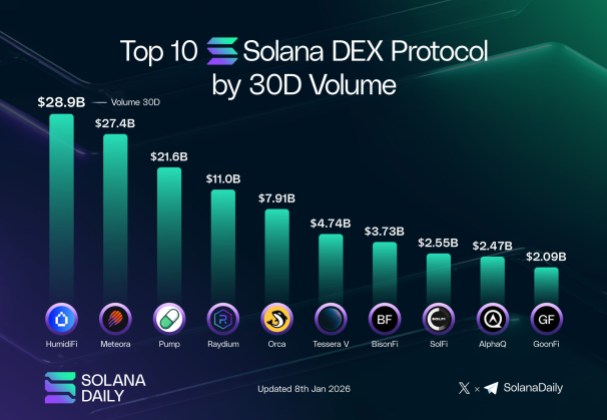
Source: Chart from Solana Daily on X

As SOL improves in these areas, it expands its lead over competing layer 1 and layer 2 ecosystems. With active market makers, robust DeFi protocols, and high transaction throughput, the network’s liquidity infrastructure seems to be maturing rather than withering after previous spikes in activity.

Another notable development highlighted by Solana Daily is the rise in SOL’s derivatives market as open interest broadens. At the time of the report, the altcoin’s open interest had reached a staggering $3.35 billion, indicating a fresh wave of trader engagement and risk-taking around the asset.

Increasing open interest usually indicates a new capital inflow into futures and perpetual markets, and in SOL’s case, it coincides with growing on-chain activity and a resurgence of speculative activity.

A Milestone In On-Chain Performance Into 2026

In another X post, Solana Daily reported that the SOL network closed 2025 with record on-chain performance, reflecting steady growth in real economic activity across applications, liquidity, and users. Traders, developers, and capital are not just testing Solana. They seem to be committing to the network, cementing its position as one of the most active centers in the cryptocurrency field.

This rise in on-chain performance underscores strong revenue metrics, increasing stablecoin supply, and growing institutional participation, which outline an evolving ecosystem heading into the next cycle. As the network further advances into 2026, narratives about Real World Assets (RWAs), payments, AI-native finance, and privacy infrastructure are beginning to emerge throughout the robust ecosystem.

SOL is slowly becoming an on-chain finance prodigy, which is indicated by the surge in stablecoin supply on the network. The Kobeissi Letter has outlined SOL’s stablecoin growth following a supply spike of over +$900 million in 24 hours.

According to the leading commentary, this is a result of Jupiter, the world’s largest on-chain platform, launching its on-chain focused stablecoin. During the period, Morgan Stanley also filed for a Spot Solana Exchange-Traded Fund (ETF). These moves point to a resurgence in crypto flows.

SOL trading at $139 on the 1D chart | Source: SOLUSDT on Tradingview.com

Related Questions

QWhat is the current DEX volume being processed by the Solana network, and how does it compare to other blockchain solutions?

AThe Solana network is processing $6.7 billion in DEX volume, which surpasses that of all other layer 1 and layer 2 solutions.

QWhat does the significant increase in Solana's open interest indicate about market activity?

ASolana's open interest reaching $3.35 billion indicates a fresh wave of trader engagement, risk-taking, and new capital inflow into futures and perpetual markets.

QWhat two major events contributed to the surge in stablecoin supply on the Solana network?

AThe surge was primarily due to Jupiter, the world's largest on-chain platform, launching its on-chain focused stablecoin, and Morgan Stanley filing for a Spot Solana Exchange-Traded Fund (ETF).

QHow did Solana's on-chain performance fare at the end of 2025, and what does this signify?

ASolana closed 2025 with record on-chain performance, reflecting steady growth in real economic activity and signifying that traders, developers are committing to the network, cementing its position as a highly active center in crypto.

QWhat emerging narratives are beginning to take shape within the Solana ecosystem as it advances into 2026?

ANarratives about Real World Assets (RWAs), payments, AI-native finance, and privacy infrastructure are beginning to emerge throughout the robust Solana ecosystem.

Related Reads

Yang Ge Gary: Agent Economy and AI Sub-Microeconomics

"Agent Economy and AI Submicroeconomics" by Gary Yang discusses the evolution of AI Agent economies, written from Singapore in June 2026. The author observes a significant "civilizational generational gap" in AI development, particularly highlighted by events in Silicon Valley. The article identifies a current bottleneck in the transition from Human-to-Agent (H2A) economies to true Agent-to-Agent (A2A) ecosystems. While AI Payment protocols are rapidly emerging, many implementations remain non-AI-native, focusing on traditional human decision-making models rather than leveraging autonomous Agent decision-making. A core thesis is the inevitable formation of an **Agent Economy**, defined as a system where autonomous AI Agents create, exchange, and capitalize value independently. This requires new infrastructure: **AI Protocols**, which are the foundational rules and standards for Agent interaction. The piece explores the relationship and current gap between AI Protocols and Crypto Protocols, suggesting political and regulatory factors from traditional finance are temporarily constraining development. However, a future fusion into a mature Digital Protocol system is deemed inevitable based on first principles. The author introduces **AI Agent Submicroeconomics**, contrasting it with human economics. Key differences include higher transaction frequency, lower value per transaction, efficiency-driven (not emotion-driven) decisions, task-oriented (not consumption-oriented) behavior, and near-zero organizational and communication costs. A biological analogy is drawn, comparing an Agent to a cell, its LLM to a nucleus, and its protocol stack to a cell membrane. The rise of **AIFi** (AI Finance) is presented as a natural consequence, where value originates from AI-native activities and is subsequently tokenized and financialized. This contrasts with DeFi/TradFi, where finance is the source of value. The concept of a **Financial Chip (FinChip)**—an autonomous AI Agent integrated with a crypto smart contract—is highlighted as key infrastructure for this new economy. The conclusion emphasizes that **AI-Native** thinking represents a paradigm shift distinct from "Internet+" upgrades. It requires reasoning from first principles, focusing on energy-value shortest paths and maximum efficiency, which presents a steep learning curve and significant challenge for all participants in this rapidly evolving field.

marsbit24m ago

Yang Ge Gary: Agent Economy and AI Sub-Microeconomics

marsbit24m ago

ViaBTC CEO Haipo Yang: Looking Back at the Decade, Re-understanding the Value of Crypto

In "A Decade in Retrospect: Re-evaluating the Value of Crypto," ViaBTC & CoinEx CEO Haipo Yang reflects on the cryptocurrency industry's evolution since founding ViaBTC in 2016. Initially a niche interest, Crypto has fundamentally transformed key financial infrastructures like market making, trading, settlement, and issuance through open protocols, as seen with Uniswap and GMX, and enabled efficient cross-border transfers via stablecoins. While acknowledging speculation's role in fueling innovation and liquidity, Yang warns it often overshadows real demand. He distinguishes between blockchain (a trust-minimizing technology), Web3 (an application model requiring genuine utility), and Crypto assets. The latter's value derives from block space as a commodity (e.g., gas fees) and "sovereign liquidity premium" (e.g., Bitcoin's censorship resistance), with most tokens lacking such dual support. Looking ahead, Yang argues the next decade's focus should shift from "open participation" to "sustainable participation," emphasizing reliable infrastructure. He predicts consolidation towards networks with strong security and liquidity (like Bitcoin and Ethereum), and sees DeFi becoming a specialized tool rather than a mass replacement for traditional finance. Crypto will integrate into traditional finance (e.g., via Bitcoin ETFs) but may sacrifice some decentralization for mainstream adoption. Real future demand may come from AI agents and machine economies needing permissionless settlement. Ultimately, Yang believes Crypto's enduring value lies not in hype or replacing everything, but in verifiably reducing trust costs, increasing efficiency, and providing stable, transparent services across market cycles.

marsbit24m ago

ViaBTC CEO Haipo Yang: Looking Back at the Decade, Re-understanding the Value of Crypto

marsbit24m ago

Trading

Spot
Futures

Hot Articles

Discussions

Welcome to the HTX Community. Here, you can stay informed about the latest platform developments and gain access to professional market insights. Users' opinions on the price of SOL (SOL) are presented below.

活动图片















