Solana ETFs record 7-day inflow streak despite price slump

cointelegraphPublished on 2025-12-13Last updated on 2025-12-13

Abstract

Despite a significant price decline and broader crypto market downturn, Solana (SOL) exchange-traded funds (ETFs) have recorded a seven-day inflow streak. The highest single-day inflow was approximately $16.6 million, bringing total net inflows to $674 million. This institutional interest persists even as SOL’s price has fallen nearly 55% from its January all-time high of $295 and struggles to break the $140-$145 resistance level. The token continues to trade well below its 365-day moving average, with its market cap dropping over 2% in the past week. The ongoing ETF inflows highlight sustained traditional finance engagement amid challenging market conditions.

Solana (SOL) exchange-traded funds (ETFs) recorded a seven-day inflow streak, despite SOL’s downward price performance and a broader downturn in the crypto market.

Tuesday marked the highest day of inflows during the seven-day streak, with about $16.6 million in capital flowing into SOL ETFs, according to data from investment management company Farside Investors.

This brings the total net inflow into SOL ETFs to $674 million at the time of this writing, data from Farside shows.
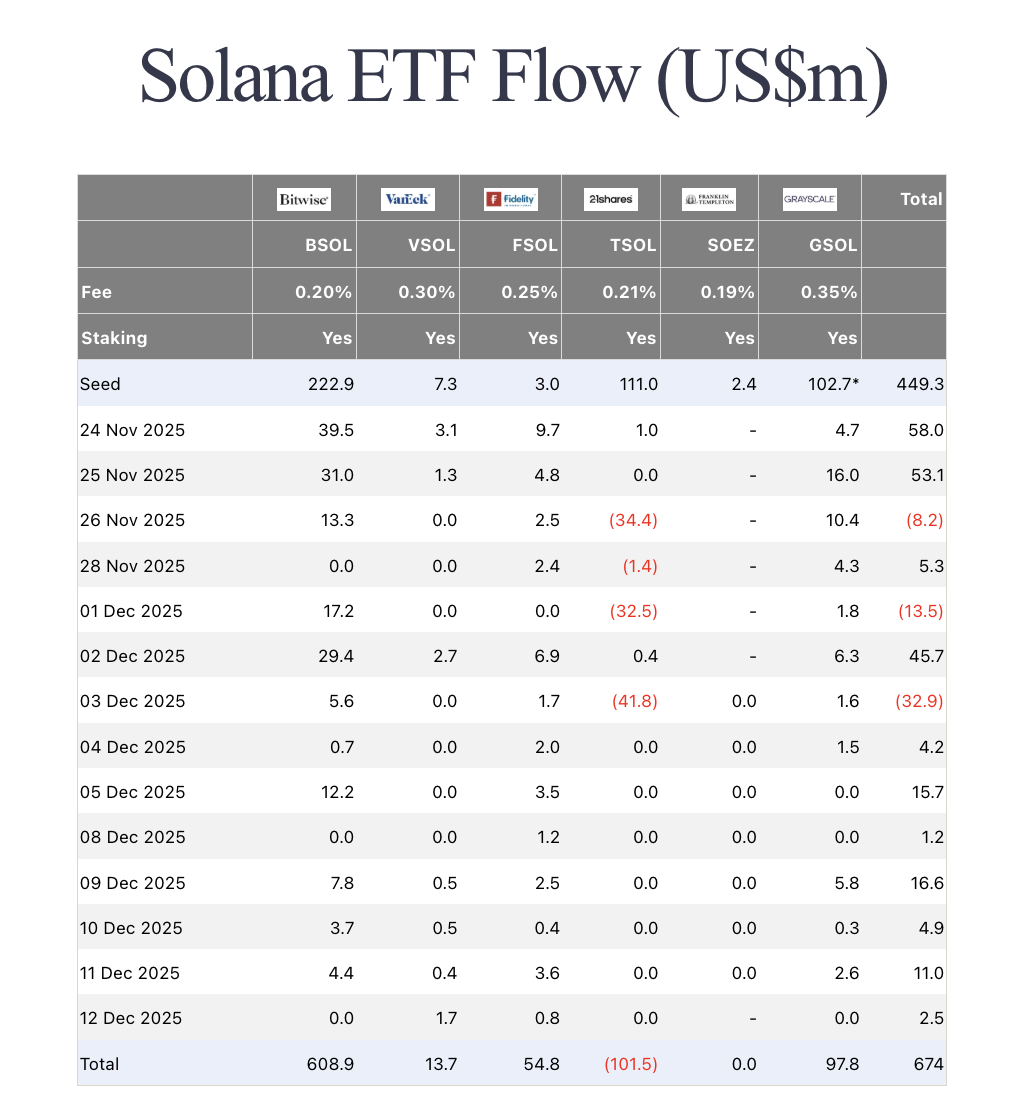
SOL ETF inflows. Source: Farside Investors

SOL ETFs debuted in the US in July, with the launch of REX-Osprey’s staked SOL ETF followed by investment company Bitwise’s BSOL Solana ETF in October, which was one of the hottest ETF launches of 2025, Bloomberg ETF analyst James Seyffart said.

The ETF flows signal interest in SOL from institutional and traditional finance investors, even as price and onchain metrics like total value locked, the amount of capital held in smart contracts for a protocol, decline during the ongoing market drawdown.

Related: Solana onchain flows flag notable supply shift as SOL trades near key support

SOL continues to struggle and is trading at a steep discount to its all-time high

Solana’s market capitalization has fallen by over 2% in the last seven days, according to crypto market analytics platform Nansen.

Open interest for SOL perpetual futures, which are futures contracts that lack an expiry date, is over $447 million at the time of this writing, Nansen’s data shows.

SOL’s price has fallen by nearly 55% since the all-time high of about $295 reached in January, fueled by the launch of the Trump memecoin on the Solana network.

The token has been trading well below its 365-day moving average, a critical level of support, since November, and is down by about 47% since the local high of about $253 recorded in September.
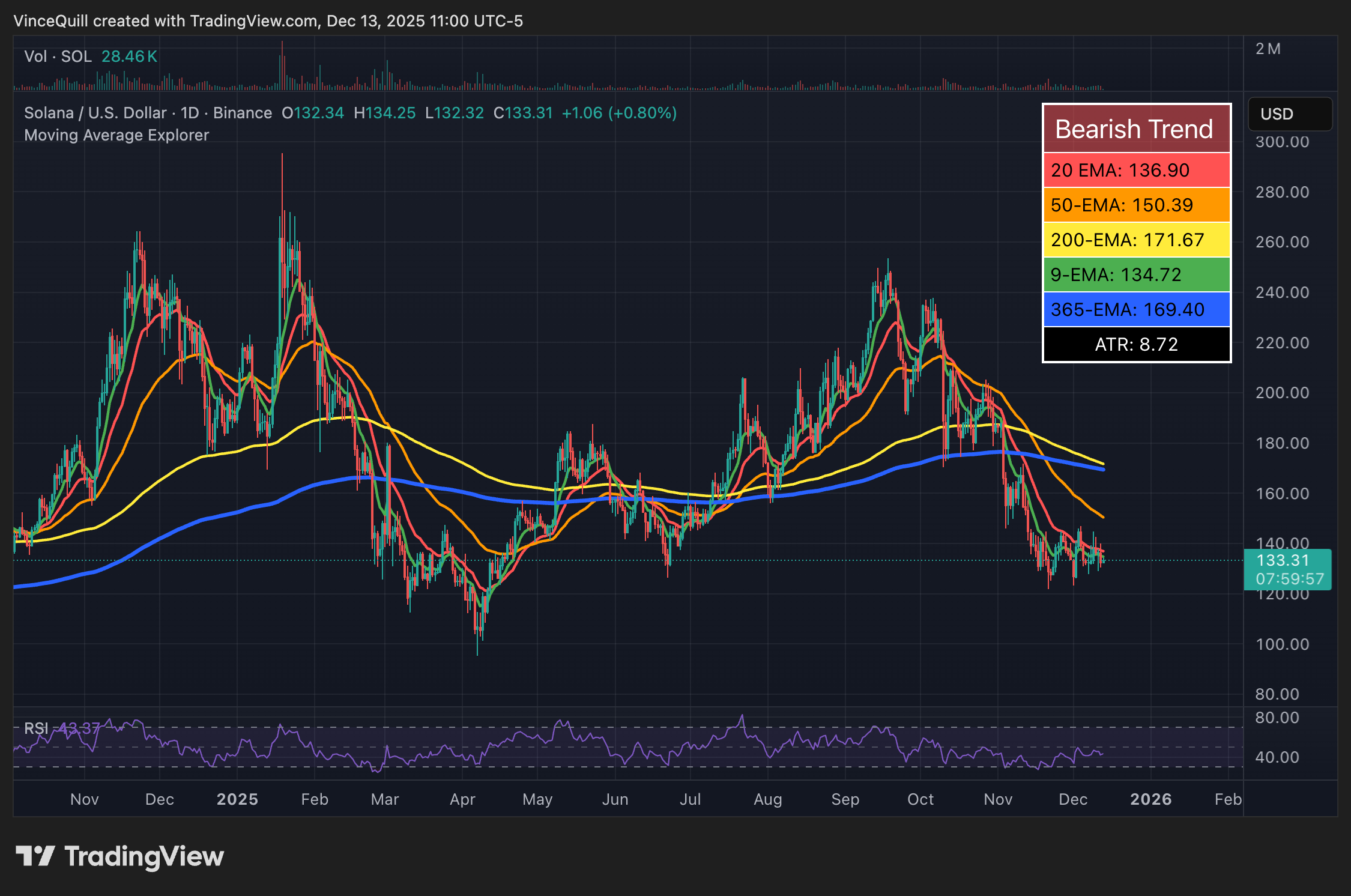
SOL’s price action from November 2024 to December 2025. Source: TradingView

SOL is also facing resistance between $140-$145 and has failed to close past those levels in December, despite the launch of SOL ETFs in the US and a growing interest in internet capital markets from crypto industry executives and US regulators.

“US financial markets are poised to move onchain,” Securities and Exchange Commission (SEC) Chair Paul Atkins said on Thursday.

Magazine: Meet the onchain crypto detectives fighting crime better than the cops

Trending Cryptos

Related Reads

Mathematicians Refute Open AI's Claim of Proving Connes Rigidity Conjecture Within 24 Hours: 'AI Proved Every Sentence Correct, but They Are No Longer About the Original Conjecture'

Mathematician Refutes OpenAI's Claim of Disproving Connes Rigidity Conjecture in 24 Hours OpenAI claimed its next-generation AI model solved 10 world-class problems, including disproving the Connes Rigidity Conjecture. The next day, mathematician J. L. Nielsen from the University of Kansas published a paper refuting the AI's counterexample. Nielsen meticulously reviewed OpenAI's publicly released 37,000 lines of Lean 4 code, mapping each object back to its mathematical origin. He identified two independent failure paths in the AI's argument. He concluded that one of the two groups constructed by the AI does not satisfy the required conditions (specifically ICC and Kazhdan's property (T)) necessary to serve as a valid counterexample to the original conjecture. This means the AI may have successfully proven something about its constructed objects, but that statement is not equivalent to disproving the Connes Rigidity Conjecture itself. The incident highlights a crucial limitation of formal verification tools like Lean. While Lean's kernel can verify the logical correctness of a proof's steps, it cannot verify whether the formal statement being proven correctly corresponds to the intended mathematical conjecture. Human oversight remains essential to ensure the alignment between the formalized problem and the original research question. This case exemplifies what researchers call "successfully proving the wrong statement." The Connes Rigidity Conjecture, concerning the uniqueness of group von Neumann algebras under certain conditions, remains an open problem.

marsbit9m ago

Mathematicians Refute Open AI's Claim of Proving Connes Rigidity Conjecture Within 24 Hours: 'AI Proved Every Sentence Correct, but They Are No Longer About the Original Conjecture'

marsbit9m ago

When Crypto Assets Become Mortgage Collateral: The Triangular Dilemma of Regulation, Cost, and Tokenized Equity

When Crypto Assets Become Mortgage Collateral: The Trilemma of Regulation, Cost, and Tokenized Rights Better, in partnership with Coinbase, has launched a mortgage solution allowing borrowers to pledge Bitcoin or USDC as collateral. This facilitates two loans: a primary, Fannie Mae-compliant mortgage and a separate private loan for the down payment, secured by the crypto assets and a second lien on the property. The product targets asset-rich but cash-poor buyers, with high collateral requirements (250% for Bitcoin, 125% for USDC) and no margin calls. The initiative has drawn significant regulatory scrutiny. Seven U.S. Senators, led by Dick Durbin and Elizabeth Warren, sent a letter to the FHFA urging a halt, arguing the high collateral ratio itself acknowledges crypto's risk and that combined loan costs could be 1.5 percentage points higher, potentially burdening taxpayers. Despite criticism and Bitcoin's price volatility, Better's CEO Vishal Garg plans to expand support to tokenized equities (e.g., Tesla, SpaceX) and envisions using retirement accounts to help family members buy homes. A core challenge for tokenized assets is clarifying the legal rights conferred by holding such tokens. To reduce costs, Better partnered with Framework Ventures, aiming to lower capital expenses by over 100 basis points and offer sub-5% rates. While the company posted a loss in Q1 2025, it reports strong demand, with a waitlist representing ~$250M in potential loans. Garg remains committed to the model, viewing it as a key channel for integrating digital assets into the banking system.

marsbit19m ago

When Crypto Assets Become Mortgage Collateral: The Triangular Dilemma of Regulation, Cost, and Tokenized Equity

marsbit19m ago

Trading

Spot

Hot Articles

Discussions

Welcome to the HTX Community. Here, you can stay informed about the latest platform developments and gain access to professional market insights. Users' opinions on the price of SOL (SOL) are presented below.

活动图片