Smart Money Is Moving Back Into Bitcoin — What’s Driving The Surge?

bitcoinistPublished on 2026-05-13Last updated on 2026-05-13

Abstract

Bitcoin and crypto investment products recorded a significant $857.9 million in net inflows for the week ending May 11, marking the sixth consecutive week of positive flows and the strongest weekly total since late April, according to CoinShares. This surge, a sevenfold increase over the prior week, is seen as a potential structural reset in institutional demand. Bitcoin products attracted the majority at $706.1 million, but inflows were broad-based, with Ethereum, Solana, and XRP products also seeing substantial investments. Short-Bitcoin products experienced their largest outflow of 2026, indicating a reversal of bearish bets. Geographically, the United States led with $776.6 million in inflows, with European markets like Germany and Switzerland also contributing steady participation. Analysts attribute Bitcoin's climb above $80,000 to ETF inflows, corporate treasury buying, and regulatory optimism around stablecoin legislation. The sustained inflow streak presents a pivotal shift, challenging traditional allocators to reconsider the asset class.

Global crypto investment products recorded $857.9 million in net inflows for the week ending May 11 with Bitcoin capturing a big portion of the increase. This marked the sixth consecutive week of positive flows and the strongest weekly total since April 24, according to CoinShares’ latest Digital Asset Fund Flows report — a streak that analysts are increasingly reading as a structural reset in institutional demand rather than a temporary bounce.

The weekly figure represents a more than sevenfold increase over the prior week’s $117.8 million, per CoinShares’ data, underscoring how sharply sentiment shifted as Bitcoin climbed back above the $80,000 threshold. Total assets under management across digital asset investment products rose to $160 billion on the back of the inflows, according to the report.

Bitcoin Leads, But The Breadth Is Notable

Bitcoin products captured the dominant share of last week’s flows, attracting $706.1 million and bringing year-to-date inflows to $4.9 billion, per CoinShares. The directional shift extended well beyond Bitcoin. Ethereum products recorded $77.1 million in inflows, reversing the prior week’s $81.6 million outflow. Solana drew $47.6 million. XRP products attracted $39.6 million.
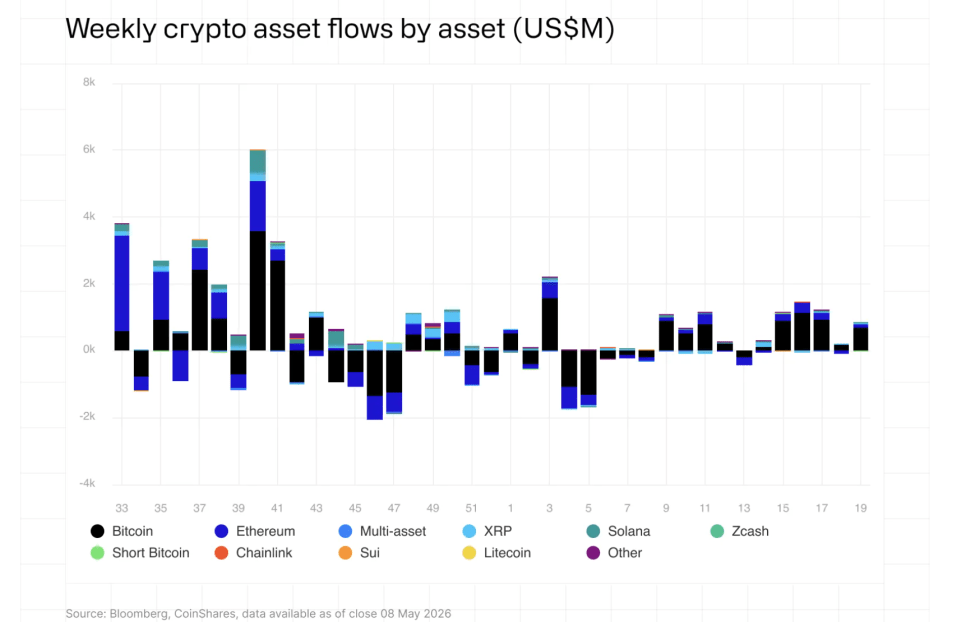
Crypto ETF inflows on the rise over the past week. Source: CoinShares

The breadth of positive flows across major assets signals a broader improvement in institutional risk appetite rather than Bitcoin-specific positioning, per the report’s geographic and asset-level breakdown. Short-Bitcoin products — instruments used to bet against the asset — posted their largest outflow of 2026, according to CoinShares, a signal that bearish institutional positioning is unwinding alongside the inflow surge.

The US Led, But Europe Held Firm

Geographically, the United States dominated with $776.6 million in inflows, recovering sharply from $47.5 million the prior week, per CoinShares. Germany followed at $50.6 million, Switzerland at $21.1 million, and the Netherlands at $5 million — a distribution that, according to analysis by TradingNews, points to European institutional participation holding steady even as Washington’s regulatory progression has emerged as the dominant catalyst driving sentiment.
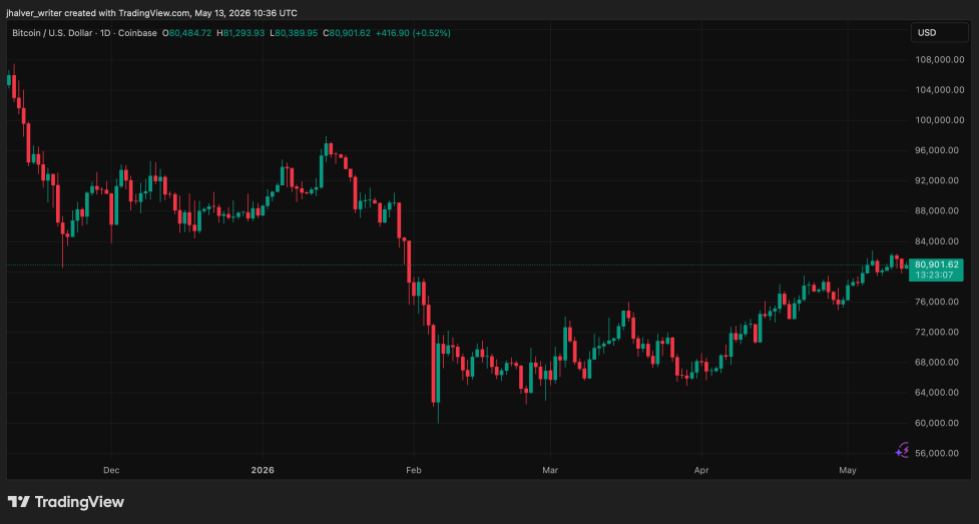
BTC's price trends to the upside on the daily chart. Source: BTCUSD on Tradingview

Laser Digital’s derivatives desk attributed Bitcoin’s move above $80,000 to the combination of ETF inflows, anticipated purchases by digital asset treasury companies, and growing optimism surrounding a compromise on the CLARITY Act related to stablecoins, as reported by Bloomingbit citing market commentary from the week.

Six consecutive weeks of positive inflows into crypto investment products marks a pivotal shift in the nascent sector’s institutional demand profile. Whether the streak extends into a sustained re-rating of crypto as an institutional asset class — or fades as macro uncertainty reasserts itself — the $857.9 million weekly figure is the kind of number that makes it increasingly difficult for traditional allocators still sitting on the sidelines to justify staying there.

Cover image from Grok, BTCUSD chart from Tradingview

Trending Cryptos

Related Questions

QAccording to the CoinShares report, how much net inflow did global crypto investment products record for the week ending May 11, and what was the key trend?

AGlobal crypto investment products recorded $857.9 million in net inflows for the week ending May 11, marking the sixth consecutive week of positive flows.

QWhich cryptocurrency investment products attracted the most inflows last week, and what was the amount?

ABitcoin products attracted the most inflows last week, capturing $706.1 million of the total.

QWhat geographic region dominated the weekly inflows into crypto investment products, and what was the approximate amount?

AThe United States dominated the weekly inflows with approximately $776.6 million.

QWhat are the three factors that Laser Digital's derivatives desk attributed to Bitcoin's move above $80,000?

ALaser Digital's derivatives desk attributed Bitcoin's move above $80,000 to a combination of ETF inflows, anticipated purchases by digital asset treasury companies, and growing optimism surrounding a compromise on the CLARITY Act related to stablecoins.

QWhat does the report suggest the sustained inflow streak signals about institutional demand, as opposed to being a temporary event?

AThe report suggests analysts are increasingly reading the six-week inflow streak as a structural reset in institutional demand rather than a temporary bounce.

Related Reads

Token FOLD Auction Imminent, What is The Interfold, Supported by Vitalik?

**Title:** FOLD Token Auction Approaches: What is The Interfold, Supported by Vitalik? **Summary:** The Interfold, a "confidential coordination infrastructure" previously known as Enclave, is launching its functional token FOLD via a Uniswap Continuous Clearing Auction (CCA) starting July 8th. Endorsed by Ethereum co-founder Vitalik Buterin in May, the protocol tackles the core problem of governance bribery in decentralized voting (e.g., on platforms like Votium) by enabling multiple parties to compute a verifiable result without exposing their private input data. Its core technology, the Encrypted Execution Environment (E3), uses a distributed network of "Ciphernodes" that perform computations on fully encrypted data using Fully Homomorphic Encryption (FHE), with process integrity verified by Zero-Knowledge (ZK) proofs and decryption keys managed via Decentralized Threshold Cryptography (DTC) to eliminate a single point of trust. The primary application is CRISP (Coercion-Resistant Impartial Selection Protocol) for DAO governance, which ensures encrypted voting, "receipt-free" votes to prevent bribery, and verifiable tallying. The Interfold, developed by the Gnosis Guild team (creators of the Zodiac DAO tooling), positions itself as a focused solution to make on-chain voting truly un-buyable, realizing the vision of Vitalik's earlier MACI (Minimal Anti-Collusion Infrastructure) framework without its reliance on a single trusted coordinator. FOLD tokens will be used for Ciphernode staking, paying for computation requests, and protocol governance. Following the 48-hour auction, there is a 40-day cooling period where tokens can only be staked, with the official Token Generation Event (TGE) expected around August 19th.

Foresight News4m ago

Token FOLD Auction Imminent, What is The Interfold, Supported by Vitalik?

Foresight News4m ago

Bridging Traditional Funds and DeFi: Who Will Capture the Next Decade's RWA Dividends?

Bridging Traditional Funds and DeFi: Who Will Capture the RWA Decade's Value? Tokenization of real-world assets (RWA) is merging the 24/7, permissionless world of DeFi with the time-bound, regulated world of traditional finance. While the complexity is immense, the infrastructure layer enabling this fusion holds significant value. The total value of on-chain tokenized real-world assets now exceeds $33 billion. While tokenized U.S. Treasuries dominate, their share has fallen from 55% to under 45% in a year as other assets like institutional and private credit grow. The key differentiator for on-chain assets is *composability*, allowing capital to be recycled across multiple yield-generating strategies simultaneously. However, tokenized funds remain regulated products with daily NAV updates, KYC requirements, and redemption windows. Bridging these to DeFi requires solving core conflicts: pricing assets between NAV updates, enforcing compliance without stifling DeFi activity, and maintaining accurate accounting during cross-chain transfers. Solutions like the Centrifuge V3 architecture, in collaboration with LayerZero, propose a hub-and-spoke model. A single authoritative hub chain manages NAV, compliance, and accounting, while LayerZero's messaging layer syncs this data to spokechains where tokens can be freely composed in DeFi. This creates a high-barrier, essential middleware layer. The major incentive for institutions is the potential for recursive yield strategies—for example, depositing into a tokenized Treasury fund, borrowing stablecoins against it, and redeploying those funds into another yield-bearing asset, amplifying returns. Yet, risks remain: mismatches between on-chain instant redemptions and off-chain fund limits (as seen in recent private credit fund runs), pricing arbitrage due to NAV lags, and cross-chain settlement failures. Infrastructure must solve these while maintaining regulatory compliance. Just as SWIFT and Visa captured immense value as financial plumbing, the entities that build the robust middleware connecting traditional finance and DeFi are positioned to capture the next decade's value in the RWA space.

Foresight News29m ago

Bridging Traditional Funds and DeFi: Who Will Capture the Next Decade's RWA Dividends?

Foresight News29m ago

Trading

Spot

Hot Articles

What is $BITCOIN

DIGITAL GOLD ($BITCOIN): A Comprehensive Analysis Introduction to DIGITAL GOLD ($BITCOIN) DIGITAL GOLD ($BITCOIN) is a blockchain-based project operating on the Solana network, which aims to combine the characteristics of traditional precious metals with the innovation of decentralized technologies. While it shares a name with Bitcoin, often referred to as “digital gold” due to its perception as a store of value, DIGITAL GOLD is a separate token designed to create a unique ecosystem within the Web3 landscape. Its goal is to position itself as a viable alternative digital asset, although specifics regarding its applications and functionalities are still developing. What is DIGITAL GOLD ($BITCOIN)? DIGITAL GOLD ($BITCOIN) is a cryptocurrency token explicitly designed for use on the Solana blockchain. In contrast to Bitcoin, which provides a widely recognized value storage role, this token appears to focus on broader applications and characteristics. Notable aspects include: Blockchain Infrastructure: The token is built on the Solana blockchain, known for its capacity to handle high-speed and low-cost transactions. Supply Dynamics: DIGITAL GOLD has a maximum supply capped at 100 quadrillion tokens (100P $BITCOIN), although details regarding its circulating supply are currently undisclosed. Utility: While precise functionalities are not explicitly outlined, there are indications that the token could be utilized for various applications, potentially involving decentralized applications (dApps) or asset tokenization strategies. Who is the Creator of DIGITAL GOLD ($BITCOIN)? At present, the identity of the creators and development team behind DIGITAL GOLD ($BITCOIN) remains unknown. This situation is typical among many innovative projects within the blockchain space, particularly those aligning with decentralized finance and meme coin phenomena. While such anonymity may foster a community-driven culture, it intensifies concerns about governance and accountability. Who are the Investors of DIGITAL GOLD ($BITCOIN)? The available information indicates that DIGITAL GOLD ($BITCOIN) does not have any known institutional backers or prominent venture capital investments. The project seems to operate on a peer-to-peer model focused on community support and adoption rather than traditional funding routes. Its activity and liquidity are primarily situated on decentralized exchanges (DEXs), such as PumpSwap, rather than established centralized trading platforms, further highlighting its grassroots approach. How DIGITAL GOLD ($BITCOIN) Works The operational mechanics of DIGITAL GOLD ($BITCOIN) can be elaborated on based on its blockchain design and network attributes: Consensus Mechanism: By leveraging Solana’s unique proof-of-history (PoH) combined with a proof-of-stake (PoS) model, the project ensures efficient transaction validation contributing to the network's high performance. Tokenomics: While specific deflationary mechanisms have not been extensively detailed, the vast maximum token supply implies that it may cater to microtransactions or niche use cases that are still to be defined. Interoperability: There exists the potential for integration with Solana’s broader ecosystem, including various decentralized finance (DeFi) platforms. However, the details regarding specific integrations remain unspecified. Timeline of Key Events Here is a timeline that highlights significant milestones concerning DIGITAL GOLD ($BITCOIN): 2023: The initial deployment of the token occurs on the Solana blockchain, marked by its contract address. 2024: DIGITAL GOLD gains visibility as it becomes available for trading on decentralized exchanges like PumpSwap, allowing users to trade it against SOL. 2025: The project witnesses sporadic trading activity and potential interest in community-led engagements, although no noteworthy partnerships or technical advancements have been documented as of yet. Critical Analysis Strengths Scalability: The underlying Solana infrastructure supports high transaction volumes, which could enhance the utility of $BITCOIN in various transaction scenarios. Accessibility: The potential low trading price per token could attract retail investors, facilitating wider participation due to fractional ownership opportunities. Risks Lack of Transparency: The absence of publicly known backers, developers, or an audit process may yield skepticism regarding the project's sustainability and trustworthiness. Market Volatility: The trading activity is heavily reliant on speculative behavior, which can result in significant price volatility and uncertainty for investors. Conclusion DIGITAL GOLD ($BITCOIN) emerges as an intriguing yet ambiguous project within the rapidly evolving Solana ecosystem. While it attempts to leverage the “digital gold” narrative, its departure from Bitcoin's established role as a store of value underscores the need for a clearer differentiation of its intended utility and governance structure. Future acceptance and adoption will likely depend on addressing the current opacity and defining its operational and economic strategies more explicitly. Note: This report encompasses synthesised information available as of October 2023, and developments may have transpired beyond the research period.

671 Total ViewsPublished 2025.05.13Updated 2025.05.13

What is $BITCOIN

Discussions

Welcome to the HTX Community. Here, you can stay informed about the latest platform developments and gain access to professional market insights. Users' opinions on the price of BTC (BTC) are presented below.

活动图片