Anthropic's New Models 'Catch the Gossip', The Strongest Fable 5 Unexpectedly Falls Flat

marsbitPublished on 2026-08-24Last updated on 2026-08-24

Abstract

Anthropic has been discovered working on two new, previously unknown models codenamed "Marshmallow" (claude-marshmallow-eap) and "Melon" (claude-melon-eap), with early tests showing Marshmallow potentially surpassing Claude Opus 5 in conversational naturalness. Their emergence coincides with surprising new data revealing that Anthropic's flagship Fable 5 model, released two months ago as its strongest and most expensive offering, is being largely ignored by the enterprise market. According to spending data from Ramp tracking over 70,000 US companies, Fable 5 accounts for only about 11% of total token spending on Anthropic's models. This pales in comparison to OpenAI's flagship GPT-5.6 Sol, which commands roughly 25% of token spending in the same period. The tepid adoption is largely attributed to Fable 5's extremely high cost—double that of Opus 4.8 and ten times that of Haiku 4.5—without delivering proportionally superior performance for most business applications. Compounding the issue, the later-released Claude Opus 5, priced at half the cost of Fable 5, has achieved comparable or even better results in key benchmarks like programming and knowledge work, quickly surpassing Fable 5 in enterprise spending share. Furthermore, the rapid rise of powerful, low-cost open-source models—whose token usage share surged from 11% in April to 62% in August while costing less than 4% of enterprise AI budgets—applies additional pressure. Analysts suggest the sudden appearance of Marshm...

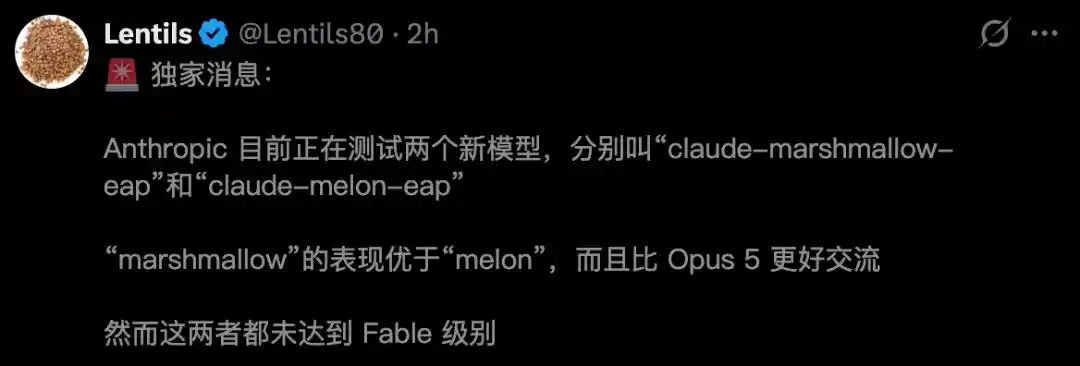
Anthropic has once again prematurely revealed two 'new cards'!

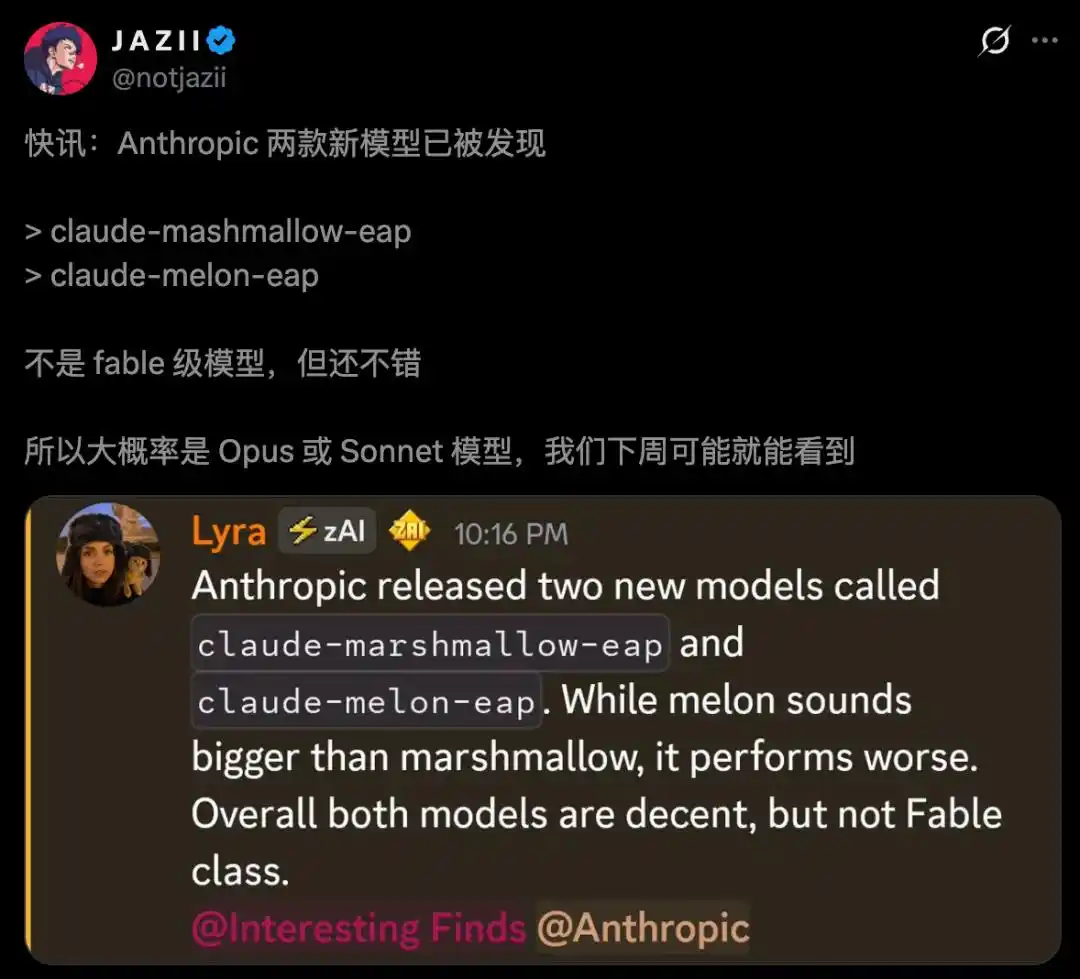
Today, two unfamiliar model IDs appeared consecutively in third-party developer applications and the Discord community—

  • claude-mashmallow-eap (Marshmallow)
  • claude-melon-eap (Melon)

Early actual tests leaked, showing Marshmallow performs stronger, surpassing Opus 5 in conversational naturalness, while Melon slightly falls behind.

However, their overall capabilities are not at the 'Fable level', and they are scheduled to launch as early as next week.

Just as the whole internet was catching the gossip, Anthropic internally 'detonated' a landmine first—

Two months after its launch, Fable 5 has encountered an almost collective cold shoulder.
Anthropic Rushes to Fill the Gap

Claude's New Models Exposed

This round of updates seems to have come more urgently than before.

Big names in the AI circle speculate that Marshmallow likely corresponds to an iterative upgrade at the Opus level, possibly Opus 5.1.

Whereas Melon is closer to the Sonnet level.

The SVG test results shared by a netizen further widened the gap between the two models.

The Anthropic official team has not yet formally responded, but various clues are beginning to converge.

If it were just a normal upgrade, this event itself wouldn't be strange.

What's truly subtle is, why exactly now?

After all, just over two months ago, Anthropic had just placed its strongest, most expensive card on the table.

That is Fable 5, standing at the very top of the Claude pyramid.

The Strongest Fable 5 Unexpectedly Falls Flat

Two months ago, Fable 5 debuted with the halo of Anthropic's 'strongest flagship'.

The most capable, the most expensive, and also the most advanced AI in the entire Claude product line.

According to industry habits, once a new flagship is released, major companies often quickly migrate, shifting their budgets towards the newest and strongest model.

This time, the pattern failed on Fable 5!
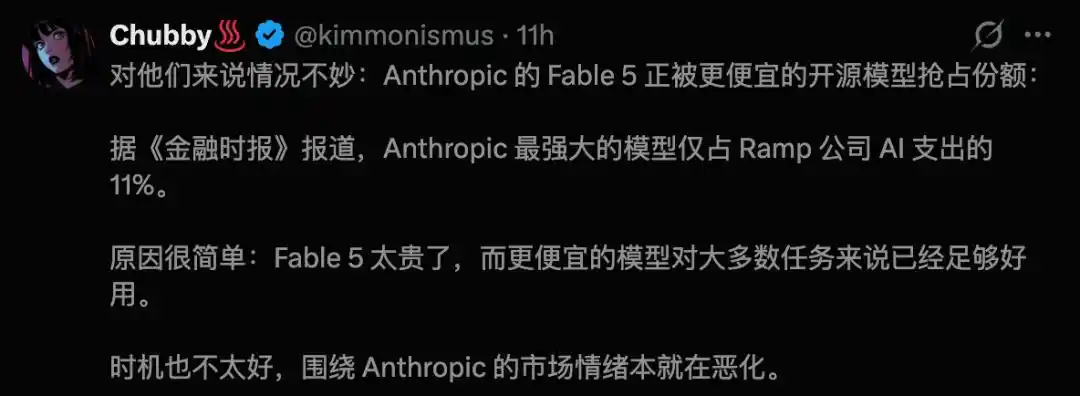
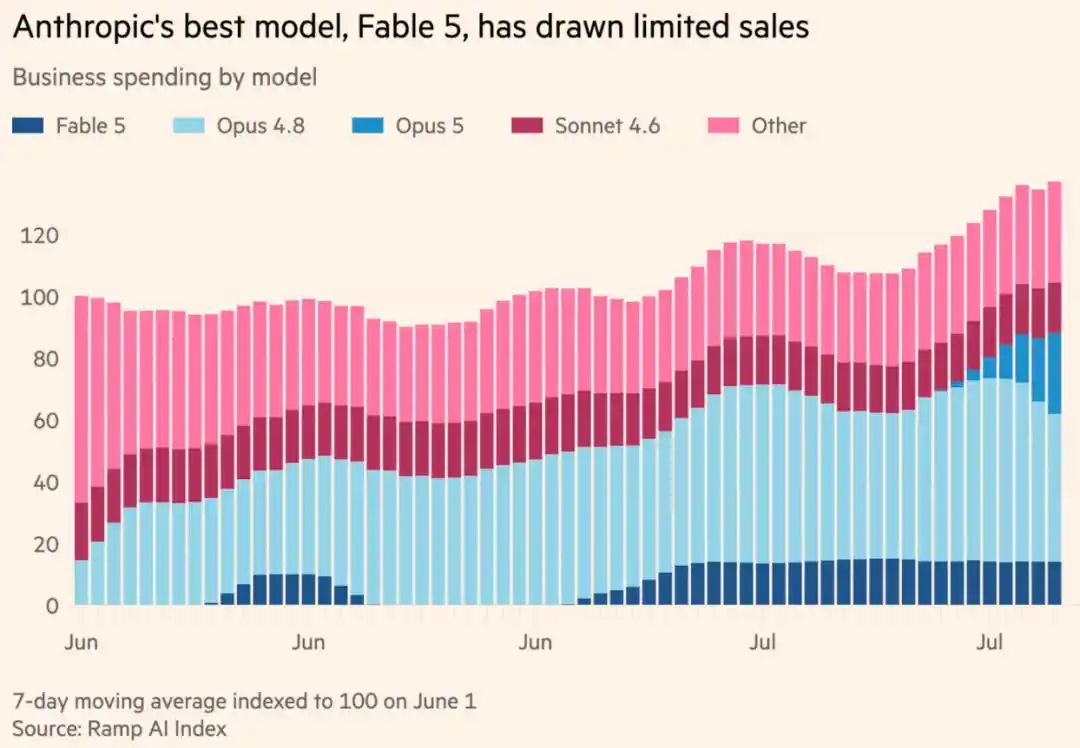
The payment platform Ramp tracked the token consumption data of over 70,000 U.S. companies and found:

One month after Fable 5's launch, it only accounted for 6% of companies' token call volume on Anthropic, with an expenditure share of 11.4%.

Now, over two months later, the latest data obtained by FT shows this expenditure share still hovering around 11%.

In other words, there are very few developers and major companies truly willing to switch their models to Fable 5.

Meanwhile, rival OpenAI's flagship GPT-5.6 Sol captured 25% of tokens and a 23% expenditure share during the same period.

On the same playing field, Anthropic's top-tier model's share is only a quarter of its competitor's.

Even more awkwardly, Fable 5's total revenue contribution is only about 75% of GPT-5.6 Sol's, despite being twice as expensive per token.
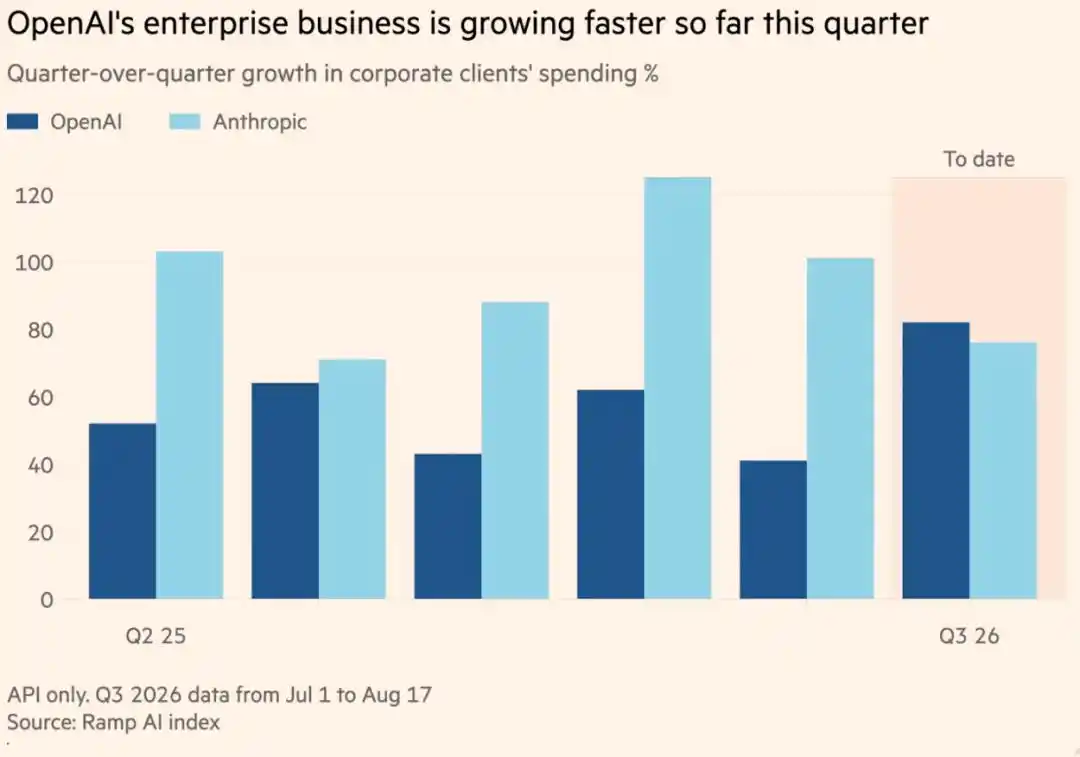
How expensive is it?

Fable 5's unit price is twice that of Anthropic's own Opus 4.8 and ten times that of Haiku 4.5.

Although powerful, most corporate daily scenarios simply don't require that level of capability.

In-House Opus 5 Stages a Comeback Against the Big Brother

Another Anthropic model delivered a 'direct blow' to Fable 5.

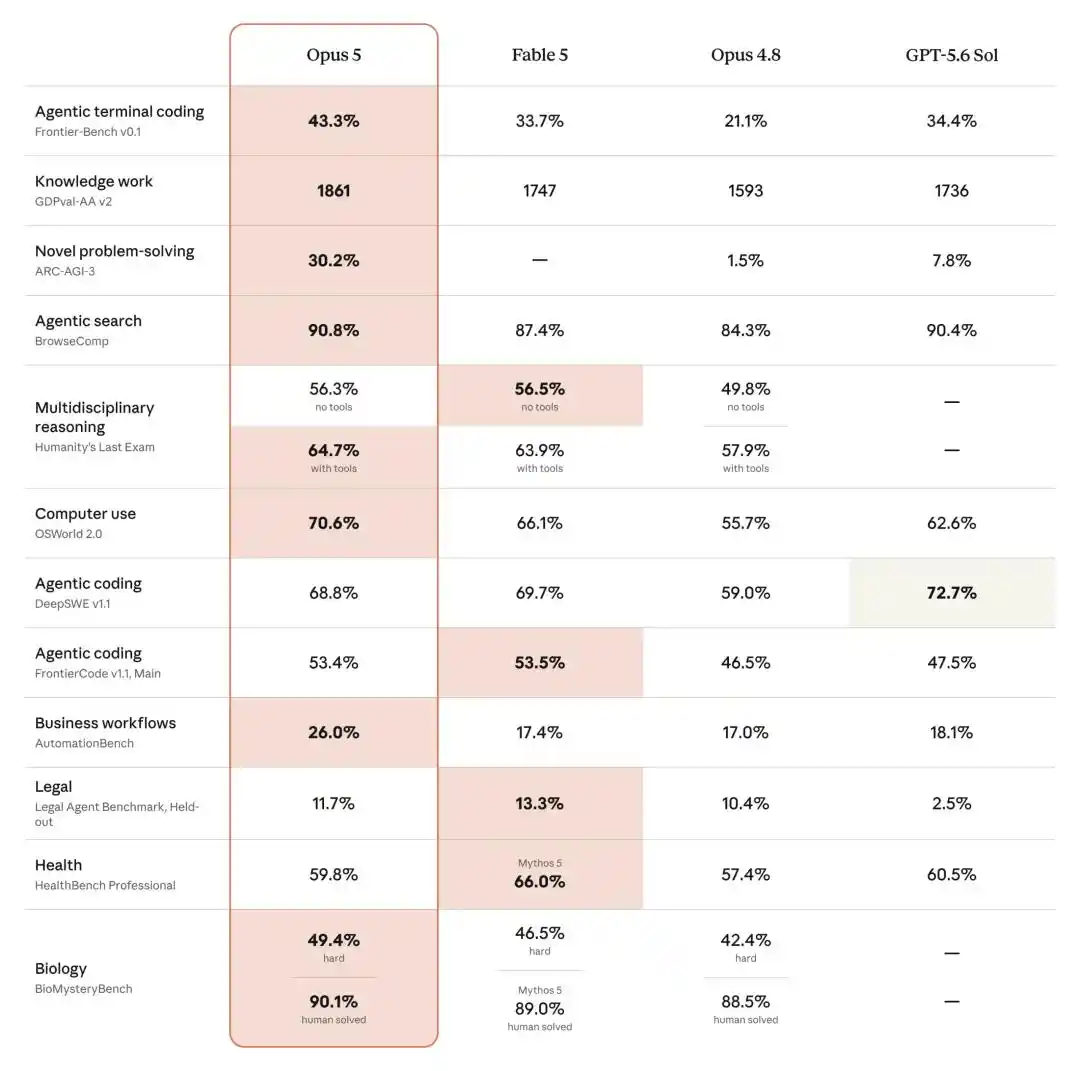
At the end of July, Opus 5 officially debuted, priced at only half of Fable 5, yet it achieved better scores in programming and knowledge work evaluations.
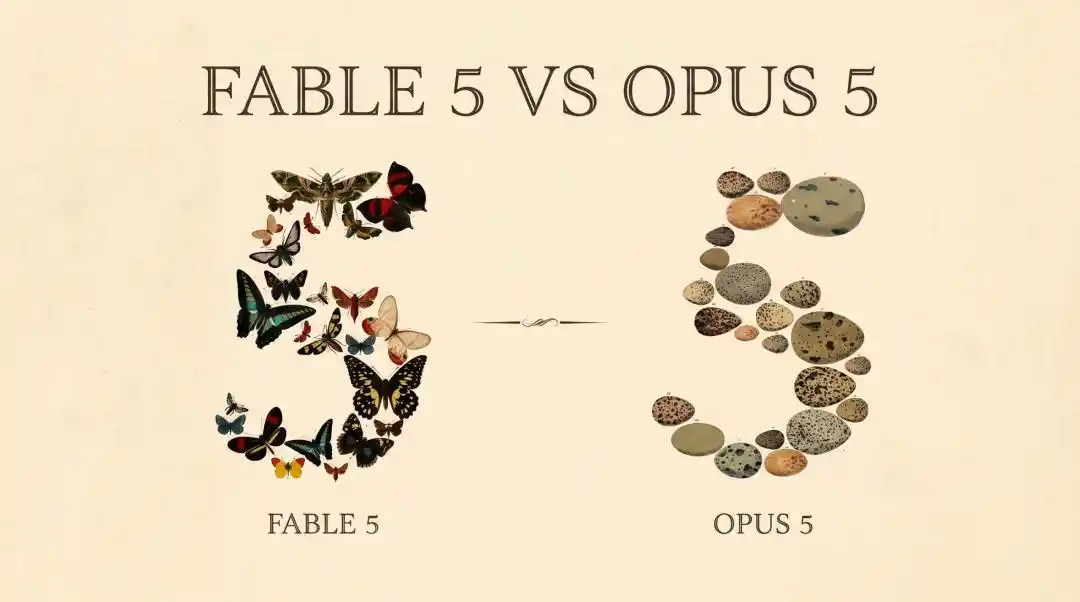
The test results from CursorBench 3.2 are even more direct—

Opus 5 scored 70% at maximum compute power, costing $8.23 per task. Fable 5 scored 70.5%, 0.5 percentage points higher, but costing $17.32.

That's equivalent to spending twice as much money for only a 0.5% better performance.

The result of businesses voting with their feet is unsurprising. Ramp data shows that after Opus 5's launch, its expenditure quickly surpassed Fable 5's.
But the problem is, if the flagship model is just a 'display case', what justifies a $2 trillion valuation from the market?

Open Source Jumps from 11% to 62% in Just Four Months

Moreover, the crazy expansion of open-source AI is also putting pressure on Anthropic.

Vercel AI Gateway statistics show—

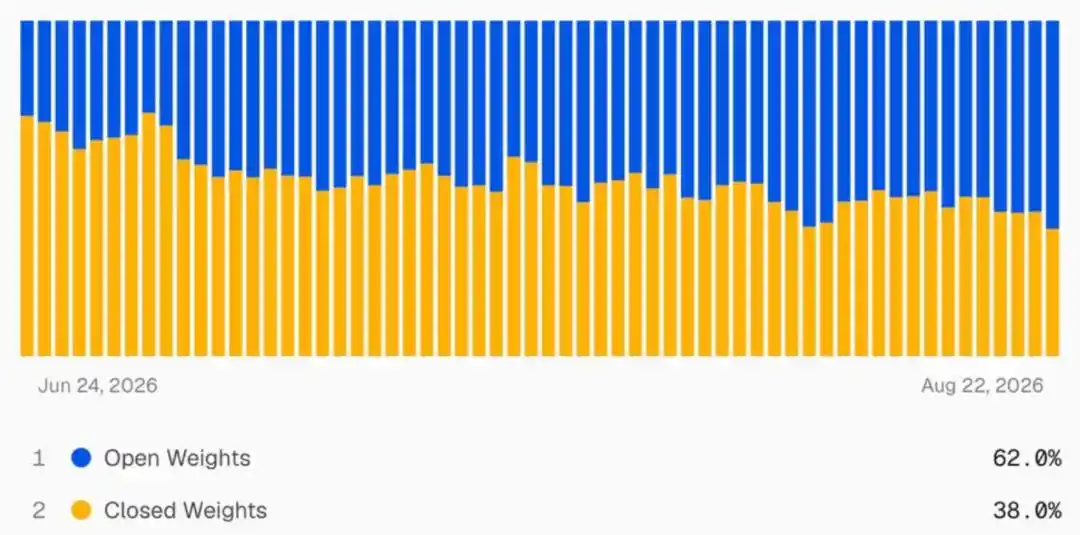
In April, open-source models' token share was only 11%. By June, this number surged to 29%. The latest August data directly soared to 62%.

In just two months, it skyrocketed from less than one-third to over 60%. And the money they spent was less than 4% of the total corporate expenditure.

In other words, the models doing most of the work cost almost nothing.
This makes Fable 5's position increasingly awkward.

Looking inward, Opus 5, at half the price, is already catching up right behind it; looking outward, open-source models are relentlessly driving prices down in rounds.

Fable 5 can, of course, continue to be responsible for pushing the limits of capability.

But what Anthropic urgently needs right now are models that businesses are genuinely willing to use long-term and at scale.

Viewed this way, the sudden emergence of Marshmallow and Melon is not that surprising.

What they aim to fill is likely the most crucial piece in the Claude 'full package'—

Strong enough, yet affordable enough; capable of showing off muscle, but more importantly, getting people to pay for it.

References:

https://x.com/kimmonismus/status/2091599817084412221?s=20

https://www.ft.com/content/5ee49718-c258-4f01-aa32-7e5b76ae5245?syn-25a6b1a6=1

This article is from WeChat Official Account "New Zhiyuan", author: ASI Apocalypse, editor: Taozi

Related Questions

QWhat are the two new Claude model IDs that appeared in third-party apps and Discord, according to the article?

AThe two new model IDs are 'claude-mashmallow-eap' (Marshmallow or 'Cotton Candy') and 'claude-melon-eap' (Melon).

QWhy is Anthropic's flagship model, Fable 5, experiencing poor adoption based on the Ramp data?

AFable 5 adoption is low because its performance gains are minimal compared to its much higher cost. For example, in CursorBench 3.2, it scored only 0.5% higher than Opus 5 but cost over twice as much. Most enterprise use cases do not require its extreme capabilities, making it a poor value proposition.

QHow does the performance and cost of Opus 5 compare to Fable 5, according to the CursorBench 3.2 test results mentioned?

AIn the CursorBench 3.2 test, Opus 5 scored 70% at a cost of $8.23 per task. Fable 5 scored 70.5% (only 0.5% higher) at a cost of $17.32 per task.

QWhat trend does the Vercel AI Gateway data show regarding the usage share of open-source AI models from April to August?

AThe data shows a rapid surge in open-source model usage share: from 11% in April, to 29% in June, and reaching 62% by August. These models handle a majority of the workload while accounting for less than 4% of corporate AI spending.

QWhat is the suggested role of the newly exposed 'Marshmallow' and 'Melon' models for Anthropic's product strategy?

AThe article suggests 'Marshmallow' and 'Melon' are intended to fill a critical gap in Claude's product lineup: offering models that are powerful enough but also cost-effective, aiming for models that enterprises are willing to use widely and consistently, not just for showcasing peak capabilities.

Related Reads

The Biggest Political Economy Question in the AI Era: As Robots Become More Capable, How Do Humans Share the Value?

In the AI era, the most pressing political economy question is: as machines become increasingly capable, how can humanity share in the value they create? An article originally critiquing China's tech focus has sparked a deeper debate on this global challenge. Historically, industrial progress improved efficiency but still relied on human labor for wealth creation and distribution. AI is fundamentally different—it is now replacing cognitive and knowledge work. As AI and robots take over more tasks, economic growth may continue while direct human participation in value creation shrinks, creating a core tension between productivity gains and widespread income generation. The issue is not unique to China. While leading tech companies amass enormous wealth, labor's share of income is declining globally. The core problem is a broken link: technological innovation and corporate profits are not translating into sufficient consumer income and demand. Three potential paths forward are outlined: a traditional capitalist model where profits primarily go to capital owners; a state-capitalist approach with public investment in AI; and more innovative models like digital sovereign wealth funds, universal shareholding, or AI-era basic income schemes to directly distribute AI-generated value. The future competitive advantage may lie not just in technological supremacy, but in which society can build a new, inclusive distribution system for the intelligent economy. The ultimate challenge is ensuring that as AI creates value, humans have a means to obtain income and share in the resulting widespread social benefits.

marsbit7m ago

The Biggest Political Economy Question in the AI Era: As Robots Become More Capable, How Do Humans Share the Value?

marsbit7m ago

Generating Profits for Seven Consecutive Quarters, Emerging Markets Carry Trade Outperforms Everything

For the seventh consecutive quarter, dollar-funded emerging market carry trades have delivered positive returns, marking the longest winning streak since 2008. According to Bloomberg's index, this strategy has gained approximately 22% since late 2024, outperforming U.S. Treasuries, emerging market sovereign, and corporate dollar debt. The core of the trade involves borrowing low-interest currencies like the U.S. dollar, euro, or yen to invest in high-yielding emerging market assets, such as Turkish lira bonds offering over 40% returns. Returns were amplified by favorable currency moves, with the dollar weakening against most emerging market currencies and other traditional funding currencies. For instance, the trade gained 48% on the Colombian peso in the past year. A key test came in August 2024 with a historic joint U.S.-Japan currency intervention, which caused only a modest 1% dip in the carry trade risk premium as investors shifted funding from the yen to the euro and Swiss franc. Looking ahead, the primary risk is the timing of Federal Reserve policy changes. While persistent inflation allows the Fed to hold rates, a rapid rise in long-term U.S. yields could threaten the trade. Another concern is crowding, as massive inflows increase vulnerability to a sudden reversal. High interest rates in regions like Latin America and Eastern Europe, supported by external factors like Middle East tensions and energy prices, continue to sustain the opportunity. Major investors remain engaged, favoring currencies like the Mexican peso, South African rand, and Turkish lira.

marsbit22m ago

Generating Profits for Seven Consecutive Quarters, Emerging Markets Carry Trade Outperforms Everything

marsbit22m ago

Unpacking the Truth Behind On-chain Assets: Leverage, Liquidity, and Risk

The article analyzes the concept of "real-world asset" (RWA) tokenization, arguing that while tokenizing assets on-chain is a useful step, it is far from transformative on its own. The author compares it to placing a barcode on a shipping container—it enables identification but does not build the necessary market infrastructure. The core argument is that true value emerges not from tokenization, but from integrating these tokens into DeFi systems where they can be valued, financed, hedged, traded, and liquidated under stress. Key challenges identified include: 1. **Multiple Time Clocks**: A fundamental tension exists between blockchain's 24/7 settlement and the slower, business-hour-dependent processes of traditional markets, custody, and redemption. This "duration mismatch" can create dangerous liquidity gaps during crises. 2. **Liquidity Misconceptions**: True liquidity is not measured by Total Value Locked (TVL) or trading pairs, but by the ability to exit a position within a required timeframe at an acceptable price. It requires analyzing multiple exit paths and stress-testing scenarios. 3. **Leverage and Risk**: Leverage unlocks economic utility (e.g., using tokenized assets as collateral) but also introduces fragility. Risk models must account for more than asset volatility, incorporating factors like legal enforceability, oracle freshness, and market structure. Paradoxically, a "safer" asset like tokenized Treasury bonds could require a higher collateral discount than ETH due to slower, less-proven liquidation mechanisms. 4. **A Risk Graph**: RWA risk should be modeled as a network of interconnected dependencies (e.g., issuers, custodians, oracles, stablecoin pools), not a single score. Failures can propagate through this graph, turning operational issues into systemic liquidity crises. The article states that tokenized government bonds are merely an entry point, while more complex frontiers like computing power and energy assets present greater challenges and opportunities. It also examines the interplay and risks between tokenized stocks and perpetual futures contracts. The conclusion is that the future lies not in "tokenizing everything," but in building robust market layers where tokenized rights become resilient financial primitives within a programmable capital system. The token is just the barcode; the market is the machine.

marsbit46m ago

Unpacking the Truth Behind On-chain Assets: Leverage, Liquidity, and Risk

marsbit46m ago

Trading

Spot
活动图片