Source: Sequoia Capital
Compiled by: Yuliya, PANews
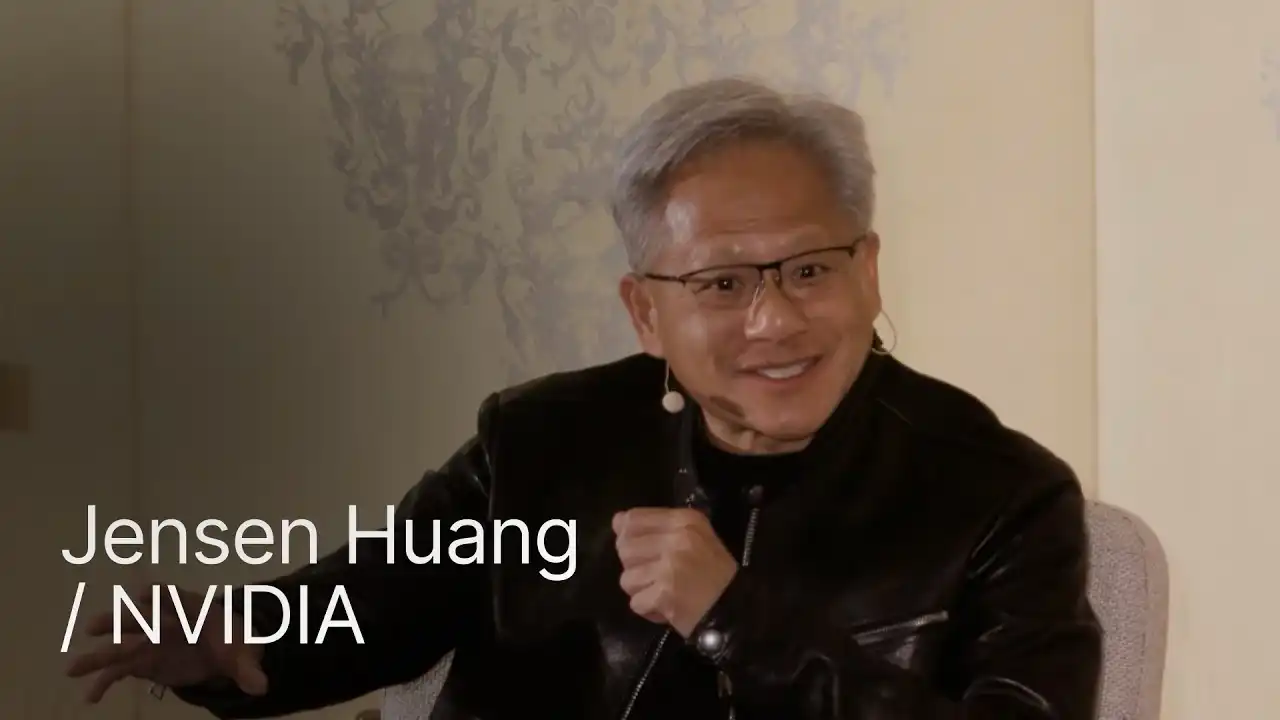
Editor's Note: In the past, our data centers merely stored files for human retrieval; now, computing is shifting towards generation, where every word, image, and video is produced in real-time and highly customized according to the requester's context. In this global wave of transformation, Sequoia Capital Partner Konstantin Buhler and NVIDIA founder and CEO Jensen Huang engaged in an in-depth dialogue, discussing the major shifts in computing technology. Huang believes that automation will not lead to unemployment but rather a comprehensive upgrade in labor demand and a dimensional elevation of professions themselves; people will not lose their jobs because of AI, but they may be replaced by those who are adept at leveraging AI.
AI Factories and the Generational Leap in Computing Models: From Retrieval to Generation
Konstantin: Thank you very much for being here, Jensen. We are in the midst of a massive AI revolution, whose scale and speed may even surpass the Industrial Revolution. You have stated that what is happening now is the largest infrastructure construction in human history. At the heart of this construction are AI factories, and the company powering all of this is NVIDIA. Can you tell us what an AI factory is and why it is the most worthwhile investment for all enterprises in the next decade?
Jensen Huang: There are many ways to understand AI. What the public is most familiar with might be interacting with a chatbot through a web browser: you give it a prompt, and it replies with a passage. Even if you've been using AI for a while, you'll find its capabilities have evolved remarkably over the past two to three years.
Two years ago, everyone heard about ChatGPT. It is essentially computer software that understands the information you input. It can perceive, comprehend information, and transform and generate it into other content. For example, you can give it a PDF file and ask it to summarize it—that's text-to-text. You can also have it generate an image based on a story—that's text-to-image. Or give it a photo and ask it to describe the scene—that's image-to-text. This capability was called generative AI two years ago.
But beyond understanding and generation, thinking ability is even more valuable. The foundation of generative AI endows it with the capacity for internal thought, step-by-step reasoning, and problem-solving. Moreover, it can now generate control instructions to use tools—whether digital tools like browsers, spreadsheets, Photoshop, AutoCAD, or, in the future, to control mechanical systems (which is robotics and autonomous driving).
Two years ago, people found ChatGPT interesting; it could write poems and songs but occasionally talked nonsense. Today, two years later, we have agentic systems. AI is no longer just about understanding information; it can now reason and perform useful work. Because it can do useful work, AI has created real commercial value. We don't pay for friends who only talk big, but we pay people who actually get work done. Now, people are hiring AI by the hour every day, for example, paying it $20 to $30 per hour. That's also why it has become the fastest-growing software business in human history.
Looking upstream from an industrial logic perspective, we must return to first principles. The fundamental concept of the computer industry as we know it today was established roughly 64 years ago. At that time, IBM launched the System/360, which was also the reason IBM became the world's most valuable company then.
For the past 60 years, the essence of computing has been pre-recording and retrieval: you write a story, take a photo, record a video, save it as a file into a hard drive; when you want to use it, you retrieve it from the hard drive. That's why those buildings are called data centers. They just store data and don't do much computing.
But now things have changed. In the AI era, every time you provide new context and a new request, AI performs real-time understanding, reasoning, and generates brand-new results. For instance, the speech I'm giving now is generated in real-time based on the different backgrounds of everyone present, rather than being read from a script. This is what intelligence is.
In the future, every pixel, every sound, every piece of video, even every ad and news article will be custom-made, fully generated for you, rather than pre-recorded and retrieved. This means, we will need a massive number of generators in the future, which are the large-scale computers we are building—these are AI factories.
The Intelligent Network Enveloping the Earth and the Dynamo of the Digital Age
Konstantin: How large will this generator be?
Jensen Huang: Currently, we provide information and intelligence generation for roughly 1 billion people globally. But because AI has become agents that can work on their own, one agent can even communicate and collaborate with another. Within NVIDIA, there might be hundreds or thousands of agents talking to each other and solving problems (of course, they operate within safe sandboxes and guardrails).
This means that in the future, not only will humans be using the internet, but there might also be hundreds of billions of agents working tirelessly day and night on the internet. Agents for enterprises, autonomous vehicles, robots, even systems in every building will all be talking to each other. All instructions, all thinking will be generated in real-time.
It's like a thick computational network, wrapping the entire Earth like a cocoon. This sounds exaggerated, but it has actually happened twice in history:
-
The first time was 300 years ago when Germany's Siemens made a machine. You ignite it, and it outputs a powerful invisible force—electricity. Today, the power generation network (the electrical grid) envelops the entire Earth.
-
The second time was 35 years ago with the birth of the internet in the US, which now also envelops global communications.
Now, we are welcoming the third network after energy and communication: the intelligent network. The business NVIDIA relies on for survival today is building this new era's dynamo. The dynamo 300 years ago input the physical motion of water flow, wind, or coal (atoms) and output electrons; our NVIDIA machine, on the other hand, inputs electrons (electrical energy) and outputs digits. These digits, through different combinations, become language, mathematics, or the language of proteins and human biology, the language of physical laws and climate prediction, even the language of 3D worlds, robotics, and autonomous driving.
These two machines, separated by 300 years, share a similar principle: atoms in, electrons out; electrons in, digits out. These digits are what we call Tokens, which is intelligence. We mass-produce these intelligent Tokens in factories; that's the essence of AI factories.
Konstantin: We are in the midst of a wave where multiple revolutions converge. From the energy transition, routers of global telecommunication networks, to today's GPUs and AI factories at the core of the intelligence revolution, like the H100 or the latest Vera Rubin architecture. Integrating everything needed.
Jensen Huang: Yes, our compute unit is called a "rack." A rack contains 72 chips. This year, we will produce about 8 million of these components. A rack weighs 2 tons, costs $4 million, and has 1.5 million parts. It's the most expensive piece of equipment in the world, but we're mass-producing them like smartphones, shipping them to data centers worldwide. This thing is huge; moving them is definitely heavy labor.
The Five-Layer Cake Investment Logic for Participating in the AI Era
Konstantin: This is a very exciting vision. How can both large enterprises and individuals participate in this revolution?
Jensen Huang: To invest in the AI industry, you can imagine its industrial layout as a five-layer cake. You know, a $50 billion AI factory can generate $300 to $400 billion worth of intelligence; its return on investment is quite astonishing. So, what are these five layers?
The first layer is Energy: That is, the power generators at the very bottom. This is the biggest growth opportunity for the energy industry in generations. To support computing, sustainable energy (nuclear, wind, solar, hydrogen, etc.) will receive massive investments. As long as you can generate energy, you will get investment. That's why companies like Siemens, Mitsubishi, GE Vernova are performing so well now.
The second layer is Chips/Computers: Including chips, computers, networking equipment, switches, and silicon photonics technology.
The third layer is Infrastructure: Including land, power, building shells, capital, and the day-to-day operations of data centers. These resources are currently in extreme shortage.
The fourth layer is the Model Layer: That is, the large models built on cloud infrastructure. This is the most market-driven, capital-intensive field in human history. Well-known examples include OpenAI and Anthropic. But remember, AI can learn not just natural language; it can learn anything with structure. We are learning the laws of the physical world—for example, when I sat down just now, I was very confident not because I had a 47% chance of falling through the chair, but 100% confident in the laws of physics. AI can similarly learn the meaning of proteins, the significance of genes, the function of cells. The industry scale of the physical world is $80 trillion, a crucial frontier that is currently less discussed.
The fifth layer is the Application Layer: Based on the underlying technology, countless startups are reshaping industries like financial services, law, accounting, transportation, and logistics. Last year, venture capital invested $100 billion in this top layer, the highest VC investment year in human history.
This future will be immense. We are merely at the starting line, with an estimated $1 trillion being invested into this ecosystem this year. But I estimate that AI will be a massive ecosystem worth around $20 trillion annually in the future. How important is intelligence? Who needs it? How much do you need? Figure these out, and you'll know the direction for investment.
AI Isn't Here to Take Your Job; It's Here to Help You Level Up
Konstantin: This is not only a market opportunity worth trillions of dollars but also means the explosion in hardware infrastructure and application layers will create a vast number of real jobs for humanity.
Jensen Huang: Absolutely correct, and this point we must emphasize. Right now, attitudes toward AI vary across countries and cultures. But I sincerely want to advise everyone: Beware of those Hollywood sci-fi movie plots. Stop listening to people saying things like "The Terminator is coming," "the technological singularity is here," "there's a 20% chance AI will destroy humanity." That's complete nonsense.
Some even scare others by saying, "We don't even know how AI works; it's too mysterious; maybe it will just walk away tomorrow." That's even more baseless. AI is computers and software; engineers certainly know how it works, otherwise how could they make it safer and smarter every year?
Today's AI has significantly reduced hallucinations; the knowledge it generates is accurate and contextually relevant. When it doesn't know something, it even looks it up. It might even self-reflect before answering you, compare several options, and then tell you the answer. Just as cars today are much safer than they were 100 years ago, the tech world is going all out to make AI extremely safe.
So, focus your attention on what is certain. I am very certain about one thing: You probably won't lose your job because of AI, but you will definitely lose your job to the person who uses AI.
Since this is a technology that can give humans superpowers, you should hurry up and use it! Whether you're telling your loved ones, your children, your company, or your country: you must embrace AI.
Konstantin: But when it comes to jobs, people are genuinely anxious.
Jensen Huang: I get upset every time I hear people creating panic about jobs. This year, we invested $1 trillion into this ecosystem—energy, chips, infrastructure, model layer, application layer—all creating far more jobs than ever before.
Some might ask, what about traditional positions? There's a common cognitive mistake people make here: they confuse "Job" with "Task."
Take me, for example. I'm a CEO. My daily "tasks" mainly involve typing and speaking. Now, AI is far better at typing and speaking than I am—it's superhuman level. But as a CEO, I'm actually busier now than before.
Let me give you a more profound example. About 12 years ago, a top computer scientist stood up and warned everyone, saying computer vision could read medical images tirelessly, never missing a detail, already at superhuman levels. He asserted that the first profession to be eliminated by AI would be "radiologists," advising people not to study this field anymore.
He was completely correct in his technical judgment. Now, all radiology systems integrate computer vision; all radiologists use AI to assist their work. But what was the outcome? The global demand for radiologists actually increased!
Why? Because the purpose of a radiologist is not to read images but to diagnose diseases alongside clinicians. Due to automation, their efficiency greatly increased; hospitals could take in more patients waiting in line, and radiology departments became more profitable. Hospitals found profits rising and patient numbers growing, so they hired even more radiologists! Those who heeded the warning and didn't study radiology missed the opportunity.
Similarly, recently, some said that because AI can write code, 90% of software programming is gone; we no longer need software engineers. But the fact is, we are hiring more software engineers now than ever before! Because the purpose of a software engineer is to solve problems and innovate, not to compete in typing speed. Writing code is just a task; solving problems is the core.
AI will not only not eliminate jobs; it will actually enhance the value of your work. If I were a plumber today, I might just work according to blueprints; but tomorrow, with AI's support, I might also be a kitchen designer. If I were a furniture seller or carpenter, in the past, you only expected me to nail wood together, but with AI, I can directly provide you with full interior design plans, making your home incredibly beautiful. My professional skills have been elevated to a higher dimension!
So I believe that the current narrative about AI causing human unemployment is completely wrong; it's just to scare others away so that they can profit from it. Looking at my entire career, computer technology has become increasingly complex. In the past, people who mastered the C++ programming language only accounted for 2% of the population (maybe more among you in the Silicon Valley venture capital circle). But now, because of AI, as long as you understand human language, you can program. For the first time, we are truly closing the technological gap; we must bring everyone along into this new era.