Senate Has 4 Days to Advance CLARITY Act as White House Considers Deal

cryptonews.ruPublished on 2026-08-04Last updated on 2026-08-04

Abstract

The U.S. Senate has just four scheduled session days left before the August recess to advance the comprehensive CLARITY Act, a major cryptocurrency regulatory framework, intensifying pressure from industry advocates. The pro-crypto group Stand With Crypto, representing over three million supporters, is pushing for passage and will score senators on their vote. While the bill, a 616-page proposal setting registration rules for exchanges, brokers, and custodians, has cleared the Senate Banking Committee with bipartisan support, its fate hinges on resolving a final sticking point regarding ethics provisions. The White House is currently reviewing a counter-proposal on these ethics rules from Senators Tillis and Gallego. Senate Banking Chair Tim Scott expressed hope for progress on digital asset bills soon. If unresolved, the ethics issue, covering digital asset transaction restrictions for officials and reporting requirements, could delay the bill until after the recess. Analysts at Galaxy Research recently gave the bill a 30% chance of becoming law in 2026. Supporters may need 60 votes to overcome procedural hurdles in the limited time window.

The Senate has only four scheduled session days left to advance the CLARITY Act before the August recess, sparking a fresh wave of pressure from cryptocurrency advocates and industry groups.

Stand With Crypto, a cryptocurrency advocacy organization representing over three million supporters, has called on senators to approve the bill before the recess. The group claims that support spans Wall Street, the crypto industry, and other organizations.
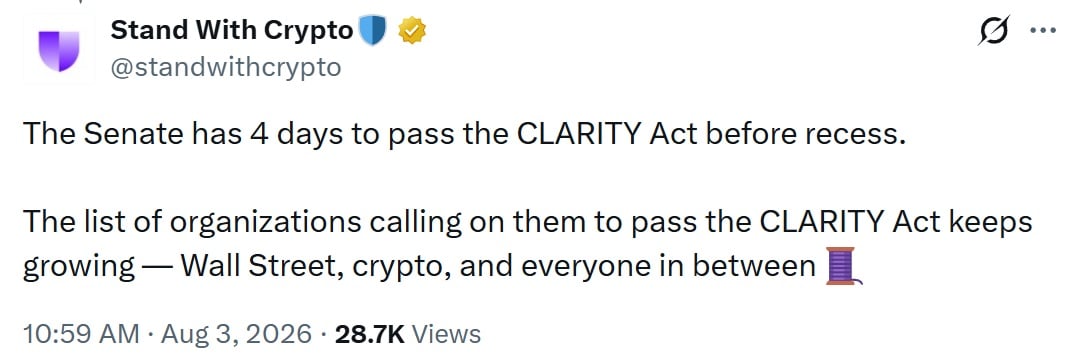
The organization also plans to score each senator's vote on the CLARITY Act bill, increasing political pressure as lawmakers work through their final working days before the August recess.

White House Response Remains Pivotal to Negotiations

Attention is also focused on the White House, as lawmakers await a response to a counteroffer on ethics issues presented by U.S. Senator Thom Tillis (R-N.C.) and U.S. Senator Ruben Gallego (D-Ariz.). Journalist Eleanor Terrett reported that the administration is reviewing the proposal, leaving one of the last outstanding issues on the CLARITY Act bill unresolved as the Senate enters its final working days before the congressional recess.

U.S. Senator Tim Scott (R-S.C.), Chairman of the Senate Banking Committee, expressed hope that lawmakers would be able to advance digital asset legislation soon. His statements set a compressed timeline for the remaining negotiations, which are being watched by investors, digital asset companies, and financial markets as Congress approaches the August break.

Reaching an agreement will impact how federal agencies oversee cryptocurrency exchanges, digital commodity trading brokers, token issuers, custodians, decentralized finance services, and other market participants. Unresolved wording on ethics provisions has become a central point of negotiations, linking industry rules to restrictions regulating digital asset transactions involving federal officials.

Updated Bill Advances Toward Senate Floor Vote

On July 22, U.S. Senator Cynthia Lummis (R-Wyo.) unveiled an updated CLARITY Act bill, consolidating the work of the Senate Banking and Agriculture committees after months of negotiations on consumer protections, enforcement authority, market oversight, national security, and federal control over digital assets.

The 616-page accompanying text of the CLARITY Act establishes a registration framework for digital commodity exchanges, brokers, dealers, and qualified custodians. It also addresses issues concerning customer assets, software developers, decentralized finance, stablecoin yields, cybersecurity, illicit finance, self-custody, bankruptcy protections, and ethics requirements.

Committee members previously advanced the bill by passing it through the Senate Banking Committee with a bipartisan vote of 15-9, sending the proposal to the full Senate floor after lawmakers reconciled issues concerning regulatory authority, enhanced consumer protection, enforcement tools, and measures to support digital asset innovation.

Support for the bill has extended beyond the Capitol. U.S. Securities and Exchange Commission (SEC) Commissioner Paul Atkins expressed optimism that Congress could pass the bill, and Executive Chairman of Strategy Inc. (Nasdaq: MSTR) Michael Saylor endorsed the proposal as a step towards establishing clearer digital asset rules in the U.S.

Four-Day Window Raises Stakes for Senate Action

According to the Senate's official 2026 legislative calendar, the congressional recess begins on August 10. With only four scheduled session days remaining from August 4 to 7, lawmakers have an extremely narrow window to advance the CLARITY Act before leaving Washington.

Supporters of the bill may need 60 votes to overcome procedural hurdles ahead of a final vote. Research firm Galaxy Research recently placed the odds of the bill becoming law in 2026 at 30% amid ongoing ethics negotiations and scheduling pressure.

The ethics section includes restrictions on certain digital asset transactions, reporting requirements, a U.S. Government Accountability Office study, an effective date, and a sunset provision. Feedback from the White House could determine whether negotiators revise these provisions during the remaining four days or continue discussions after the Senate reconvenes in September.

end-content


Trending Cryptos

Related Questions

QWhat is the main pressure facing the U.S. Senate regarding the CLARITY Act in the article?

AThe main pressure is the four remaining scheduled session days before the August recess to advance the CLARITY Act, a window that has intensified calls for approval from cryptocurrency advocates and industry groups like Stand With Crypto.

QWhich organization is cited as applying pressure on senators to pass the CLARITY Act before the recess?

AThe organization cited is Stand With Crypto, an advocacy group claiming to represent over three million supporters from Wall Street, the crypto industry, and other groups.

QWhat unresolved issue is reportedly being reviewed by the White House, according to the article?

AThe White House is reportedly reviewing a counter-proposal on ethics issues, presented by Senators Tom Tillis and Ruben Gallego, which is one of the last unresolved matters holding up the CLARITY Act.

QWhat was the updated status of the CLARITY Act as of July 22 mentioned in the article?

AAs of July 22, an updated 616-page version of the CLARITY Act was released by Senator Cynthia Lummis, merging work from the Senate Banking and Agriculture committees and covering a comprehensive framework for digital asset regulation.

QAccording to Galaxy Research, what is the estimated probability of the CLARITY Act becoming law in 2026?

AGalaxy Research estimated the probability of the CLARITY Act becoming law in 2026 at 30%, citing ongoing negotiations over ethics provisions and scheduling pressures.

Related Reads

After Memes, Solana Foundation's 'Survival Roadmap'

**Title:** After Memes, Solana Foundation's "Survival Roadmap" **Summary:** Solana Foundation's recent hiring spree for senior roles in stablecoins, AI, Asian institutional growth, and DeFi signals a strategic pivot away from its meme-driven past. This move comes as the blockchain faces a 43% quarterly drop in real economic value and declining application revenue, despite maintaining high network activity. While meme platforms like Pump.fun still dominate fee generation, new demand is emerging in tokenized equities (with $5.8B volume in Q2, a 114% increase) and institutional adoption (7 global systemically important banks are now active on Solana). The foundation's new hires aim to bridge a critical gap: transforming this growing non-speculative demand into sustainable, fee-generating activity. The stablecoin lead seeks "step-change growth" for a sector lagging behind competitors. The Asia-focused roles aim to convert institutional interest into concrete pipelines, leveraging upcoming network upgrades for millisecond settlement. The AI ecosystem role is tied to new stablecoin payment channels for AI agents, a nascent but promising revenue stream. The core challenge is clear: reduce reliance on volatile meme trading income and successfully monetize the rising institutional and real-world asset activity. The success of this "survival roadmap" will be measured by whether projects from these new focus areas can break into Solana's top revenue rankings, displacing the current meme-centric leaders.

marsbit13m ago

After Memes, Solana Foundation's 'Survival Roadmap'

marsbit13m ago

Anchorage Unveils Plan to Protect Against Quantum Threats

Regulated crypto bank Anchorage Digital has presented a strategy for preparing institutional assets for the post-quantum era, including implementing hybrid protection for internal TLS connections. The bank highlights that for cryptocurrencies, the main quantum risk lies in digital signatures, as Shor's algorithm could theoretically derive a private key from a public one. To mitigate this, Anchorage uses Bitcoin addresses based on a hash of the public key, which keeps the key hidden until a transaction is sent, and practices minimal address reuse. Internally, the company has deployed post-quantum key encapsulation for employee devices on ChromeOS and is implementing post-quantum cryptography within its hardware security modules (HSMs). A key proposal is the "Post-Quantum Turnstile" mechanism, which uses STARK zero-knowledge proofs to allow users to migrate signing rights to a post-quantum key without exposing their old private or public key. This could help secure an estimated two-thirds of circulating coins that might otherwise become inaccessible if the network phases out classical signatures. Furthermore, Anchorage open-sourced its Rust implementation of the SQIsign digital signature scheme, which it claims offers signatures about seven times smaller than the Falcon algorithm. This comes amid warnings that around 6 million BTC in addresses with exposed public keys could be vulnerable to future quantum attacks.

cryptonews.ru46m ago

Anchorage Unveils Plan to Protect Against Quantum Threats

cryptonews.ru46m ago

Trading

Spot

Hot Articles

How to Buy 4

Welcome to HTX.com! We've made purchasing 4 (4) simple and convenient. Follow our step-by-step guide to embark on your crypto journey.Step 1: Create Your HTX AccountUse your email or phone number to sign up for a free account on HTX. Experience a hassle-free registration journey and unlock all features.Get My AccountStep 2: Go to Buy Crypto and Choose Your Payment MethodCredit/Debit Card: Use your Visa or Mastercard to buy 4 (4) instantly.Balance: Use funds from your HTX account balance to trade seamlessly.Third Parties: We've added popular payment methods such as Google Pay and Apple Pay to enhance convenience.P2P: Trade directly with other users on HTX.Over-the-Counter (OTC): We offer tailor-made services and competitive exchange rates for traders.Step 3: Store Your 4 (4)After purchasing your 4 (4), store it in your HTX account. Alternatively, you can send it elsewhere via blockchain transfer or use it to trade other cryptocurrencies.Step 4: Trade 4 (4)Easily trade 4 (4) on HTX's spot market. Simply access your account, select your trading pair, execute your trades, and monitor in real-time. We offer a user-friendly experience for both beginners and seasoned traders.

5.0k Total ViewsPublished 2025.10.20Updated 2026.06.02

How to Buy 4

Discussions

Welcome to the HTX Community. Here, you can stay informed about the latest platform developments and gain access to professional market insights. Users' opinions on the price of 4 (4) are presented below.

活动图片