Santa Didn’t Come For Bitcoin ETFs: $782 Million Walks Out The Door

bitcoinistPublished on 2025-12-29Last updated on 2025-12-29

Abstract

Spot Bitcoin ETFs experienced significant outflows of approximately $782 million during the Christmas week, reducing total net assets to around $113.5 billion. The outflows were led by major funds including BlackRock’s IBIT and Fidelity’s FBTC. Despite the withdrawals, Bitcoin price remained near $87,000. Market analysts attribute part of the decline to seasonal factors and reduced liquidity during the holidays, but data shows a broader trend of institutional outflows since early November. Meanwhile, gold and silver rallied, drawing some investment away from crypto. The divergence suggests a potential shift in institutional risk allocation, though flows may recover in early 2026 if monetary easing expectations strengthen and market conditions normalize.

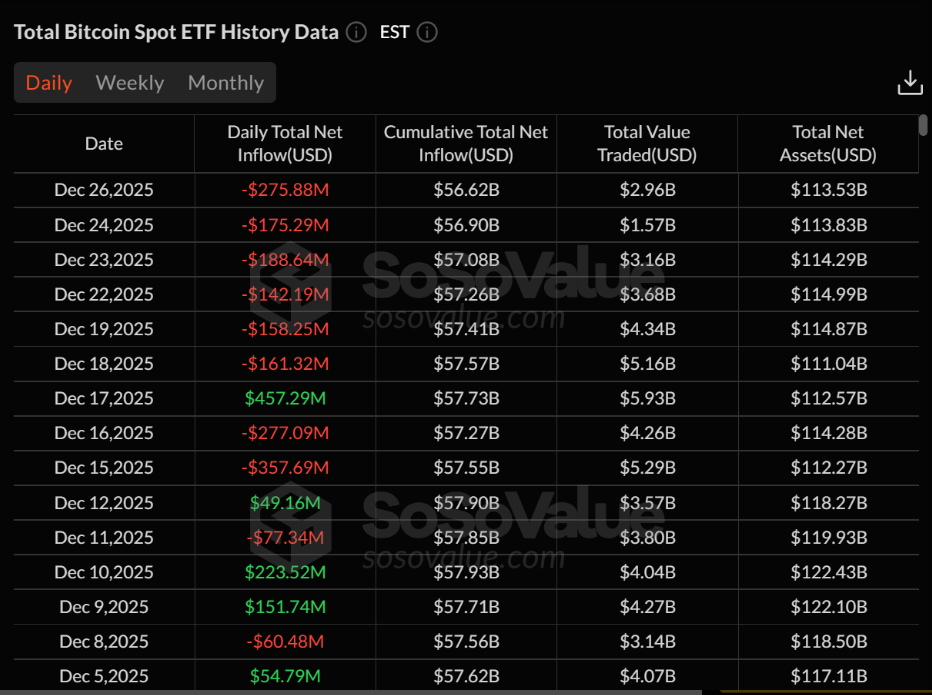
Spot Bitcoin ETFs suffered heavy withdrawals over the Christmas week as investors pulled about $782 million from the products, according to data from SoSoValue.

Bitcoin’s market price stayed roughly near $87,000, even as the funds lost cash. The drop trimmed total net assets in US-listed spot Bitcoin ETFs to about $113.5 billion, down from levels above $120 billion earlier in December.

Major Funds Lead The Withdrawals

Friday was the worst single day of the stretch, when ETFs recorded a combined $276 million in net outflows. BlackRock’s IBIT accounted for nearly $193 million of that exit, while Fidelity’s FBTC lost about $74 million.

Grayscale’s GBTC saw more modest redemptions during the same period. Friday also marked the sixth straight day of outflows — the longest streak since early autumn — with more than $1.1 billion draining out across that run.

December sees heavy outflows from spot Bitcoin ETFs. Source: SoSoValue
Seasonal Pressure Or A Bigger Shift

According to Vincent Liu, chief investment officer at Kronos Research, holiday moves and thin market depth can cause short-term withdrawals as desks close for the holidays.

He expects institutional flows to come back when trading desks reopen in early January and thinks a shift toward Fed easing in 2026 — markets are pricing roughly 75–100 bps of cuts — could lift demand for ETFs.

Based on reports from Glassnode, however, the trend looks broader than holiday noise: the 30-day moving average of net flows into US spot Bitcoin and Ether ETFs has been negative since early November, signaling sustained outflows by institutional players.

BTCUSD trading at $87,823 on the 24-hour chart: TradingView

Metals Take Center Stage

Meanwhile, gold and silver enjoyed a banner run while crypto saw pullbacks. Gold futures climbed above $4,550, hitting multiple records this year. Silver topped $75 per ounce and has gained about 150% year-to-date.

That rally has prompted some investors to reallocate away from crypto. Market experts like Louis Navellier said that with central banks active in the metal markets and volatility lower, gold has attracted flows that might otherwise have gone into digital assets.

Outspoken critic Peter Schiff wrote on social media that Bitcoin’s inability to rise alongside other risk assets raises doubts about its near-term upside.

What This Means For Institutional Demand

ETFs are widely watched as a proxy for institutional appetite. Based on the latest figures, institutions appear to be pulling back after a period when they were a key driver of crypto markets.

The divergence between rising precious metals and a modest decline in Bitcoin — about 6% year-to-date — has reinforced that view. Some of the selling likely reflects rebalancing and cash needs during the holidays. Some of it may reflect a rethinking of risk allocation by large allocators.

Reports suggest flows could normalize when trading activity returns to normal after the holiday break. If rate markets continue to price in easing and bank-led crypto infrastructure becomes easier for big investors to use, ETF inflows might resume. For now, the flow data points to a cautious institutional stance, even as Bitcoin’s price holds at elevated levels.

Featured image from Shutterstock, chart from TradingView

Related Questions

QWhat was the total amount of withdrawals from spot Bitcoin ETFs over the Christmas week, according to SoSoValue?

AInvestors pulled about $782 million from spot Bitcoin ETFs over the Christmas week.

QWhich two major funds led the outflows on the worst single day of the stretch, and how much did they lose?

AOn the worst day, BlackRock's IBIT accounted for nearly $193 million in outflows, while Fidelity's FBTC lost about $74 million.

QAccording to Vincent Liu, what two factors could cause a resurgence in institutional demand for Bitcoin ETFs?

AVincent Liu expects institutional flows to return when trading desks reopen in early January and thinks a shift toward Fed easing in 2026 could lift demand for ETFs.

QWhat alternative asset class saw a significant rally while crypto ETFs experienced outflows, and how much has silver gained year-to-date?

AGold and silver enjoyed a banner run. Silver topped $75 per ounce and has gained about 150% year-to-date.

QWhat does the sustained negative 30-day moving average of net flows into US spot Bitcoin and Ether ETFs since early November signal?

AThe negative 30-day moving average signals sustained outflows by institutional players, indicating a broader trend than just holiday-related noise.

Related Reads

BIP-110 Controversy Intensifies: Bitcoin May Face Its Most Divisive Hard Fork Battle in Years

Bitcoin is approaching a critical block height of 961,632, which could activate the controversial BIP-110 proposal. This proposal aims to restrict the amount of non-financial data, such as inscriptions and other large data payloads, within Bitcoin transactions. Supporters, including some node operators and Bitcoin purists, argue that BIP-110 is necessary to preserve Bitcoin's core function as a monetary settlement layer by reducing network congestion and node operational burdens caused by non-essential data. They frame it as a correction to keep the network true to its original purpose. However, critics, including prominent figures like Blockstream's Adam Back and developer Jameson Lopp, warn that the proposal's implementation mechanism is dangerously flawed. They highlight that its low 55% miner signaling threshold, coupled with a contentious enforcement mechanism allowing nodes to unilaterally reject non-compliant blocks, significantly increases the risk of a chain split. Opponents argue this sets a dangerous precedent for transaction censorship, undermines Bitcoin's protocol neutrality, and creates excessive uncertainty for developers and businesses, especially since the rule is proposed as a temporary one-year measure. Market analysts, such as those from Bitfinex, suggest a full-scale network split is unlikely due to a lack of broad economic consensus. Major mining pools remain neutral, and adoption of the new rules is minimal. They view the situation more as a governance stress test. The primary risk is operational disruption: if a minority chain persists, major exchanges and custodians may need to temporarily suspend Bitcoin deposits and withdrawals to manage security and liquidity, potentially unsettling newer institutional investors. While BIP-110 is not expected to succeed in overtaking the main chain, its approach has ignited a significant debate about Bitcoin's governance, core values, and resilience.

Foresight News20m ago

BIP-110 Controversy Intensifies: Bitcoin May Face Its Most Divisive Hard Fork Battle in Years

Foresight News20m ago

Crypto Market Makers Are Collectively Seeking Change as Money Becomes Harder to Earn

**Summary: Crypto Market Makers Adapt as Margins Shrink** Leading crypto market maker GSR exemplifies a broader industry shift, moving beyond traditional market-making to become a full-service "Web3 investment bank." Its recent strategic acquisitions—including an SEC-registered broker-dealer, rebranded as GSR Securities—and purchases of token advisory firms aim to create an integrated platform covering token design, fundraising, listing, liquidity provision, and asset management. This includes launching an ETF and investing in tokenization platforms like Libeara, backed by a strategic investment from Standard Chartered's SC Ventures. This transformation is not unique to GSR. Other major players like Keyrock, B2C2, Wintermute, and DWF Labs are also expanding geographically, pursuing regulatory licenses (especially under frameworks like MiCA in the EU), and diversifying into over-the-counter (OTC) trading, asset management, and real-world asset tokenization. The driving force behind this collective pivot is a rapidly changing market. Profits from traditional altcoin market-making are declining due to fewer viable projects, reduced client budgets, increased competition, and smarter, more demanding clients. Simultaneously, regulatory pressures are mounting, making compliance a baseline cost. Extreme market events further expose teams lacking robust risk controls. Consequently, the crypto market-making business model is evolving from one reliant on information asymmetry and volatility to a more institutionalized, regulated, and service-diverse industry. Survival now depends on building systemic capabilities beyond mere liquidity provision.

marsbit1h ago

Crypto Market Makers Are Collectively Seeking Change as Money Becomes Harder to Earn

marsbit1h ago

Trading

Spot
Futures

Hot Articles

How to Buy T

Welcome to HTX.com! We've made purchasing Threshold Network Token (T) simple and convenient. Follow our step-by-step guide to embark on your crypto journey.Step 1: Create Your HTX AccountUse your email or phone number to sign up for a free account on HTX. Experience a hassle-free registration journey and unlock all features.Get My AccountStep 2: Go to Buy Crypto and Choose Your Payment MethodCredit/Debit Card: Use your Visa or Mastercard to buy Threshold Network Token (T) instantly.Balance: Use funds from your HTX account balance to trade seamlessly.Third Parties: We've added popular payment methods such as Google Pay and Apple Pay to enhance convenience.P2P: Trade directly with other users on HTX.Over-the-Counter (OTC): We offer tailor-made services and competitive exchange rates for traders.Step 3: Store Your Threshold Network Token (T)After purchasing your Threshold Network Token (T), store it in your HTX account. Alternatively, you can send it elsewhere via blockchain transfer or use it to trade other cryptocurrencies.Step 4: Trade Threshold Network Token (T)Easily trade Threshold Network Token (T) on HTX's spot market. Simply access your account, select your trading pair, execute your trades, and monitor in real-time. We offer a user-friendly experience for both beginners and seasoned traders.

12.0k Total ViewsPublished 2024.03.29Updated 2026.06.02

How to Buy T

Discussions

Welcome to the HTX Community. Here, you can stay informed about the latest platform developments and gain access to professional market insights. Users' opinions on the price of T (T) are presented below.

活动图片













