RootData Transparency Bounty Activities Report for Rounds 3 and 4

marsbitPublished on 2026-02-12Last updated on 2026-02-12

Abstract

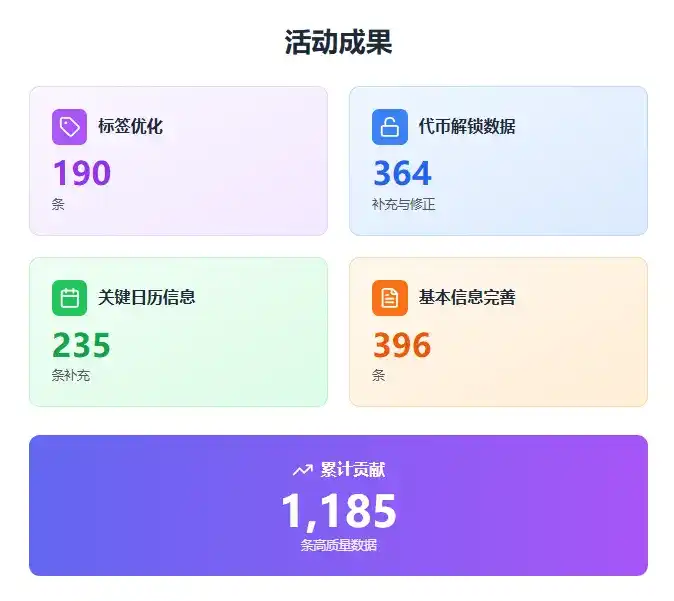
RootData Transparency Bounty Program Reports for Rounds 3 and 4 From January 30 to February 8, 2026, RootData, a Web3 asset data platform, conducted its third and fourth transparency bounty programs. The initiatives focused on due diligence around recently listed projects on major exchanges, covering key financial metrics such as funding structure, team background, token unlocks, and major timelines. The programs reviewed two main categories: Binance-listed projects from the past year and projects listed on major exchanges in 2026. Over 160 users participated, contributing to 190 tag optimizations, 364 token unlock data updates, 235 key calendar entries, and 396 general information improvements. Notably, the overall approval rate was below 30%, reflecting structural challenges in Web3 project transparency. Common issues included incomplete unlock schedules, denial of historical documentation by official sources, complex inflationary token models, and unverified AI-generated content. To date, RootData has hosted four rounds of bounty programs, covering 526 unique projects. Some, like River and Audiera, were repeatedly submitted, showing sustained community interest and gradual transparency improvement. RootData emphasizes that transparency is an ongoing process rather than a one-time goal. The platform remains committed to factual, neutral, and third-party validated data disclosure, avoiding value judgments. It aims to enhance Web3's data infrastructure through community-...

Source: RootData

From January 30 to February 8, 2026, Web3 asset data platform RootData officially launched the Transparency Bounty Activities for Rounds 3 and 4. This event continued the previous mechanism, focusing on热门 projects recently listed on mainstream exchanges. It invited the community to participate in information verification and supplementation around core financial data such as funding structure, team information, token unlocking, and key timeline milestones.

This event featured two main thematic directions: "In-Depth Look at the Transparency of Binance Listing Projects from the Past Year" and "Reviewing the Transparency of Mainstream Exchange Listing Projects in 2026".

Prior to this, RootData had already consecutively held 2 rounds of transparency bounty activities,持续 focusing on verifying information for the most market-attended trading assets. This round not only continued the previous data co-construction mechanism but also further expanded the review scope, placing the discussion focus on the core industry issue of "the completeness of information for projects listed on exchanges".

Approval Rate Below 30%, Exposing Structural Issues

During the 10-day event period, over 160 users participated in submissions. After multiple rounds of review and cross-verification, this event resulted in 190 tag optimizations,364 token unlock data additions and corrections,235 key calendar information additions,and 396 basic information improvements.
The overall average approval rate for this event was less than 30%. This is not due to lack of participation enthusiasm but rather reflects the many objective obstacles in the current disclosure structure of Web3 projects. During the review process, RootData identified the following typical issues:

1、Incomplete Unlock Data Disclosure

Some project official documents only disclose部分 token allocation components, for example, only公开 the schedule for 3 out of 5 allocation categories, making it impossible to accurately record the overall release structure.

2、Official Information Denies or Avoids Historical Documents

After community members submitted original documents,个别 project parties denied their validity or did not provide clear clarification regarding historical version information, leaving the data sources in a gray area.

3、Complex Structure of Inflationary Token Models

Projects using continuous inflation mechanisms, due to their non-linear, non-fixed cycle release methods, make it difficult to standardize the录入 of traditional unlock structures, increasing data processing difficulty.

4、AI-Generated Data Lacks Factual Support

In key calendar data, the review team found multiple instances of疑似 AI-generated content, lacking clear source links or verifiable evidence. In this regard, RootData explicitly advocates: Leverage AI tools to improve efficiency, but must adhere to a rigorous, verifiable data attitude."Reasonable inference" without factual links is not equivalent to valid information.

Cumulative Observations from Bounty Activities: Transparency is a Process, Not a Conclusion

As of now, RootData has held 4 rounds of transparency bounty activities, primarily focusing on热门 exchange assets, conducting持续 scrutiny on the funding structure, team background, and token release mechanisms of the underlying projects.

The cumulative record total reached 719 entries, involving 526 unique projects. Among them, 361 projects appeared once, and 165 projects appeared repeatedly, with a repetition rate of approximately 31.4%.

This data indicates that some projects have been repeatedly submitted and verified at different stages and in different activities, showing the community's持续关注 on their information completeness.

It is worth noting that ,River and Audiera were submitted and repeatedly verified in every round of activities. Their relevant data transparency has significantly improved after multiple rounds of supplementation, becoming typical cases of transparency improvement under the community co-construction mechanism.

Even after multiple rounds of verification, the transparency improvement for some projects remains limited. This phenomenon further confirms that transparency is not something that can be completed with a single supplement but rather a process requiring持续 verification and dynamic updates.

A Sustainable Mechanism for Co-building Data Transparency

In the process of promoting transparency, RootData adheres to the following principles:

1、Transparency Only Does "Fact Disclosure", Not "Value Judgment"

RootData does not make subjective evaluations of project quality, risk level, etc. The platform only presents whether the information is complete, verifiable, and持续 updated.

2、Transparency Has a "Layered" Phenomenon; Cannot View Exchange Listing Transparency with a "One-Size-Fits-All" Approach

Information disclosure has差异性. RootData uses data status labeling and structured entry to allow users to understand the information completeness of different projects, rather than simply labeling them as "good" or "bad".

3、The Executing Body of Transparency Must Be a Third Party

Exchanges and project parties themselves find it difficult to simultaneously play the roles of discloser and evaluator. As an independent data platform, RootData's responsibility is to record, verify, and公开 information status, not to participate in investment decisions.

In summary, Web3, as a highly market-driven financial environment, lacks a unified mandatory disclosure system. In this context, the improvement of transparency indispensably relies on community participation and third-party持续 recording. RootData will continue to advance the transparent infrastructure of the Web3 data ecosystem through public bounties, data disclosure, and community co-construction mechanisms, providing the community with verifiable, traceable information records for the market.


Related Questions

QWhat was the overall average approval rate for submissions in RootData's 3rd and 4th Transparency Bounty events?

AThe overall average approval rate was less than 30%.

QWhat were the two main thematic focuses of the 3rd and 4th Transparency Bounty events?

AThe two focuses were 'Digging into the Transparency of Binance Listing Projects in the Past Year' and 'Reviewing the Transparency of 2026 Mainstream Exchange Listing Projects'.

QWhat are two examples of projects that were repeatedly submitted and verified across all the bounty events, showing improved transparency?

AThe projects River and Audiera were repeatedly submitted and verified, and their data transparency significantly improved through multiple rounds of community contributions.

QAccording to the report, what is one of the key principles RootData adheres to in promoting transparency efforts?

AOne key principle is that transparency only involves 'fact disclosure' and does not make 'value judgments' about a project's quality or risk.

QWhat was one of the typical problems identified during the audit process that contributed to the low approval rate?

AOne typical problem was incomplete disclosure of unlocking data, where official documents only revealed the unlock schedules for some token allocation categories but not all, making it impossible to accurately record the overall release structure.

Related Reads

Dialogue with Morgan Stanley Executive: Wall Street Isn't Rejecting Bitcoin, It's Just Waiting for the Right Time

In a podcast interview, Amy Oldenburg, Head of Digital Asset Strategy at Morgan Stanley, discusses Wall Street's evolving stance on Bitcoin, explaining the bank's measured approach and the road ahead. Oldenburg, with 26 years at Morgan Stanley, traces her perspective to witnessing transformative tech cycles and her experience in emerging markets, where she observed the need for alternative financial systems like mobile money (e.g., M-Pesa). This background informs her view of Bitcoin's value proposition. She clarifies that Morgan Stanley is "client-driven." Regulatory hurdles, particularly as a bank holding company under Federal Reserve oversight, initially slowed their entry. While the firm couldn't act as quickly as independent asset managers, persistent client demand and a changing regulatory environment led to offerings like their low-fee Bitcoin ETP (MSBT). They are now gradually rolling out spot Bitcoin trading on their E*Trade platform. Regarding advisor adoption, Oldenburg cites a "lack of education" as the primary barrier. Morgan Stanley recommends a 0-2% allocation for more conservative portfolios and 2-4% for aggressive ones, but price volatility and confusion about its place in asset allocation persist. She notes competition for investor attention from AI and commodities. Addressing Bitcoin's price stagnation despite institutional buying, Oldenburg points to a confluence of factors: competing investment narratives (AI, quantum computing) and the complex financial landscape. She suggests a catalyst for Bitcoin as a neutral reserve asset might require a "slow-burn crisis" that exposes fragility in traditional systems. For wider bank adoption, including holding Bitcoin on balance sheets, she identifies the need for regulatory clarity to reduce punitive capital treatment and for the asset to be usable as collateral within financial ecosystems. Looking ahead, Oldenburg predicts steady, moderate adoption growth through 2030 rather than an explosive "J-curve." She emphasizes the importance of differentiating Bitcoin from other crypto assets and expresses concern that the core cypherpunk ethos of self-custody is being diluted as traditional finance enters the space. She concludes that the digital asset field remains in its early stages with significant innovation, like AI agents and micropayments, still to come.

marsbit2m ago

Dialogue with Morgan Stanley Executive: Wall Street Isn't Rejecting Bitcoin, It's Just Waiting for the Right Time

marsbit2m ago

10% Position Limit Proposed: UK Retail Authorized Funds to Gain Indirect Exposure to Crypto Assets

The UK Financial Conduct Authority (FCA) is consulting on a proposal (CP26/17) that would allow retail funds, including UCITS and most Non-UCITS Retail Schemes (NURS), to invest up to 10% of their total assets in cryptoasset exchange-traded notes (crypto ETNs). This would enable indirect exposure to cryptoassets for mainstream investors through regulated funds. The rule maintains the existing prohibition on funds holding underlying cryptocurrencies like Bitcoin or Ethereum directly. The proposal introduces a strict 10% cap, positioning crypto ETNs as a potential satellite holding within diversified portfolios. Funds must ensure these investments align with their stated objectives and risk profiles. Notably, the cap does not apply to Qualified Investor Schemes (QIS) for professional clients, while Long-Term Asset Funds (LTAFs) would be prohibited from holding crypto ETNs. This move builds on the FCA's 2025 decision to permit retail trading of crypto ETNs on UK regulated exchanges. However, significant compliance burdens fall on fund managers, who must conduct thorough due diligence, assess liquidity, and provide clear risk disclosures to investors. The FCA emphasizes that even a small allocation can significantly impact a fund's risk profile. The policy's practical impact remains uncertain. Widespread adoption depends on whether asset managers deem the potential benefits worth the operational costs, disclosure requirements, and reputational risks. The consultation is open for feedback until July 13, 2026. Ultimately, the proposal represents a cautious, incremental step toward integrating cryptoassets into the regulated fund landscape, rather than a broad opening.

Foresight News31m ago

10% Position Limit Proposed: UK Retail Authorized Funds to Gain Indirect Exposure to Crypto Assets

Foresight News31m ago

Public Version of Mythos Officially Launched: Analyzing the Advantages and Limitations of AI Smart Contract Auditing

Publicly available Mythos, Anthropic's AI model, has officially launched, demonstrating both significant potential and limitations in smart contract security auditing. The article analyzes its capabilities through real-world cases. AI excels in identifying subtle, low-level vulnerabilities through pattern recognition and large-scale code screening. A key example is detecting a storage slot collision between a custom rewards mapping and a third-party library's ReentrancyGuard, a vulnerability easily missed in manual audits. In the recent Zcash incident, AI also rapidly discovered a critical soundness bug that had remained hidden for years. However, AI currently struggles with complex, interconnected scenarios. When tested on the Curve LlamaLend sDOLA exploit, which involved manipulating prices across multiple protocols (Curve pools, lending markets) to trigger liquidations, Fable 5 failed to identify the core cross-protocol attack vector. These scenarios require a deep understanding of DeFi economic models and multi-contract interactions. In conclusion, while AI tools like Mythos significantly boost efficiency in finding standardized, syntactic vulnerabilities, they cannot yet replace expert analysis for complex, business-logic, and cross-protocol attacks. An effective audit workflow combines AI's speed for initial screening with human expertise for in-depth, holistic analysis.

marsbit36m ago

Public Version of Mythos Officially Launched: Analyzing the Advantages and Limitations of AI Smart Contract Auditing

marsbit36m ago

Trade.xyz's Rebase Refusal Sparks Controversy, On-Chain Pre-IPO Market Faces Major Pricing Test

The debate surrounding Trade.xyz's refusal to adjust its SPCX (SpaceX pre-IPO) perpetual contract pricing amid updated share count revelations highlights a key challenge for on-chain pre-IPO markets. While several centralized exchanges (CEXs) paused and repriced their contracts after SpaceX's filing showed a ~10% increase in total shares, Trade.xyz maintained its market-driven pricing logic, which tracks expected per-share price sentiment rather than fundamental valuation metrics like market cap. This discrepancy triggered cross-platform arbitrage and caused leveraged long positions on Trade.xyz to suffer significant losses, as the platform's HIP-3 architecture lacks a native "Rebase" mechanism to neutrally adjust all user positions following such corporate actions. The incident underscores the difficulty for decentralized perpetual exchanges (Perp DEXs) to implement Rebase—a process CEXs handle by centrally pausing markets and adjusting ledger data. On-chain, this requires complex smart contract modifications, increasing gas costs, complexity, and potential attack surfaces. While some DEXs have managed similar adjustments, Trade.xyz's current design does not natively support it, though the team is reportedly exploring solutions for future events like stock splits. Ultimately, the controversy serves as a critical case study for the nascent on-chain pre-IPO sector, raising questions about price discovery reliability, transparent rule disclosure, and the readiness of DeFi infrastructures to handle traditional corporate actions as real-world assets (RWAs) gain traction.

marsbit43m ago

Trade.xyz's Rebase Refusal Sparks Controversy, On-Chain Pre-IPO Market Faces Major Pricing Test

marsbit43m ago

Trading

Spot
Futures

Hot Articles

How to Buy 4

Welcome to HTX.com! We've made purchasing 4 (4) simple and convenient. Follow our step-by-step guide to embark on your crypto journey.Step 1: Create Your HTX AccountUse your email or phone number to sign up for a free account on HTX. Experience a hassle-free registration journey and unlock all features.Get My AccountStep 2: Go to Buy Crypto and Choose Your Payment MethodCredit/Debit Card: Use your Visa or Mastercard to buy 4 (4) instantly.Balance: Use funds from your HTX account balance to trade seamlessly.Third Parties: We've added popular payment methods such as Google Pay and Apple Pay to enhance convenience.P2P: Trade directly with other users on HTX.Over-the-Counter (OTC): We offer tailor-made services and competitive exchange rates for traders.Step 3: Store Your 4 (4)After purchasing your 4 (4), store it in your HTX account. Alternatively, you can send it elsewhere via blockchain transfer or use it to trade other cryptocurrencies.Step 4: Trade 4 (4)Easily trade 4 (4) on HTX's spot market. Simply access your account, select your trading pair, execute your trades, and monitor in real-time. We offer a user-friendly experience for both beginners and seasoned traders.

4.2k Total ViewsPublished 2025.10.20Updated 2026.06.02

How to Buy 4

Discussions

Welcome to the HTX Community. Here, you can stay informed about the latest platform developments and gain access to professional market insights. Users' opinions on the price of 4 (4) are presented below.

活动图片