Research Report Analysis: AI Triggers MLCC Supercycle, How Many Years of Gains Can Samsung Electro-Mechanics Enjoy?

marsbitPublished on 2026-06-24Last updated on 2026-06-24

Abstract

Title: Analyst Report: AI Ignites MLCC Super Cycle, How Many Years of Benefits Can Samsung Electro-Mechanics Reap? Summary: Morgan Stanley has sharply raised its target price for Samsung Electro-Mechanics from 920,000 KRW to 2,560,000 KRW, recasting the MLCC (Multi-Layer Ceramic Capacitor) industry from cyclical to structurally bullish. The core thesis is that AI servers demand 10-15 times more MLCCs than traditional servers, with a single AI server requiring up to 440,000 units compared to just 30,000 for a standard server. This drives not only higher volumes but also a shift to more advanced, higher-value MLCCs, boosting Average Selling Prices (ASP). The current supply crunch is seen as structural, not a temporary cyclical mismatch, driven by capacity constraints meeting sustained new demand. High-end MLCC production lines are fully booked, with new lines taking two years to build. Morgan Stanley forecasts MLCC price increases of 30% in H2 2026 and another 30-50% in 2027. Samsung Electro-Mechanics is positioned as the primary beneficiary through three channels: 1) Direct MLCC price hikes, especially for high-margin AI-use MLCCs, driving significant operating margin expansion from 15.7% (present) to 24.5% by 2027. 2) Strong growth in its ABF substrate business from saturated AI/ASIC chip orders. 3) Future revenue streams from new product lines like silicon capacitors and glass substrates. The firm's ROE is projected to surge from 7.5% in FY25 to 32.2% by FY28, with an in...

Author: Rita

Tide's Guide

Morgan Stanley just raised its target price for Samsung Electro-Mechanics from 920,000 KRW to 2,560,000 KRW. Analysts are rewriting the story of MLCC (Multi-Layer Ceramic Capacitors) from a cyclical industry to one with structural growth. The core logic is straightforward: the hunger of AI servers for MLCCs is 10 to 15 times higher than that of traditional servers.

AI Ignites "Volume and Price Simultaneous Increase"

One AI server requires 440,000 MLCCs. A traditional server? 30,000. A difference of over ten times.

This isn't just about quantity. AI's demands on MLCCs are also upgrading: higher capacitance, smaller size, lower ESL and ESR. It's evolving from competing on quantity to competing on quality, pushing ASP (Average Selling Price) up. Morgan Stanley says that Samsung Electro-Mechanics' MLCC business will contribute 15% of its revenue by 2026, and this proportion jumps directly to over 50% by 2030. Behind this is improved pricing power, leading to genuine profit expansion.

Supply Constraints Are Now Structural, Not Cyclical

This round resembles the MLCC supercycle of 2017 to 2018, but the underlying logic is completely different. That time was short-term mismatch due to inventory shortages and order surges. This time, capacity ceilings are meeting continuously growing new demand.

High-end MLCC production lines have long been fully booked, and building new lines takes two years to become operational. The low inventory levels in the supply chain have now spread from the spot market to contract prices, with distributors starting to hoard, indicating they no longer see this as a temporary shortage.

Morgan Stanley expects MLCC prices to rise by 30% in the second half of 2026, and another 30% to 50% in 2027. This isn't a futures trader's forecast, but a conclusion based on contract prices and distributor behavior visible right now.

Why Samsung Electro-Mechanics is the Biggest Beneficiary

Samsung Electro-Mechanics' benefits come from three dimensions.

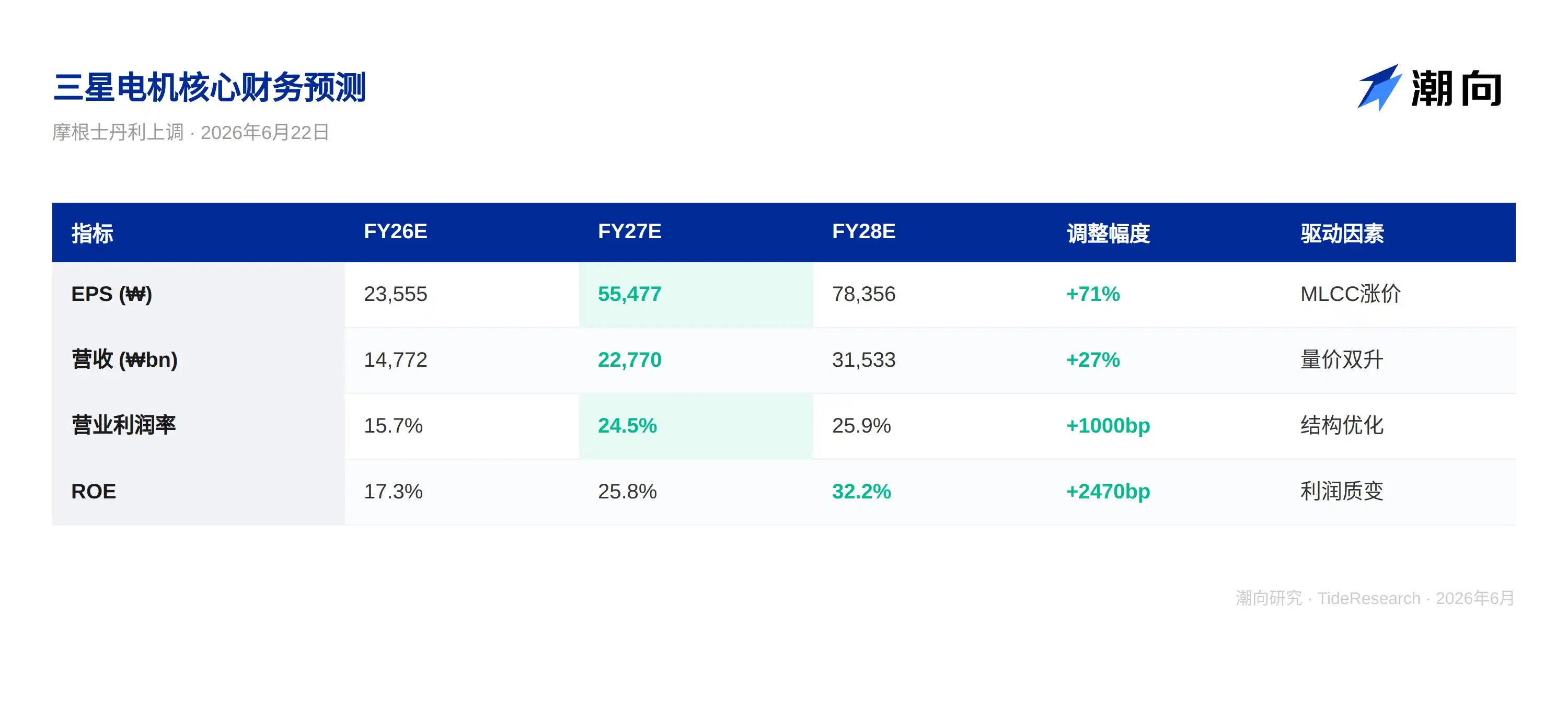
The first is direct MLCC price increases. IT-use MLCCs are rising, AI-use MLCCs are rising, and the AI segment offers even thicker margins. When the 1Q26 earnings report came out, revenue already exceeded expectations: 3.2 trillion KRW vs. 3.1 trillion KRW expected. More importantly, Morgan Stanley raised its EPS forecasts for the next three years, with the FY27E figure reaching 55,477 KRW, 71% higher than before. Operating profit margin is expected to jump from the current 15.7% to 24.5% in 2027, and then to 25.9% in 2028. This isn't a numbers game; it's genuine profit expansion from enhanced pricing power.
The second is ABF substrates. AI customer orders for ASIC chips are already saturated, and Samsung Electro-Mechanics' shipments and profits in this area are growing rapidly.

The third is new product lines. Silicon capacitors have secured $1.3 billion in orders, and glass substrates have begun trial production. These won't contribute to revenue this year or this month, but they set the stage for the coming years.

Can ROE Really Jump from 7.5% to 32.2%?

Morgan Stanley assumes that Samsung Electro-Mechanics' ROE (Return on Equity) will rise from 7.5% in FY25 to 17.3% in FY26, and then to 32.2% in FY28. Simultaneously, the company's dividend payout ratio will increase from the current 5% to 20%.

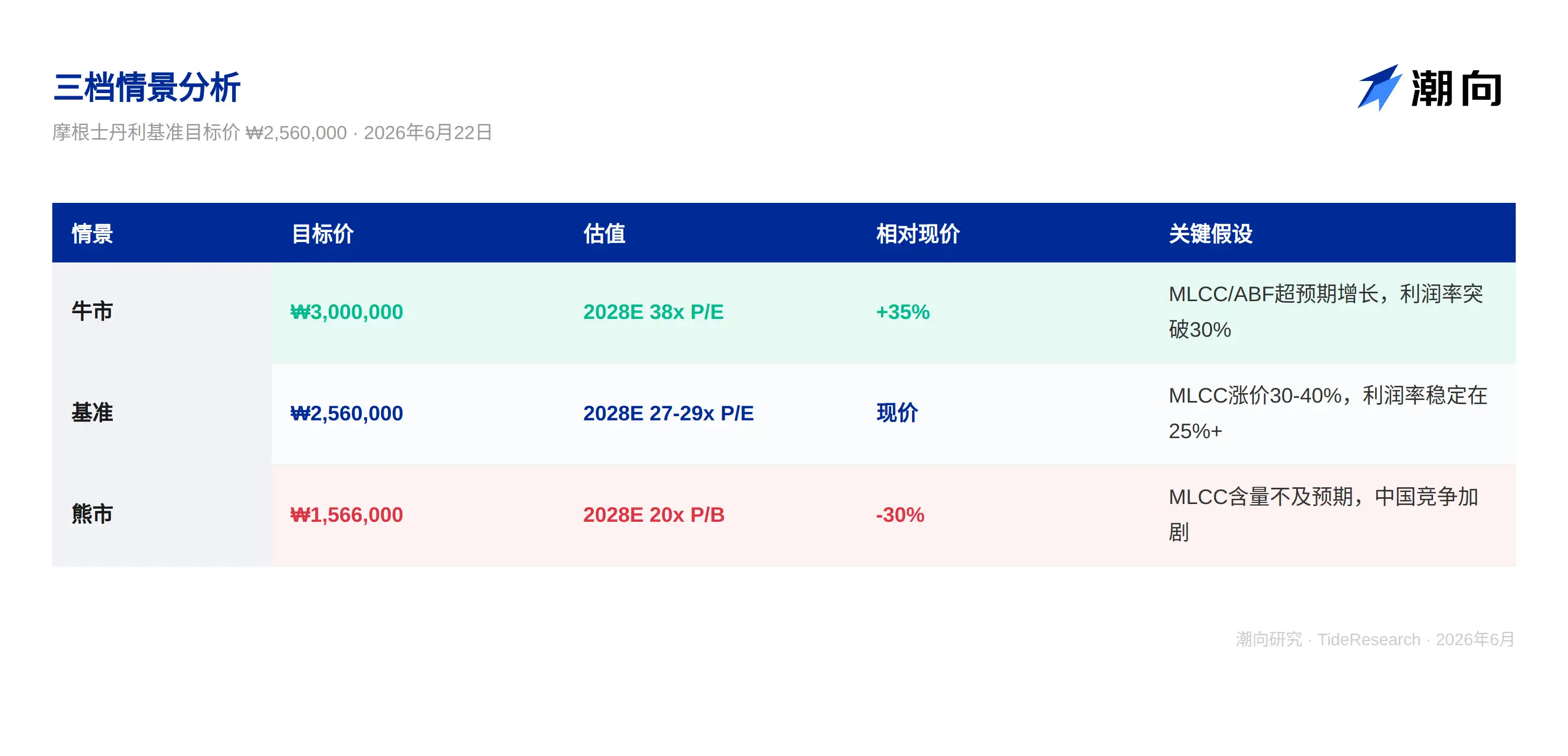
This means a Korean electronic components company, whose ROE was already not low, could enter a higher profit cycle due to changes in product mix and pricing power. The current valuation is 1.4x P/B (Price-to-Book ratio), lower than the historical average of 1.7x. Raising the target price from 920,000 to 2,560,000, an increase of nearly 178%, isn't solely due to net profit growth; there is also room for valuation re-rating.
Identifying the Risks

Upside risks: MLCC prices are forced to rise significantly further due to genuine shortages; smartphone demand rebounds beyond expectations; Chinese government consumption stimulus policies bring additional demand.

Downside risks: Samsung Electronics' flagship smartphone cycle declines significantly (Samsung Electro-Mechanics still has a considerable proportion of consumer products); poor execution in expanding business with Chinese smartphone clients; weak global consumer demand.

Catalysts? Further increases in contract prices, continued rise in the Book-to-Bill ratio, capacity utilization nearing full load, and confirmation of MLCC content growth by next-generation AI platforms (Rubin, VR200).

The New AI Infrastructure Darling

From side dish to main course, from cyclical to structural, from traditional capacitor maker to AI infrastructure supplier. This is the story Morgan Stanley is telling for Samsung Electro-Mechanics. How long the story lasts depends on how AI chip demand, capacity construction, and competitive landscape evolve. But for now, supply constraints are indeed supporting prices, and price increases are supporting profits.

Disclaimer

This article is Tide Research's compilation and interpretation of a third-party securities firm's research report. The ratings, target prices, profit forecasts, and related judgments cited herein are the views of Morgan Stanley analysts, representing only the stance of their affiliated institution. They do not represent the views of Tide Research, nor do they constitute any investment advice.

Please note three points when reading: 1. Target prices are analysts' expectations for the next approximately 12 months; they are forecasts, not promises, and will be adjusted repeatedly based on performance and market conditions. 2. Sell-side research reports are naturally biased toward optimism, and some covered companies may have investment banking relationships with the reporting firm. 3. The value of a research report lies in its core logic and underlying assumptions, not just a single target price. Focus on the logic, not just the price.

The market carries risks; decisions should be made independently. This article should not be used as a basis for buying or selling any securities.

Data Sources: Samsung Electro-Mechanics 1Q26 Earnings Report (SEC and other public data) · Morgan Stanley Research Report (Shawn Kim et al., June 22, 2026)

Tide Research · TideResearch · June 2026

Trending Cryptos

Related Questions

QAccording to the report, what is the primary driver for the structural rather than cyclical upturn in the MLCC industry?

AThe primary driver is the surge in demand from AI servers, which require 10 to 15 times more MLCCs than traditional servers. This demand is characterized by a need for higher-capacity, smaller-sized MLCCs with lower ESL and ESR, leading to a sustained 'quantity and quality' upgrade cycle. This creates a structural supply-demand tension, as new high-end production capacity takes years to build, unlike the past short-term inventory mismatch.

QWhat is the key difference between the current MLCC 'super cycle' and the one in 2017-2018, as highlighted by Morgan Stanley?

AThe key difference lies in the underlying cause. The 2017-2018 cycle was driven by a temporary mismatch between insufficient inventory and a surge in orders. The current cycle is caused by a structural ceiling on high-end production capacity meeting continuously growing new demand from AI infrastructure, making the supply tension persistent rather than temporary.

QWhy is Samsung Electro-Mechanics considered the biggest beneficiary in this scenario?

ASamsung Electro-Mechanics benefits from three main factors: 1) Direct price increases for both IT and AI-use MLCCs, with higher margins on AI-related products, leading to significant expansion in operating profit margins. 2) Strong growth in its ABF substrate business driven by saturated orders for AI client ASIC chips. 3) Diversification into future growth drivers like silicon capacitors and glass substrates, which secure long-term revenue streams.

QWhat is Morgan Stanley's ROE (Return on Equity) forecast for Samsung Electro-Mechanics, and what drives this projected increase?

AMorgan Stanley forecasts Samsung Electro-Mechanics' ROE to rise from 7.5% in FY25 to 17.3% in FY26 and further to 32.2% in FY28. This dramatic increase is driven by a fundamental shift in the company's product mix and pricing power, primarily due to the structural growth and premium pricing of high-end MLCCs for AI servers, which transforms its profitability profile.

QWhat are the key upside and downside risks mentioned for Samsung Electro-Mechanics' outlook?

AUpside risks include: 1) Further significant price hikes for MLCCs due to severe shortages. 2) A stronger-than-expected rebound in smartphone demand. 3) Additional demand from Chinese government consumer stimulus policies. Downside risks include: 1) A significant downturn in Samsung Electronics' flagship smartphone cycle. 2) Poor execution in expanding business with Chinese smartphone clients. 3) A general weakening of global consumer demand.

Related Reads

Base Under Pressure

**Title: The Pressure Mounts for Base** Base, the Ethereum Layer 2 scaling solution backed by Coinbase, is facing significant pressure and public scrutiny from its leadership following the launch of Robinhood Chain. Base co-founder Jesse Pollak recently acknowledged strategic missteps, admitting that the chain's past focus on social and creator tokens (e.g., through Farcaster, Zora) failed to deliver sustainable adoption. He has refocused on core infrastructure, handing leadership of the Base App back to Coinbase's Cobie. While Base remains a top L2 contender alongside OP Mainnet and Arbitrum, and boasts the highest TVL (nearly $12B), its weaknesses are being highlighted by the new competitor. Key criticisms include its slow progress on decentralization. Base has faced issues with its single sequencer causing block production halts, and L2BEAT is reportedly considering downgrading its decentralization rating from Stage 1 to Stage 0. This contrasts sharply with the rapid initial success of Robinhood Chain, whose DEX quickly entered the top five by volume. The leadership styles of the parent companies are also being compared: Robinhood's CEO actively engages with new projects, while a recent incident where Coinbase's Brian Armstrong briefly changed his profile picture—sparking and then crashing a related meme token—drew community ire and mockery. Pollak stated Base is working with Coinbase on tokenized stocks backed 1:1 by real equity, differentiating it from Robinhood's derivatives model. However, the article argues that Base's most urgent task is to address its long-standing technical and trust issues. With more traditional finance players likely to emulate Robinhood's path, Base must use this competitive pressure to solidify its position as long-term financial infrastructure.

Foresight News8m ago

Base Under Pressure

Foresight News8m ago

White House Concession Removes Ethical Hurdle, Clarity Act Races Against Final Window Before Recess?

On July 21st, industry sources reported that the Trump administration has agreed to include an ethics provision in the "Clarity Act" (Digital Asset Market Clarity Act of 2025). This concession addresses the long-standing conflict-of-interest concerns regarding government officials and the crypto industry, potentially removing the final major obstacle to the bill's progress. Additionally, Patrick Witt, the executive director of the White House's Digital Asset Advisory Committee, confirmed he will remain in his role to help finalize the bill, alleviating previous concerns about his potential departure. The Clarity Act aims to establish a unified federal regulatory framework for the U.S. digital asset market. Its core objective is to resolve regulatory ambiguity by defining different types of digital assets (digital commodities, investment contract assets, and permitted payment stablecoins) and clarifying the respective oversight roles of the SEC and CFTC. This would end the long-running jurisdictional dispute between the two agencies and provide clearer compliance paths for the industry. With the ethics issue moving toward resolution, the most urgent challenge now is time. The U.S. Congress is set to begin its August recess in mid-August, leaving only a few working weeks to finalize the text and advance the bill through the Senate. Industry advocates, like the Blockchain Association's Kristin Smith, stress that this is a critical moment. If negotiations conclude successfully in the coming weeks, the Clarity Act could pass a key hurdle before the recess; otherwise, it may face significant delays. If enacted, the Clarity Act could mark a historic turning point in crypto regulation. By providing a clearer and more predictable legal framework, it aims to reduce uncertainty for businesses, developers, and traditional financial institutions looking to enter the digital asset space, potentially setting a global benchmark for market structure regulation.

Odaily星球日报13m ago

White House Concession Removes Ethical Hurdle, Clarity Act Races Against Final Window Before Recess?

Odaily星球日报13m ago

AI Era, Industrial Revolution, and Future Civilization Interview — Zhang Dingwen: The Future Does Not Belong to Chasers

"AI Era, Industrial Revolution and Future Civilization: An Interview with Zhang Dingwen – The Future Does Not Belong to Those Who Chase" In this interview, entrepreneur Zhang Dingwen reflects on his entrepreneurial journey and philosophy, moving beyond discussions of financing or success to emphasize understanding the "era" itself. He argues that true entrepreneurs should not chase short-term trends ("winds"), but position themselves in the direction of long-term technological and societal evolution. Zhang shares key lessons from his early days, including the realization that user value does not automatically translate to commercial value. For him, the core of entrepreneurship is not building a company but constantly upgrading one's own "cognition" – the ability to interpret information, ask the right questions, and understand the underlying "causes" behind business outcomes, not just the effects. His thinking has evolved from a focus on creating good products to a strategic focus on building "entrances" – platforms that naturally connect users to digital services. He sees smart wearables, like watches, not merely as hardware but as potential future gateways combining technological, financial, social, and even fashion attributes to create sustained user relationships and ecosystems. Ultimately, Zhang's vision transcends individual products or companies. He discusses business competition in three stages: product, platform, and finally, "civilization" – where the greatest companies influence how society operates by defining new rules and ways of life. He believes the mission of a truly great enterprise is to solve problems of its time, build enduring trust, and contribute lasting value, leaving behind not just wealth but a positive impact on how the world works. The future, he concludes, belongs not to the fastest, but to those with the correct long-term direction and a commitment to continuous learning and evolution.

marsbit24m ago

AI Era, Industrial Revolution, and Future Civilization Interview — Zhang Dingwen: The Future Does Not Belong to Chasers

marsbit24m ago

Cryptocurrency & Stock Market Barometer丨Strategy Cash Reserves Increase to $3.23 Billion, Halting BTC Purchases; Vanguard and Other Asset Managers Increase Holdings in Strategy Stock (July 21)

Market Overview & Warnings: The article warns of high volatility in South Korean stocks and continued dependence on U.S. stocks on geopolitics. Chinese A-shares remain under pressure. It advises against using leverage in current equity markets. For crypto-linked stocks, most have limited growth except Robinhood, with caution advised. U.S. Stock Market: Bearish bets on U.S. stocks, particularly targeting AI-related companies, have reached record highs since 2010, signaling deep skepticism about the sustainability of the AI-driven rally. Tech and chip stocks led a market decline, with the Philadelphia Semiconductor Index potentially entering a bear market. Increased expectations for Federal Reserve interest rate hikes and geopolitical tensions contributed to the negative sentiment. Bitcoin Treasury Company Updates: * Strategy: Increased its cash reserves to $3.23 billion and paused Bitcoin purchases. Several major asset managers, including Vanguard Group and Capital Group, increased their holdings of Strategy (MSTR) stock. * Global corporate Bitcoin buying slowed significantly to just $1.33 million last week. * Other notable activity: Strive purchased 21 BTC; ORANGE JUICE raised $40 million for Bitcoin acquisitions; Bitcoin Japan Corp. raised $60 million, allocating $4.08 million for its first BTC purchase. Other Crypto Treasury Holdings: * Ethereum: BitMine increased its ETH holdings to 5.78 million, nearing its 5% of supply goal. Its total crypto assets, cash, and securities are valued at $11.5 billion. * Solana: No significant corporate treasury activity reported. * Altcoins: HypeStrat made no adjustments to its treasury; its mNAV ratio fell to a long-term low. (Note: This summary is for informational purposes only and does not constitute investment advice.)

marsbit25m ago

Cryptocurrency & Stock Market Barometer丨Strategy Cash Reserves Increase to $3.23 Billion, Halting BTC Purchases; Vanguard and Other Asset Managers Increase Holdings in Strategy Stock (July 21)

marsbit25m ago

Trading

Spot

Hot Articles

Discussions

Welcome to the HTX Community. Here, you can stay informed about the latest platform developments and gain access to professional market insights. Users' opinions on the price of AI (AI) are presented below.

活动图片