Ray Dalio: The Revival of a China-led 'Tribute System', and the AI Industry Will Develop Like the EV Industry

Odaily星球日报Published on 2026-06-08Last updated on 2026-06-08

Abstract

Ray Dalio, founder of Bridgewater Associates, discusses shifting global power dynamics and the AI competition between the U.S. and China. He argues U.S. credibility as a global power willing to fight for its interests is declining, while China is accumulating wealth and influence. Dalio observes a trend where world leaders visit China, which he compares to a modern "tribute system"—not oppressive, but a hierarchy where nations acknowledge China's strength, affecting trade and security. This shift creates market uncertainty, prompting investors to seek asset diversification, including gold. Regarding AI, Dalio contrasts the U.S. and Chinese approaches. U.S. companies like OpenAI focus on monetization and subscriptions for revenue. In contrast, China treats AI as a public utility, akin to electricity or water, aiming for widespread worker accessibility over immediate profitability. He draws a parallel to China's electric vehicle industry success, where companies like BYD achieved rapid market growth. Dalio and JPMorgan's Mary Callahan Erdoes note China lacks U.S.-style fear of AI displacing jobs; instead, it focuses on leveraging AI for development and dominance in next-generation industries like robotics.

Source:"Wall Street Week" Program: Dalio's Warning&Ray Dalio on China-U.S. AI Development

Compiled | Odaily Planet Daily (@OdailyChina)

Translator | Wenser (@wenser2010)
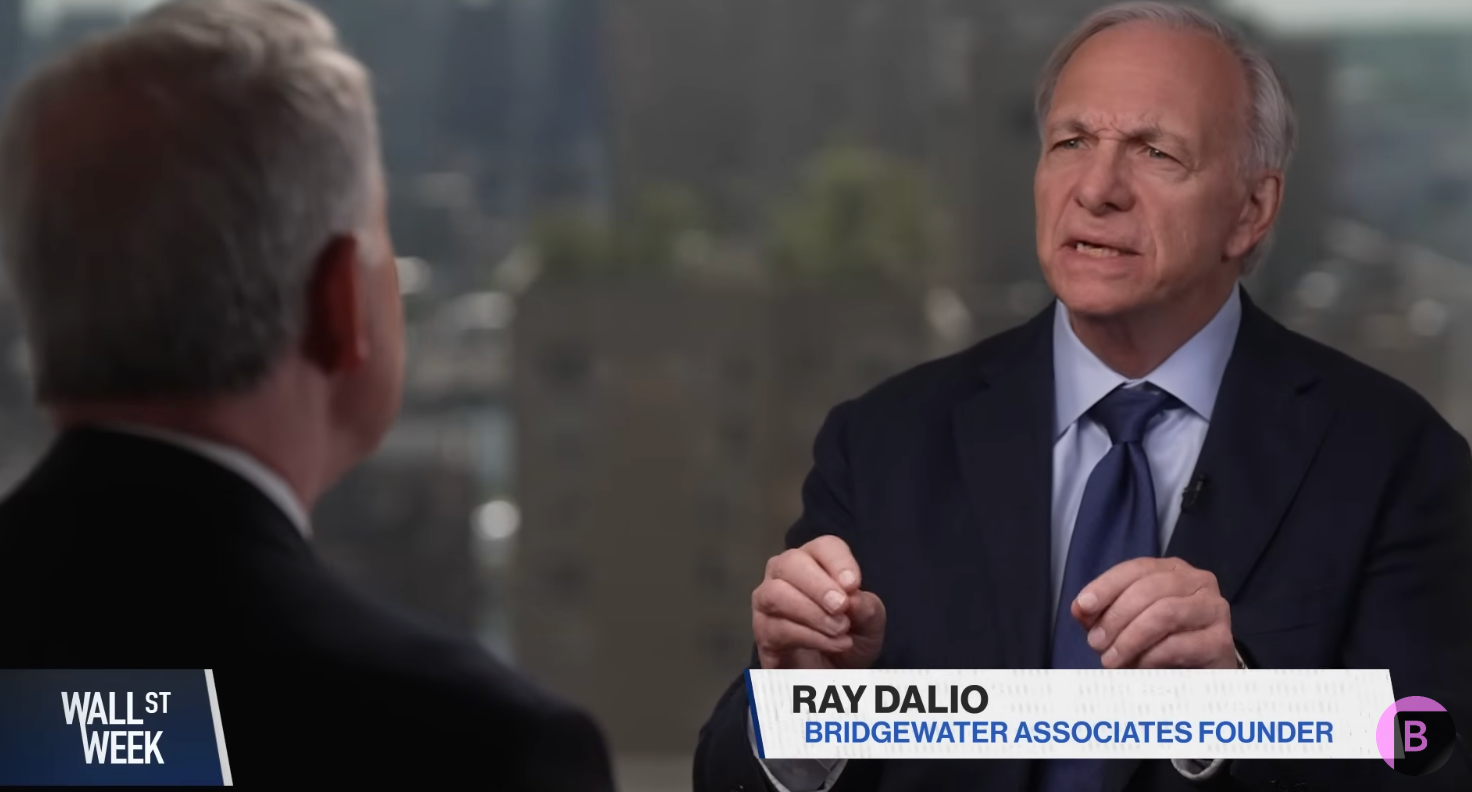
Editor's Note: As the founder of Bridgewater Associates, the world's largest hedge fund, Ray Dalio's remarks have always garnered significant attention from various sectors of society. His insights into the global macroeconomic landscape and different industries, in particular, are a frequent topic of discussion. Following the visits to China last month by leaders including US President Donald Trump and Russian President Vladimir Putin, Ray Dalio has put forward a new perspective – "The world structure is changing, a China-led tribute system is being established." Recently, regarding the "competition landscape between AI giants in China and the US," he has also offered his targeted views. The following content is compiled and translated by Odaily Planet Daily, with some details edited for brevity.

Ray Dalio on a "China-led World": The Reappearance of the Tribute System

Last month, after US President Donald Trump and Russian President Vladimir Putin visited China, Ray Dalio was interviewed by David Westin for Bloomberg's "Wall Street Week" program.

In the interview, Ray Dalio stated directly, "America's credibility as a global power willing to fight for its own interests is declining, while China is continually accumulating its own global wealth and world influence. This situation is fundamentally changing how other countries view these two nations."

"Currently, the United States has about 750 military bases in over 80 countries worldwide, and thus has long been seen as a trustworthy ally when facing (war) attacks." However, after concluding a roughly one-month trip to Asia (which included about 10 days of meetings with multiple leaders in China), Ray Dalio sensed an important shift: a growing number of countries are gradually coming to believe – "America cannot be counted on to win wars."

Dalio's remarks further elaborate on his long-held view: "America's strength is gradually waning, while China's strength is correspondingly increasing." Thanks to Bridgewater's significant engagement with China, this perspective has gained considerable acceptance. On the other hand, due to his relatively close relationship with Chinese leaders, these views have also drawn criticism.

Dalio then stated that international recognition is very important for China. Currently, China's economic scale is about 60% to 70% that of the United States, a proportion that has more than tripled over the past 20 years. He said that while China does not seek to conquer or occupy other countries, it places great emphasis on recognition from political leaders worldwide. "You can see leaders from many countries visiting China one after another, which is akin to the 'tribute system' in Chinese history – countries come to acknowledge and respect China's formidable strength, but this system is not an oppressive or controlling one." (Odaily Planet Daily Note: The original term used was 'tribute system')

"So, this tribute system is essentially a hierarchical structure. When dealing with other countries, what's important is how such a system affects trade and national security between the parties. I believe, from a political perspective, we are now entering a period where arrangements resembling a tribute system will form between (China and) various countries, and the relative strength between nations will become the determining factor (in the world's political landscape)." During the discussion, Ray Dalio also mentioned that concepts like the nation-state and borders only gradually emerged in Western societies around the mid-17th century. Before that, power structures in Western societies were constituted by different royal families, which is fundamentally different from the concept of frontiers consistently maintained throughout Chinese history.

He believes this change will directly impact (global capital and financial) markets. Because investors must navigate the current turbulent situation: currency values are at risk, and (global) uncertainty demands that investors maintain liquidity and diversify their asset allocations, including investments in gold.

Ray Dalio on the "Competition Landscape in AI Between China and the US": China's AI Industry Will Develop Like the EV Industry

In June, Business Insider reported Ray Dalio's views on the competition in the AI sector between China and the United States, similarly highlighting the vast differences and potential implications between the two.

Ray Dalio stated that China views artificial intelligence as an important tool that should be accessible to all workers. "It's like electricity and tap water, something everyone should have access to,"

As a prominent entrepreneur who first visited China as early as 1984, Ray Dalio has long been optimistic about China's development. He previously told attendees at a Forbes magazine conference in New York: "China has earned enormous profits through exports, and these funds are being widely utilized for research and development in the field of artificial intelligence, thereby driving economic growth through improved production efficiency."

It is worth noting that Ray Dalio emphasized that while American companies like OpenAI and Anthropic are adjusting (AI model) subscription package structures, striving to increase revenue in preparation for public listings, Chinese companies are committed to making their models accessible to as many ordinary employees as possible. "It doesn't necessarily have to be expensive, and it doesn't even necessarily have to be profitable (right now)."

"To some extent," Dalio believes, "it mimics the country's successful path in sectors like the electric vehicle industry – where domestic Chinese enterprises like BYD have achieved rapid growth in markets such as Europe."

In a guest discussion following Dalio's speech, JPMorgan Chase executive Mary Callahan Erdoes pointed out that unlike the social atmosphere in the US, where "employment issues are treated as political topics," executives of Chinese AI companies and political figures, when mentioning AI, show "no fear of AI displacing jobs." Instead, the country focuses more on "leveraging AI to drive various developments" and is committed to identifying the next industrial sector where it can achieve dominance. "The robotics sector can basically be seen as China's 'next-generation electric vehicle industry,'" she stated.


Related Questions

QWhat does Ray Dalio mean by the 'tribute system' returning under Chinese leadership?

ARay Dalio suggests that as China's global influence grows, many countries' leaders are visiting China to acknowledge and respect its power. He likens this dynamic to a historical 'tribute system,' where other states recognize a dominant power's strength. He clarifies this is not an oppressive or controlling system, but rather a hierarchical arrangement that influences trade and national security between nations.

QAccording to Ray Dalio, what is the primary difference between U.S. and Chinese AI companies' current goals?

ARay Dalio states that while U.S. AI companies like OpenAI and Anthropic are adjusting subscription models and focusing on increasing revenue for potential IPOs, Chinese AI companies are primarily focused on making their AI models accessible and affordable for as many ordinary workers as possible, even if they are not immediately profitable.

QHow does Ray Dalio compare the development of China's AI industry to its electric vehicle industry?

ARay Dalio draws a parallel by suggesting that China's approach to AI development is mimicking its successful path in the electric vehicle industry. Just as Chinese companies like BYD achieved rapid growth in markets like Europe, the focus in AI is on widespread adoption and technological advancement as a tool for national development, potentially leading to a similar dominant position in the global market.

QWhat key change in global perception does Ray Dalio identify after his recent travels in Asia?

ARay Dalio identifies a significant shift in perception among many countries: a growing belief that they 'cannot count on the U.S. to win a war.' He contrasts this with the past view of the U.S. as a trustworthy ally willing to fight for its interests, noting that this change is fundamental to how nations view both the U.S. and the rising power of China.

QWhat investment advice does Ray Dalio offer in light of the current global geopolitical shifts?

AIn response to the turbulent global situation marked by currency risks and uncertainty, Ray Dalio advises investors to maintain liquidity and diversify their asset allocations. He specifically mentions including investments in gold as part of this strategy to hedge against the prevailing risks.

Related Reads

The Value Distribution of Stablecoins

**Summary: The Value Distribution of Stablecoins** The article argues that stablecoins are evolving from mere trading tools into broader channels for dollar access. It divides the stablecoin ecosystem into four layers to analyze how value is distributed: 1. **Issuance Layer:** Mints stablecoins, holds reserve assets, and captures the spread between reserve yield and user costs (e.g., Tether, Circle). This layer currently earns the largest profit margin. 2. **Infrastructure Layer:** Connects stablecoins to the traditional financial system, handling fiat on/off-ramps, banking integration, compliance (KYC/AML), and asset management (e.g., Bridge, BVNK). This is the "unglamorous" but critical work, building the essential bridges between crypto and real-world finance. 3. **Acquiring/Distribution Layer:** Integrates stablecoins into merchant systems, manages payment flows, and provides enterprise financial software (e.g., Stripe, Coinbase). They act as the access point for businesses. 4. **Application Layer:** The end-users and businesses that ultimately use stablecoins for payments, settlements, or as a store of value. They benefit from convenience but have little pricing power. The core thesis is that while the issuance layer currently dominates profits, the often-overlooked **infrastructure layer holds significant long-term potential**. The real challenge and barrier to mass adoption is not the on-chain transfer of stablecoins (which is simple), but the complex "last mile" integration into existing business workflows, banking systems, and regulatory frameworks across different countries. Companies in this layer are currently in a "land grab" phase, investing heavily to build networks, secure bank partnerships, and establish compliance pathways. While their position is currently pressured by the profitable issuers above and distribution platforms below, the article suggests that if stablecoins become a default financial rail for businesses, the infrastructure providers who have done the hard work of integration will ultimately gain strong pricing power and become entrenched, essential players.

marsbit1h ago

The Value Distribution of Stablecoins

marsbit1h ago

The Value Distribution of Stablecoins

The Value Distribution of Stablecoins The article argues that stablecoins are evolving from a mere trading tool into a broad "dollar channel." It analyzes the industry's value chain through four layers: 1. **Issuance Layer (e.g., Tether, Circle):** The top layer that mints stablecoins, holds reserve assets, and captures the thickest interest rate spread. 2. **Infrastructure Layer (e.g., Bridge, BVNK):** Connects stablecoins to the traditional financial system, handling critical but complex "dirty work" like fiat on/off-ramps, banking integration, compliance (KYC/AML), and cross-border settlement. 3. **Acquiring/Distribution Layer (e.g., Stripe, Coinbase):** Embeds stablecoins into merchant systems, manages payment flows, and integrates with enterprise software. 4. **Application Layer:** End-users and businesses that ultimately use stablecoins for payments, settlement, or storing value. The author posits that while the issuance layer currently captures the most profit, the most overlooked and potentially critical layer is infrastructure. The core challenge for stablecoin adoption isn't the on-chain transfer (which is simple), but bridging the gap between blockchain and the real-world financial system. This involves solving practical problems for businesses: fiat conversion, reconciliation, tax handling, and user onboarding. Infrastructure companies are currently in a difficult "land-grab" phase—building networks, securing banking relationships, and achieving compliance country-by-country. They face pressure from both the profitable issuance layer above and distribution platforms below. However, the author suggests this layer is building a crucial moat. Once stablecoins become a default business rail, the infrastructure players who have done the hard work of integration may gain significant, durable value and pricing power.

链捕手1h ago

The Value Distribution of Stablecoins

链捕手1h ago

How to Do Research Well: Deliberately Practice the Real Skills That Matter

No one truly teaches you how to do research. You're often given a desk, a pre-selected problem, and vague instructions to "create something new." Consequently, many people reverse-engineer the job based on visible outputs—papers, posts, announcements—learning only how to *appear* like a researcher rather than how to *become* one. True research capability is built from stacking small, trainable skills, nearly all of which can be developed through deliberate practice. **Pick Your Own Problem:** Most researchers absorb problems from advisors or trends, lacking the underlying reasoning. Choosing a problem you genuinely care about, as John Schulman advises, leads to original work. Develop "taste" like a muscle: predict experiment outcomes, guess paper results from methods, and track which findings remain important over time. **Upgrade Your Inputs:** Relying on shared reading lists (arXiv hot lists, filtered group chats) leads to unoriginal conclusions. Undervalued old literature often holds crucial insights (e.g., MoE, LSTM, backpropagation). Richard Sutton's "The Bitter Lesson" or Claude Shannon's 1952 talk on creative thinking are more predictive than lengthy modern surveys. Breadth matters as much as depth: draw from neuroscience, mechanism design, hardware knowledge, and honest statistics. Read papers directly, especially appendices and limitations sections. **Write Everything Down:** As Paul Graham noted, writing exposes flaws in seemingly mature ideas. Writing is the cheapest defense against self-deception. Following Feynman's principle, Darwin programmatically wrote down facts contradicting his theory to combat memory bias. Maintain a detailed log of hypotheses, setups, predictions, results, and updated understandings. Reviewing past logs fosters essential humility.

marsbit3h ago

How to Do Research Well: Deliberately Practice the Real Skills That Matter

marsbit3h ago

Trading

Spot
Futures

Hot Articles

Discussions

Welcome to the HTX Community. Here, you can stay informed about the latest platform developments and gain access to professional market insights. Users' opinions on the price of AI (AI) are presented below.

活动图片