The Value Distribution of Stablecoins

marsbitPublished on 2026-06-15Last updated on 2026-06-15

Abstract

**Summary: The Value Distribution of Stablecoins** The article argues that stablecoins are evolving from mere trading tools into broader channels for dollar access. It divides the stablecoin ecosystem into four layers to analyze how value is distributed: 1. **Issuance Layer:** Mints stablecoins, holds reserve assets, and captures the spread between reserve yield and user costs (e.g., Tether, Circle). This layer currently earns the largest profit margin. 2. **Infrastructure Layer:** Connects stablecoins to the traditional financial system, handling fiat on/off-ramps, banking integration, compliance (KYC/AML), and asset management (e.g., Bridge, BVNK). This is the "unglamorous" but critical work, building the essential bridges between crypto and real-world finance. 3. **Acquiring/Distribution Layer:** Integrates stablecoins into merchant systems, manages payment flows, and provides enterprise financial software (e.g., Stripe, Coinbase). They act as the access point for businesses. 4. **Application Layer:** The end-users and businesses that ultimately use stablecoins for payments, settlements, or as a store of value. They benefit from convenience but have little pricing power. The core thesis is that while the issuance layer currently dominates profits, the often-overlooked **infrastructure layer holds significant long-term potential**. The real challenge and barrier to mass adoption is not the on-chain transfer of stablecoins (which is simple), but the complex "last mile...

Author: @0xjiawei

Previous chapters discussed the broad direction: stablecoins are evolving from mere trading tools into a general-purpose dollar channel.

This chapter examines how the stablecoin "pie" is divided.
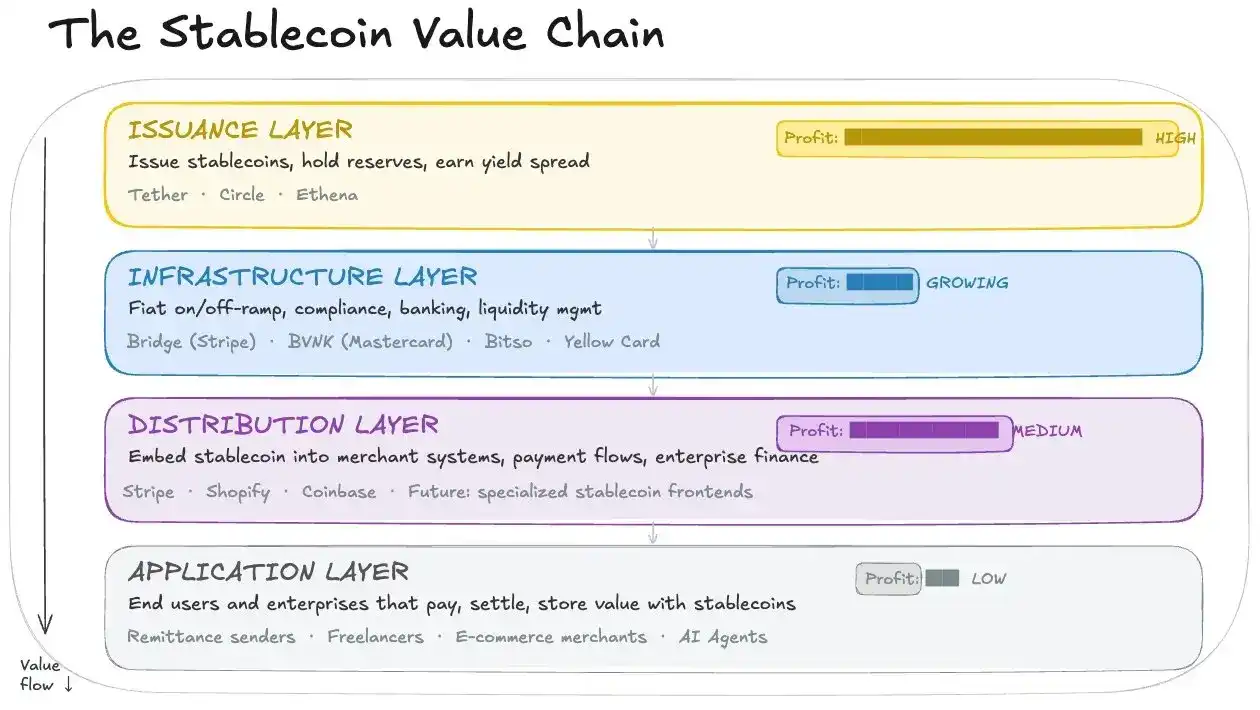
I categorize stablecoins into four layers:

  1. Issuance Layer: Mints stablecoins, holds reserve assets, captures the interest rate spread. Representatives: Tether and Circle.
  2. Infrastructure Layer: Connects stablecoins to the real-world financial system – fiat on/off-ramps, bank integrations, asset management, compliance. Representatives: Bridge (acquired by Stripe), BVNK (acquired by Mastercard), Bitso, Yellow Card, etc.
  3. Acquiring/Distribution Layer: Embeds stablecoins into merchant systems, manages payment flows, enterprise financial software. Representatives: Stripe, Infini, Coinbase.
  4. Application Layer: End users and businesses that ultimately use stablecoins for payments, settlement, or as a store of value.

The issuance layer captures user funds and earns the thickest interest spread; the middle two layers profit from traffic, distribution fees, and foundational infrastructure; the application layer enjoys convenience but lacks pricing power.

I believe the infrastructure layer is currently undervalued by the market.

It does the gritty, thankless work: integrating with banks, handling KYC/AML, managing local fiat on/off-ramps, connecting merchants and APIs, interfacing with card networks, and solving settlement and regulatory issues across different countries.

But conversely, this is precisely where its moat lies. Because the technology behind stablecoins is straightforward—transferring USDC on-chain isn't the hard part. The real challenge is penetrating the real world, convincing a Latin American company, an African payment provider, or a cross-border e-commerce platform to incorporate stablecoins into their daily cash flows. This gritty work is essential and must be done by someone.

The On-Chain Part is Easiest; The Bridge to Reality is Hardest

At first glance, stablecoin payments seem simple: on-chain transfers are fast, confirm quickly, have low fees. The rest is just distributing the product to users, right?

But the real difficulty with stablecoins lies in the vast gap between the blockchain and the traditional financial system. Businesses have decision-making and switching costs; they won't overhaul a perfectly functional workflow just because they heard stablecoins settle in one second.

This raises a cascade of questions: How do I convert fiat to stablecoins? And back again? How do I handle reconciliation and taxes? Will my bank block me later? Do users still need to learn how to use a wallet?

The core task of the infrastructure layer is bridging these two worlds: connecting to blockchains and wallets on one side, and to banks, local payment networks, enterprise systems, and compliance on the other.

Stripe's acquisition of Bridge in 2025 brought Bridge's "stablecoin orchestration" system—helping businesses integrate stablecoin capabilities into their operations. Mastercard's announcement in March 2026 to acquire BVNK followed a similar logic.

In other words, traditional payment companies are competing to become the default gateway for enterprises using stablecoins.

The key to scaling stablecoin payments lies precisely here.

The Road Builders

Looking closer at the infrastructure layer, its functions include:

  1. On/Off-Ramps + FX: Most enterprise use cases involve a "local currency → stablecoin → local currency" flow. This touches on banking relationships, compliance, liquidity, and other issues.
  2. >API + Account Layer: Businesses need a set of financial capabilities embedded into their workflows—account opening, sending/receiving payments, fund splitting, clearing, reconciliation. This resembles financial SaaS, similar to the concept of Neobanks.
  3. Payment Network Connectivity: The more payment rails, banks, and regions connected, the greater the customer dependency and switching costs become over time.
  4. Capital Efficiency: Helping businesses reduce idle funds, wait times, and FX losses.

I believe this layer has three defining characteristics that ensure its path is arduous before it becomes rewarding.

  • It's gritty, thankless work. Requires integrating with banks, achieving compliance, obtaining licenses, and building local teams, country by country.
  • It requires upfront investment to capture the gateway. Enterprises won't easily switch their payment infrastructure. Whoever first secures large clients, banking relationships, compliant pathways, and local fiat rails will later benefit from network effects. Companies at this stage are more in a "land grab" phase, far from reaping the harvest.
  • It's squeezed between upstream and downstream players. Upstream issuers capture the interest spread first, while downstream platforms want to control the user gateway. Infrastructure sits in the middle, in an awkward position, easily becoming "everyone needs you, but no one wants you to earn too much."

Right now, it's in an intermediate stage moving towards "forming pricing power."

If we look only at today, the issuance layer takes the largest profits, while the infrastructure layer is thinner and more burdensome.

But if we're talking about how to invest in the stablecoin space, the seigniorage logic of the issuance layer is already well-understood by the market, and its valuation will increasingly revolve around interest rates, regulation, and profit-sharing. The infrastructure layer is less conspicuous today, largely because it's still in the heavy-investment phase; pricing power and solidified user habits haven't fully formed yet.

Once stablecoins further become the default rails for enterprise finance, the true beneficiaries will be those who spent years building the bridges between stablecoins and the real-world commercial system.


Related Questions

QAccording to the article, what are the four layers of the stablecoin value stack?

AThe four layers are: 1) The Issuance Layer (e.g., Tether, Circle), which mints stablecoins, holds reserve assets, and earns the spread. 2) The Infrastructure Layer (e.g., Bridge, BVNK, Bitso, Yellow Card), which connects stablecoins to the real-world financial system (fiat on/off-ramps, bank integration, compliance). 3) The Acquirer/Distribution Layer (e.g., Stripe, Infini, Coinbase), which embeds stablecoins into merchant systems and manages payment flows. 4) The Application Layer, comprising the end-users and enterprises that use stablecoins for payments, settlements, and storing value.

QWhy does the author believe the Infrastructure Layer is currently underappreciated?

AThe author believes the Infrastructure Layer is underappreciated because it handles the 'dirty work' or heavy lifting: integrating with banks, performing KYC/AML, managing local fiat on/off-ramps, connecting to merchants and APIs, interfacing with card networks, and navigating the complex compliance and regulatory issues across different countries. This work, while not glamorous, builds a significant moat and is essential for stablecoins to penetrate real-world business operations.

QWhat is the most difficult part of enabling stablecoin payments, according to the article?

AAccording to the article, the most difficult part is not the on-chain transfer itself, which is simple, fast, and cheap. The true challenge lies in the vast middle ground 'between the blockchain and the real-world financial system.' This involves solving problems like converting fiat to/from stablecoins, handling reconciliation and taxation, managing banking relationships, and ensuring user-friendliness for businesses with high switching costs and decision-making inertia.

QWhat examples does the article provide of traditional payment companies acquiring infrastructure layer firms, and why?

AThe article cites Stripe's 2025 acquisition of Bridge and Mastercard's 2026 announcement to acquire BVNK. These acquisitions were made to obtain these firms' 'stablecoin orchestration' systems. The goal is to become the default gateway for businesses to integrate stablecoin capabilities into their operations, indicating that traditional payment giants are competing to control this crucial entry point for enterprise stablecoin adoption.

QWhat are the three characteristics of the Infrastructure Layer that suggest its path will be 'hard work first, rewards later'?

AThe three characteristics are: 1) It involves labor-intensive 'dirty work' requiring country-by-country integration with banks, compliance, licensing, and local team building. 2) It requires significant upfront investment to capture key entry points (major clients, banking relationships, regulatory pathways, local fiat rails) to build network effects for the future. 3) It is squeezed between the upstream Issuance Layer, which takes the thickest profits, and the downstream platforms that want to control user access, putting it in a vulnerable position where 'everyone needs you, but no one wants you to earn too much.'

Related Reads

The Entire Internet Hails Noam's Joining, But OpenAI's Loss Bill Just Got Thicker

While the AI community celebrates Noam Shazeer, co-author of the "Attention Is All You Need" paper, joining OpenAI as Head of Architectural Research, the company's audited financials reveal a starkly different reality. In 2025, OpenAI reported $13.07 billion in revenue but a massive $20.92 billion operating loss. Even excluding a one-time accounting charge, the cash burn is severe, with $3.7 billion consumed in Q1 2026 alone. This high-profile hiring occurs against a backdrop of significant internal research talent drain, with key founders and researchers departing as the company's focus shifts from exploratory research to product iteration. Meanwhile, OpenAI's fundamental business model faces a deep crisis. It paid Microsoft $10.59 billion for compute in 2025, while its vast user base of 9 billion weekly actives includes only 50 million paying customers, making growth a direct driver of escalating costs. The article argues Shazeer's recruitment is less about technical necessity and more about crafting a compelling narrative for OpenAI's upcoming IPO, aiming to justify a rumored $1 trillion valuation to future public market investors. It contrasts OpenAI's strategy with Anthropic's reported path to profitability, which relies on a strong enterprise customer base and cost control, rather than star-powered narratives. Ultimately, the piece concludes that while Shazeer's architectural work may take 1-2 years to materialize, OpenAI's financial clock is ticking much faster, with its massive losses undercutting the celebratory headlines.

marsbit1h ago

The Entire Internet Hails Noam's Joining, But OpenAI's Loss Bill Just Got Thicker

marsbit1h ago

Market Trend (June 19): US-Iran Deal Drives Out Geopolitical Premium; Chip Stocks Soar to New Highs; Energy Sector Leads Declines

U.S. Market Trends (June 19): U.S.-Iran Deal Eases Tensions, Chip Stocks Soar, Energy Sector Leads Declines. U.S. stocks rallied on Thursday as the signing of a temporary U.S.-Iran deal in Geneva de-escalated Middle East tensions, with Saudi oil tankers transiting the Strait of Hormuz. This geopolitical relief helped markets recover from recent Fed-driven volatility. The S&P 500 rose over 1%, the Nasdaq gained nearly 2%, and the Dow Jones Industrial Average closed at another record high. The Philadelphia Semiconductor Index surged over 6% to a historic peak. Chip stocks were the standout performers. Reports of an Apple-Intel design and foundry deal for certain products, alongside mentions of potential Nvidia and SpaceX collaborations with Intel, propelled the sector. Intel surged ~10.5%, while memory chip makers like Micron also saw significant gains, highlighting sustained confidence in long-term AI capital expenditure. In contrast, the energy sector was the day's sole loser, with the S&P 500 energy sub-index declining as WTI crude fell ~2% to around $74.29/barrel. The reopening of key shipping routes erased prior geopolitical risk premiums. SpaceX extended losses for a second day on news of a potential large bond offering. Market volatility (VIX) dropped sharply, indicating a swift reversal of post-Fed jitters. Treasury yields dipped slightly but remained elevated. The focus now shifts to upcoming economic data, including next week's PCE inflation report and Micron's earnings, which will serve as a key test for the AI trade's durability.

marsbit1h ago

Market Trend (June 19): US-Iran Deal Drives Out Geopolitical Premium; Chip Stocks Soar to New Highs; Energy Sector Leads Declines

marsbit1h ago

Will MicroStrategy Fall Into a Death Spiral? How Will the Macro Outlook Evolve in the Second Half of the Year?

**Summary:** The discussion centers on recent Bitcoin price declines and the evolving financial strategy of MicroStrategy (MSTR). The core argument is that the primary pressure is not from one-off Bitcoin sales by MSTR, but from the market's new expectation that MSTR may need to engage in *sustained, small-scale* Bitcoin sales to cover cash flow obligations for its growing portfolio of preferred shares and debt instruments (like STRC). This shift is driven by its stated goal of maintaining "bitcoins per share neutrality." The market is now testing whether it can absorb this potential ongoing selling pressure without entering a severe "death spiral" with Bitcoin's price. A resolution may involve MSTR softening its approach to avoid damaging both its stock and Bitcoin. The conversation then explores the parallel rise of AI-related stocks. The guest posits that AI is fundamentally restructuring labor, with "tokens" (representing access to AI models/compute) becoming a new form of capital and a substitute for human execution. This drives corporate efficiency and profits, benefiting upstream hardware providers (semiconductors, data centers), which explains the sustained rally. This represents the early stages of a "machine economy." Regarding crypto exchanges offering US stock trading, this is seen as a natural evolution. With few crypto-native assets generating lasting value, exchanges are pivoting to distribute valuable real-world assets (RWAs). This doesn't necessarily harm crypto's long-term prospects, as blockchain infrastructure may become crucial for future machine-to-machine economies. The analysis concludes that the era of rampant altcoin speculation is likely over, heavily damaged by the liquidity shock of the "1011" event (likely referring to a major market crash). Meme-driven capital has largely migrated to US equities. Looking ahead, macroeconomic uncertainty is rising due to potential large IPOs (e.g., SpaceX) and the US elections. While short-term market corrections are possible, the long-term trends of AI-driven productivity gains and the maturation of blockchain towards real-world utility and institutional adoption remain intact.

marsbit1h ago

Will MicroStrategy Fall Into a Death Spiral? How Will the Macro Outlook Evolve in the Second Half of the Year?

marsbit1h ago

Trading

Spot
Futures
活动图片