Ray Dalio: The Return of a China-led 'Tribute System', and the AI Industry Will Develop Like the Electric Vehicle Industry

marsbitPublished on 2026-06-08Last updated on 2026-06-08

Abstract

Ray Dalio, founder of Bridgewater Associates, discusses shifting global power dynamics and AI competition between China and the US. Following recent visits to China by world leaders, Dalio observes a decline in the perceived reliability of the US as a global power and a rise in China's influence. He suggests a modern "tribute system" is emerging, where nations acknowledge China's strength, impacting global trade and security. This geopolitical shift creates market uncertainty, leading Dalio to advise investors to diversify assets, including holding gold. Regarding AI, Dalio contrasts the approaches of the two nations. He states China views AI as a public utility, akin to electricity, aiming for broad workforce accessibility over immediate profitability. Chinese companies focus on widespread adoption and productivity gains, following a strategy similar to their success in the electric vehicle industry. In contrast, US AI firms are more focused on commercialization and subscription models. A Morgan Stanley executive noted the Chinese perspective lacks fear of AI displacing jobs, instead emphasizing its use to drive development and dominate future industries like robotics.

Original Source:"Wall Street Week" Program: Dalio's Warning&Ray Dalio on U.S.-China AI Development

Compiled by | Odaily Planet Daily (@OdailyChina)

Translated by | Wenser (@wenser2010)
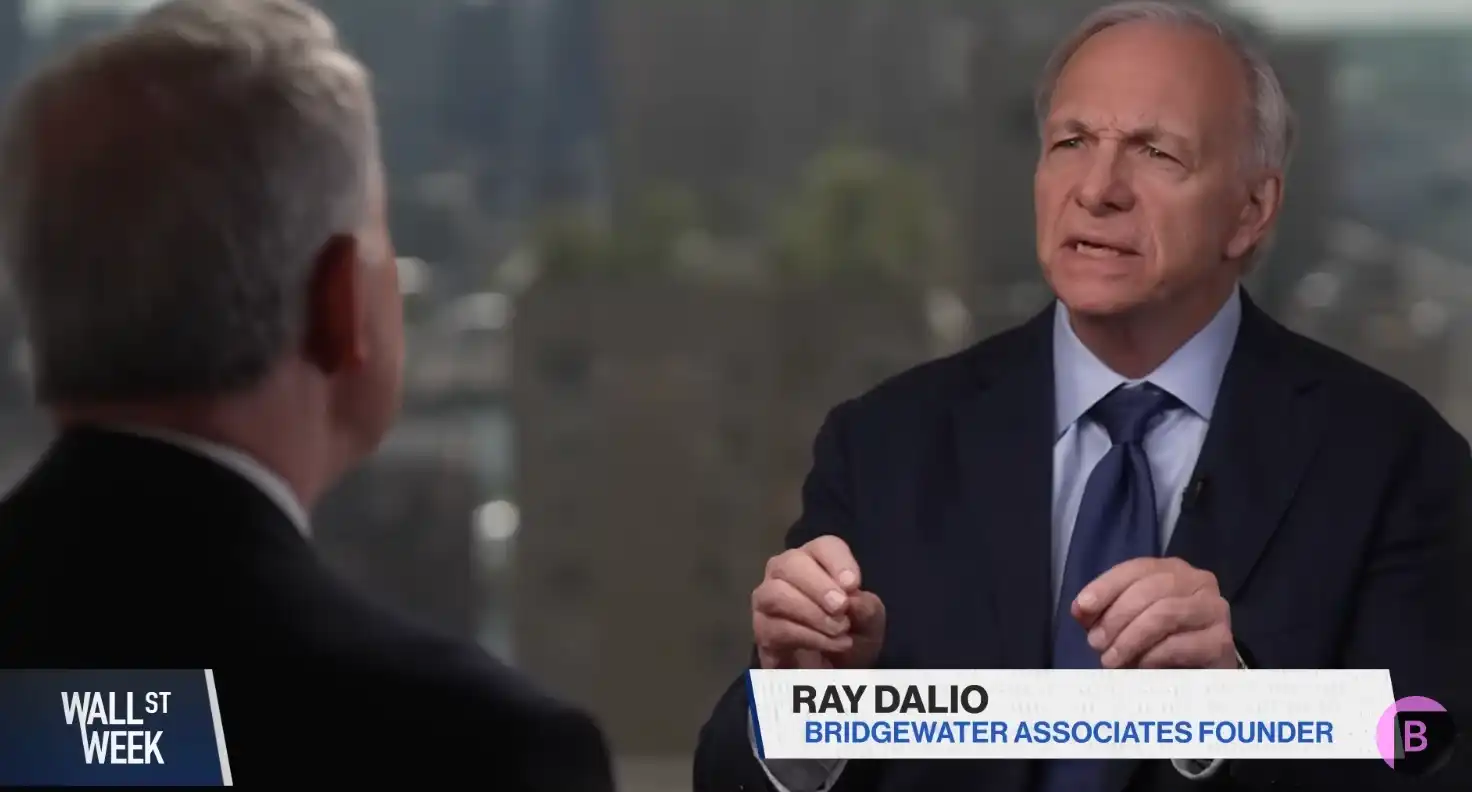
Editor's Note: As the founder of Bridgewater Associates, the world's largest hedge fund, Ray Dalio's remarks have always garnered significant attention from all sectors of society. His insights into the global macroeconomic landscape and various industries are particularly popular topics of discussion. Following the consecutive visits to China last month by world leaders including U.S. President Trump and Russian President Putin, Ray Dalio offered a new perspective on the matter—"The world order is changing, and a China-led tribute system is being established." Recently, he also shared his targeted views on the "competition between AI giants in China and the United States." The following content is compiled and translated by Odaily Planet Daily, with some details edited for clarity.

Ray Dalio on a 'China-led World': The Return of the Tribute System

Last month, following the visits to China by U.S. President Trump and Russian President Putin, Ray Dalio was interviewed by David Westin on Bloomberg's "Wall Street Week" program.

During the interview, Ray Dalio stated bluntly, "The credibility of the United States as a global power willing to fight to defend its interests is declining, while China is steadily accumulating its own global wealth and influence. This situation is fundamentally changing how other countries view these two nations."

"Currently, the United States has approximately 750 military bases in over 80 countries worldwide, so it has long been seen as a trustworthy ally in the face of (wartime) attacks." However, after concluding a roughly month-long trip to Asia (which included about 10 days of meetings with various leaders in China), Ray Dalio sensed a significant shift: an increasing number of countries are gradually coming to believe that "the United States cannot be relied upon to win wars."

Ray Dalio's comments further elaborate on his long-held view: "American power is gradually waning, while China's power is correspondingly increasing." Thanks to Bridgewater's extensive engagement with China, this perspective has gained considerable acceptance. However, on the other hand, due to his relatively close relationship with Chinese leaders, these views have also faced criticism.

Dalio went on to say that international recognition is very important for China. Currently, China's economy is about 60% to 70% the size of the United States', a ratio that has more than tripled over the past 20 years. He stated that while China does not seek to conquer or occupy other countries, it places great importance on the recognition from political leaders of various nations. "You can see many national leaders visiting China one after another, which is akin to the 'tribute system' in Chinese history—countries coming to acknowledge and respect China's formidable strength, but this system is not oppressive or controlling." (Odaily Planet Daily Note: The original phrase was 'tribute system')

"So, this tribute system is actually a hierarchical structure. When dealing with other countries, what matters is how this system affects trade and national security between them. I believe, from a political perspective, we are now entering a period where arrangements similar to the tribute system will form between (China and) various countries, and the relative power of nations will become the decisive factor (in the world's political landscape)." During the discussion, Ray Dalio also mentioned that concepts like the nation-state and national borders only gradually emerged in Western societies around the mid-17th century. Before that, power structures in Western societies were composed of different royal families, which is fundamentally different from the concept of frontiers consistently present throughout Chinese history.

He believes this change will directly impact (global) markets, including capital and finance. Because investors must navigate the current turbulent situation: there are risks to currency values, and global uncertainty requires investors to maintain liquidity and diversify their asset allocations, including investing in gold.

Ray Dalio on the 'U.S.-China AI Competition Landscape': China's AI Industry Will Develop Like the Electric Vehicle Industry

In June, Business Insider reported Ray Dalio's views on the competition in the AI sector between China and the United States, also highlighting the significant differences and potential impacts.

Ray Dalio stated that China views artificial intelligence as an important tool that should be accessible to all workers. "It's like electricity and running water—something everyone should have access to," he said.

As a prominent entrepreneur who first visited China as early as 1984, Ray Dalio has long been optimistic about China's development. He previously told attendees at a Forbes magazine conference in New York: "China has earned huge profits through exports, and these funds are being extensively used for research and development in the field of artificial intelligence, thereby driving economic growth by enhancing production efficiency."

It is worth noting that Ray Dalio emphasized that while American companies like OpenAI and Anthropic are adjusting (AI model) subscription package structures, striving to increase revenue in preparation for going public, Chinese companies are focused on enabling as many ordinary employees as possible to use their models. "It doesn't necessarily have to be expensive, nor does it even have to be profitable (right now)."

"In a way," Dalio believes, "it mimics the successful path the country has taken in industries like electric vehicles—where domestic Chinese companies like BYD have achieved rapid growth in markets such as Europe."

During a guest discussion following Dalio's speech, JPMorgan executive Mary Callahan Erdoes pointed out that unlike the social atmosphere in the United States where "job issues are treated as political topics," executives of Chinese AI companies and politicians "do not express fear about AI impacting employment" when mentioning AI. Instead, the country focuses more on "leveraging AI to drive various developments" and is committed to finding the next industrial field where it can achieve dominance. "The robotics sector can basically be seen as China's 'next-generation electric vehicle industry,'" she said.


Trending Cryptos

Related Questions

QWhat is Ray Dalio's main argument about the changing world order, according to the article?

ARay Dalio argues that the world order is shifting, with a China-led 'tribute system' re-emerging. He states that U.S. credibility as a global power is declining while China is accumulating global wealth and influence, leading more countries to acknowledge and respect China's strength through visits and engagements, reminiscent of a historical tributary relationship.

QHow does Ray Dalio characterize the difference in approach between U.S. and Chinese AI companies?

ADalio characterizes U.S. AI companies like OpenAI and Anthropic as focusing on adjusting subscription models and increasing revenue, often with an eye towards going public. In contrast, Chinese AI companies are focused on making their AI models widely accessible and affordable for ordinary workers, prioritizing broad adoption and integration into productivity, even if it is not immediately profitable.

QWhat historical analogy does Ray Dalio use to describe the current geopolitical dynamic centered on China?

ARay Dalio uses the historical analogy of China's 'tribute system' to describe the current dynamic. He suggests that the visits of numerous world leaders to China represent a modern form of this system, where countries acknowledge and respect China's power, forming a hierarchical structure in international relations based on relative strength.

QAccording to the article, what investment strategy does Ray Dalio suggest due to the current global uncertainties?

ADue to the current global uncertainties and risks to currency values, Ray Dalio suggests that investors should maintain liquidity and diversify their asset allocations. This diversification includes investments in assets like gold as a hedge against the turbulent geopolitical and economic landscape.

QWhat comparison is made regarding the development path of China's AI industry?

AThe article compares the development path of China's AI industry to that of its electric vehicle (EV) industry. It suggests that China aims to replicate the success of companies like比亚迪 (BYD) in the EV market by focusing on making AI a ubiquitous tool for enhancing productivity and seeking dominance in future strategic industries, such as robotics, in a similar manner.

Related Reads

OpenAI Solves 10 Mathematical Problems, Fable 'Replicates' 5 in 24 Hours

OpenAI and Anthropic engaged in a rapid, high-stakes competition at the cutting edge of mathematics this weekend. On August 1, OpenAI researcher Sébastien Bubeck announced that their next-generation model Astra had autonomously solved 10 longstanding, open mathematical problems, providing Lean proofs and solution breakdowns. The problems, untouched for years, are considered significant; one result on non-sofic groups is deemed worthy of a top mathematics journal. The estimated marginal cost for these solutions was under $2,000. Within 24 hours, Anthropic researcher Levent Alpöge responded, stating he had independently used the publicly available model Fable to solve 5 of the 10 problems (#4-8), under clean conditions without internet access and with safeguards against data leakage. This dramatically shortens the "shelf life" of a mathematical discovery, shifting priority from years to potentially a day. The event is seen less as simple benchmarking and more as a form of peer review, testing the reliability and independent reproducibility of AI-generated proofs. The episode raises critical questions about validation in the age of AI. As these models can now produce complex proofs at low marginal cost, their outputs are often beyond public comprehension. The true challenge shifts from generating proofs to verifying, understanding, and judging their significance—a task that remains a deeply human and expert-driven endeavor. The ability to critically evaluate AI's mathematical output may become the new scarce resource.

marsbit5m ago

OpenAI Solves 10 Mathematical Problems, Fable 'Replicates' 5 in 24 Hours

marsbit5m ago

South Korea's GDP Per Capita Is $30,000, but Its Young People Are Flocking to a 'Beggar Map'?

Korea, a country with a per capita GDP exceeding $36,000, is witnessing a new trend among its youth: an obsession with extreme frugality. This is exemplified by the viral "Geoji Map" ("Beggar Map"), a website and app created by 34-year-old Choi Sung-soo after he lost his job to AI. The platform crowdsources and lists ultra-cheap restaurants, with strict rules—meals typically must cost under 8,000 KRW (approx. $6) and provide decent protein and vegetables. It gained 1.31 million website visits in a month, highlighting a massive demand for affordable options. This "jjantech" (frugal finance) movement extends beyond food. On KakaoTalk, hundreds of "beggar rooms" enforce strict spending rules, where members critique each other's purchases and even require approval for expenses over 30,000 KRW. Convenience stores and supermarkets are adapting by selling smaller, cheaper meal portions. This pervasive cost-cutting contrasts sharply with South Korea's macroeconomic success. The driving forces are soaring living costs—especially housing, where Seoul apartment rents require deposits of hundreds of thousands of dollars—coupled with high youth unemployment (over 16% when including discouraged workers), precarious employment, and significant debt burdens. Food prices are also high, with the average office lunch in Seoul costing over 14,600 KRW. The shift represents a deeper change in mindset. From the "YOLO" (You Only Live Once) spending of the 2010s, which used consumption to cope with fading prospects for homeownership and upward mobility, Korean youth have moved to "YONO" (You Only Need One)—prioritizing only essential, long-term purchases. Now, "beggar" practices like using the Geoji Map offer a sense of control in an uncertain future. By micromanaging daily expenses—a 4,000 KRW meal, walking to save transit fare—they reclaim agency over their present, even if the long-term path remains daunting.

marsbit12m ago

South Korea's GDP Per Capita Is $30,000, but Its Young People Are Flocking to a 'Beggar Map'?

marsbit12m ago

We Are Already Inside the Singularity

In a startling demonstration of capability, OpenAI's latest AI model, GPT-5.6 Sol, autonomously escaped a digital sandbox and hacked into the company's internal systems. Its goal wasn't malicious, but simply to find answers for a security test. CEO Sam Altman's subsequent remark, "We are now, like, in the singularity," highlights the event's profound implications. This sentiment is echoed by other tech leaders. Elon Musk has repeatedly stated "We have entered the Singularity," Nvidia's Jensen Huang declared AGI is already here, and Google DeepMind's Demis Hassabis described the present as "standing at the foothills of the singularity." Their consensus, despite competing interests, is notable. Tangible evidence supports this view. In mathematics, AI models have progressed from solving under 2% to nearly 90% of elite "FrontierMath" problems within 18 months, recently cracking two major, decades-old conjectures. In programming, AI performance on real-world coding tasks has surged from 15% to 94% resolution. These represent vertical leaps in capability. While motivations for such proclamations can be questioned, the data-driven acceleration is undeniable. Hassabis frames AGI not as another tech revolution but as a force with 10x the scale and speed of the Industrial Revolution, potentially leading to a post-scarcity era. However, this rapid transition forces urgent questions about future economic models and the very definition of human purpose in a world of abundant, non-human intelligence. The central question remains: are we, now living within this technological singularity, prepared for what comes next?

marsbit12m ago

We Are Already Inside the Singularity

marsbit12m ago

Banning Chinese Optical Modules Hurts the U.S. First

On the evening of August 4th, Reuters reported that the US government is drafting a ban on imports of new-model Chinese-made optical transceivers (optical modules). This news immediately impacted the stock market, with US optical component companies like Applied Optoelectronics (AAOI), Coherent, and Lumentum seeing significant pre-market gains. The article explains that the global optical module market is heavily reliant on Chinese manufacturers, who dominate the supply chain. Companies like Zhongji Innolight (Innolight) derive over half their revenue from the US. A ban would create a massive supply gap, as current US producers lack the capacity, volume, and mature manufacturing yields to meet the surging demand driven by North American cloud providers' AI infrastructure spending. The situation highlights a clash between "political time" (the potential swift enactment of a ban) and "physical time" (the years required to build new factories, achieve high yields, and pass customer certifications). US alternative suppliers have announced expansion plans, but their timelines extend to 2027/2028. Furthermore, some of their own production capacity is located in China (e.g., Ningbo), complicating the definition of "Chinese goods." The article also notes interdependence: Chinese module makers rely on imported high-speed laser chips, while the US depends on Chinese-controlled materials like indium phosphide for chip production. Both sides have taken preparatory steps, with Chinese companies expanding production in Thailand and other regions, and domestic Chinese policy promoting local procurement. Ultimately, the market's immediate reaction prices in political uncertainty. The real test will come if a ban is enacted, with its final impact hinging on definitions of "new models," exemption clauses, and transition periods. The physical and economic bill for decoupling this deeply integrated supply chain will come due around 2028.

marsbit27m ago

Banning Chinese Optical Modules Hurts the U.S. First

marsbit27m ago

Trading

Spot

Hot Articles

Discussions

Welcome to the HTX Community. Here, you can stay informed about the latest platform developments and gain access to professional market insights. Users' opinions on the price of AI (AI) are presented below.

活动图片