Ray Dalio: The Return of a China-led 'Tribute System', and the AI Industry Will Develop Like the Electric Vehicle Industry

marsbitPublished on 2026-06-08Last updated on 2026-06-08

Abstract

Ray Dalio, founder of Bridgewater Associates, discusses shifting global power dynamics and AI competition between China and the US. Following recent visits to China by world leaders, Dalio observes a decline in the perceived reliability of the US as a global power and a rise in China's influence. He suggests a modern "tribute system" is emerging, where nations acknowledge China's strength, impacting global trade and security. This geopolitical shift creates market uncertainty, leading Dalio to advise investors to diversify assets, including holding gold. Regarding AI, Dalio contrasts the approaches of the two nations. He states China views AI as a public utility, akin to electricity, aiming for broad workforce accessibility over immediate profitability. Chinese companies focus on widespread adoption and productivity gains, following a strategy similar to their success in the electric vehicle industry. In contrast, US AI firms are more focused on commercialization and subscription models. A Morgan Stanley executive noted the Chinese perspective lacks fear of AI displacing jobs, instead emphasizing its use to drive development and dominate future industries like robotics.

Original Source:"Wall Street Week" Program: Dalio's Warning&Ray Dalio on U.S.-China AI Development

Compiled by | Odaily Planet Daily (@OdailyChina)

Translated by | Wenser (@wenser2010)
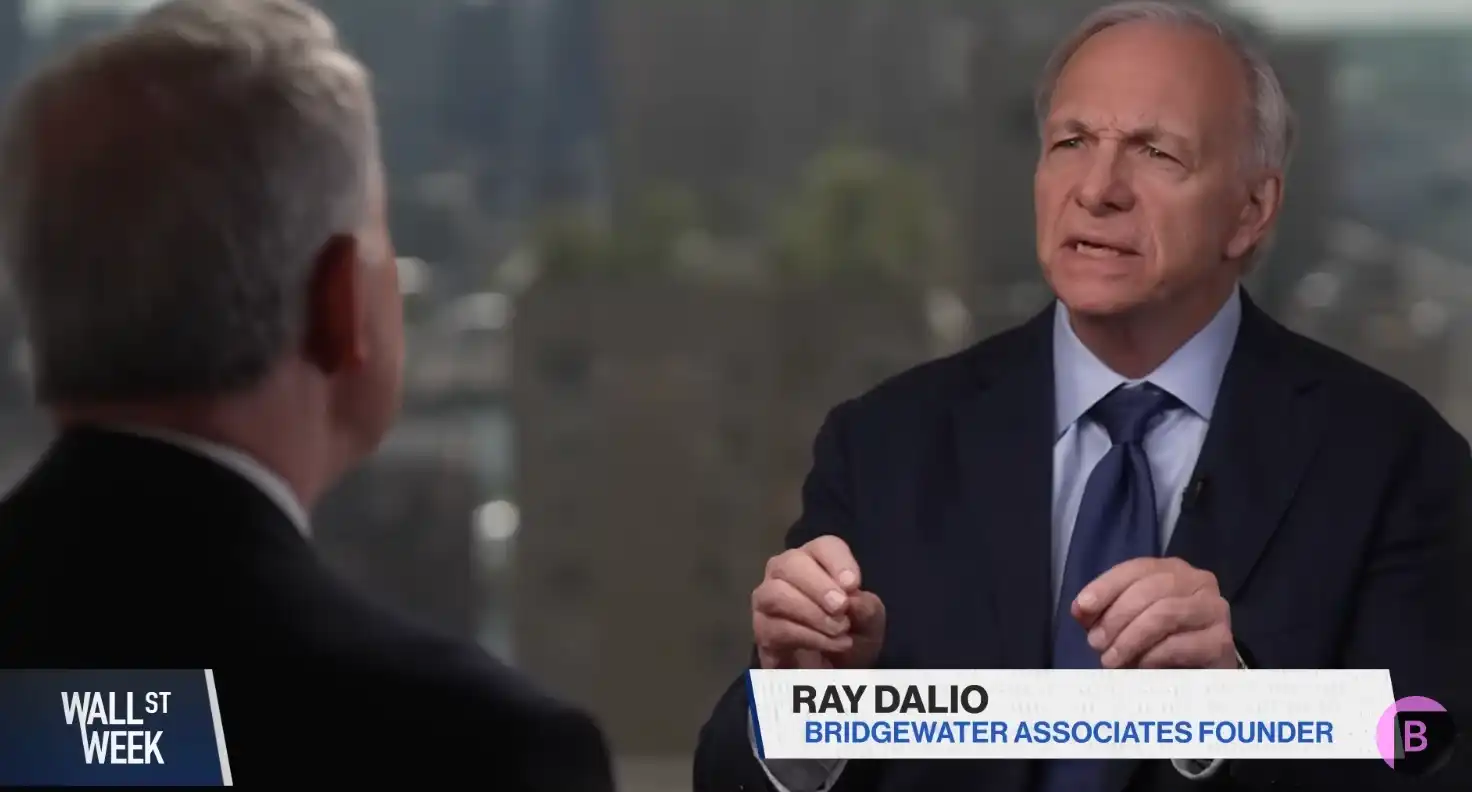
Editor's Note: As the founder of Bridgewater Associates, the world's largest hedge fund, Ray Dalio's remarks have always garnered significant attention from all sectors of society. His insights into the global macroeconomic landscape and various industries are particularly popular topics of discussion. Following the consecutive visits to China last month by world leaders including U.S. President Trump and Russian President Putin, Ray Dalio offered a new perspective on the matter—"The world order is changing, and a China-led tribute system is being established." Recently, he also shared his targeted views on the "competition between AI giants in China and the United States." The following content is compiled and translated by Odaily Planet Daily, with some details edited for clarity.

Ray Dalio on a 'China-led World': The Return of the Tribute System

Last month, following the visits to China by U.S. President Trump and Russian President Putin, Ray Dalio was interviewed by David Westin on Bloomberg's "Wall Street Week" program.

During the interview, Ray Dalio stated bluntly, "The credibility of the United States as a global power willing to fight to defend its interests is declining, while China is steadily accumulating its own global wealth and influence. This situation is fundamentally changing how other countries view these two nations."

"Currently, the United States has approximately 750 military bases in over 80 countries worldwide, so it has long been seen as a trustworthy ally in the face of (wartime) attacks." However, after concluding a roughly month-long trip to Asia (which included about 10 days of meetings with various leaders in China), Ray Dalio sensed a significant shift: an increasing number of countries are gradually coming to believe that "the United States cannot be relied upon to win wars."

Ray Dalio's comments further elaborate on his long-held view: "American power is gradually waning, while China's power is correspondingly increasing." Thanks to Bridgewater's extensive engagement with China, this perspective has gained considerable acceptance. However, on the other hand, due to his relatively close relationship with Chinese leaders, these views have also faced criticism.

Dalio went on to say that international recognition is very important for China. Currently, China's economy is about 60% to 70% the size of the United States', a ratio that has more than tripled over the past 20 years. He stated that while China does not seek to conquer or occupy other countries, it places great importance on the recognition from political leaders of various nations. "You can see many national leaders visiting China one after another, which is akin to the 'tribute system' in Chinese history—countries coming to acknowledge and respect China's formidable strength, but this system is not oppressive or controlling." (Odaily Planet Daily Note: The original phrase was 'tribute system')

"So, this tribute system is actually a hierarchical structure. When dealing with other countries, what matters is how this system affects trade and national security between them. I believe, from a political perspective, we are now entering a period where arrangements similar to the tribute system will form between (China and) various countries, and the relative power of nations will become the decisive factor (in the world's political landscape)." During the discussion, Ray Dalio also mentioned that concepts like the nation-state and national borders only gradually emerged in Western societies around the mid-17th century. Before that, power structures in Western societies were composed of different royal families, which is fundamentally different from the concept of frontiers consistently present throughout Chinese history.

He believes this change will directly impact (global) markets, including capital and finance. Because investors must navigate the current turbulent situation: there are risks to currency values, and global uncertainty requires investors to maintain liquidity and diversify their asset allocations, including investing in gold.

Ray Dalio on the 'U.S.-China AI Competition Landscape': China's AI Industry Will Develop Like the Electric Vehicle Industry

In June, Business Insider reported Ray Dalio's views on the competition in the AI sector between China and the United States, also highlighting the significant differences and potential impacts.

Ray Dalio stated that China views artificial intelligence as an important tool that should be accessible to all workers. "It's like electricity and running water—something everyone should have access to," he said.

As a prominent entrepreneur who first visited China as early as 1984, Ray Dalio has long been optimistic about China's development. He previously told attendees at a Forbes magazine conference in New York: "China has earned huge profits through exports, and these funds are being extensively used for research and development in the field of artificial intelligence, thereby driving economic growth by enhancing production efficiency."

It is worth noting that Ray Dalio emphasized that while American companies like OpenAI and Anthropic are adjusting (AI model) subscription package structures, striving to increase revenue in preparation for going public, Chinese companies are focused on enabling as many ordinary employees as possible to use their models. "It doesn't necessarily have to be expensive, nor does it even have to be profitable (right now)."

"In a way," Dalio believes, "it mimics the successful path the country has taken in industries like electric vehicles—where domestic Chinese companies like BYD have achieved rapid growth in markets such as Europe."

During a guest discussion following Dalio's speech, JPMorgan executive Mary Callahan Erdoes pointed out that unlike the social atmosphere in the United States where "job issues are treated as political topics," executives of Chinese AI companies and politicians "do not express fear about AI impacting employment" when mentioning AI. Instead, the country focuses more on "leveraging AI to drive various developments" and is committed to finding the next industrial field where it can achieve dominance. "The robotics sector can basically be seen as China's 'next-generation electric vehicle industry,'" she said.


Trending Cryptos

Related Questions

QWhat is Ray Dalio's main argument about the changing world order, according to the article?

ARay Dalio argues that the world order is shifting, with a China-led 'tribute system' re-emerging. He states that U.S. credibility as a global power is declining while China is accumulating global wealth and influence, leading more countries to acknowledge and respect China's strength through visits and engagements, reminiscent of a historical tributary relationship.

QHow does Ray Dalio characterize the difference in approach between U.S. and Chinese AI companies?

ADalio characterizes U.S. AI companies like OpenAI and Anthropic as focusing on adjusting subscription models and increasing revenue, often with an eye towards going public. In contrast, Chinese AI companies are focused on making their AI models widely accessible and affordable for ordinary workers, prioritizing broad adoption and integration into productivity, even if it is not immediately profitable.

QWhat historical analogy does Ray Dalio use to describe the current geopolitical dynamic centered on China?

ARay Dalio uses the historical analogy of China's 'tribute system' to describe the current dynamic. He suggests that the visits of numerous world leaders to China represent a modern form of this system, where countries acknowledge and respect China's power, forming a hierarchical structure in international relations based on relative strength.

QAccording to the article, what investment strategy does Ray Dalio suggest due to the current global uncertainties?

ADue to the current global uncertainties and risks to currency values, Ray Dalio suggests that investors should maintain liquidity and diversify their asset allocations. This diversification includes investments in assets like gold as a hedge against the turbulent geopolitical and economic landscape.

QWhat comparison is made regarding the development path of China's AI industry?

AThe article compares the development path of China's AI industry to that of its electric vehicle (EV) industry. It suggests that China aims to replicate the success of companies like比亚迪 (BYD) in the EV market by focusing on making AI a ubiquitous tool for enhancing productivity and seeking dominance in future strategic industries, such as robotics, in a similar manner.

Related Reads

In Jinjiang, Fujian, a Storage Super Unicorn Lies Quiet

In Fujian's Jinjiang, a city known for sportswear, lies a quiet semiconductor giant: Fujian Jinhua Integrated Circuit Co. (JHICC). Once a promising domestic DRAM manufacturer alongside Yangtze Memory and ChangXin Memory Technologies (CXMT), its journey was derailed in 2018 when the U.S. placed it on an Entity List and filed criminal charges for alleged trade secret theft. This halted production for years. A turning point came in February 2024 when a U.S. federal court found JHICC not guilty. However, it had lost crucial time. While CXMT soared to become a top-valued A-share company in 2024, JHICC, with an estimated valuation of 80 billion RMB, was just restarting. Its current output is primarily customized DDR4 chips, not the advanced DDR5/HBM demanded for AI, but it still benefits from the broader memory chip upcycle. JHICC's story is tied to Chen Zhengkun, a veteran engineer who left Micron to lead the venture. Founded in 2016 with state-backed funding, JHICC partnered with Taiwan's UMC to develop DRAM technology. Rapid progress was cut short by the U.S. actions, which Micron initiated, partly due to its heavy reliance on the Chinese market. Post-sanctions, Chen's team worked to rebuild the production line with reduced reliance on U.S. technology. According to its records, JHICC achieved small-scale production and revenue growth under immense pressure. It now focuses on the stable "niche" DRAM market (e.g., TVs, routers) with a monthly capacity of ~40,000 wafers, aiming for 60,000 by 2026. It holds over 1,000 patents but remains on the Entity List. For Jinjiang, investing in JHICC was a bold industrial leap. The local government provided unwavering financial and logistical support during the crisis, helping the company survive. JHICC has become the anchor for a growing local semiconductor cluster. Though its scale lags behind domestic peers, JHICC's persistence symbolizes a hard-won foothold in a global market long dominated by Samsung, SK Hynix, and Micron. Having missed one boom, it seeks a place in the new AI-driven memory supercycle.

marsbit23m ago

In Jinjiang, Fujian, a Storage Super Unicorn Lies Quiet

marsbit23m ago

Must-Watch Events Next Week|CLARITY Act Could Face Senate Vote; SpaceX, Circle to Report Earnings (8.3-8.9)

**Summary: Key Events and Developments to Watch (August 3-9)** The upcoming week is marked by significant financial disclosures, key legislative deadlines, and notable product updates. **Major Financial Events:** Several companies are scheduled to release their Q2 2026 earnings. American Bitcoin (ABTC) will report on August 3, followed by SpaceX and Hut 8 Mining Corp. on August 4, and Circle on August 5. Notably, a significant portion of SpaceX shares (up to 12% of total shares) will be unlocked on August 6 following their earnings release. **Key Legislative Deadline:** The U.S. Senate faces an August 7 deadline to secure 60 votes for the CLARITY Act, a bipartisan bill aiming to establish a federal regulatory framework for cryptocurrencies. The Senate may hold a full vote on the bill during the week. **Economic Data:** The U.S. July Non-Farm Payrolls report will be released on August 7, providing crucial labor market data. **Technology & Product Updates:** * **Shutdowns:** DeFi portfolio tracker Zapper and wallet app Ctrl Wallet will cease operations on August 3. * **Upgrades:** LayerZero will deprecate its v1 relayers on August 3. XRP Ledger's new version 3.3.0, featuring five new functions, is expected next week. * **AI:** Elon Musk announced that the advanced Grok 4.6 AI model is set for release around August 7. * **Bitcoin:** The BIP-110 forced signaling for a potential Bitcoin network change is scheduled to begin around August 8. **Other Notable Events:** Chinese robotics firm Unitree Tech has set its preliminary price inquiry for its IPO for August 5. South Korean exchange Upbit will delist AQT and AERGO tokens on August 3.

marsbit2h ago

Must-Watch Events Next Week|CLARITY Act Could Face Senate Vote; SpaceX, Circle to Report Earnings (8.3-8.9)

marsbit2h ago

Trading

Spot

Hot Articles

Discussions

Welcome to the HTX Community. Here, you can stay informed about the latest platform developments and gain access to professional market insights. Users' opinions on the price of AI (AI) are presented below.

活动图片














