Perspective: The current AI supercycle will last 15 years, but most are still buying stocks in the first FOMO stage

marsbitPublished on 2026-05-09Last updated on 2026-05-09

Abstract

This article outlines a 15-year AI supercycle, segmented into four investment stages. It argues that while most investors are still focused on the first stage, smart money is already moving to the third. **Stage 1: The Foundation (2023-2025) - Priced In** The semiconductor layer (e.g., NVIDIA, AMD) is complete. While growth continues, the historic entry opportunity is over as risk/reward has compressed. **Stage 2: The Build-Out (2025-2027) - In Progress** This phase involves building the necessary physical infrastructure: power/utilities (CEG), cooling (VRT), networking (ANET), and nuclear SMRs (OKLO, SMR). Significant upside remains, but obvious names have already moved. **Stage 3: The Asymmetric Bet (2026-2028) - Positioning Window** AI moves into the physical world. Key areas include robotics/autonomy (Tesla Optimus), space/defense/drones (Rocket Lab, LUNR), and critical materials. This stage presents the best asymmetric risk/reward and is where positioning should occur now. **Stage 4: The Endgame (2028+) - Software Dominance** The mega-cap cloud platforms (Microsoft, Alphabet, Amazon, Meta), with their massive capital expenditure, will build the AI software layer and AGI infrastructure, aiming to win the entire cycle. **Core Conclusion:** The cycle is confirmed in Stage 2. Stage 3 (robotics, space, defense, nuclear SMRs) is where capital is currently rotating for maximum opportunity, while the majority of investors are expected to be 12 months behind this shift.

Author: Rand Group (@cryptorand)

Compiled by: Deep Tide TechFlow

Deep Tide Intro: Crypto KOL Rand Group breaks down the AI supercycle into four stages, from chips to infrastructure to robots to platform software, marking the core targets and risk-reward ratios for each stage. His judgment is: Stage 1 (Semiconductors) is over, Stage 2 (Power/Cooling/Networks) is being priced, and the true asymmetric opportunity lies in Stage 3 — robotics, space, defense, nuclear energy.
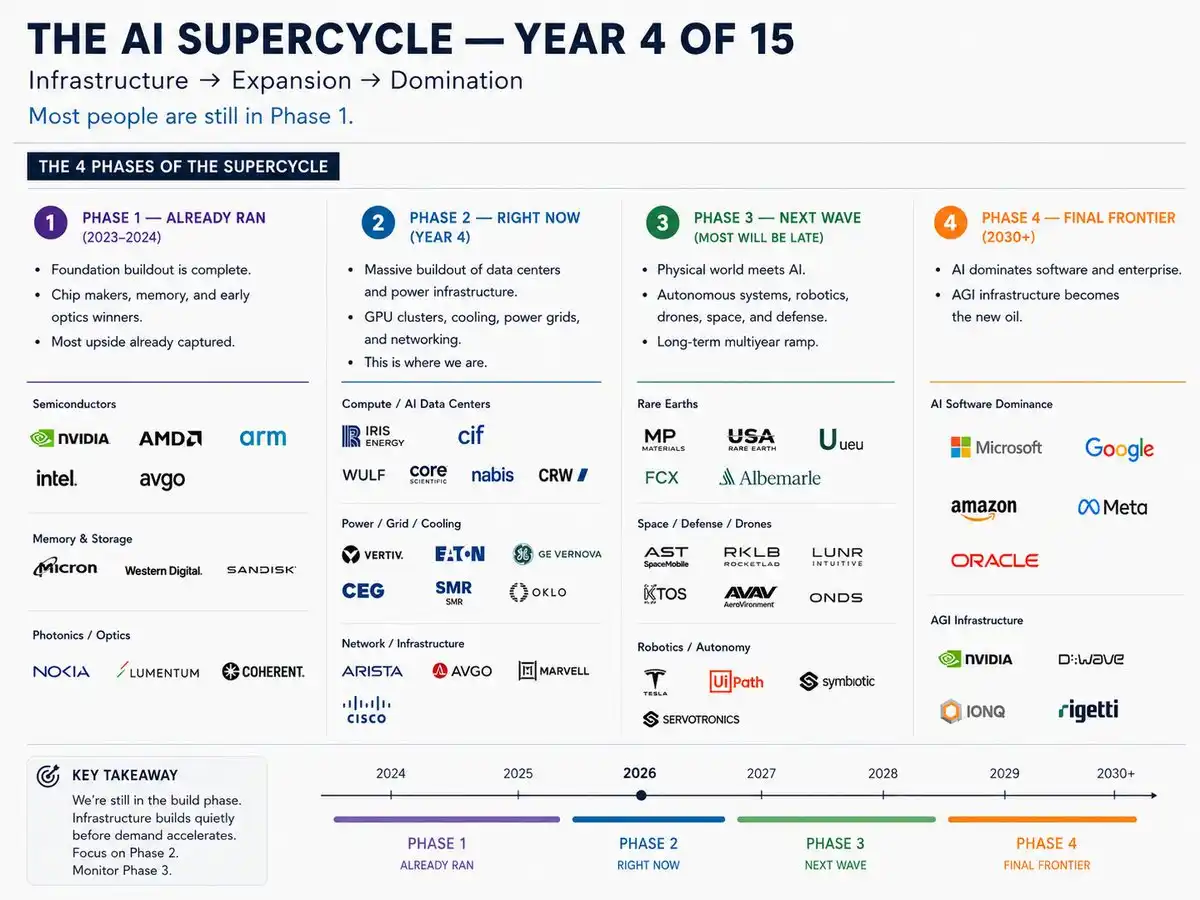
The AI supercycle will last 15 years. This is year three.

Most investors are still buying Stage 1 stocks, but smart money is already rotating into Stage 3.

I've broken the entire cycle into four stages, with the most important tickers labeled for each.

The AI supercycle is the biggest investment theme of this generation. Bigger than mobile internet, bigger than cloud computing. A 15-year structural shift that will reshape every industry in the global economy. Hyperscale cloud providers just committed $725 billion in capex for 2026, nearly double last year's. Microsoft, Google, Amazon, Meta — each over $100 billion individually.

This is not speculation.

🔴 Stage 1: Over (2023-2025)

The foundation layer is complete. AMD was up 78% in 2025, NVDA up 39%, Intel just delivered a blowout Q1, pushing the Philadelphia Semiconductor Index above 10,000 for the first time. Chips still drive every stage, but the historic entry opportunity is gone; the risk-reward has compressed.

Tickers: NVDA, AMD, ARM, INTC, AVGO, MU, GLW

Sectors: Semiconductors, Memory, Photonics/Optics

Status: Foundation complete, still growing, but priced in.

🟡 Stage 2: Buildout Peak (2025-2027)

The stage most investors are just waking up to. CEG acquiring Calpine to become the largest private U.S. power producer at 55 GW. GEV up over 200% in a year. VRT co-designing cooling for NVIDIA's Rubin architecture. GLW up 74% YTD on fiber demand. Nuclear SMR is the biggest dark horse — OKLO, SMR, BWXT are laying direct power lines for data centers.

Still upside, but the most obvious names have moved.

Tickers: CEG, GEV, VRT, VST, TLN, ANET, GLW, MOD, EQIX, OKLO, SMR, BWXT, NNE

Sectors: Power/Grid, Cooling, Networking, Nuclear SMR Buildout Peak

Note: Nuclear SMR is the hidden major opportunity.

🟡 Stage 3: Positioning Window (2026-2028)

The stage where AI leaves the data center and enters the physical world. Most will be late.

Tesla is converting its Fremont factory into an Optimus robot production line — $25 billion capex, targeting mass production in H2 2026. Rocket Lab posted a record $602M revenue, backlog at $1.85B. LUNR up 47% YTD with $943M in contracts. KTOS's Valkyrie drone selected by the Marine Corps.

The positioning window is open now.

Tickers: TSLA, RKLB, LUNR, KTOS, AVAV, PATH, ISRG, MP, FCX, ALB, ASTS

Sectors: Robotics/Autonomy, Space/Defense/Drones, Rare Earths

Judgment: The asymmetric risk-reward is here.

🟢 Stage 4: Endgame (2028+)

The endgame. Microsoft capex $190B, Alphabet $190B, Amazon $200B, Meta $145B. Google Cloud backlog exceeds $460B. They are building AI software dominance and AGI infrastructure. Quantum computing is early, but IONQ and D-Wave are laying the groundwork.

The platforms controlling the software layer win the entire supercycle.

Tickers: MSFT, GOOGL, AMZN, META, ORCL, IONQ

Sectors: AI Software Dominance, AGI Infrastructure, Decade-long thesis

Strategy: Buy the dips.

Key Conclusions

  • Stage 2 is confirmed (hyperscale $725B capex)
  • Stage 3 is where smart money is positioning — robotics, space, defense, nuclear
  • SMR is the core trade from 2026 to 2028
  • Most will rotate into these names 12 months late

A 15-year supercycle. Not a single trade. Stage 1 is over, Stage 2 is being priced, Stage 3 is where you should be.


Related Questions

QAccording to the article, what is the author's view on the duration and current stage of the AI supercycle?

AThe author believes the AI supercycle will last 15 years and is currently in its third year. The first stage (2023-2025) is already over, the second stage (2025-2027) is in progress, and the third stage (2026-2028) is where the most asymmetric opportunities lie.

QWhat sectors or 'stages' does the author identify as having the best asymmetric risk/reward opportunity right now?

AThe author identifies the third stage as having the best asymmetric risk/reward opportunity. This stage includes robotics/autonomous systems, space/defense/drones, and rare earths, with specific mentions of companies like Tesla, Rocket Lab, and Intuitive Machines.

QWhich specific sector within the 'construction boom' (second stage) is highlighted as a major hidden opportunity?

AWithin the second stage (the construction boom), the author highlights nuclear energy, specifically Small Modular Reactors (SMRs), as the major hidden opportunity. Companies mentioned include Oklo, NuScale Power (SMR), and BWX Technologies.

QWhat key metric is cited as evidence confirming the transition to the second stage of the AI supercycle?

AThe author cites the $725 billion in committed capital expenditure for 2026 by hyperscale cloud providers (Microsoft, Google, Amazon, Meta) as the key metric confirming the transition to the second stage. This amount is nearly double that of the previous year.

QWhat does the author suggest is the strategy for investing in the 'Endgame' (fourth stage) companies?

AFor the 'Endgame' or fourth stage companies (like Microsoft, Alphabet, Amazon, Meta), which control the AI software platform, the author's suggested strategy is to 'buy the dips,' indicating a long-term, patient accumulation approach.

Related Reads

380,000 Apps Exposed, 2,000+ Apps Leaked Secrets: AI Programming Turns 'Intranet' into Public Internet

Israeli cybersecurity firm RedAccess uncovered a severe data exposure trend linked to "vibe coding" or AI-powered software development tools. Their research found approximately 38,000 publicly accessible web applications built with platforms like Lovable, Base44, Netlify, and Replit. Of these, an estimated 2,000 apps exposed sensitive corporate and personal data, including medical records, financial information, internal strategic documents, and customer chat logs. In some cases, access even granted administrative privileges. The core issue stems from default privacy settings that make applications public by default, combined with a lack of built-in security controls (like authentication) in the AI-generated code. This allows employees without security expertise—"citizen developers"—to easily create and deploy applications that bypass standard corporate security reviews. The exposed apps, often indexed by search engines, are trivially discoverable. While some platform providers (Replit, Lovable, Wix/Base44) argue that security configuration is the user's responsibility and question the validity of some findings, security researchers confirm the widespread reality of such exposures. This pattern, also noted in prior studies, highlights a critical security gap as AI democratizes app creation, potentially leading to massive, unintentional data leaks.

marsbit58m ago

380,000 Apps Exposed, 2,000+ Apps Leaked Secrets: AI Programming Turns 'Intranet' into Public Internet

marsbit58m ago

Attracting Global Capital, Asia's New 'Super Cycle' Is Unfolding

Investors are turning to Asia as the next frontier for global equity growth, with a new "super cycle" unfolding across the region. Driven by the AI revolution, Asian markets, particularly South Korea, have seen significant rallies. According to Morgan Stanley analysis, the underlying drivers of Asia's industrial cycle are shifting from traditional sectors like real estate and manufacturing to massive investments in AI infrastructure, energy security and transition, and supply chain resilience. Fixed asset investment in Asia is projected to grow from around $11 trillion in 2025 to $16 trillion by 2030, with a 7% annual growth rate from 2026-2030. The AI wave is a primary catalyst, driving immense capital expenditure for chips, servers, data centers, and power systems. Asia is central to this hardware supply chain. In China, AI investment is focused on building a full-system domestic capability, with the local AI chip market potentially reaching $86 billion by 2030. Beyond AI, China's export story is expanding from EVs and batteries to robotics. The country already captures about half of new global industrial robot demand and over 90% of humanoid robot shipments. This growth phase mirrors the early stages of China's EV export boom. Simultaneously, energy security investments, spurred by AI's massive power needs, are rising, with China benefiting from its leadership in solar, batteries, and EVs. Regional defense spending is also increasing structurally, supporting demand for advanced manufacturing. The main beneficiaries are China, South Korea, and Japan, positioned in core supply chain areas. However, risks remain, including potential overcapacity, profit margin pressures from competition, persistent technological restrictions, geopolitical friction, and workforce displacement due to AI-driven automation. Market volatility is also expected to increase as investor expectations diverge on the realization of these capital investment and export themes.

marsbit59m ago

Attracting Global Capital, Asia's New 'Super Cycle' Is Unfolding

marsbit59m ago

Funding Weekly Report | 14 Public Funding Events, Kalshi Completes $10B New Funding Round at $220B Valuation Led by Coatue Management

Weekly Funding Roundup: 14 Deals and $10.49B+ in Total Funding, Led by Kalshi's $1B Round Last week (5.4-5.10) saw 14 notable funding events in the global blockchain ecosystem, raising over $10.49 billion in total. Key highlights include Kalshi, a prediction market platform, securing a $1 billion round led by Coatue Management, reaching a $22 billion valuation. The platform now boasts ~2 million MAUs and $178B in annualized trading volume. In DeFi, regulated on-chain reinsurer OnRe raised $5 million in Series A funding, and Bitcoin-backed credit protocol Saturn Credit completed a $2 million seed round. For Infrastructure & Tools, OpenTrade raised $17 million to expand its stablecoin yield infrastructure, and RWA platform Balcony secured $12.7 million to deploy its property settlement service in the US. Centralized Finance saw one deal: AI-driven trading platform Stockcoin.ai completed a seed round led by Amber Group. In the prediction market sector alongside Kalshi, AI-powered platform Elastics raised $2 million. Other notable deals include SC Ventures' strategic investment in crypto market maker GSR and Centrifuge securing a "seven-figure" investment from Coinbase to become a core RWA partner for Base. On the investor side, Haun Ventures raised a new $1 billion fund targeting crypto and AI, and Multi Investment raised ~$616 million to focus on blockchain and Web3 investments.

marsbit2h ago

Funding Weekly Report | 14 Public Funding Events, Kalshi Completes $10B New Funding Round at $220B Valuation Led by Coatue Management

marsbit2h ago

Trading

Spot
Futures

Hot Articles

Discussions

Welcome to the HTX Community. Here, you can stay informed about the latest platform developments and gain access to professional market insights. Users' opinions on the price of AI (AI) are presented below.

活动图片