This Week's Highlights
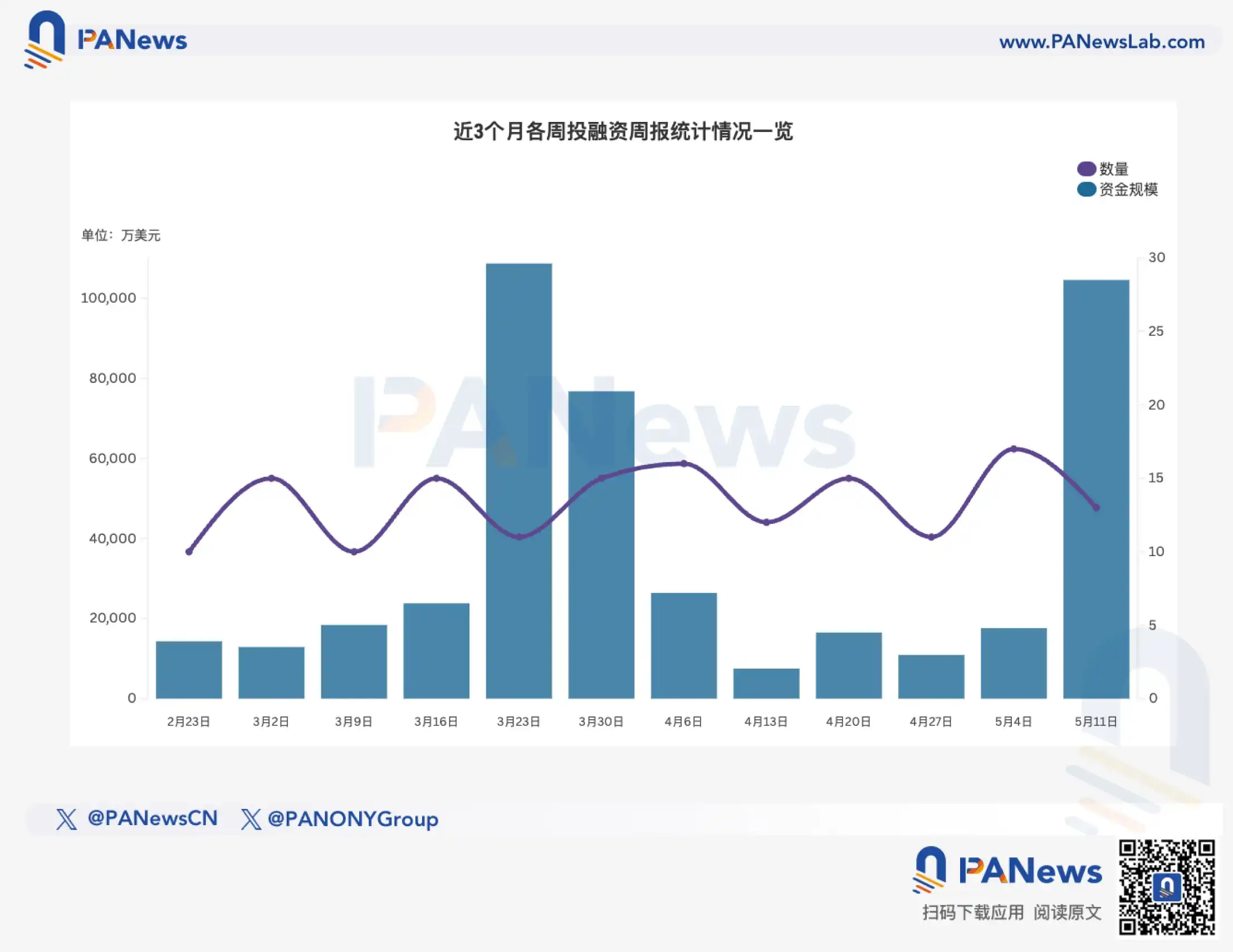
According to incomplete statistics from PANews, there were 14 investment and financing events in the global blockchain sector last week (5.4-5.10), with a total funding scale exceeding $1.049 billion. Overview as follows:
- DeFi sector announced 4 funding events, with on-chain reinsurance company OnRe completing a $5 million Series A round led by Forward Industries and Rockaway;
- Infrastructure & Tools announced 4 funding events, with OpenTrade completing a $17 million strategic financing round led by Mercury Fund and Notion Capital;
- Centralized Finance announced 1 funding event, with AI-driven stock and cryptocurrency futures trading platform Stockcoin.ai completing a seed round led by Amber Group;
- Prediction Markets announced 3 funding events, with Kalshi completing a $1 billion new funding round led by Coatue Management;
- Other Web3 application fields announced 2 funding events, with SC Ventures, the investment and fintech arm of Standard Chartered Bank, making a strategic investment in crypto market maker GSR.
DeFi
On-chain reinsurance company OnRe completes $5 million Series A funding led by Forward Industries and Rockaway
Solana treasury company Forward Industries announced that it, together with digital asset investment company RockawayX, co-led a $5 million Series A funding round for regulated on-chain reinsurance company OnRe. Forward plans to deploy up to an additional $25 million into ONyc, OnRe's yield-bearing token on Solana. According to the introduction, OnRe is a licensed collateralized reinsurance company and on-chain asset manager. ONyc provides exposure to a reinsurance risk portfolio, has been integrated into major Solana DeFi venues, and can be used as collateral for lending and looping strategies.
Bitcoin-backed digital credit protocol Saturn Credit completes $2 million seed round
Bitcoin-backed digital credit protocol Saturn Credit has completed a $2 million seed funding round led by The Spartan Group, with participation from Anchorage Digital and Susquehanna Crypto. It is reported that Saturn Credit is a stablecoin protocol built on Strategy company's STRC, launched in March 2026. Saturn Credit employs a dual-token system: USDat is a non-yield-bearing stablecoin, backed by tokenized U.S. Treasury bonds via M tokens, is licensed and pegged 1:1 to USDC; sUSDat is an ERC-4626 yield-bearing vault that accumulates STRC dividends, featuring a 3 to 7-day withdrawal queue.
Blockchain trading platform Ekiden completes $2 million seed funding round, with participation from Unicorn Factory Ventures, etc.
Blockchain trading platform Ekiden announced the completion of a $2 million seed funding round, valuing the company at $20 million. This round was led by Unicorn Factory Ventures and P2 Ventures, also attracting participation from angel investors who have previously invested in projects like GSR, Pyth, Aptos, LayerZero, and Cube Exchange. It is reported that Ekiden is dedicated to bringing institutional-grade trading on-chain, providing efficient and secure trading solutions through blockchain technology.
Tokenization infrastructure Centrifuge receives "seven-figure dollar" strategic investment from Coinbase
Coinbase announced a "seven-figure dollar" strategic investment in tokenization infrastructure company Centrifuge and designated it as the primary real-world asset (RWA) tokenization partner within its Base ecosystem. Under the collaboration, Centrifuge will serve as the core infrastructure provider for tokenizing traditional financial assets such as ETFs, credit funds, and structured products on the Base chain, handling asset tokenization, structure design, yield APIs, and compliance tools, and connecting to DeFi protocols to expand liquidity. Both parties stated that the long-term goal is to promote the tokenization of more financial assets, including stocks and potentially Coinbase's own equity (COIN), and build a scalable on-chain financial market system by combining exchange distribution capabilities with RWA infrastructure.
Infrastructure & Tools
OpenTrade raises $17 million to expand stablecoin yield infrastructure
London-based crypto startup OpenTrade has completed a $17 million strategic financing round led by Mercury Fund and Notion Capital, with participation from a16z crypto, AlbionVC, CMCC Global, etc., bringing its total funding to over $30 million. OpenTrade provides institutional-facing on-chain and real-world asset collateralized lending and stablecoin yield products and plans to use the funds to expand its infrastructure in both permissioned and permissionless scenarios. Its products include a permissionless protocol layer and the Curation+ yield vault curation framework, which can design yield strategies across RWA and on-chain assets for fintech companies, digital banks, treasuries, and asset issuers. OpenTrade stated that its total value locked has surpassed $200 million, it processed over $250 million in trading volume in 2025, and is projected to cumulatively exceed $1 billion by the end of 2026.
RWA blockchain platform Balcony completes $12.7 million seed round
Avalanche-based RWA infrastructure Balcony announced the completion of a $12.7 million seed funding round led by Blockchange Ventures. To date, its total funding has reached $14 million. The new capital will be used to deploy its platform for on-chain real estate trading and asset settlement services in the U.S. market, consolidating fragmented property records into tamper-proof digital registries while utilizing AI-powered detection technology to combat title fraud.
Enterprise blockchain infrastructure Antier Solutions raises $3 million in funding led by GVFL
Enterprise blockchain infrastructure company Antier Solutions announced the completion of a $3 million funding round led by GVFL. The new funds will be used to support the development of secure transactions, verifiable workflows, and institutional-grade blockchain infrastructure, expand deployments in government and financial institution (BFSI) sectors, and expand business in the US, Middle East, and Asia-Pacific markets.
Coinbase makes strategic investment in Kemet and integrates its derivatives trading onto institutional-grade execution platform
Coinbase announced a partnership with institutional-grade trading system provider Kemet to expand institutional clients' access to its multi-market trading ecosystem. Under the agreement, Kemet will integrate multiple Coinbase trading platforms, including Coinbase Exchange, Coinbase Derivatives Exchange, Coinbase International Exchange, and Deribit, enabling institutional users to execute unified trading and strategy management across spot, futures, and options within a single platform.
Concurrently, Coinbase Ventures will make a strategic investment in Kemet to support the long-term collaboration between the two parties in the field of institutional trading infrastructure. Coinbase stated that the goal of this partnership is to further solidify its position as a "core institutional trading platform," providing deeper liquidity integration and execution capabilities across spot, futures, and options markets, allowing institutional clients to directly access Coinbase's full product suite through the Kemet platform and optimize trading efficiency.
Prediction Markets
Prediction market platform Kalshi completes $1 billion new funding round at $22 billion valuation, led by Coatue Management
According to The New York Times, prediction market platform Kalshi has completed a $1 billion new funding round led by Coatue Management, reaching a latest valuation of $22 billion. This funding marks the company's third round in seven months, with valuation roughly doubling each round. A funding round last December had already made co-founders Tarek Mansour and Luana Lopes Lara paper billionaires. Kalshi claims to have about 2 million monthly active users, annualized trading volume has reached $178 billion, growing more than threefold over the past six months, with annualized revenue exceeding $1.5 billion. The company is seeking partnerships with large financial institutions for expansion, despite facing multi-state regulatory lawsuits and insider trading concerns regarding its sports and other contracts.
AI prediction market platform Elastics completes $2 million Pre-Seed round led by First VC
AI prediction market platform Elastics announced the completion of a $2 million Pre-Seed funding round led by First VC, with participation from angel investors from ElevenLabs, XBTO, RedStone, and a16z Scout Fund. According to the introduction, Elastics is building an AI-native operating system for prediction markets, where users can trade via natural language, executed automatically by AI agents.
Sports AI intelligence infrastructure platform Sportix raises $3.2 million with participation from Animoca Brands, etc.
Sports AI intelligence infrastructure platform Sportix announced the completion of a $3.2 million funding round. This round saw participation from institutions including Coinvestor Ventures, Animoca Brands, Becker Ventures, X21 Digital, and Alpha Capital. It is reported that Sportix is an intelligent platform built around sports events and athletes, aiming to integrate real-time data, AI prediction models, and market infrastructure into a unified ecosystem, providing users with structured and actionable sports intelligence. The funds from this round will be directly used to deepen the R&D of its AI aggregation engine, improve the accuracy of MIE and PIS, and scale its B2B API to empower a broader sports data ecosystem.
Centralized Finance
AI-native trading platform Stockcoin.ai completes seed funding round led by Amber Group
The AI-driven stock and cryptocurrency futures trading platform Stockcoin.ai has completed a seed funding round, this round led by Amber Group, with participation from angel investors in crypto and traditional finance. The platform focuses on bridging on-chain data and the stock market. According to disclosures, Stockcoin.ai will subsequently launch features for Hong Kong IPO subscription and US Pre-IPO access.
Other
Standard Chartered's SC Ventures makes strategic investment in crypto market maker GSR
SC Ventures, the investment and fintech unit of Standard Chartered Bank, has made a strategic investment in crypto market maker GSR. This investment makes SC Ventures the first external strategic shareholder in GSR since its founding in 2013. The investment amount has not been disclosed. It is reported that the transaction is based on a partnership established between the two parties last month. At that time, GSR invested in the tokenization platform Libeara, backed by SC Ventures, as part of its foray into the crypto capital markets.
Bitcoin reserve company Capital B announces completion of €1.1 million funding and adjusts convertible bond price to support Bitcoin strategy
Bitcoin reserve company Capital B announced the completion of €1.1 million in funding, provided by Blockstream CEO Adam Back subscribing to BSA 2026-02 equity subscription warrants. Concurrently, the company reduced the conversion price of the OCA B-04 convertible bond from €5.174 per share to €2.59 per share and added that each converted share will receive one two-year equity subscription warrant (BSA OC). This move aims to optimize the capital structure and accelerate the advancement of its Bitcoin reserve strategy.
Investment Institutions
Crypto investor Katie Haun's Haun Ventures completes $1 billion fundraising for new fund
Crypto investor Katie Haun's venture capital firm Haun Ventures has completed fundraising of $1 billion for a new fund, with capital to be equally allocated between early and late-stage investments. It is reported that the new fund will focus on investing in startups in crypto, AI, and alternative assets. Katie Haun was previously a partner at Andreessen Horowitz and founded Haun Ventures in 2022.
Multi Investment completes approximately $616 million fundraising, to increase investments in blockchain and Web3
Swiss investment firm Multi Investment announced the completion of a CHF 480 million (approximately $616 million) fundraising, with assets under management now exceeding CHF 3 billion. It aims to further advance its portfolio diversification strategy, focusing on high-growth areas such as fintech, deep tech, blockchain, and Web3. Multi Investment plans to increase investments in these strategic areas before Q3 2026, with multiple deals currently under evaluation, while also rapidly expanding its influence in related emerging ecosystems.
Global Millennial's fund completes $100 million fundraising, focusing on DeFi market investments
Global Millennial Capital (GMCL) announced that its first "IPO Opportunities Fund" has completed its final $100 million fundraising. Investors include family offices from Saudi Arabia, Kuwait, and Qatar, as well as international wealth management institutions. The fund will provide private placement investment opportunities in technology companies nearing liquidity events to professional and institutional investors. The fund primarily targets mid-cap technology companies with market capitalizations between $5 billion and $20 billion, focusing on areas such as artificial intelligence and DeFi technology, emphasizing companies with scalable business models, stable revenue structures, and mature governance systems. GMCL states that such mid-cap tech companies are in the pre-value release phase but are often overlooked by large funds and early investors. The fund's strategy will focus on participating in the critical stages before a company's IPO or strategic exit, while strengthening risk management and investment discipline.