Pantera Partner: In the Age of Agents, Blockchain is the Inevitable Answer for AI

marsbitPublished on 2026-06-02Last updated on 2026-06-02

Abstract

Summary: AI and blockchain are converging around four key pillars: payment settlement, identity systems, open systems, and resource aggregation, with commercial projects already emerging in each area. The two technologies are fundamentally complementary: AI enables infinite supply (content, agents), while blockchain establishes scarcity and verifiable ownership. AI agents generate content and services, and blockchain handles the verification and value settlement. A significant valuation mismatch exists, with leading AI companies historically overvalued compared to crypto assets, despite their deep underlying integration. The emergence of autonomous AI agents—which require assets, value transfer, and large-scale coordination—creates a need for a non-human-centric financial infrastructure. Blockchain, with its programmability, 24/7 access, and low-trust settlement, is the only suitable foundation. AI agents will not use traditional bank accounts or payment rails; they will transact using stablecoins and on-chain systems. Examples include OpenFX, which settles hundreds of billions in forex trades on-chain for AI agents, and Alchemy, a core development platform. For human identity verification in an age of AI-generated content, projects like World (Worldcoin) use blockchain-based biometric verification, while TransCrypts focuses on self-sovereign identity and verifiable credentials. The current divergence presents a unique investment opportunity. AI valuations are highly elev...

Original Author: Paul Veradittakit, Partner, Pantera Capital

Original Compilation: Saoirse, Foresight News

Content Summary

  • AI and blockchain are converging and landing around four pillars: payment settlement, identity systems, open systems, and resource aggregation. All four tracks have commercially viable projects, and Pantera's portfolio companies have deployments in all areas.
  • Their underlying logics are inherently complementary: AI represents infinite supply abundance (massive content, endless agents), while blockchain represents the scarcity of verifiable ownership (verifiable provenance, native on-chain settlement); the former generates content and services, the latter authenticates ownership and settles value.
  • There is a clear market valuation mismatch: the valuation of the ten leading AI companies tracked by Pantera shows the largest divergence in history from crypto asset valuations, yet their industrial foundations are deeply intertwined.
  • AI agents will not open corporate bank accounts, use Fedwire, or ACH clearing channels. Instead, they will rely on stablecoins to complete machine-speed transactions on-chain; the agent economy is being built on blockchain infrastructure that existing institutions have barely allocated to.

While global capital is currently focused on AI, AI is only half the story of industrial transformation. A new era-defining technological convergence is quietly taking shape at the intersection of AI and blockchain. Massive capital piled into primary and secondary markets has inflated AI company valuations, with many targets already in a valuation bubble; in contrast, the crypto sector is fundamentally undervalued, representing a premium opportunity to position for this long-term tech shift. Neither technology can reach its full potential alone; empowering each other is the core thesis. For years, the market has viewed AI and crypto as separate trends, but in essence, they are two landing paths for the same industrial wave.

AI has given rise to a new economic entity—autonomous agents. These entities need to hold assets, transfer value, and collaborate at scale, and crypto and blockchain are the only financial collaboration infrastructure designed from the ground up for non-human entities. Agents and programmatic bots are already native blockchain users, leading us to conclude that the vast majority of agent-driven transactions will occur on-chain in the future. The convergence of AI and blockchain is one of Pantera's strongest research and investment theses, and the team is dedicating significant resources and capital to this sector.

Technology Convergence Patterns from Industrial Development History

Throughout history, the collision of two leading technologies often catalyzes leaps in economic development: steam engines paired with railroads, electricity paired with manufacturing, the internet paired with smartphones. Each time, new technological capabilities combined with supporting infrastructure gave birth to entirely new economic models and enduring companies.

AI enables the mass production of intelligence, content, agents, and digital identities at near-zero marginal cost, bringing infinite supply; blockchain anchors scarcity, providing verifiable asset ownership, collaboration with minimal trust, and cryptographically secure data. As Dan Morehead and Cosmo Jiang stated in Pantera's latest blockchain research report, talent pools for both technologies highly overlap (rooted in math and open-source culture), and their underlying logics are complementary yin and yang: AI creates abundance, blockchain defines ownership.

Previously, at the Convergence Summit hosted by YZi Labs, I had an in-depth conversation with Alex Odagiu about this macro shift, discussing how AI agents can leverage blockchain for programmable trust, the utility value of stablecoins and asset tokenization, and the adoption timeline for the agent economy.
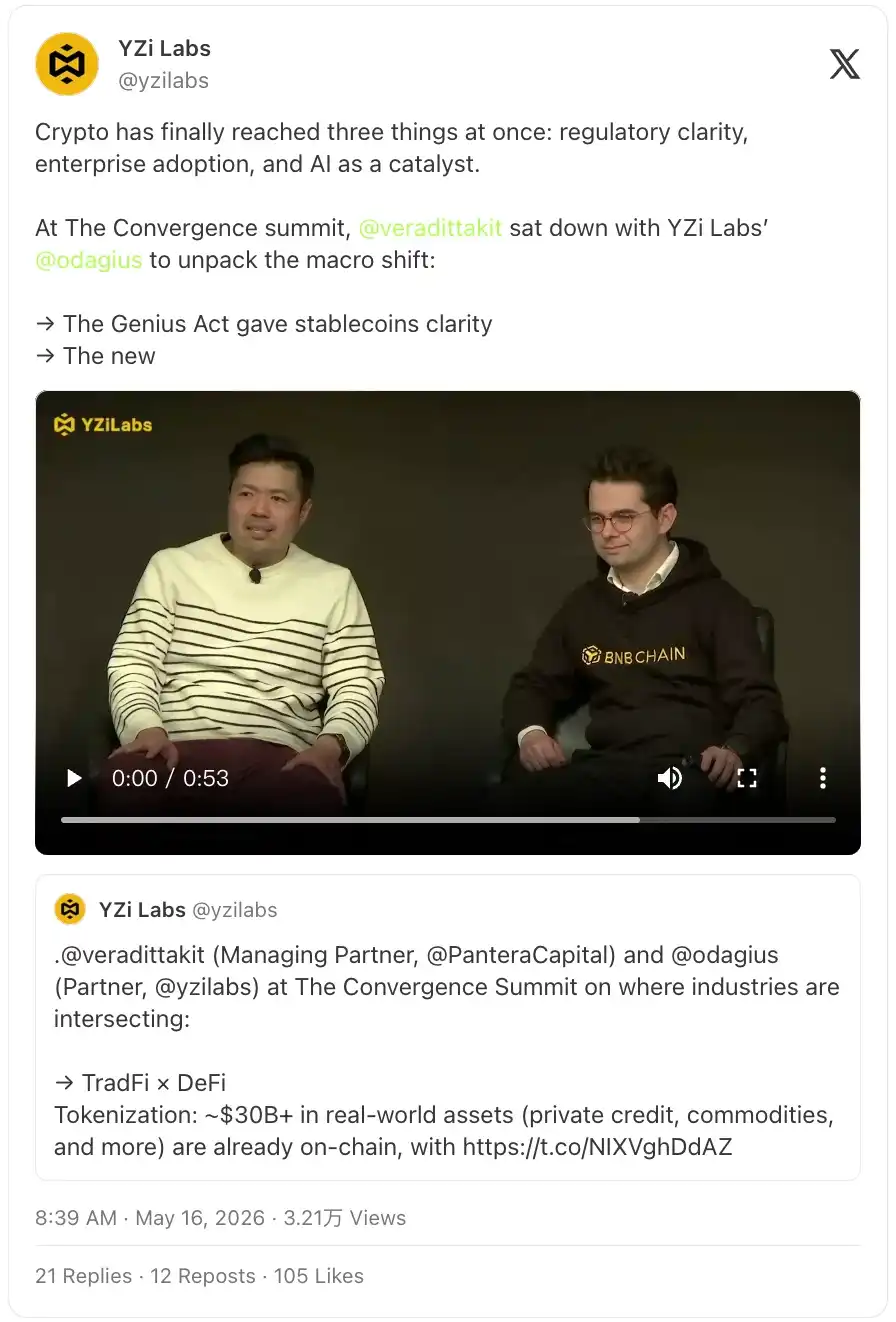
Source:YZi Labs Convergence Summit, May 2026

Current State of Convergence Applications

AI Agents Need a Native Financial System Built for Machines

The current financial system is designed for humans, with cumbersome approvals, limited access, and heavy reliance on centralized intermediaries. The industry urgently needs infrastructure tailored for agents, and blockchain is the optimal solution ready for scale.

Transaction and Payment Scenarios

Use cases are already live and validated. OpenFX uses stablecoins as its underlying settlement layer, with annualized transaction settlement volume exceeding $60 billion. The firm explicitly states: the next generation of users are not natural persons but software programs, and within a decade, AI agents will become the largest trading group in the forex market.

Agents cannot open bank accounts, access Fedwire, or the SWIFT system. They need low-cost, permissionless, 24/7, programmatically clearable payment rails, which are precisely blockchain's core strengths.

Another benchmark project, Alchemy, hailed as the AWS of Web3, is a core development platform for next-gen AI + crypto applications. From agent-specific wallets to on-chain execution layers, Alchemy significantly lowers the barrier for developers building agent infrastructure.

Human Identity Verification and Attestation Become Essential

In an environment flooded with AI-generated content and synthetic accounts, distinguishing real humans, programs, and AI-generated content has become essential. Traditional identity systems like passports, government records, and bank cards, built on centralized institutions, are unfit for the current landscape. The industry urgently needs a global, cryptographically secure, privacy-preserving, censorship-resistant online identity verification solution, and blockchain perfectly fits the bill.

World (formerly Worldcoin) is the leading project in this space, building a global, privacy-preserving identity and financial network based on a human identity attestation protocol, using cryptographic proofs to verify users as unique individuals:

  • Users verify via iris scanning using the World Orb biometric device;
  • Users obtain a World ID, with identity information hashed and stored on the Worldchain public blockchain;
  • The project has verified over 18 million unique real users, ranking among the top five most active public chains globally.

Its practical value is evident from enterprise partnerships disclosed in Pantera's latest Stateful podcast: Tinder uses it to combat fake accounts, Reddit uses it to filter real users, and Zoom integrates deepfake detection for video calls. OpenAI founder Sam Altman co-founded World, anticipating the massive identity fraud challenges his own AI technology would create.

We also invested in TransCrypts, which focuses on a self-sovereign identity and verifiable credentials blockchain base layer. Users can self-custody trusted records like education, employment, and income on-chain, preventing AI-forged identities and deepfake scams at the source. In the age of agents, programmable trust is becoming the industry standard.

AI Valuation Bubble, Crypto Assets Undervalued

AI sector valuations have surged, while crypto assets have corrected, creating a historically rare relative value investment window. As of May 2026, the leading AI index traded at a 49% premium to its four-year long-term trend line; Bitcoin's price traded at a 42% discount to its own historical long-term trend line. Even though the agent economy will ultimately run on crypto infrastructure, the degree of their valuation divergence has reached a historical extreme.
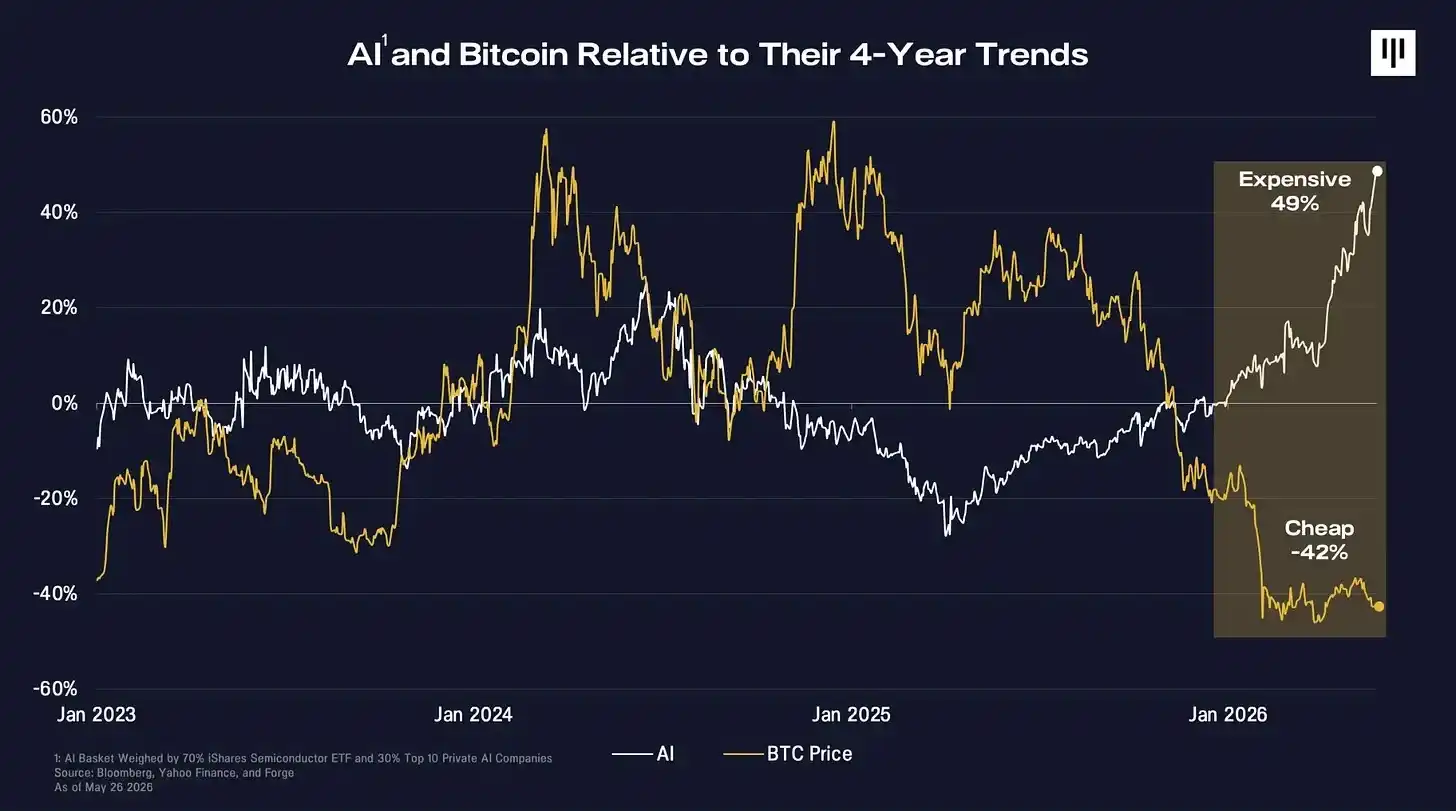
Bitcoin is Undervalued Relative to AI and its Trend

Investment competition in the AI and crypto crossover sector is intensifying. BlackRock's Robbie Mitchnick recently stated: AI agents will not use the traditional banking system; they will only use blockchain financial tools. Cryptocurrencies are the native currency of the machine intelligence era.

The Window for Industrial Adoption is Open

Entrepreneurs currently building in this space should know: the convergence of AI and blockchain is not a future trend, but a present reality being deployed. Agents require dedicated payment rails, decentralized identity verification systems, verifiable credentials, programmable money, and development infrastructure that treats agents as native users—none of which traditional finance can provide.

Underlying projects within Pantera's investment and research ecosystem, like Alchemy, World, TransCrypts, and OpenFX, are maturing. The global regulatory environment continues to improve favorably, and capital is gradually recognizing the valuation discount in the crypto sector. If you are working on agent-native finance, decentralized identity, attestation and provenance for AI-generated content, or autonomous system collaboration on-chain, now is the golden time to start. The industry is still early, underlying technology is ready, and market demand is exploding.


Trending Cryptos

Related Questions

QAccording to Pantera Capital partner Paul Veradittakit, what are the four main pillars where AI and blockchain are converging?

AThe four main pillars are payment and settlement, identity systems, open systems, and resource aggregation.

QWhat is the core complementary relationship between AI and blockchain's underlying logic as described in the article?

AAI represents the unlimited supply of intelligence, content, and agents, while blockchain represents the verification of scarcity through provable ownership and native on-chain settlement. AI is responsible for generating content and services, and blockchain is responsible for establishing ownership and value settlement.

QWhy does the article argue that AI agents (Agents) will primarily use blockchain infrastructure for transactions?

AAI agents will not open traditional bank accounts or use systems like Federal Wire or ACH. They require a low-cost, 24/7, permissionless, and programmatically accessible payment and settlement rail, which is the core strength of blockchain and stablecoins.

QWhat is World (formerly Worldcoin), and what problem does it aim to solve in the context of AI and blockchain fusion?

AWorld is a leading project building a global, private identity and financial network based on a human identity verification protocol. It uses biometric iris scans via the World Orb device to cryptographically prove a user is a unique human, creating a World ID to combat AI-generated fake identities and deepfakes.

QWhat current market phenomenon does the article highlight regarding the valuation of AI companies versus crypto assets?

AThe article highlights a significant valuation disconnect. As of May 2026, leading AI indices traded at a 49% premium to their four-year trend line, while Bitcoin traded at a 42% discount to its own long-term historical trend line, creating a historic relative value investment opportunity.

Related Reads

human.tech Launches Clean SDK for Privacy-First Web3 Apps

human.tech has launched the Clean SDK, a toolkit enabling developers to build privacy-first Web3 applications with transparent accountability. Released alongside Aztec's version 5, the SDK provides components for integrating zero-knowledge identity verification, sanctions screening, and private transactions, without developers handling sensitive user data or building compliance infrastructure from scratch. It uses zero-knowledge proofs and programmable verification to allow apps to confirm user legitimacy and sanctions compliance while keeping identities confidential. The first application built on the SDK, Shield, a privacy bridge to Aztec, also launched. It allows users to transfer assets privately while proving a unique human is behind each transfer and that funds have passed sanctions checks, as verified by a May 2026 audit. The SDK offers three core verification techniques: Proof of Innocence (sanctions screening against 23 sources), Proof of Personhood (simpler verification via Human Passport), and Proof of Clean Hands (higher-assurance zero-knowledge government ID checks). This allows apps to authenticate users and transactions without exposing personal data. Designed for Aztec builders, the SDK lets developers add programmable privacy to decentralized apps, eliminating the need to create their own verification and ZK infrastructure. Shield demonstrates its practical use for private bridges, but the SDK aims to enable a wider ecosystem of private, accountable financial apps and services. The launch addresses growing demand for infrastructure that balances privacy and accountability. The SDK avoids traditional identity databases, storing encrypted data off-chain, screening at both entry and exit points, and including a gated disclosure mechanism for legal requests. human.tech's products, including the Clean SDK, focus on using zero-knowledge technology to enable verifiable personhood and privacy in digital systems.

TheNewsCrypto25m ago

human.tech Launches Clean SDK for Privacy-First Web3 Apps

TheNewsCrypto25m ago

Unlocking $100 Million in Liquidity? Pump.fun's New Policy Tests the 5-Minute Pump Technique

Pump.fun, a popular meme coin launchpad, has introduced a new standard mechanism called BOOST. It aims to address a significant capital efficiency issue: when a newly launched token graduates from its initial bonding curve to a liquidity pool (LP), roughly 20% of its liquidity becomes permanently locked as "dead liquidity," estimated to waste over $100 million annually. Instead of locking these funds permanently, BOOST repurposes them. Upon a token's migration, approximately 20% of the settlement funds (e.g., 17.6 SOL or ~$2516 USDC) are used to buy back the token on the open market over a 5-minute period via a Time-Weighted Average Price (TWAP) mechanism. All purchased tokens are immediately burned. This creates a brief, systematic buy pressure immediately after migration, potentially generating a short-term price surge ("pump") while permanently reducing the token's circulating supply. The goal is to enhance the immediate post-launch trading experience, potentially increasing trader retention and sustainable protocol revenue, which funds ongoing token buybacks. However, concerns exist that this artificial 5-minute boost could lower the barrier for launching low-quality tokens and lead to steeper price crashes once the buy pressure stops, if followed by large sell-offs. The feature automatically applies to tokens migrating after July 21, 2024, but not to previously migrated tokens or those launched via the Mayhem AI Agent lab.

marsbit33m ago

Unlocking $100 Million in Liquidity? Pump.fun's New Policy Tests the 5-Minute Pump Technique

marsbit33m ago

Podcast Notes | Conversation with GSR Asset Management Head: To Determine if This Crypto Rally is Real, Just Watch the Lending Rates on Aave

Podcast Summary: Dialogue with GSR's Head of Asset Management: To Determine if This Crypto Rally is Real, Just Check Lending Rates on Aave Andy Baehr, Managing Director of Asset Management at GSR, discusses the current crypto market, characterizing it as stuck in a state of "ambivalence" with short-lived, unsustainable rallies. He outlines a simple framework: the market moves between "ambivalence" and "conviction" (sustained upward momentum). Currently, every rally resembles a single-stage rocket booster that quickly fizzles out. Baehr identifies three key signals to watch: 1) DeFi lending rates, 2) the potential passage of the CLARITY Act, and 3) the market forming a consensus on the "Fed hawkish peak." He emphasizes that the most immediate indicator for the sustainability of the recent CPI-triggered rally is the USDC borrowing rate on Aave, currently around 3.75%—close to U.S. Treasury yields. The absence of a credit spread indicates low leverage demand and a lack of market energy. He explains that a healthy, sustained rally requires layered buying pressure. Last year's rally progressed from an ETH short squeeze to crypto-native trader influx and finally to ETF inflows. Currently, this structure is missing. Other potential structural buyers like Digital Asset Treasury (DAT) companies are absent, and ETF flows have proven transient. Baehr notes that while small-cap crypto tokens outperformed large caps in Q2—a potential sign of capitation in major assets—capital is also flowing to more exciting opportunities like AI stocks and tech IPOs, leaving crypto sidelined. Regarding DeFi, he highlights that platforms like Aave provide a clear, real-time signal of leverage demand through their supply/demand-driven interest rates. A significant, sustained rate increase would signal genuine market conviction. He also observes the quiet emergence of fixed-income-like products and vaults in DeFi. On regulation, the probability of the CLARITY Act passing before the August 7th deadline has dropped linearly from 75% to below 40% on Polymarket. Baehr suggests its passage would be treated as a bullish surprise, a potent driver for price movement. However, political hurdles, including ethical clause debates and disclosures about the First Family's crypto profits, remain significant obstacles. Ultimately, the market awaits clarity on the Fed's terminal rate under Chair Warsh. Until the "Fed Solstice"—the point where the market collectively understands the peak of hawkish policy—sustained conviction will be difficult to achieve.

marsbit1h ago

Podcast Notes | Conversation with GSR Asset Management Head: To Determine if This Crypto Rally is Real, Just Watch the Lending Rates on Aave

marsbit1h ago

Trading

Spot

Hot Articles

Discussions

Welcome to the HTX Community. Here, you can stay informed about the latest platform developments and gain access to professional market insights. Users' opinions on the price of AI (AI) are presented below.

活动图片














