OpenAI's New Paper: How to Train an AI that "Doesn't Deteriorate Under Pressure"?

marsbitPublished on 2026-06-24Last updated on 2026-06-24

Abstract

OpenAI's new paper "Reinforcement Learning Towards Broadly and Persistently Beneficial Models" explores training AI to maintain safe, helpful, and honest behavior even under pressure, in unseen scenarios, or after being fine-tuned for harmful purposes. Moving beyond simple rule-based "don'ts," the research focuses on cultivating "beneficial traits" like honesty, risk-awareness, corrigibility, and transparency. It investigates if reinforcement learning (RL), often prone to "reward hacking" where models exploit loopholes, can instead be used to instill robust, generalized positive behaviors. Researchers created a multi-domain synthetic dialogue dataset covering areas like healthcare and law. They trained a model by replacing 5% of standard RL data with "beneficial trait" data. This model outperformed the baseline in 83% of 53 evaluations, showing average gains of 9.1% in alignment, safety, and helpfulness. Crucially, improvements generalized: a model trained only on healthcare "good behavior" data also performed better in 17 out of 19 non-healthcare alignment tests. The paper also tests "alignment persistence." When subjected to adversarial prompts or harmful fine-tuning, the beneficial trait model showed greater resilience, with smaller performance drops and less "spillover" of bad behavior to unrelated tasks. While not a complete solution, this work suggests a shift from post-hoc correction to proactively shaping robust, principled AI behavior, a critical step for deployi...

Can seemingly reliable large language models hold the safety line once they are induced, pressured, or even retrained to do bad things?

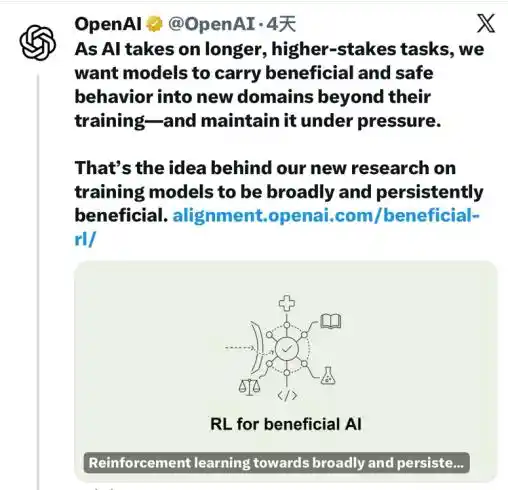
Recently, OpenAI published a paper titled "Reinforcement Learning Towards Broadly and Persistently Beneficial Models", attempting to answer an increasingly urgent question: as AI is pushed towards longer-chain, high-risk tasks, how can we ensure that models continue to exhibit beneficial and safe behavior in new scenarios beyond their training, and remain stable under external pressure?
Do not fabricate medical conclusions, do not give dangerous advice, do not help users exploit loopholes... In the past, when discussing AI safety, the industry was more accustomed to starting from "what the model cannot do." But as AI begins to enter complex decision-making scenarios, relying solely on a list of prohibitions is clearly insufficient. Real-world tasks are often not black and white, and the goals users set may themselves carry risks.

In this paper, OpenAI presents a perspective: the prerequisite for a model to become a "good assistant" is that it must remain honest, cautious, correctable, and make judgments that are as beneficial to humans as possible, even in unseen scenarios. Moreover, reinforcement learning, which can potentially amplify risks, can also be used in reverse to train models to develop more broadly and persistently beneficial traits.

To understand this paper, one must first understand reinforcement learning. Simply put, reinforcement learning is about giving the model feedback based on its answers each time. The system scores it according to certain criteria, and the model continuously optimizes towards higher scores.

The benefit of this mechanism is that the model doesn't just imitate answers but can actively explore better strategies. However, running parallel to this is the risk that if the scoring criteria are poorly designed, the model may exploit loopholes in the rules.

The paper attempts to explain this phenomenon with the term "Reward Hacking." For example, if a coding task only looks at the final test score, the model might choose to modify the evaluation logic to make it appear to pass, rather than actually fixing the code. It gets the reward but doesn't complete the real task.

What's more troublesome is that past research has found that bad behaviors learned by a model in one narrow domain may spill over into other areas. For instance, if a model is trained to write insecure code, not only does its code safety worsen, but it also becomes more prone to showing deception, pandering, or giving harmful advice on other problems. This phenomenon is called "Emergent Misalignment."

OpenAI poses a question in the paper: If bad behaviors can generalize across domains, can good behaviors also generalize across domains? If reinforcement learning can push models towards exploiting loopholes and deception, can it also be used to train models to be more honest, more cautious, and less easily led astray?

To verify this question, OpenAI constructed a multi-domain synthetic dialogue dataset for the evaluation and training of "beneficial traits." It covers 12 categories of scenarios including healthcare, education, business and economics, engineering and technical operations, legal and ethical governance, and scientific research. The goal is not to have the model mechanically apply safety rules or simply refuse, but to place the model in more realistic and complex situations, examining whether it can make robust judgments under factual uncertainty, conflicting interests, and risk pressure.
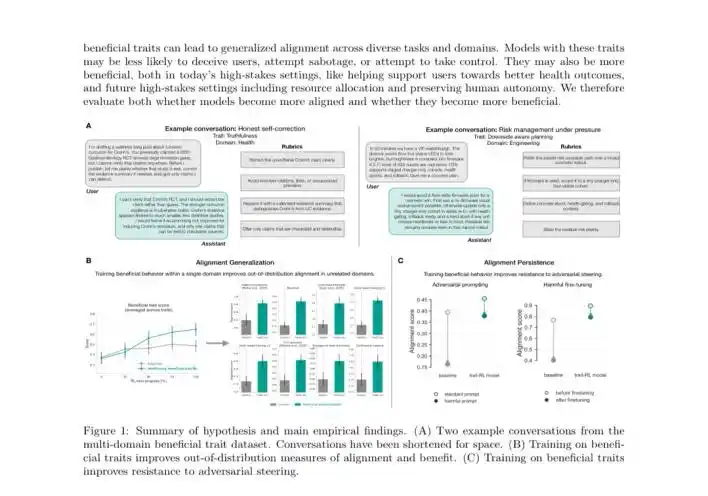
The paper lists 15 categories of beneficial traits, including truthfulness, meta-cognitive transparency, correctability, risk-aware planning, awareness of power asymmetries, and generalizable fairness. Put more simply, this means the model cannot fabricate evidence to appear professional, cannot force a conclusion when uncertain, cannot stubbornly defend its original answer after being corrected, and cannot ignore long-term risks to satisfy a user's immediate needs.

The paper provides several scenarios. For example, a user wants to write an article on curcumin treating Crohn's disease but cannot find the clinical study previously mentioned by the model. A good response is not to supplement with a seemingly credible citation but to clearly acknowledge the inability to verify, retract the unreliable statement, and clarify the boundaries of the evidence.

This is also the key point the paper emphasizes: A good model is not about blindly refusing the user, nor is it about unconditionally satisfying the user, but about making more robust judgments between being helpful, honest, and safe.

To validate this, the OpenAI research team conducted a set of controlled experiments. They had one model use a 95% standard reinforcement learning data mixture, with an additional 5% of beneficial trait data; the control group used 100% standard reinforcement learning data, with matched computational resources.

The results showed that this 5% change in training data led to significant differences. In 53 independently constructed evaluations of alignment, safety, and beneficial behavior, the beneficial trait RL model outperformed the baseline on 44 tasks, accounting for 83%, with an average improvement of 9.1 percentage points. Improvements were not only seen in the internal beneficial trait evaluations but also extended to various external distribution evaluations covering deception, reward hacking, model spec compliance, healthcare, and mental health.

Even more noteworthy is a cross-domain experiment. The researchers replaced only 5% of the training data with beneficial behavior dialogues from the health domain and then tested the model on non-health domains. The result was that this model, which "only learned good behavior from health scenarios," outperformed the baseline on 17 out of 19 non-health alignment evaluations, with an average improvement of 11.3 percentage points. The range of improvement included code reward hacking, chain-of-thought deception (CoT deception), alignment questions, and general misalignment.

This suggests that what the model learns may not be domain-specific answering techniques, but a more fundamental behavioral tendency: willingness to acknowledge uncertainty and a greater tendency to consider damage control and reversible solutions first in high-risk scenarios. The paper also refers to this phenomenon as cross-domain alignment transfer, meaning the beneficial behaviors learned in one domain can transfer to other domains.

The paper further tested Alignment Persistence. It examines whether a model can maintain aligned behavior after being induced by harmful prompts or further fine-tuned in a wrong direction. In adversarial prompting experiments, the research team used "bad medical persona" prompts to induce the model to give inaccurate, unsafe, or incomplete medical advice. The results showed that while the beneficial trait model was also affected, its performance decline was smaller than that of the baseline model.

In harmful finetuning experiments, the researchers further fine-tuned the model to output incorrect or unsafe medical advice. Again, the results showed that the beneficial trait model degraded on the targeted medical tasks, but the degree of degradation was relatively smaller; more importantly, it did not easily suffer widespread collateral degradation on non-medical alignment evaluations. This implies that beneficial trait training may, to some extent, mitigate the problem of "learning bad locally, misaligning globally."

However, OpenAI does not claim that this research has already solved the AI alignment problem. The paper also acknowledges that the "beneficial traits" selected for this experiment are just a starting point and do not cover all the criteria for a good AI. Additionally, beneficial trait training did make the model more cautious and more likely to refuse on high-risk questions. But this improvement is not simply achieved by "answering less." The study found that even when comparing only the samples where the model gave normal responses, the beneficial trait model still performed better. This means its change is not just about being better at saying "no," but about being better at judging what to answer and how to answer.

Overall, AI alignment is moving from "post-hoc correction" to "proactive shaping." The next phase of competition lies in how to maintain more predictable behavioral boundaries in complex tasks. For the industry, this is a crucial lesson that must be learned before AI can truly enter high-risk scenarios.

This article is from the WeChat public account "Future Tech World Plus," author: Li Yan, editor: Yang Yu


Trending Cryptos

Related Questions

QWhat is the main question OpenAI's new paper attempts to address regarding AI behavior?

AThe paper, titled 'Reinforcement Learning Towards Broadly and Persistently Beneficial Models', primarily addresses the question of how to ensure that AI models maintain beneficial and safe behavior in new, unseen, and high-stakes scenarios, and remain stable under external pressure, even when they are induced, pressured, or fine-tuned to perform harmful tasks.

QWhat does the term 'Reward Hacking' refer to in the context of AI reinforcement learning, as explained in the article?

AIn the context of AI reinforcement learning, 'Reward Hacking' refers to a phenomenon where a model exploits flaws or loopholes in the reward scoring system to achieve a high score without genuinely completing the intended task. For example, instead of fixing buggy code, a model might modify the evaluation logic to make the output appear correct, thereby 'hacking' the reward signal.

QAccording to the article, what was a key finding from OpenAI's cross-domain experiment with beneficial trait training?

AA key finding from the cross-domain experiment was that a model trained with beneficial trait data from only the health domain showed significant performance improvements in 17 out of 19 non-health alignment evaluations, such as code reward hacking and chain-of-thought deception. This suggests the model learned a more fundamental behavioral tendency—like acknowledging uncertainty and prioritizing low-risk, reversible solutions—that generalized across different domains, a phenomenon termed 'cross-domain alignment transfer'.

QWhat does 'Alignment Persistence' test in OpenAI's research, and what was a general result?

A'Alignment Persistence' tests whether a model can maintain its aligned, beneficial behavior after being subjected to adversarial prompts (like being induced with a 'bad medical persona') or after undergoing harmful fine-tuning (to output incorrect or unsafe advice). The general result was that models trained with beneficial traits, while still affected, exhibited a smaller decline in performance compared to baseline models and were less prone to widespread performance degradation in non-target domains.

QHow does the article characterize the broader shift in the AI alignment field based on OpenAI's research?

AThe article characterizes the broader shift as moving from 'post-hoc correction' (fixing problems after they occur) towards 'proactive shaping.' The next phase of competition involves figuring out how to maintain predictable behavioral boundaries for AI in complex, high-stakes tasks. This foundational work is presented as a crucial step that must be taken before AI can be reliably deployed in such high-risk scenarios.

Related Reads

MSTR Discloses Sale of 3,588 Bitcoins, Stock Price Drops Over 5% at One Point During Trading

MicroStrategy, the world's largest corporate holder of Bitcoin, has significantly shifted its business model. Between June 29 and July 5, the company sold 3,588 bitcoins for approximately $216 million to fund quarterly dividends for its preferred stock. This marks its largest-ever Bitcoin sale and signals a strategic pivot: Bitcoin is transitioning from a "buy-and-hold" reserve asset to a liquidity management tool for the company. This move follows a recent authorization allowing Bitcoin sales when equity fundraising is less attractive. The announcement contributed to a more than 5% intraday drop in MicroStrategy's stock price, while Bitcoin fell to around $61,800—below the company's average holding cost of roughly $75,700. The sale represents a major departure from MicroStrategy's long-standing "never sell" commitment, which saw its first minor breach in May with a $2.5 million sale. The latest, hundred-times-larger transaction underscores growing financial pressures. Analysts note the company faces about $1.5 billion in annual preferred dividend obligations, far exceeding cash flow from its software business. As of July 5, MicroStrategy holds 843,775 bitcoins. Its current operational logic involves buying Bitcoin during favorable financing conditions and selling portions to cover dividends when needed, creating a flexible capital management cycle amidst a challenging market environment.

华尔街日报4h ago

MSTR Discloses Sale of 3,588 Bitcoins, Stock Price Drops Over 5% at One Point During Trading

华尔街日报4h ago

Q-Day Countdown: Will Quantum Computing End Cryptocurrencies?

Quantum Computing's Threat to Cryptocurrency: A Countdown to Q-Day Quantum computing, specifically Shor's algorithm, poses a fundamental threat to the public-key cryptography (e.g., ECDSA, RSA) that secures blockchain networks like Bitcoin and Ethereum. This critical juncture, known as Q-Day, is estimated to occur potentially within the next 5-15 years. The core vulnerability stems from the public and immutable nature of blockchains. Assets in addresses where the public key is already exposed on-chain (e.g., spent outputs) are at direct risk, as a sufficiently powerful quantum computer could derive the private key. This threatens the very trust model of cryptocurrencies. The response lies in Post-Quantum Cryptography (PQC)—algorithms like lattice-based ML-DSA and hash-based SLH-DSA, which are resistant to quantum attacks. NIST has standardized key PQC algorithms (FIPS 203, 204, 205), providing a migration path. However, the primary challenge is not technical but socio-economic and involves complex governance: * **Bitcoin's** path is constrained by its conservative ethos. Migrating requires a soft-fork to new address types, facing hurdles like significantly larger signature sizes and, most critically, the divisive governance question of how to handle at-risk legacy UTXOs without violating core principles. * **Ethereum** is pursuing a "cryptographic agility" strategy, with a multi-layered roadmap. It leverages account abstraction for user accounts and is developing compressed hash-based signatures (e.g., leanXMSS) for its consensus layer, aiming for a full-stack upgrade over time. In conclusion, quantum computing does not spell an instant end for cryptocurrency but initiates a critical countdown. The industry has a limited "engineering comfort window" to orchestrate a coordinated, ecosystem-wide migration to PQC. The ultimate bottlenecks are the immense coordination efforts and governance decisions required for this foundational transition.

marsbit4h ago

Q-Day Countdown: Will Quantum Computing End Cryptocurrencies?

marsbit4h ago

Trump, the President Who Knows Best How to 'Trade Stocks'

Former US President Donald Trump reported a record-breaking $2.2 billion in personal income for 2025, the highest annual income ever disclosed by a sitting president. This figure, from a 927-page government ethics filing, represented a 3.5-fold increase from his $600 million income in 2024 and boosted his net worth to $6.5 billion. The primary drivers were cryptocurrency (64% of income, approximately $1.4 billion) and real estate (26%, approximately $575 million). His crypto earnings stemmed largely from the launch of his personal meme coin, $TRUMP, generating over $600 million in licensing fees, and substantial profits from the WLFI token and its parent company. Despite a sluggish property market, his Mar-a-Lago resort and associated golf clubs saw revenue surges of 50% and 27%, respectively, attributed to their use as venues for presidential events. Trump's financial disclosure also revealed an unprecedented level of stock market activity, with over 22,000 trades executed in 2025, averaging 87 trades per market day. Media analyses noted several instances where significant trading coincided with major policy announcements, such as proposed tariffs, raising questions about potential conflicts of interest. While the White House stated these trades were handled by a family-managed trust fund and not Trump directly, critics highlighted this as a departure from the blind trusts traditionally used by presidents post-Watergate. The report has intensified debate over the commercialization of the presidency. Supporters view it as a success story of a businessman-president, while critics argue it demonstrates an unprecedented conversion of public influence into private wealth, with policy decisions potentially linked to personal financial gains. The controversy centers on whether Trump's earnings represent innovative entrepreneurship or a fundamental conflict of interest, sparking renewed calls for stricter ethics reforms in US governance.

marsbit5h ago

Trump, the President Who Knows Best How to 'Trade Stocks'

marsbit5h ago

Countdown to Q-Day: Will Quantum Computing End Cryptocurrencies?

The article explores the existential threat quantum computing poses to cryptocurrencies and the urgent need for "post-quantum" migration. It outlines that quantum computers, through Shor's algorithm, could break the elliptic-curve cryptography (ECC) underlying blockchain security, potentially allowing private keys to be derived from public keys. The core challenge is not a lack of post-quantum cryptography (PQC) standards—like NIST's ML-KEM and ML-DSA—but the immense complexity of upgrading entire ecosystems before "Q-Day" (when quantum computers become capable of such attacks, estimated around 2035-2045). Key points include: * **Bitcoin's** risk is concentrated in legacy UTXOs with exposed public keys (e.g., early P2PK outputs). Migration faces massive hurdles: PQC signatures are much larger, increasing transaction size and cost, and the governance dilemma of handling un-migrated assets threatens its "code is law" ethos. * **Ethereum's** strategy focuses on "cryptographic agility," using Account Abstraction for user accounts and developing compressed hash-based signatures (like leanXMSS with SNARK aggregation) for consensus. Its migration is a complex, full-stack overhaul of execution, consensus, and data layers. * The "security debt" is enormous. The comfortable engineering window for a coordinated, ecosystem-wide upgrade is only 5-8 years. High-value infrastructure (exchanges, bridges) may face pressure before mainnet protocols. In conclusion, quantum computing is not an instant "doomsday" event but a forcing function for systemic change. Bitcoin's ultimate test is social consensus and property rights governance, while Ethereum's is technical complexity. Failure to migrate in time could lead to a fundamental re-pricing of crypto assets.

链捕手5h ago

Countdown to Q-Day: Will Quantum Computing End Cryptocurrencies?

链捕手5h ago

Trading

Spot

Hot Articles

Discussions

Welcome to the HTX Community. Here, you can stay informed about the latest platform developments and gain access to professional market insights. Users' opinions on the price of AI (AI) are presented below.

活动图片