OKX reports trading increase after expansion into US, EU

cointelegraphPublished on 2025-12-23Last updated on 2025-12-23

Abstract

Cryptocurrency exchange OKX reported a 53-fold increase in trading volume within its licensed and regulated markets in 2025, driven by its expansion into the United States and the European Economic Area. The exchange cited internal data showing daily active wallets doubled, with approximately 190,000 new wallets created daily. Global decentralized exchange volume surged 262%, while centralized trading rose 16%. The growth is attributed to OKX's licensed operating approach, including a MiCA license in the EU and entry into the U.S. market alongside regulatory developments like the GENIUS Act. OKX ranks as the fourth-largest global crypto exchange per CoinMarketCap. Additionally, major exchanges like Bybit, Coinbase, Kraken, and Gemini secured European licensing under MiCA. The U.S. stablecoin market, bolstered by the GENIUS Act, now exceeds $310 billion, dominated by USDT and USDC.

Crypto exchange OKX said volume in its licensed and regulated markets increased 53-fold in 2025, driven by its expansion into the United States and the European Economic Area.

Citing internal data, the exchange said daily active wallets doubled over the past year, with an average of about 190,000 new wallets created each day, while decentralized exchange volume on its platform rose 262% globally and centralized trading increased 16% over the same period.

The company attributed its market growth to an operating model focused on licensed access to regulated markets. OKX expanded across the European Economic Area in January after receiving a license under the EU’s Markets in Crypto-Assets framework, or MiCA.

In the United States, the exchange noted that its April market entry coincided with several positive regulatory developments, including the passage of the GENIUS Act and steps by the Office of the Comptroller of the Currency to charter crypto-native trust banks.

Data from CoinMarketCap place OKX fourth globally among cryptocurrency exchanges, using rankings that weigh factors such as platform traffic, liquidity, reported trading volume and confidence in volume authenticity.

In December, OKX was among several cryptocurrency exchanges blocked in Belarus after the Ministry of Information restricted access to their global websites, citing violations related to “inappropriate advertising” under the country’s Law on Mass Media.
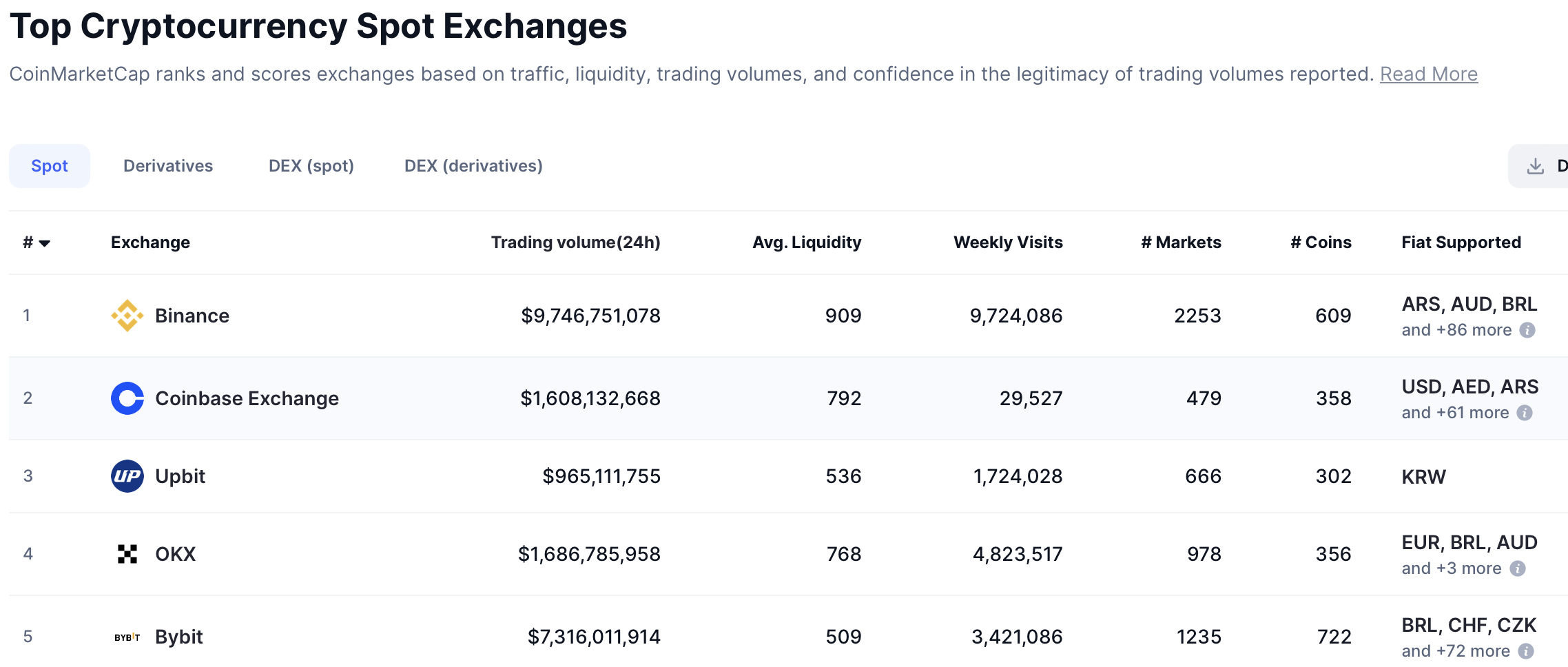
Top crypto spot exchanges. Source: CoinMarketCap

Related: OKX adds decentralized trading for US users as DEX volumes hit record high

Top exchanges secure licensing in Europe

The MiCA legislation created a single licensing regime for crypto service providers across the bloc and became fully applicable to exchanges in December 2024. Since then, several major platforms have moved to secure approvals that allow them to passport services across the European Economic Area.

In 2025, Bybit received authorization from Austria’s Financial Market Authority and established Vienna as its European headquarters, while Coinbase obtained a MiCA license a month later from Luxembourg and designated the country as its regional base.

Kraken followed with approval from the Central Bank of Ireland, building on earlier MiFID and electronic money licenses, and Gemini secured authorization from Malta’s Financial Services Authority in August, according to regulatory records.

In the US, the passage of the GENIUS Act in July established a federal framework governing stablecoin issuance and use. Since then, the stablecoin market has grown to more than $310 billion, with US dollar–backed tokens Tether’s USDt (USDT) and Circle’s USDC (USDC) together accounting for about 85% of total supply, according to data from DefiLlama.
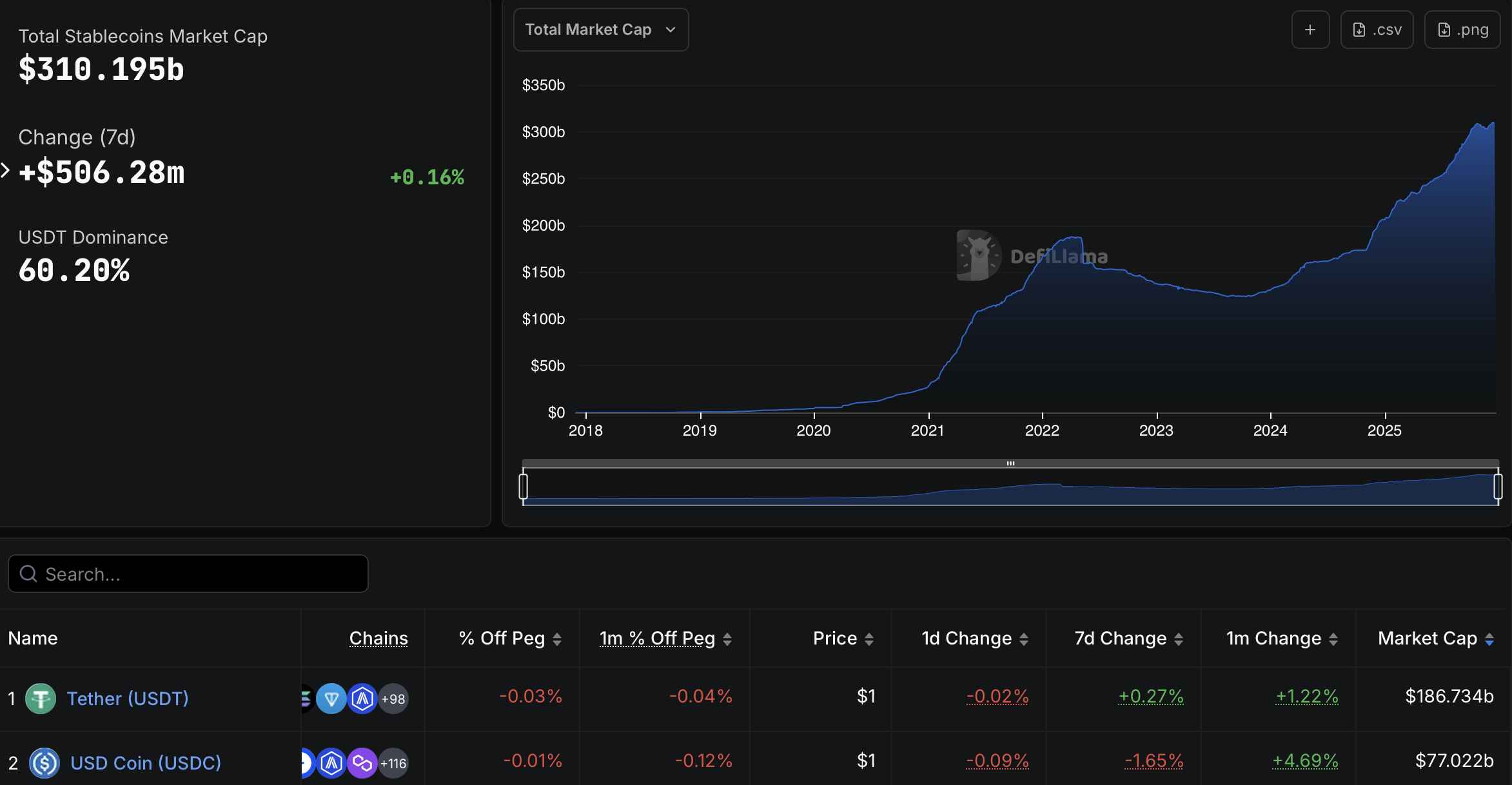
Stablecoin market cap. Source: DefiLlama

Magazine: Sei wallets in Xiaomi, Bhutan’s gold on Solana: Asia Express

Trending Cryptos

Related Questions

QWhat was the percentage increase in trading volume for OKX in its licensed and regulated markets in 2025?

AOKX reported a 53-fold increase in trading volume in its licensed and regulated markets in 2025.

QWhich two major regions did OKX expand into, leading to its significant growth?

AOKX expanded into the United States and the European Economic Area (EEA).

QWhat specific EU regulatory framework did OKX receive a license under for its expansion in Europe?

AOKX received a license under the EU’s Markets in Crypto-Assets (MiCA) framework.

QAccording to CoinMarketCap, what is OKX's global ranking among cryptocurrency exchanges?

AOKX is ranked fourth globally among cryptocurrency exchanges by CoinMarketCap.

QWhat was the name of the US federal act passed in July that established a framework for stablecoin issuance?

AThe GENIUS Act was passed in July, establishing a federal framework governing stablecoin issuance and use.

Related Reads

Buyback and Burn: Just Empty Promises? The Unbridgeable Rights Gap Between Tokens and Equity

"Token Repurchase and Burn: An Empty Promise? The Unbridgeable Rights Gap Between Tokens and Equity" Holding company stock grants shareholders residual claim rights - a legally enforceable entitlement to remaining assets after all other obligations are paid. This comes with rights like voting, dividends, and a share in sale proceeds. Crypto protocols have long promised token holders similar benefits: governance participation and a share of future growth. However, this narrative is fundamentally flawed and built on voluntary promises, not enforceable legal rights. The core difference is that token holders lack any legally enforceable claim to a protocol's underlying value or revenues. Common mechanisms like using protocol revenue to buy back and burn tokens are purely discretionary; the team can alter or stop the policy at any time. Token holders have no legal recourse. This rights gap becomes critically apparent when protocols introduce traditional equity alongside tokens, as seen with Venice AI's $65M funding round. Equity investors hold legal contracts with rights to company assets and profits, while token holders' benefits depend entirely on the continued goodwill of the protocol's management. The acquisition of Houdini Swap, where equity holders were paid while token holders received nothing, starkly illustrates this disparity. Upcoming legislation like the CLARITY Act threatens to eliminate the regulatory gray area that has allowed this ambiguous "pseudo-equity" narrative. The Act would classify tokens as either digital commodities (regulated by CFTC) or investment contract assets/securities (regulated by SEC). Protocols aiming for the "digital commodity" classification would be explicitly prohibited from granting token holders any legal claim to corporate revenue, profits, or assets. Promising that tokens will appreciate from protocol profits would likely classify them as securities. Projects like Aave are attempting technical solutions, such as its automated, on-chain "Aavenomics 3.0" buyback mechanism. However, this remains code that the governance body could still vote to change, not an immutable legal contract. The industry faces a clear fork: either acknowledge tokens as digital commodities and stop promising economic rights tied to corporate profits, or formally register tokens as securities and bear the associated compliance burden. The decade-long narrative equating tokens with ownership is built on unenforceable promises. The entry of traditional equity investors with real legal rights exposes this foundational weakness, which may unravel with the next major funding deal.

Foresight News1h ago

Buyback and Burn: Just Empty Promises? The Unbridgeable Rights Gap Between Tokens and Equity

Foresight News1h ago

Navigating the World of Event Trading: Top 5 Prediction Markets for Every Type of User

The prediction market industry has grown significantly, with trading volumes exceeding $20 billion monthly by mid-2026, driven by sports, politics, and macroeconomics. Success now depends heavily on platform choice and execution logistics. This guide compares five leading networks: **Polymarket**: A high-volume, decentralized platform on Polygon, using USDC for international and crypto-native users. It offers diverse markets but lacks built-in risk tools. **Kalshi**: A CFTC-regulated U.S. exchange for institutional traders, using direct fiat. It leads in regulated volume, especially for major sports and economic events, but has limited contract listings. **Outpoll**: A CeDeFi platform for advanced traders, focusing on professional tools. It uniquely features built-in stop-loss/take-profit orders, 0.1% fees, and full API support, with settlement in USDC. **OG Predictive**: A CFTC-regulated, sports-focused platform from Crypto.com. It offers granular player props and a flat fee structure, appealing to long-term position traders. **Manifold Markets**: A play-money, no-KYC platform for casual users and developers. It allows user-generated markets on any topic with zero fees, serving as a sandbox for strategy testing. Key differentiators include regulatory models (regulated vs. decentralized), funding (fiat vs. crypto), order types, risk management features, API access, and mobile support. The conclusion emphasizes that in today's event trading, profitability hinges not just on accurate predictions but on optimizing execution through platform infrastructure, liquidity, fees, and risk tools.

TheNewsCrypto2h ago

Navigating the World of Event Trading: Top 5 Prediction Markets for Every Type of User

TheNewsCrypto2h ago

Trading

Spot

Hot Articles

How to Buy US

Welcome to HTX.com! We've made purchasing Talus Network (US) simple and convenient. Follow our step-by-step guide to embark on your crypto journey.Step 1: Create Your HTX AccountUse your email or phone number to sign up for a free account on HTX. Experience a hassle-free registration journey and unlock all features.Get My AccountStep 2: Go to Buy Crypto and Choose Your Payment MethodCredit/Debit Card: Use your Visa or Mastercard to buy Talus Network (US) instantly.Balance: Use funds from your HTX account balance to trade seamlessly.Third Parties: We've added popular payment methods such as Google Pay and Apple Pay to enhance convenience.P2P: Trade directly with other users on HTX.Over-the-Counter (OTC): We offer tailor-made services and competitive exchange rates for traders.Step 3: Store Your Talus Network (US)After purchasing your Talus Network (US), store it in your HTX account. Alternatively, you can send it elsewhere via blockchain transfer or use it to trade other cryptocurrencies.Step 4: Trade Talus Network (US)Easily trade Talus Network (US) on HTX's spot market. Simply access your account, select your trading pair, execute your trades, and monitor in real-time. We offer a user-friendly experience for both beginners and seasoned traders.

5.3k Total ViewsPublished 2025.12.11Updated 2026.06.02

How to Buy US

Discussions

Welcome to the HTX Community. Here, you can stay informed about the latest platform developments and gain access to professional market insights. Users' opinions on the price of US (US) are presented below.

活动图片