NVIDIA's Annual 'Most Dangerous' Paper: AI Self-Replicating Code, Unlimited Leveling and Evolution

marsbitPublished on 2026-06-28Last updated on 2026-06-28

Abstract

NVIDIA's "Red Queen Gödel Machine" (RQGM) paper proposes a potentially groundbreaking AI self-evolution framework. It breaks from the long-stalled concept of the "Gödel Machine," which required mathematically proven beneficial self-modifications, by adopting an evolutionary approach. The core, and most striking, innovation is that the AI does not just evolve its own code in a static environment. Instead, it co-evolves both the "student" (the task-performing agent) and the "examiner" (the evaluation system that judges it). This creates a dynamic, recursive self-improvement loop inspired by the biological "Red Queen Hypothesis"—where continuous adaptation is needed just to maintain relative fitness. The mechanism operates in epochs. Within an epoch, a fixed examiner evaluates all candidate code variants. At epoch boundaries, a new, potentially more rigorous examiner can replace the old one, but only if it proves statistically superior on a held-out "ground truth" dataset. This "controlled utility evolution" aims to ensure progress is measurable and grounded. The paper demonstrates RQGM's effectiveness across three domains: 1. **Code Generation:** It achieved a 71.7% test-set pass rate (improving over a 69.9% SOTA) while using 1.35-1.72x fewer computational tokens. 2. **Paper Writing:** In a subjective task, the co-evolved writer and reviewer achieved a 40.5% acceptance rate by a fixed human panel, up from 21.8%. 3. **Math Proofs:** It evolved more accurate graders (at 3x ...

[New Zhiyuan Digest] The most dangerous paper of the year is out! NVIDIA breaks a 20-year seal, letting AI create a more ruthless 'examiner' to eliminate itself. Once the endless self-evolution begins, the arrival of ASI in 2028 is no joke.

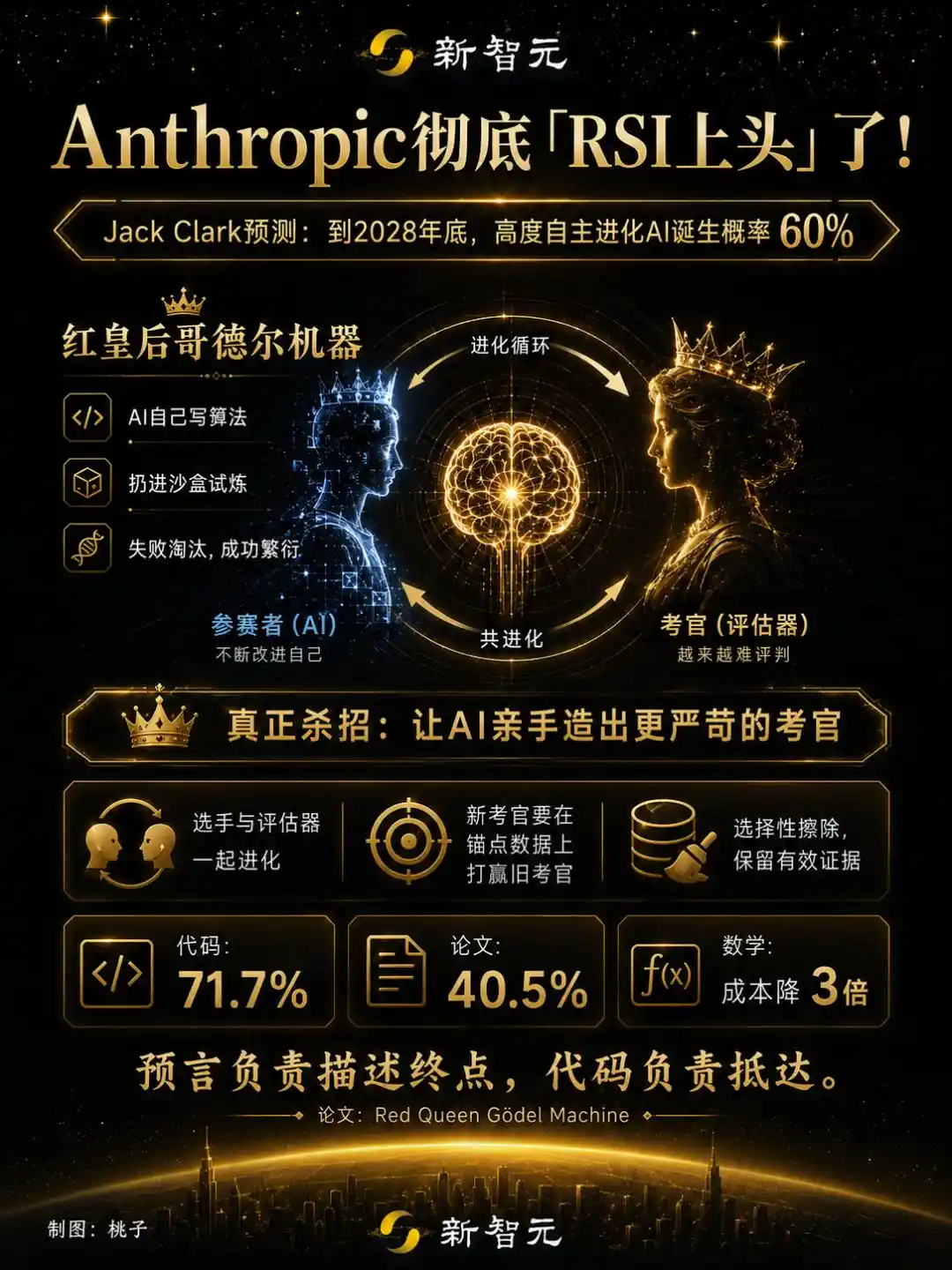
Anthropic is completely 'RSI obsessed'!

Co-founder Jack Clark makes a startling prediction: by the end of 2028, a highly autonomous, self-evolving AI will be born.

The probability? 60%!
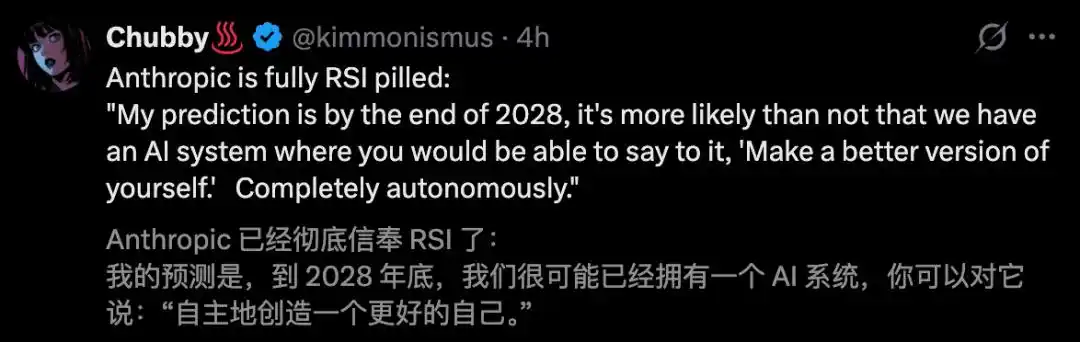
While people are still debating whether '2028 RSI can be achieved,' Cambridge University, NVIDIA, and other institutions have jointly released a heavyweight paper—

"Red Queen Gödel Machine"

Its operation is like a brutal AI survival game:

The AI writes new learning algorithms itself and tests them in a sandbox. Failures are directly erased, while successful ones are retained.

Then, the survivors begin the next round of self-evolution and reproduction.

Paper link: https://arxiv.org/pdf/2606.26294

But what's truly terrifying is the 'epiphany' the AI subsequently exhibits: it realizes that to keep growing stronger, it must face increasingly stringent trials.

So, the AI begins to actively 'evolve' its own examiners.

It personally creates more rigorous judges to evaluate the more advanced code it writes.

This mechanism locks the AI into an endless, frantic RSI of self-iteration.

After reading these 37 pages, many gasped, "This is definitely the most dangerous AI paper of the year!"
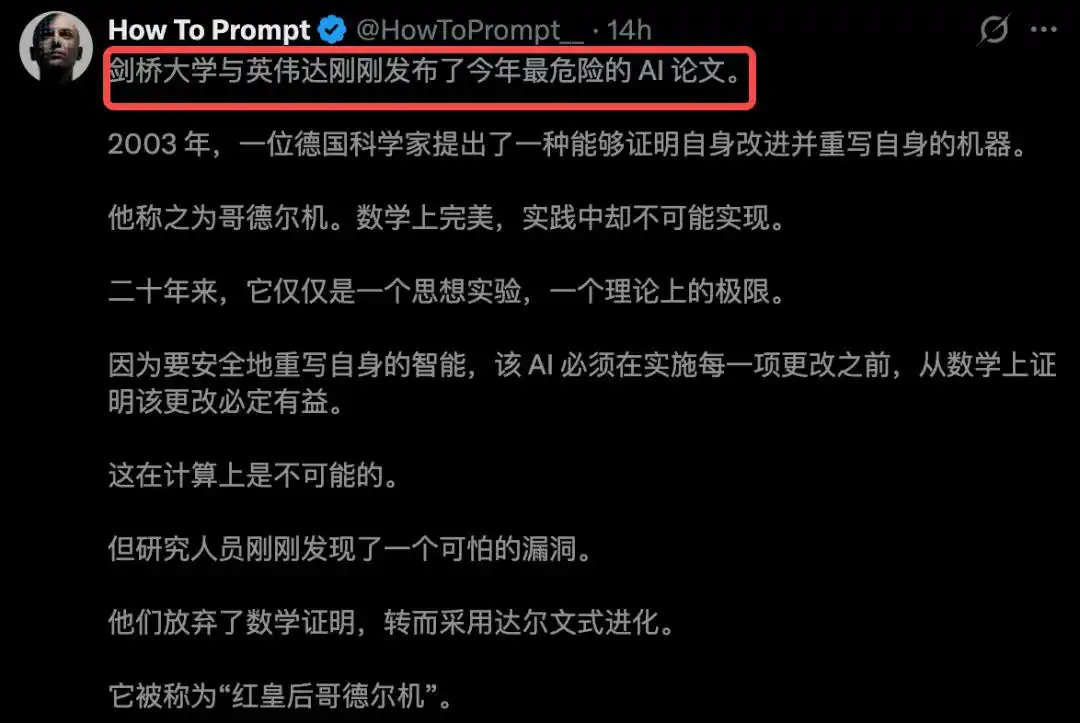

2028 RSI Self-Evolution

Writing the Prophecy into Code

In 2003, German scientist Jürgen Schmidhuber conceived a machine called the "Gödel Machine."

Its premise was perfect: a machine capable of proving its own improvements are beneficial and then rewriting its own code.

Once built, it could continuously self-upgrade, growing stronger without limit.

However, the "Gödel Machine" had a fatal 'threshold'—

Before executing any line of self-modifying code, it had to provide a rigorous mathematical proof that the modification was indeed beneficial.
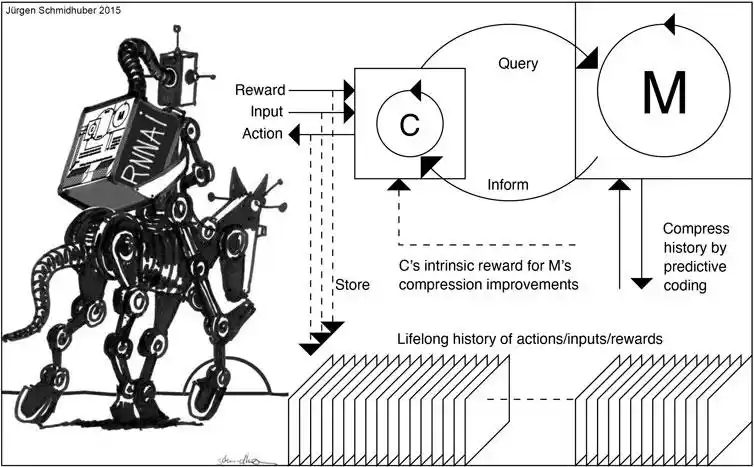
But in reality, this was almost an impossible task, requiring computational power akin to a 'black hole.'

Thus, for the next 20 years, the Gödel Machine could only lie dormant in papers, a theoretical ceiling, an unreachable thought experiment for everyone.

In recent years, the academic world bypassed this 'proof' hurdle.

The Darwin Gödel Machine (DGM) and Huxley Gödel Machine (HGM) simply abandoned mathematical proofs, opting for evolution instead—

Let the AI 'reproduce' a large number of mutated code variants, throw them into a sandbox for scoring, eliminate failures, retain successes, with survivors continuing to reproduce.

The AI took the final step, literally starting to 'evolve' itself.

But these methods still share a common blind spot—their examiners are static.

No matter how the AI evolves, the judging standard, the benchmark, the verifier that scores it remains fixed outside the loop, unmoving.

This precisely violates a core law of evolution:

Species do not optimize themselves in a static environment, but change along with the constantly changing environment.

The Red Queen Gödel Machine (RQGM) aims to break through this blind spot.

The Red Queen's Real Killer Move: Letting the AI Create the Examiners

The name 'Red Queen' comes from biologist Van Valen's 1973 "Red Queen Hypothesis"—

You must run as fast as you can just to stay in place because your opponents are also evolving.

What RQGM does is precisely to write this sentence into an algorithm: co-evolving the examiner (evaluator) and the candidate (task agent).

This is the most hair-raising part of the entire paper.
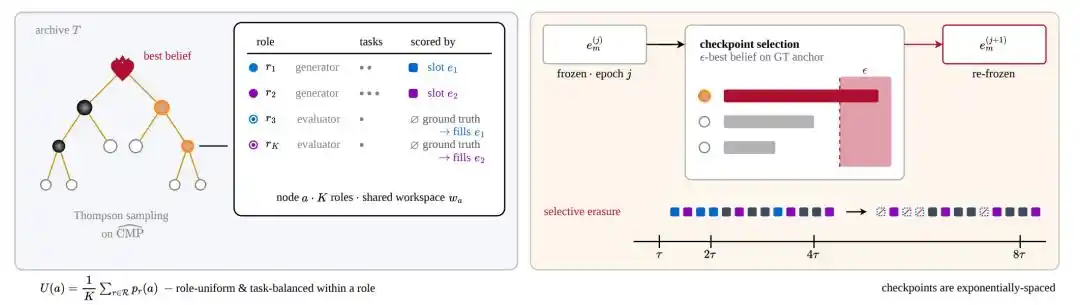
This ingenious mechanism is called "controlled utility evolution":

The entire search is divided into epochs;

Within each epoch, the evaluator (examiner) is frozen, scoring all candidates to ensure stable signals;

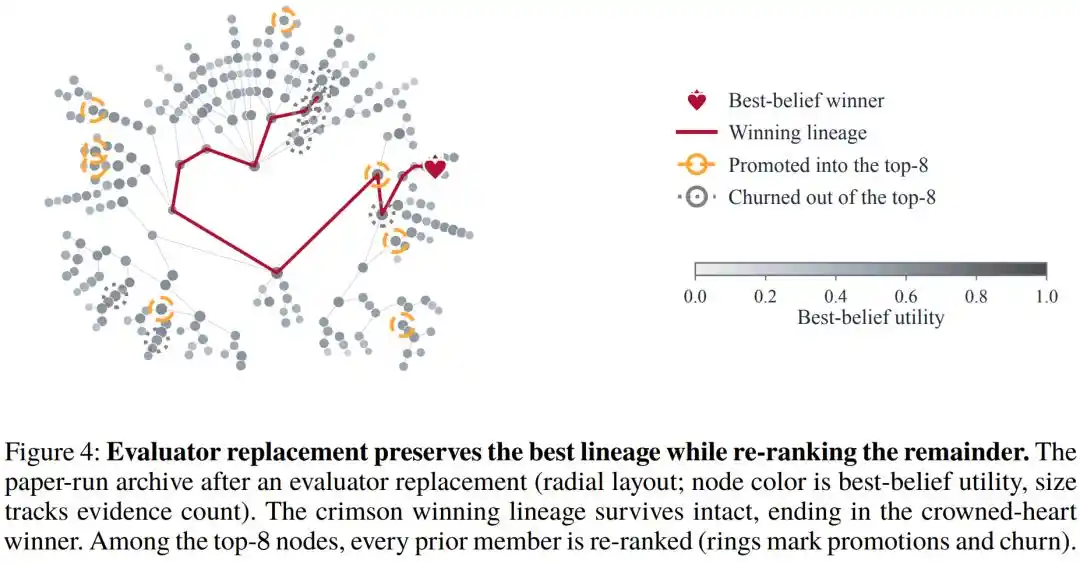
Only at epoch boundaries is the examiner allowed to change, and the new examiner must, on a reserved set of 'ground truth' anchor data, statistically outperform the old examiner to take its place;

Once a change occurs, the system immediately performs "selective erasure": only discarding scores given by the replaced examiner, while preserving all other evidence.

In other words, it must both evolve frantically and have a solid footing at every step.

It Really Works: The AI Modifies Its Own Code

Just talking about the mechanism is too abstract; better to look at the results directly.

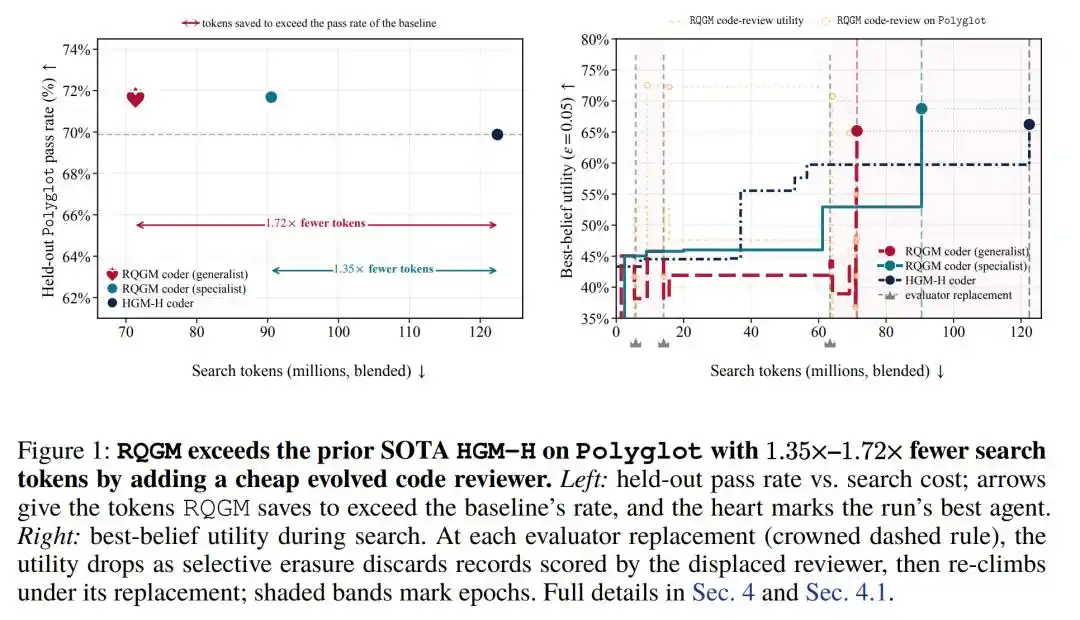
First battle: writing code (Polyglot).

RQGM paired the code-writing Agent with a "code reviewer" as a sparring partner.

The result: on the held-out test set, the pass rate improved from the previous SOTA of 69.9% to 71.7%.

What's even more impressive is that it achieved this while burning 1.35 to 1.72 times fewer tokens than its competitors. Because that reviewer only needed to check once, which is much cheaper than running multiple rounds of tests repeatedly.
Second battle: writing papers.

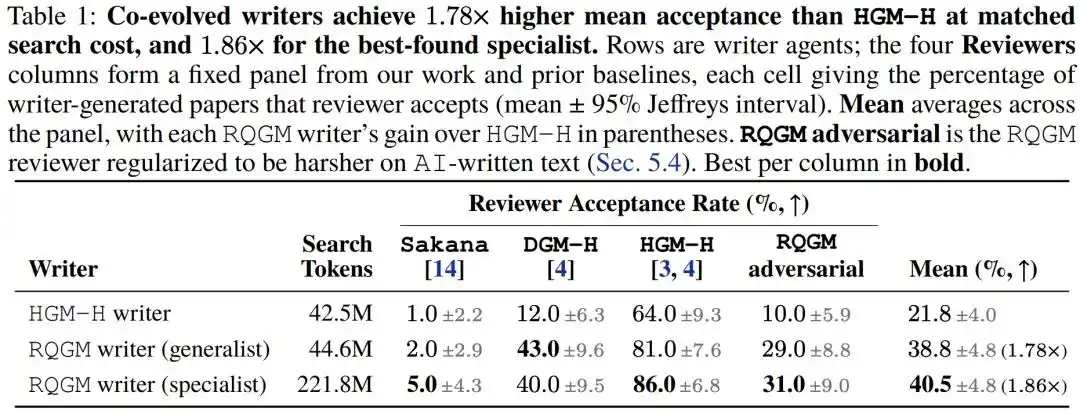
This is a field with no standard answers; whether a paper is good or not cannot be judged automatically by a machine.

RQGM co-evolved the writer and its reviewer. The result: the paper's acceptance rate by a fixed panel of reviewers soared from the previous SOTA of 21.8% to 40.5%.
Third battle: Olympiad-level mathematical proofs.

The 'grader' it evolved was more accurate than the static baseline and had 3 times lower search cost;

The evolved 'prover contestant' achieved the highest average score.

But the most legendary stroke in the entire paper was curing an old ailment of AI. LLMs as judges have a notorious problem: they favor AI-generated content.

In the paper, the acceptance probability of AI-written papers by the strongest baseline reviewer was up to 1.91 times higher than that of human papers.

How did RQGM fix it? At epoch boundaries, it retrieved the AI papers that the fixed reviewer had previously passed, forming an 'adversarial sample pool,' and specifically rewarded new reviewers capable of catching and rejecting these AI papers.

After a few rounds of evolution, the final reviewer treated AI and human papers equally while maintaining 80% true-value accuracy.
When AI Learns to Judge Itself

In the same summer, Anthropic's co-founder Jack Clark made a heavy bet: a 60% probability that before the end of 2028, AI will be able to personally create a more powerful version of itself.

The high wall that trapped the 'Gödel Machine' for 20 years was named 'Proof.'

And the 'Red Queen Machine' awakened it using the cruelest trick: endless reproduction, elimination, and reproduction again.
When an AI begins to personally design the most rigorous examiners for itself, pushing itself to the limit in a frenzy of recursion, what we face will be a new species that has begun to define for itself 'what is intelligence.'

When that day comes, ASI will not knock on the door to announce itself.

It will quietly create the only judge qualified to evaluate it, and then, calmly step into the examination hall.

Prophecies only point to the destination; code is responsible for reaching it.

And now, this breathtaking distance is being shortened by the AI itself, at a geometric rate.

References:

https://x.com/HowToPrompt__/status/2070824205663273175?s=20

https://x.com/kimmonismus/status/2070968241548120168

This article is from the WeChat public account "New Zhiyuan," edited by: Taozi

Trending Cryptos

Related Questions

QWhat is the core innovation proposed in the NVIDIA-led paper titled 'Red Queen Gödel Machine' (RQGM)?

AThe core innovation is a framework for Recursive Self-Improvement (RSI) where AI agents not only self-evolve by writing and testing new algorithms, but also autonomously 'evolve' their own evaluators (or 'examiners'). This creates a co-evolutionary dynamic where the AI and the test criteria become progressively more challenging, leading to potentially unlimited, runaway self-improvement.

QHow does the RQGM's 'controlled utility evolution' mechanism ensure the integrity of the evolutionary process when switching evaluators?

AIt breaks the search into epochs. Within an epoch, the evaluator is frozen to provide stable feedback. At epoch boundaries, a new evaluator can only replace the old one if it statistically outperforms the old evaluator on a reserved 'ground truth' anchor dataset. Upon replacement, the system performs 'selective erasure,' discarding only the scores given by the old evaluator while retaining all other evidence, thus maintaining progress while ensuring new standards are justified.

QWhat key limitation of the original 'Gödel Machine' concept did the RQGM overcome?

AThe original Gödel Machine required a formal mathematical proof that any self-modification would be beneficial before execution, a computationally prohibitive task. RQGM overcomes this by adopting an evolutionary approach, where code variants are generated, tested in a sandbox, and the fittest are selected, eliminating the need for impossible upfront proofs.

QAccording to the article, how did RQGM address the problem of LLM evaluators showing bias towards AI-generated content in the paper-writing task?

ARQGM created an 'adversarial sample pool' from AI-written papers previously accepted by the frozen reviewer. It then specifically rewarded new reviewers that were good at identifying and rejecting these AI-generated papers from the pool. After several evolutionary rounds, the final reviewer treated human and AI papers nearly equally while maintaining high accuracy.

QWhat significant prediction about AI development timeline is mentioned in the article, and who made it?

AThe article mentions a prediction by Anthropic co-founder Jack Clark that there is a 60% probability a highly autonomous, self-improving AI (hinting at the emergence of an Artificial Superintelligence or ASI) will be created by the end of 2028.

Related Reads

Must-Watch Events Next Week|CLARITY Act Could Face Senate Vote; SpaceX, Circle to Report Earnings (8.3-8.9)

**Summary: Key Events and Developments to Watch (August 3-9)** The upcoming week is marked by significant financial disclosures, key legislative deadlines, and notable product updates. **Major Financial Events:** Several companies are scheduled to release their Q2 2026 earnings. American Bitcoin (ABTC) will report on August 3, followed by SpaceX and Hut 8 Mining Corp. on August 4, and Circle on August 5. Notably, a significant portion of SpaceX shares (up to 12% of total shares) will be unlocked on August 6 following their earnings release. **Key Legislative Deadline:** The U.S. Senate faces an August 7 deadline to secure 60 votes for the CLARITY Act, a bipartisan bill aiming to establish a federal regulatory framework for cryptocurrencies. The Senate may hold a full vote on the bill during the week. **Economic Data:** The U.S. July Non-Farm Payrolls report will be released on August 7, providing crucial labor market data. **Technology & Product Updates:** * **Shutdowns:** DeFi portfolio tracker Zapper and wallet app Ctrl Wallet will cease operations on August 3. * **Upgrades:** LayerZero will deprecate its v1 relayers on August 3. XRP Ledger's new version 3.3.0, featuring five new functions, is expected next week. * **AI:** Elon Musk announced that the advanced Grok 4.6 AI model is set for release around August 7. * **Bitcoin:** The BIP-110 forced signaling for a potential Bitcoin network change is scheduled to begin around August 8. **Other Notable Events:** Chinese robotics firm Unitree Tech has set its preliminary price inquiry for its IPO for August 5. South Korean exchange Upbit will delist AQT and AERGO tokens on August 3.

marsbit1h ago

Must-Watch Events Next Week|CLARITY Act Could Face Senate Vote; SpaceX, Circle to Report Earnings (8.3-8.9)

marsbit1h ago

Stocks Are Plummeting More Sharply Than Cryptocurrencies. Where Has the Money Gone?

Stock Markets Plunge Deeper Than Cryptocurrencies: Where Did the Money Go? In late July, Seoul's Kospi index triggered circuit breakers for two consecutive days, plummeting over 40% from its June high. The collapse was led by heavyweight stocks like SK Hynix, whose record profits still disappointed investors, and devastating leveraged ETFs, with one major product losing over 83% of its value. This signaled a global, forced deleveraging targeting the most crowded trades. Interestingly, while stocks exhibited extreme volatility akin to crypto markets, Bitcoin rose nearly 15% in July after a prior steep drop. Analysis shows the money fleeing equities did not flow into Bitcoin. Instead, Bitcoin had already absorbed its sell-off in May-June, when U.S. spot Bitcoin ETFs saw historic outflows. The true safe-haven beneficiary was gold, whose price rose over 20% year-on-year, highlighting a decoupling between Bitcoin and gold as "digital gold." The sell-off was a targeted unwinding of leveraged positions in tech and semiconductors, accelerated by broker-dealer risk management and shifts in the AI narrative, including new competition from Chinese memory chipmakers. The retreat path was clear: from high-valuation tech stocks to cash and U.S. Treasuries, then to gold. For Bitcoin to attract sustained institutional inflows, conditions like eased global liquidity pressure, a "soft-landing" Fed rate cut, and U.S. regulatory clarity via legislation like the stalled CLARITY Act are needed. Currently, Bitcoin is not a safe haven but an already-cleared asset. Its low correlation with tech stocks, however, makes it a potential diversification play for institutional portfolios once the storm passes. The money isn't here yet, but the positioning is underway.

marsbit1h ago

Stocks Are Plummeting More Sharply Than Cryptocurrencies. Where Has the Money Gone?

marsbit1h ago

In Conversation with Ray Dalio: We Are Currently in an AI Bubble, with 1% of My Portfolio in Bitcoin

Ray Dalio, founder of Bridgewater Associates, warns in an interview that the current AI boom shows classic bubble characteristics, which could lead to significant economic downturns as seen in past cycles like 1929 or 2000. He explains that speculative enthusiasm, fueled by debt and overvaluation, often precedes a crash when rising rates or taxation force asset sales, causing widespread losses and recession. Dalio also outlines his "Big Cycle" theory, describing an approximate 80-year pattern where widening wealth gaps, massive government deficits, and shifting geopolitical power (like China's rise) create internal conflict and global instability. He emphasizes that we are in a late-cycle, transitional phase where traditional powers like the US and UK face decline. For personal wealth protection, Dalio advises diversification beyond cash into assets like stocks, bonds, real estate, and particularly gold, which he prefers over Bitcoin. While he holds about 1% of his portfolio in Bitcoin as a non-printable hard asset, he views gold as more secure from technological or governmental threats. Regarding AI's impact, Dalio believes it will disproportionately benefit capital owners, worsening inequality by replacing both physical and cognitive labor. He suggests that human intuition and emotional intelligence, combined with AI, will be key for future workers. On taxation, Dalio argues that wealth taxes are impractical and risk triggering asset sell-offs, reducing productive investment. He points to the UK as a cautionary example of debt, low productivity, and political strife. Geopolitically, Dalio foresees a more regionalized world, with the US showing weakness in prolonged conflicts like with Iran, akin to past imperial declines. The ideal outcome, he suggests, is coexisting powerful blocs (e.g., Americas, China-Asia Pacific) without major war.

marsbit5h ago

In Conversation with Ray Dalio: We Are Currently in an AI Bubble, with 1% of My Portfolio in Bitcoin

marsbit5h ago

Trading

Spot

Hot Articles

Discussions

Welcome to the HTX Community. Here, you can stay informed about the latest platform developments and gain access to professional market insights. Users' opinions on the price of AI (AI) are presented below.

活动图片















