Number of Active XRP Addresses Reaches Two-Month High Amid Worsening Market Sentiment

cryptonews.ruPublished on 2026-08-16Last updated on 2026-08-16

Abstract

On August 14th, activity on the XRP Ledger surged to a two-month high, with 49,929 active addresses recorded in a 24-hour period. This spike occurred despite market sentiment towards XRP hitting a three-month low, as the token traded below $1, highlighting a sharp divergence between on-chain activity and retail investor mood. The data from Santiment shows that average daily active addresses had already risen to around 35,700 by August 12th, up from approximately 26,400 in July—a nearly 35% increase. However, the number of new addresses remained flat, suggesting the surge was driven by existing addresses becoming more active rather than an influx of new users. Analysts caution that while high address activity indicates increased network participation, it doesn't specify whether the activity stems from new investors, institutional moves, exchange transactions, or existing holders. Concurrently, the bearish sentiment, tracked from social platforms like X and Reddit, reflects crowd psychology rather than fundamental network health. The report notes that the XRP Ledger's validator-based consensus allows for such on-chain activity to grow independently of short-term price pessimism. Furthermore, broader ecosystem development, including Ripple's reported $550 million in investments since 2017 into grants and institutional infrastructure for tokenized assets, provides a long-term context separate from current price trends. The key question is whether the elevated address activity...

On August 14th, activity on the $XRP Ledger surged to a two-month high: analytics firm Santiment recorded 49,929 active addresses in 24 hours, despite sentiment towards $XRP reaching a three-month low. This increase occurred as $XRP traded below the $1 mark, leading to a sharp divergence between on-chain activity and retail investor sentiment.

Santiment stated:

"Throughout this week, negative sentiment towards $XRP has intensified sharply as prices (so far) have failed to rise. User sentiment is now at a three-month low on X, Reddit, Telegram, and other crypto channels."

The latest spike continued an upward trend observed earlier in August, when the average number of daily active addresses was around 35,700 as of August 12th, compared to roughly 26,400 in July. The number of active $XRP addresses increased by nearly 35%, while new addresses averaged about 2,260 per day, virtually unchanged from July's figure of 2,270, indicating more active use of existing addresses rather than clear evidence of rapid user growth.

Santiment reported:

"The $XRP Ledger, on the other hand, is not so inactive. $XRP just recorded 49,929 active addresses in a single 24-hour period – the highest level of activity in over 2 months, after activity fell to near 2026 lows earlier in July."
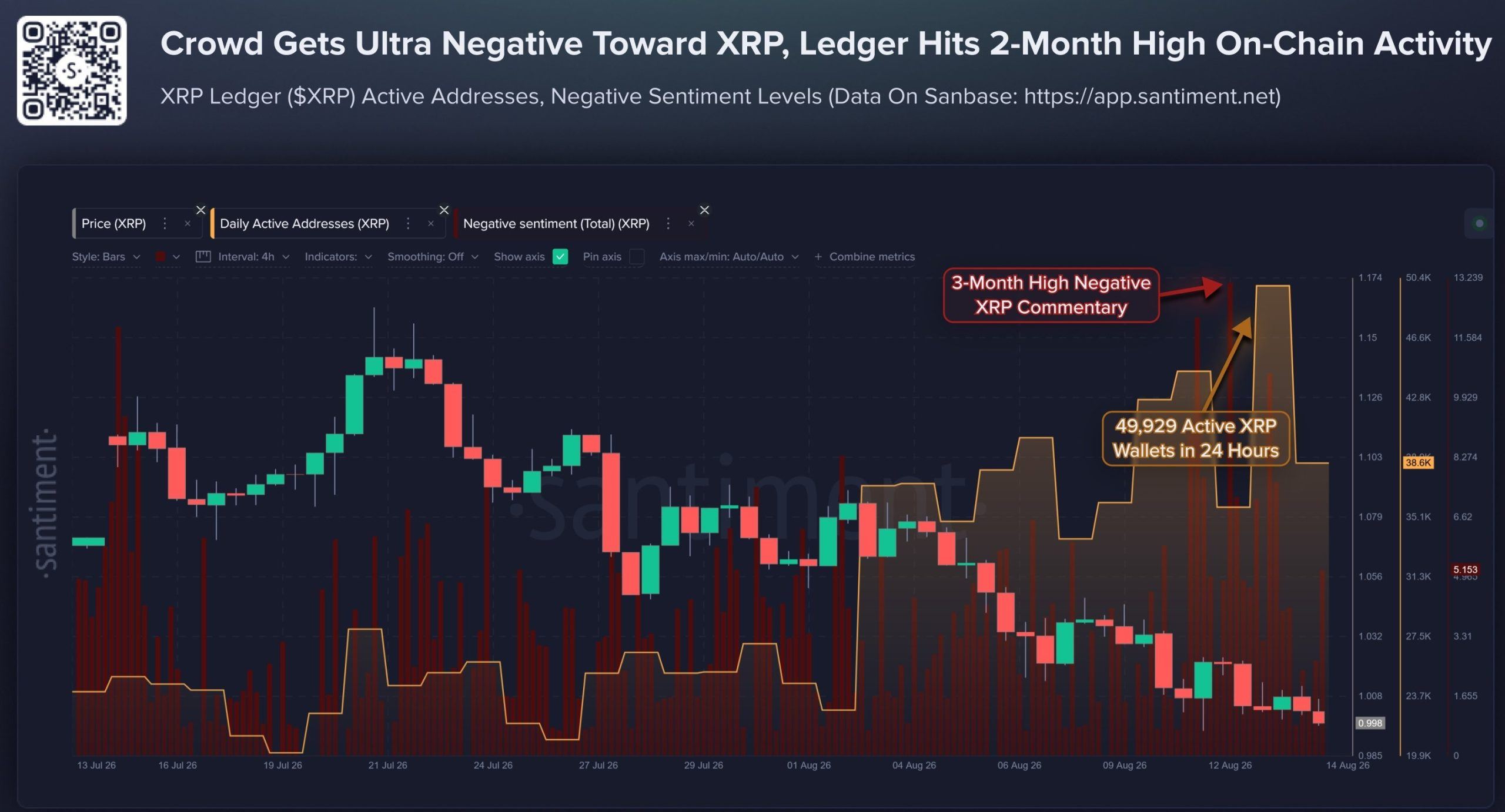
Santiment data shows activity on the $XRP Ledger increased to 49,929 active addresses in a 24-hour period, while sentiment for $XRP reached a three-month low.

This distinction is important to consider when interpreting on-chain activity. A blockchain address does not necessarily correspond to a single individual user, as wallets can generate and manage multiple addresses. Therefore, a higher number of active addresses indicates increased network participation but does not clarify whether this activity was related to new investors, institutional transfers, exchange movements, or repeated transactions by existing participants.

Bearish Comments Contrast with On-Chain Activity

The sentiment metric from Santiment tracks discussions on X, Reddit, Telegram, and other crypto channels, so the three-month sentiment low is more an indicator of crowd psychology than network fundamentals. Sentiment analysis can factor in social media, news, and other signals to assess trader attitudes, which can differ significantly from blockchain activity or long-term adoption trends.

Bearish sentiment also does not mean $XRP has entered or will remain in a definitive market phase. Bear markets are typically characterized by falling prices and weakening confidence, while individual sentiment indicators can change faster than overall price trends. Thus, the current signal for $XRP reflects unusually negative commentary, not a prediction of a reversal or a confirmation of future price direction.

The $XRP Ledger itself operates independently of these social signals. The $XRP Ledger uses a validator-based consensus process instead of proof-of-work mining, where validators agree on the order and validity of transactions before finalizing new ledger versions. This architecture allows activity to increase even when market participants maintain pessimistic outlooks on $XRP's short-term price dynamics.

XRPL Development Provides Broader Network Context

Network development represents another metric to consider separately from short-term price and market sentiment data. Ripple has reported investing over $550 million into $XRP Ledger ecosystem initiatives since 2017, including grants, incentives, partnership programs, and development programs aimed at supporting payments, tokenization, decentralized finance, and other applications.

Ripple has also expanded its institutional strategy for tokenized assets, stablecoins, custody, trading, and credit infrastructure. Its expanded institutional XRPL stack connects tokenized assets with settlement, liquidity, and collateral systems, although available data does not point to these initiatives as the cause of the August 14th activity spike.

Strategic investments have extended these efforts into regulated fund management and tokenized capital market infrastructure. Ripple's investments in Zilo and Licuido target issuance, trading, settlement, and collateral functions, serving as further evidence of XRPL's development, though not establishing a direct link to the recent rise in active addresses.

Santiment noted:

"If $XRP holds its structure and demand recovers, today's negativity could be tomorrow's story of a favorable market entry."

This statement reflects a conditional market interpretation, not proof of a price recovery beginning. The next test will be whether active address levels remain elevated following the one-day spike amidst ongoing bearish sentiment, showing whether this divergence extends beyond a short-term network activity surge.

end-content

Trending Cryptos

Related Questions

QAccording to the article, what is the key contradiction reported regarding XRP on August 14th?

AOn August 14th, the number of active addresses on the XRP Ledger surged to a two-month high of 49,929, while market sentiment towards XRP hit a three-month low. This created a sharp divergence between on-chain activity and investor mood.

QWhat does the article suggest is the likely reason for the increase in active XRP addresses, based on the data about new addresses?

AThe increase in active addresses is likely due to more intensive use of existing addresses rather than an influx of new users. Data shows the number of new addresses created daily remained virtually unchanged from July to August, while active addresses rose significantly.

QHow does the XRP Ledger's consensus mechanism differ from Bitcoin's, and why is this relevant to the reported activity?

AThe XRP Ledger uses a validator-based consensus mechanism, not Bitcoin's proof-of-work mining. This architecture allows network activity to grow independently of short-term market sentiment and price predictions, which explains why activity can increase even when traders are pessimistic.

QWhat broader ecosystem development efforts by Ripple are mentioned in the article, and how are they characterized in relation to the recent activity spike?

AThe article mentions Ripple has invested over $550 million since 2017 into the XRPL ecosystem, including grants and development programs for payments, tokenization, and DeFi. It also details Ripple's expanded strategy in tokenized assets and institutional infrastructure. However, the article states these initiatives are not directly linked as the cause of the August 14th activity spike.

QWhat does the Santiment statement quoted at the end of the article imply about the current market situation for XRP?

ASantiment's statement implies that the current negative sentiment could represent a potential buying opportunity if XRP's underlying structure holds and demand recovers. However, the article clarifies this is a conditional market interpretation, not proof of an imminent price recovery. The key test will be whether the high activity levels persist.

Related Reads

Media: Anthropic Aims for Revenue Up to $200 Billion by 2028 Ahead of IPO

Anthropic, the AI company behind Claude, is reportedly projecting its revenue could reach between $190 billion and $200 billion by 2028, according to sources cited by Reuters. This forecast, significantly higher than its reported $47 billion annual run-rate in May 2026, is being used by investors and bankers to value the company ahead of a potential IPO. Anthropic has confidentially filed with the SEC, with listing details dependent on market conditions and regulatory approval. The valuation reportedly applies a revenue multiple (EV/Revenue) to these future 2028 figures, an approach common for high-growth tech firms but unusual for a forecast two years ahead of an IPO. This reflects confidence in Anthropic's rapid scaling; its annual run-rate grew tenfold yearly for three years leading into 2026, jumping from ~$9B in late 2025 to over $47B by May 2026. Investors are betting the company's massive spending on GPUs, model training, and infrastructure will eventually outpace costs, leading to expanding margins. Public companies like Palantir, Cloudflare, and SpaceX, valued at high multiples of their forward revenue, serve as benchmarks. While this forward-looking method has precedents, some analysts question the sustainability of such valuations and the actual productivity gains from AI. Despite these concerns, earlier reports suggested Anthropic could be valued at over $1 trillion for its IPO.

cryptonews.ru19m ago

Media: Anthropic Aims for Revenue Up to $200 Billion by 2028 Ahead of IPO

cryptonews.ru19m ago

Open Blockchain Business: Who Gets the Fees and Why a Foundation is Needed

Business of Open Blockchain: Who Gets the Fees and Why a Foundation is Needed In public blockchains, user transaction fees do not simply become "revenue" for a single entity. The flow of money is complex and protocol-dependent. In Ethereum, fees consist of a base fee (burned, permanently removing ETH from circulation) and a priority tip (paid to the validator). In Solana, half the base fee is burned and half goes to the validator, while priority fees go entirely to validators. Thus, "fees" are not synonymous with "project revenue"; they may go to network operators or be destroyed. Foundations like the Ethereum Foundation do not take a cut of user fees. They are funded by their own treasuries, which can generate income (e.g., from staking rewards) and finance ecosystem development, research, and security. Their role is to fund public goods that are hard to monetize directly. Developers of open-source blockchain code can monetize through services, not the code itself. For example, Optimism provides its technology freely but sells enterprise support and managed services (OP Enterprise). Additionally, networks built on Optimism's tech, like Coinbase's Base, share a portion of their revenue with the Optimism ecosystem via agreements, creating an economic link. Token holders do not automatically receive fees as dividends. In Optimism, a portion of protocol revenue is now used to buy back and treasury-lock OP tokens, creating an indirect link between network usage and token economics. In Ethereum, fee burning reduces ETH supply but doesn't distribute funds to all holders; stakers and validators receive direct rewards. For evaluation, analysts should look beyond total fee figures. Key questions are: Who paid and for what? Where did the money go (to validators, operators, treasury, or burning)? What were the recipient's costs? Is there a mechanism linking this income to the token? The same fee amount impacts different blockchain economies in vastly different ways depending on these factors.

cryptonews.ru20m ago

Open Blockchain Business: Who Gets the Fees and Why a Foundation is Needed

cryptonews.ru20m ago

Trading

Spot

Hot Articles

What is XRP 2.0

XRP 2.0: A New Frontier in the Cryptocurrency Landscape Introduction to XRP 2.0 In the ever-evolving realm of cryptocurrency, new projects continuously emerge, vying for attention and adoption. One such promising initiative is XRP 2.0, a novel cryptocurrency project designed to leverage advanced blockchain technology and robust encryption methodologies. While the name draws parallels with Ripple’s XRP, it’s crucial to note that XRP 2.0 operates independently, focusing on enhancing transaction security, privacy, and scalability. As the digital financial landscape increasingly embraces decentralized solutions, XRP 2.0 aims to contribute meaningfully to web3 and the overall expansion of crypto projects. What is XRP 2.0? At its core, XRP 2.0 is a cryptocurrency project that aims to create a secure and decentralized digital currency ecosystem. Its foundational technology integrates sophisticated blockchain principles with cutting-edge encryption techniques. The overarching goal of XRP 2.0 is to establish itself as a reliable and efficient platform enabling swift transaction execution while prioritizing enhanced privacy protections for its users. The project is promoted as a solution to many limitations faced by existing cryptocurrencies, proposing a system that can handle a higher volume of transactions with improved speed and privacy. This versatility positions XRP 2.0 as a significant contender in a marketplace riddled with various digital currencies. Who is the Creator of XRP 2.0? The identity of the creator behind XRP 2.0 has been flagged as ‘Wilbur.’ However, comprehensive details regarding Wilbur or their associated entity remain elusive. The anonymity of many cryptocurrency creators is not an uncommon phenomenon in the industry, often designed to maintain a degree of privacy and security. Who are the Investors of XRP 2.0? As of now, specific information related to the investment foundations or organizations supporting XRP 2.0 is not publicly available. In the cryptocurrency sector, the backing by reputed investors can significantly influence a project's credibility and success, yet the transparency regarding the financial supporters of XRP 2.0 has not been established. How Does XRP 2.0 Work? XRP 2.0 stands out by employing a combination of blockchain technology and advanced encryption algorithms that ensures secure and decentralized transactions. Its innovative structure includes unique features designed to foster user engagement and broaden functionalities beyond conventional cryptocurrency transactions. Among these features, XRP 2.0 incorporates AI-powered capabilities, such as text-to-image and text-to-speech functionalities. These additions are designed to enhance the interactive experience for users, promoting broader applicability across various sectors. By bridging technological advancements with user-centered design, XRP 2.0 aims to capture the attention of a diverse range of individuals and enterprises looking to integrate cryptocurrency solutions into their operational frameworks. Timeline of XRP 2.0 Understanding XRP 2.0 requires examining the milestones that have defined its journey thus far: July 23, 2023: XRP 2.0 is introduced as a novel cryptocurrency project, aiming to revolutionize secure and decentralized transaction capabilities in the blockchain domain. September 8, 2023: The launching of another project, XRP20, occurs, marking the emergence of an ERC-20 token on the Ethereum blockchain that remains unrelated to XRP 2.0. November 13, 2023: The XRP Ledger undergoes a significant update with the release of rippled server software version 2.0.0. It is essential to note that this development is disconnected from the XRP 2.0 cryptocurrency project. Key Points About XRP 2.0 To distill the essence of XRP 2.0, several critical factors emerge: Unique Features: The inclusion of features like AI-powered text-to-image and text-to-speech further diversifies the potential applications of XRP 2.0. Blockchain Technology: The framework utilizes advanced blockchain mechanisms and encryption protocols, ensuring a secure and decentralized environment for transactions. Scalability and Privacy: XRP 2.0 prioritizes enhanced privacy protections in transaction processes and the scalability necessary to accommodate a growing user base. No Affiliation with Ripple: Importantly, despite its name, XRP 2.0 does not have any allegiance or collaboration with Ripple’s XRP, distinguishing its operational framework and objectives within the cryptocurrency ecosystem. Conclusion XRP 2.0 represents an ambitious venture into the cryptocurrency sphere, aiming to offer a combination of security, privacy, and efficiency in digital transactions. By integrating sophisticated technologies and user-friendly features, the project sets out to broaden the horizons of what cryptocurrency can achieve in today's digital economy. While the anonymity of its creator and lack of disclosed investors might raise questions for some, XRP 2.0's focus on advanced functionalities and decentralisation enhances its appeal amidst an increasingly crowded crypto market. As the cryptocurrency landscape continues to evolve, XRP 2.0 may yet emerge as a pivotal player in the expansion of secure and scalable blockchain solutions.

1.5k Total ViewsPublished 2024.04.01Updated 2024.12.03

What is XRP 2.0

Discussions

Welcome to the HTX Community. Here, you can stay informed about the latest platform developments and gain access to professional market insights. Users' opinions on the price of XRP (XRP) are presented below.

活动图片