MEV in Detail: Leading Ethereum 'Sandwich Bot' Earned $295 Million, Then Lost $7.5 Million

cryptonews.ruPublished on 2026-08-30Last updated on 2026-08-30

Abstract

In June, an attacker deployed 66 fake token contracts on Ethereum, impersonating familiar names like WETH, USDC, and USDT. The target was Jaredfromsubway.eth, the most active "sandwich attack" bot operator on the network. Over several hours, the bot's automated trading logic, scanning for arbitrage opportunities, granted spending approvals to the malicious contracts. The attacker then drained at least $7.5 million in ETH and stablecoins from the bot and laundered the funds through Tornado Cash. The incident highlighted the irony of a bot built to exploit others being defeated by its own operational mechanism. However, the scale of this business is immense. Trackers show the bot's main contract has accumulated 117,007 ETH (approx. $295 million) since its first recorded profit extraction in March 2023. MEV (Maximal Extractable Value) is profit gained by reordering, inserting, or censoring transactions. The most consumer-hostile form is the "sandwich attack," where a bot detects a large pending trade in the public mempool, buys the asset just before the victim's transaction (driving the price up), lets the victim's trade execute at the worse price, and immediately sells for a profit. This is a daily occurrence. Bots compete for block order via MEV-Boost, an out-of-protocol auction system used by over 90% of Ethereum validators. This has led to significant centralization, with one builder, Titan, assembling over 50% of blocks, raising concerns about censorship and lack of comp...

In June of this year, an unidentified attacker deployed 66 counterfeit token contracts on Ethereum, disguising them under familiar names like WETH, USDC, and USDT. The target was not a retail user's wallet, but Jaredfromsubway.eth — the most active operator of 'sandwich attacks' on the network.
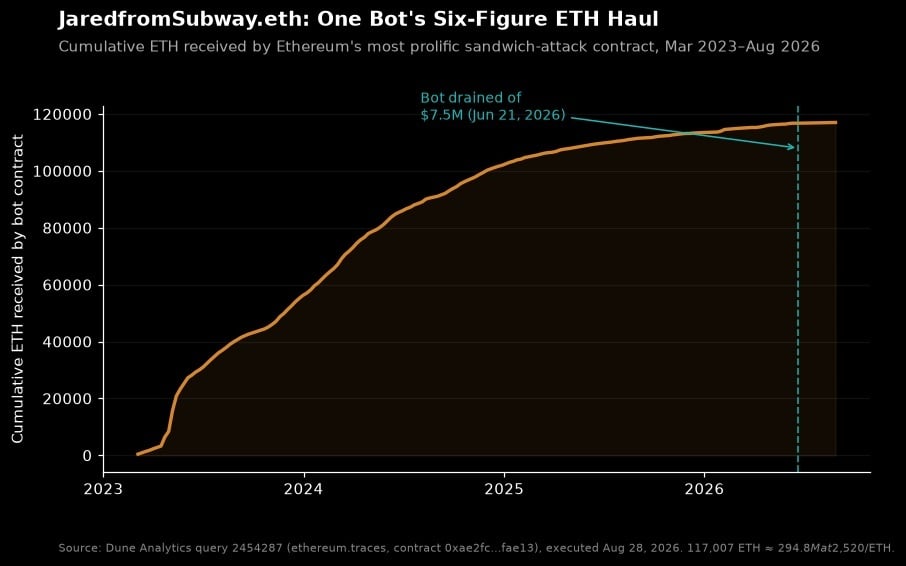
Over the next few hours, the bot's own automated trading logic operated as usual: scanning for arbitrage opportunities involving the counterfeit tokens and, in doing so, granting token spending approvals to the attacker's malicious contracts. Once sufficient approvals had accumulated, the attacker drained the bot's real assets in a coordinated series of transactions, stealing at least $7.5 million in $ETH and stablecoins, then laundering the proceeds through Tornado Cash.

To date, none of these funds have been recovered.

The irony was not lost on the Ethereum research community: a bot created to exploit the 'blind spots' of other traders was taken down by the very mechanism that makes its own business model possible.

However, this incident also underestimated the scale this business has reached. Trackers monitoring every $ETH transfer into the bot's main contract show that as of August 28th, cumulative revenue amounted to 117,007 $ETH, steadily accrued since the first recorded withdrawal from the contract in March 2023.

What MEV Really Is

Maximal Extractable Value (MEV) is the profit that a block producer (or anyone who can influence which transactions get into a block and in what order) can gain by inserting, reordering, or excluding transactions. It exists because Ethereum's mempool, where pending transactions wait to be included, is publicly visible before it becomes final. Anyone monitoring this mempool can see a large pending trade and take advantage of that information before it is completed.

The 'sandwich attack' is the most consumer-hostile form of MEV. When a trader submits a swap order large enough to affect a token's price on a decentralized exchange, a bot detects it in the mempool, sends its own buy order right before the victim's transaction (paying a higher gas fee to ensure it goes first), allows the victim's trade to execute at the now less favorable price, and then immediately sells at the price inflated by the victim's own trade.

The victim's permissible slippage (i.e., the maximum price change they are willing to accept) becomes the bot's profit margin. No hacking, no vulnerabilities, no smart contract bugs — it's a pure consequence of transaction ordering, repeated thousands of times a day.

MEV is not a new phenomenon, as researchers described miners reordering transactions for profit as far back as 2019, and the term itself was coined in 2019 in an academic paper on 'miner extractable value.' The game changed with Flashbots — a research organization founded in 2020 that created the first private auction system for MEV, aiming to move this practice out of the public mempool and into an organized bidding process.

The Ethereum community dubbed the pre-Flashbots mempool the 'dark forest' — a place where any visible transaction carrying value could be attacked within seconds. MEV-Boost, launched concurrently with Ethereum's transition to Proof-of-Stake (PoS) in 2022, made this private auction model the standard way blocks are built today.

The Mechanism Behind Every Block

Sandwich bots cannot choose block order by themselves; they compete for it via MEV-Boost — an off-protocol auction system that over 90% of Ethereum validators use to outsource block building. In MEV-Boost, specialized 'builders' assemble full blocks and submit bids to 'relays,' which verify the blocks and pass the highest bid to the validator scheduled to propose the next block. The validator chooses blindly, seeing only the bid amount, not the block contents, and then signs the block offering the highest sum.

This auction has concentrated in the hands of a few players. A recent snapshot from relayscan.io — an MEV-Boost monitor run by Flashbots — shows relay.ultrasound.money handling 34.0% of data over a 24-hour period, Titan Relay at 28.5%, and the regulated relay bloXroute at 25.0% (meaning the three relays collectively route roughly 85–88% of all MEV-Boost blocks).
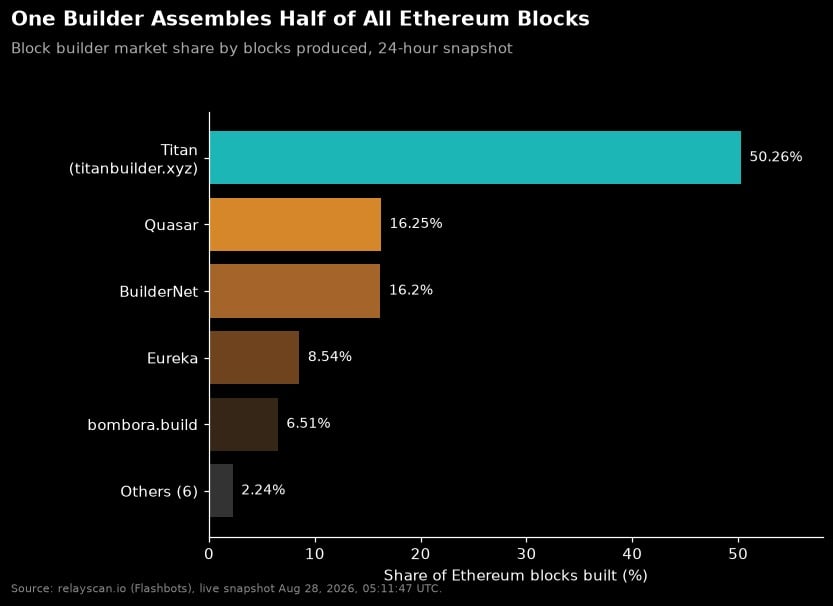
Builder concentration is even more pronounced: Titan's proprietary builder assembles a full 50.3% of blocks, with Quasar and Buildernet each claiming about 16%. Essentially, one company determines transaction order for half of Ethereum's blocks in any given interval — exactly the centralization risk critics of MEV-Boost warned about since its 2022 launch.

In other words, a dominant builder can selectively include, exclude, or reorder transactions with virtually no competitive oversight.

Sandwich Attacks Are Shrinking, But Not Fast Enough

Despite staggering lifetime totals for bots like JaredfromSubway, there is a silver lining: the economics of sandwich attacks are quietly declining overall. Data from a dataset containing over 95,000 attacks shows monthly sandwich extraction volume fell from roughly $10 million in late 2024 to about $2.5 million in October 2025 — a 75% drop in less than a year.

The main credit for shrinking this margin goes to traders using MEV protection tools (be it private RPCs or order flow auctions that keep pending trades out of the public mempool scanned by sandwich bots).

Nevertheless, analysts still estimate trader losses from sandwich attacks at around $60 million annually at the peak of this strategy's popularity — and this figure indirectly benefits blockchain builders as well, since a significant share of MEV profit ultimately goes to them as priority fees that bots pay to ensure their transactions land in the right order.

Ethereum's Roadmap Holds a Structural Solution

Looking ahead, the enshrined Proposer-Builder Separation (ePBS) module, part of the planned Glamsterdam upgrade, will move today's off-protocol MEV-Boost auction into the network's consensus rules, eliminating relays as trusted intermediaries and giving validators cryptographic guarantees about block contents without needing to trust a builder or relay operator.

However, until that upgrade is released and live, an honest assessment of the MEV situation on Ethereum remains characterized by a looming uncertainty.

end-content

Trending Cryptos

Related Questions

QWhat is a sandwich attack in the context of Ethereum and MEV?

AA sandwich attack is the most consumer-hostile form of Maximal Extractable Value (MEV). It occurs when a bot detects a large pending swap transaction in the mempool. The bot submits its own buy order just before the victim's transaction (paying a higher gas fee to ensure it gets processed first), allows the victim's transaction to execute at a now worse price, and then immediately sells the token after the victim's trade has pushed the price up. The victim's acceptable slippage tolerance becomes the bot's profit margin.

QHow did the bot 'Jaredfromsubway.eth' lose $7.5 million?

AThe bot was targeted by an unknown attacker who deployed 66 fake token contracts on Ethereum, disguised as familiar names like WETH, USDC, and USDT. The bot's own automated trading logic scanned for arbitrage opportunities involving these fake tokens, inadvertently granting spending approvals to the attacker's malicious contracts. Once enough approvals accumulated, the attacker executed a coordinated series of transactions to drain the bot's real assets, stealing at least $7.5 million worth of ETH and stablecoins.

QWhat is the role of MEV-Boost in the Ethereum ecosystem according to the article?

AMEV-Boost is an out-of-protocol auction system used by over 90% of Ethereum validators to outsource block building. Specialized 'builders' construct full blocks and bid in an auction via 'relayers', who verify the blocks and pass the highest bid to the next proposing validator. The validator selects a block blindly, seeing only the bid amount, and signs the block with the highest offer. This system has centralized block building, with a single builder (Titan) accounting for 50.3% of blocks at the time of the article.

QWhat positive trend regarding sandwich attacks does the article mention?

AThe article mentions that the economics of sandwich attacks have been quietly shrinking. Data shows that monthly sandwich extraction revenue fell from roughly $10 million in late 2024 to about $2.5 million in October 2025, a 75% decline in less than a year. This is credited to traders increasingly using MEV protection tools like private RPCs or order-flow auctions that keep pending trades out of the public mempool scanned by sandwich bots.

QWhat is the proposed structural solution for MEV in Ethereum's roadmap?

AThe proposed solution is the enshrined Proposer-Builder Separation (ePBS), which is part of the planned Glamsterdam upgrade. It aims to bring today's out-of-protocol MEV-Boost auction within the network's consensus rules. This would eliminate relayers as trusted intermediaries and give validators cryptographic guarantees about block contents without needing to trust a builder or relay operator.

Related Reads

ECB's Schnabel says central bank money 'should move to blockchain'

ECB Executive Board member Isabel Schnabel stated that central bank money "must move onto the blockchain." She argued that stablecoins lack the independent ability to scale liquidity during financial stress—a gap only a central bank can fill. Her proposed solution involves tokenization, which she says can make transactions faster, safer, and more programmable, but only if the safest asset (central bank money) is on the same "rails" as other tokenized assets. This marks a notable shift for the Eurosystem, which had previously viewed Distributed Ledger Technology (DLT) mainly as a tool for regulating stablecoins and crypto, not as infrastructure to adopt directly. The first step is Project Pontes, launching in September. It will initially synchronize the ECB’s existing TARGET services with private DLT platforms. Eventually, it aims to enable settlement finality on a Eurosystem-managed DLT platform with smart contract functionality and 24/7 operation. The long-term strategy is Project Appia, tasked with developing the architecture, standards, and legal framework for a genuine European tokenized asset market by 2028. Trials have already processed around €1.6 billion, and since March 2026, the ECB accepts DLT-based assets as collateral. While not directly impacting Bitcoin's price, these developments signal that a major G7 central bank is preparing to settle transactions on-chain, lending legitimacy to the underlying infrastructure of crypto markets. The ECB's move to avoid "disintermediation" by private tokenization shows that debates in central bank boardrooms are now aligning with discussions long followed in the crypto space.

cryptonews.ru51m ago

ECB's Schnabel says central bank money 'should move to blockchain'

cryptonews.ru51m ago

Ripple Labs Warns of a New Challenge for Blockchains

Ripple Labs is preparing the XRP Ledger for quantum threats but now emphasizes a broader challenge: ensuring financial infrastructure can adapt simultaneously to quantum computing and artificial intelligence. Senior Director of Engineering Ayo Akinyele states the goal is not merely anticipating a "Q-Day" but building infrastructure capable of preemptively adopting new security mechanisms without network disruption. The shift to post-quantum cryptography involves more than swapping algorithms; it requires flexible infrastructure, improved key management, and clear upgrade paths. Financial systems were not designed with quantum computers in mind, necessitating a rethink of transaction, identity, asset, and data protection. This is underscored by significant investments, such as the $2 billion U.S.-IBM quantum factory initiative and a 2030 U.S. government mandate for post-quantum cryptography adoption. AI introduces distinct risks by driving automation and autonomous economic activity, increasing demand for an always-on, internet-oriented payment infrastructure. AI agents could soon conduct transactions independently, creating new security requirements. Ripple Labs advocates for proactive, orderly preparation rather than a crisis-driven transition, having outlined a four-phase strategy aiming for a full XRP Ledger transition by 2028, now expanded to address both quantum and AI-driven challenges.

cryptonews.ru51m ago

Ripple Labs Warns of a New Challenge for Blockchains

cryptonews.ru51m ago

Trading

Spot

Hot Articles

Discussions

Welcome to the HTX Community. Here, you can stay informed about the latest platform developments and gain access to professional market insights. Users' opinions on the price of ETH (ETH) are presented below.

活动图片