Market Adjusts Following Google's $84.7 Billion Fundraising, AI Valuations Now Focus on Payback Speed

marsbitPublished on 2026-06-12Last updated on 2026-06-12

Abstract

After Alphabet's announcement of an $84.75 billion equity financing round, market focus for AI investment is shifting from pure growth narratives to capital efficiency and payback periods. The core argument is that AI is being re-priced from a software-like growth story into a heavy-asset infrastructure cycle, requiring massive capital expenditure (CapEx) on chips, data centers, and power grids. While Alphabet's financing itself is not a distress signal—part of it is for administrative purposes like tax obligations on stock compensation—it highlights the enormous capital demands of AI infrastructure. This demand extends beyond tech giants to pure-play AI model companies (like OpenAI, Anthropic), data center REITs, and utilities. Major tech firms are projected to spend heavily on AI data centers in 2026, signaling a broad-based capital cycle the market must absorb. Consequently, valuation logic is changing. Investors are moving away from questions about who has the strongest AI narrative and are now prioritizing clear visibility into orders, stable cash flows, and the cost of capital. This has led to recent pressure on high-multiple AI software and semiconductor stocks, while "picks-and-shovels" hardware, data center, and power assets with firmer near-term demand may see relative support. The key going forward will be monitoring whether rising CapEx guidance across companies is matched by a timely monetization of AI investments into revenue and cash flow. The market's toler...

TL;DR

Over the past few years, the core question for AI investments has been simple: Will AI change the world? As long as the answer leaned towards "yes," the market was willing to assign higher valuations to chipmakers, cloud providers, software companies, and model developers.

Recently, the market narrative has begun to shift. Some semiconductor and high-valuation AI software stocks have seen pullbacks, with market participants shifting capital preferences towards areas with clearer order pipelines and more stable cash flows. Concurrently, Alphabet announced a large-scale equity fundraising and had previously revised its 2026 capital expenditure guidance upward in its Q1 earnings report.

These two events cannot be simplistically framed as "fundraising caused the decline." A more accurate context is that the market is repricing AI—from a software-style growth story to a capital-intensive infrastructure cycle.

The keyword here is capital expenditure. AI is not a business that can scale by writing a few lines of code; it requires chips, data centers, networks, power, and land. The greater the capex, the more investors ask three questions: Where is the money coming from, how expensive is it, and how long will it take to get a return.

Alphabet's Fundraising Makes the Market Recalculate the Capital Account

Alphabet's fundraising itself is not a crisis signal, but it is a strong reminder: AI build-out is now a mega-capital project.

According to SEC filings and reports from Reuters and Investing, Alphabet announced plans in June 2026 for an approximately $80 billion equity fundraising, later adjusted to $84.75 billion. The funds are intended for uses including AI infrastructure and computing capacity expansion, though not all will be directly allocated to AI capex. SEC documents show that of a $40 billion ATM (At-The-Market) program, about $30 billion is anticipated for administrative arrangements related to tax obligations for employee stock vesting.
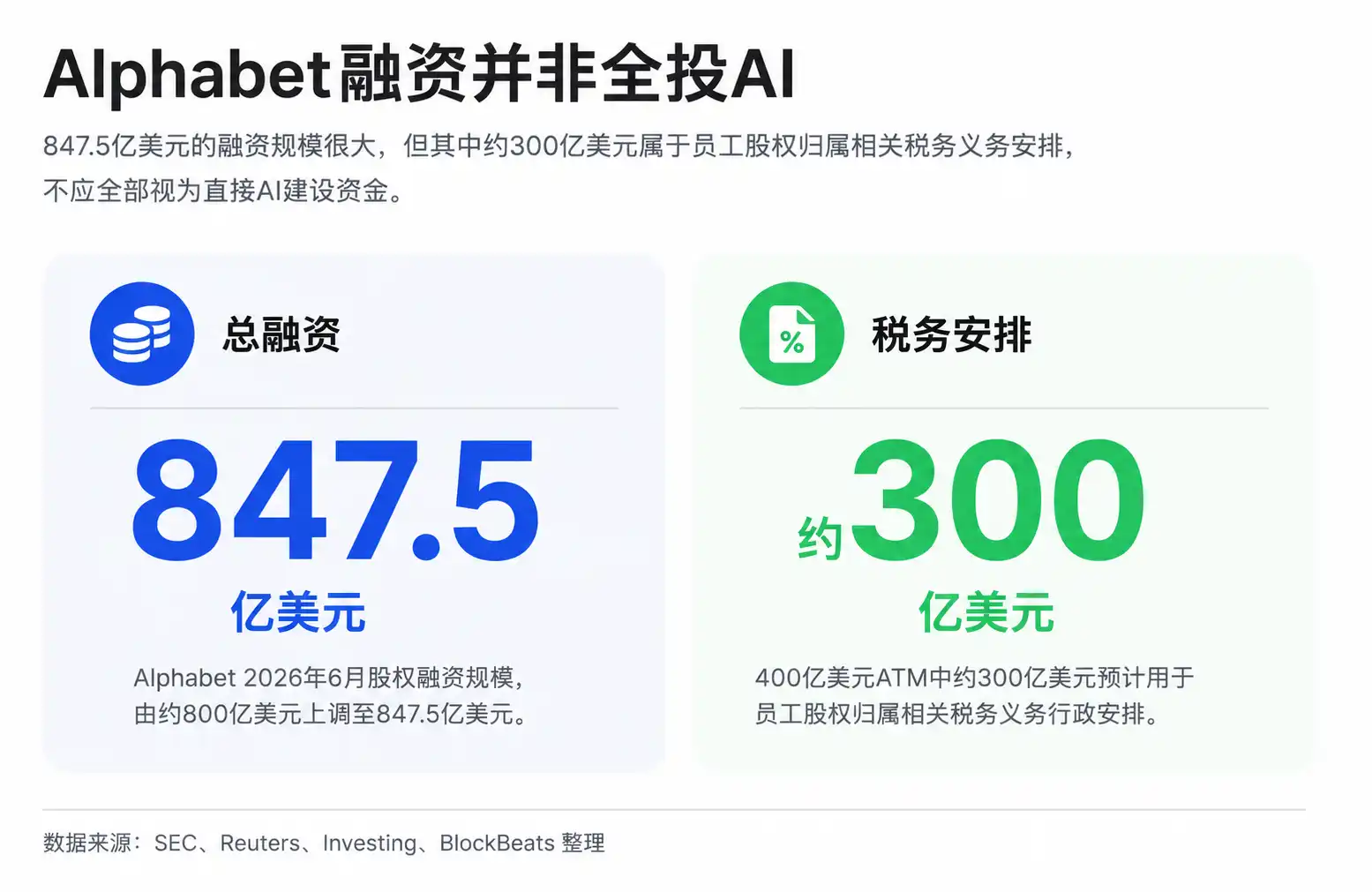
This distinction is important. Labeling the entire $84.75 billion as "AI construction funds" overstates the direct allocation, but it still alters investor sentiment. Because even a cash cow like Alphabet needs to expand fundraising in public markets, the market naturally wonders: If it needs to bolster financial flexibility, who will provide the capital needed next by OpenAI, Anthropic, xAI, data center REITs, and power companies?

Capital expenditure and operating expenses are also not the same. Spending on hiring and marketing is an opex; buying servers, building data centers, and securing power is capex. The latter is more like building a factory—it creates significant upfront cash flow pressure, appears on the books slowly through depreciation, but the market immediately assesses the payback period.

In its Q1 2026 earnings call, Alphabet raised its full-year capital expenditure guidance from $175-185 billion to $180-190 billion. The company cited reasons including investments related to the Intersect acquisition, as well as AI compute demand. Management emphasized maintaining a healthy balance sheet and financial flexibility and did not describe the fundraising as a survival pressure.
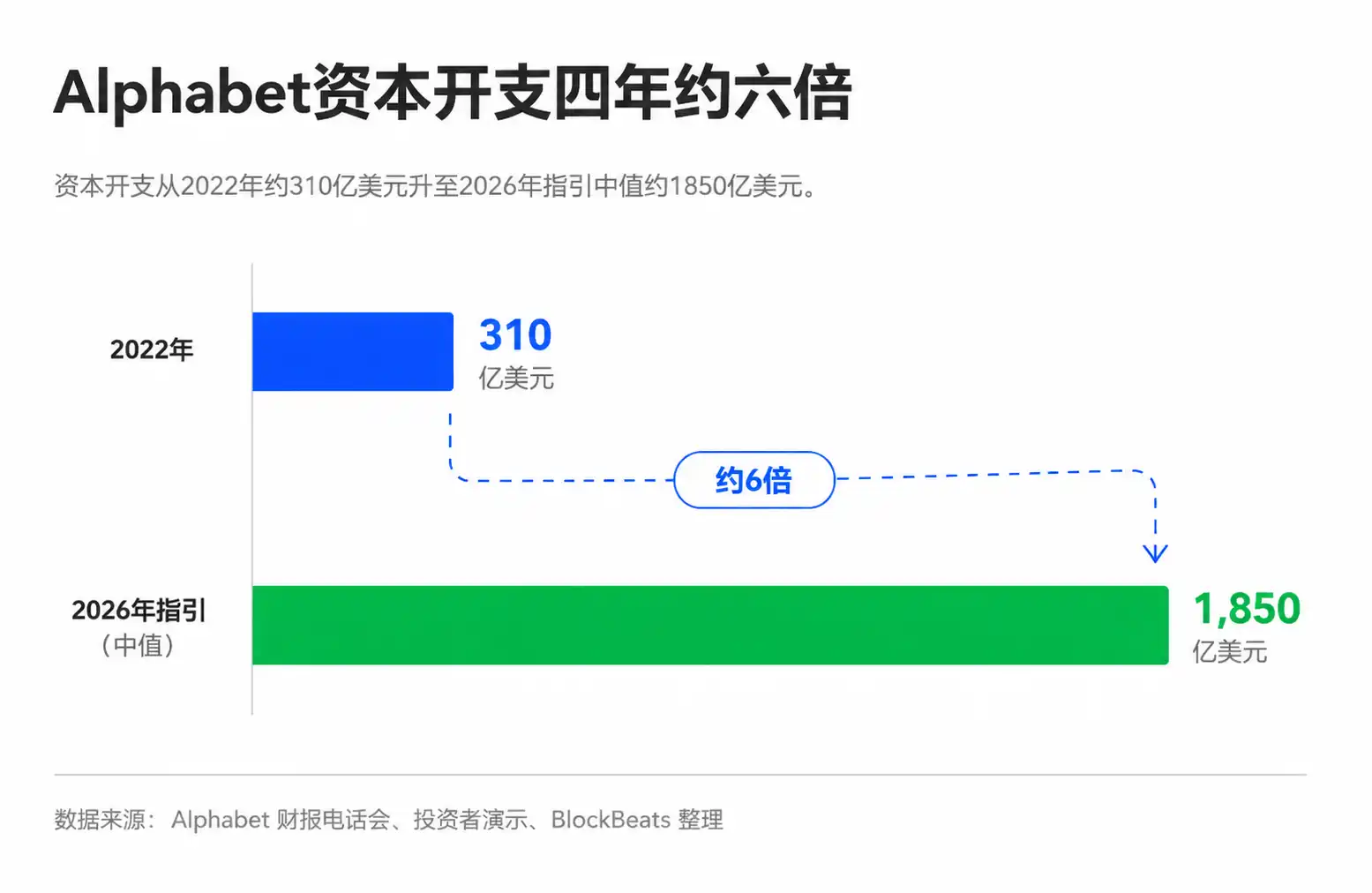
Investors are calculating a different equation. When capex guidance is repeatedly revised upward, the denominators in valuation models change: depreciation increases, free cash flow faces pressure, financing costs and potential equity dilution enter the calculation. The AI trade is entering its next phase. The previous phase rewarded imagination; the next phase rewards capital efficiency.

AI Money Isn't Just Burning on Big Tech's Books

The capital requirements for AI infrastructure don't fall solely on giants like Alphabet, Microsoft, Amazon, and Meta. What truly makes the market nervous is that multiple types of entities may simultaneously compete for the same pool of capital.

The first category is frontier model companies. Companies like OpenAI, Anthropic, and xAI see rapid revenue growth, but training and running models require continuous computing power purchases, leading to significant cash burn. Unlike established cloud providers with the cushion of advertising, cloud, and software cash flows, they rely more on external funding, strategic investments, and may later depend on IPOs or debt markets.

The second category is data center companies. AI doesn't need ordinary office servers but high-density, energy-intensive data centers. Data center REITs raise capital to build facilities and then lease computing infrastructure to cloud providers or AI companies. Assets like Digital Realty and Equinix benefit from demand expansion, but the expansion itself requires continuous financing.

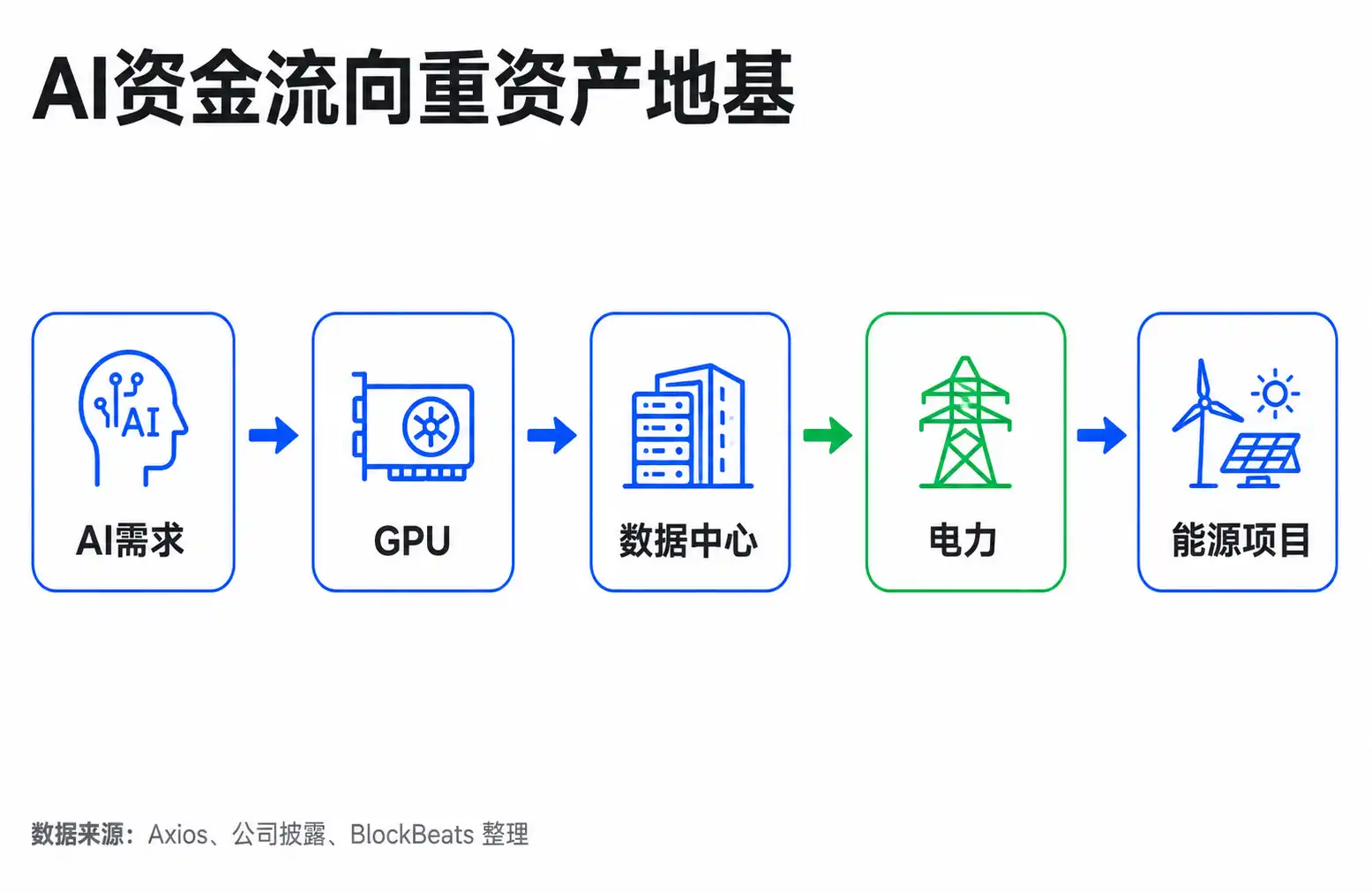
The third category is power and utilities. One of the biggest bottlenecks for large AI data centers isn't chips, but electricity. Large data centers transfer pressure to the power grid, substations, transmission lines, and long-term power purchase agreements. The money burned by AI companies doesn't stop at GPUs; it flows along the supply chain to land, facilities, cooling, the grid, and energy projects.
According to an Axios report on June 10, 2026, Alphabet, Amazon, Meta, Microsoft, and Oracle had raised $255.34 billion through equity and debt in 2026, stating that the five companies' AI data center spending for the year would reach approximately $750 billion. This figure shouldn't be taken as precise causal proof, but it gives the market a sense of scale: AI's capital needs are transitioning from a single-company issue to a financing cycle that the entire financial market needs to absorb.
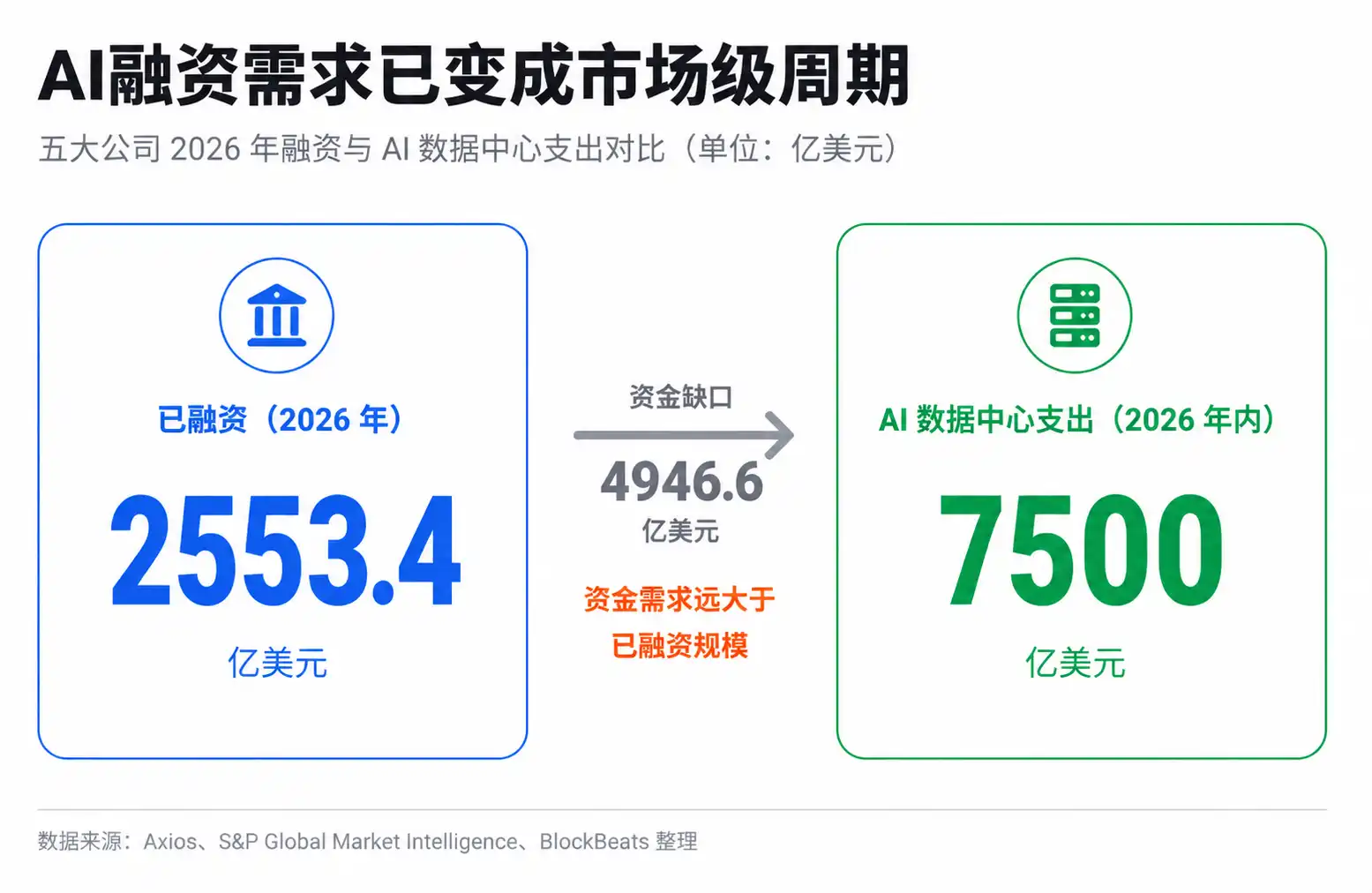
The market used to view AI as a software revolution: low marginal cost, fast growth, high margins. Now, frontier AI resembles infrastructure revolutions like railroads, electricity, and fiber optics: requiring concentrated build-out early on, massive investment, potentially creating immense value eventually, but facing tests of financing capacity, cost of capital, and capacity utilization in between.

Valuation Logic Shifts to Payback Speed

When a market reassessment occurs, prices initially reflect not that fundamentals have deteriorated, but that investors are starting to ask a different set of questions.

Previously, they asked: Whose AI narrative is strongest? Whose revenue growth is fastest? Who is closest to the next platform entrance? Now the questions are: Who can convert invested capital into cash flow? Whose order book is sufficiently certain? Who has access to low-cost financing? Who will see profit dilution or pressure during this high-capex cycle?

This explains the recent divergence within the AI sector. High-valuation AI software companies and those with heavier long-term narratives are more vulnerable because their valuations rely on future growth. Once the market raises its cost of capital estimate, the discounted present value of future cash flows declines. Some semiconductor companies may also be affected, as investors worry whether order growth can continue at super-expected rates.

But this doesn't mean all AI assets are being abandoned. Hardware, storage, networking equipment, data centers, and power assets with clearer order visibility might反而 find relative support during this reassessment. The reason is straightforward: when the market starts focusing on the build-out cycle, the "pick-and-shovel" sellers still have demand; but investors will be more挑剔 in asking whose orders are truly visible and who is just riding the narrative for valuation.

This is also the divergence between Alphabet management and cautious investors. Management emphasizes that AI investment is a strategic necessity, and fundraising is to maintain initiative in long-term competition. The cautious camp worries that AI monetization速度 may lag behind capital expenditure, especially when multiple giants and model companies simultaneously expand fundraising, prompting capital markets to demand higher returns and thus压低 valuations.

Both sides can be true simultaneously. AI can be the correct long-term infrastructure investment while also temporarily depressing free cash flow and valuation multiples in the short term. For investors, being "bullish on AI" and "bearish on a subset of AI valuations" are not contradictory.

Next Steps: Watch Capex and Revenue Realization

It's too early to attribute the recent pullback solely to AI financing pressure driving the market, let alone claim an AI liquidity crisis has emerged. Macro interest rates, profit-taking, cooling of crowded trades, and employment data fluctuations could all be reasons for sector volatility. The fundraising news更像是 incorporated into the market's explanatory framework rather than a button单独 driving prices.

But this explanatory framework itself deserves attention. Once the market starts pricing AI with "capex, cost of capital, payback period," the ranking of many assets will change.

For cash cows like Alphabet, the question isn't whether they can raise money, but whether AI investment will持续挤压 free cash flow and whether new投入 can translate into cloud revenue, advertising efficiency, subscription revenue, or enterprise service revenue. As long as revenue growth can cover depreciation and financing costs, the market can accept higher capex; if capex continues to be revised upward while returns迟迟不出现, valuation pressure will become more pronounced.

For pure-play AI companies, the question is more direct: Can high revenue growth keep pace with computing power consumption? If OpenAI, Anthropic, xAI can prove that enterprise customers are willing to持续付费 and unit economics improve, external capital will still flow in; if revenue growth is largely consumed by higher training and inference costs, the next round of financing or IPO pricing will be more挑剔.

For data center and power assets, the market will watch long-term contracts, utilization rates, financing structures, and power constraints. The more real the AI demand, the more important these "foundation" assets become; but if financing costs rise, or if data center construction超前于 real demand, they could shift from beneficiaries to承压方 of heavy-asset压力.

The most important validation points going forward are not the daily涨跌 of a semiconductor index, but whether the next round of earnings reports shows further upward revisions to capex guidance, whether AI revenue can materialize faster, and whether public markets can still smoothly absorb large-scale equity and debt issuance. As long as these variables remain positive, the AI trade isn't over; but the valuation language the market uses for AI has likely moved past the phase of只看想象空间.


Trending Cryptos

Related Questions

QWhat is the main shift in market valuation logic for AI investments discussed in the article?

AThe market is shifting from valuing AI based on its transformative potential and growth narrative to evaluating it as a capital-intensive infrastructure cycle, with a focus on capital efficiency, funding costs, and payback periods.

QWhy did Alphabet's announced capital raise cause market concern, according to the article?

AAlphabet's capital raise, while partly for administrative purposes, served as a strong reminder that AI infrastructure is a massive capital project. It prompted investors to reassess the broader funding needs of the AI ecosystem and question where capital would come from for other players like model companies, data center REITs, and utilities.

QWhat three categories of entities does the article identify as competing for capital in the AI infrastructure build-out?

AThe three categories are: 1) Frontier model companies (e.g., OpenAI, Anthropic), 2) Data center companies and REITs, and 3) Power and utility companies responsible for supplying the massive electricity needs of AI data centers.

QHow has the market's reaction to AI stocks changed with this new valuation focus?

AThe market reaction has become more differentiated. High-valuation AI software and semiconductor stocks with less certain near-term returns have faced pressure, while assets with clearer order visibility—like certain hardware, networking equipment, data centers, and power infrastructure—have found relative support as 'picks and shovels' plays in the build-out phase.

QWhat key metrics will investors now focus on to validate the AI investment thesis, as per the article?

AInvestors will focus on: 1) The trajectory of capital expenditure guidance in upcoming earnings reports, 2) The speed at which AI investments convert into tangible revenue streams (e.g., cloud, advertising, enterprise services), and 3) The public market's capacity to absorb large-scale equity and debt issuances from AI-related companies without significantly raising the cost of capital.

Related Reads

EF's Epic Reorganization: 20% Layoffs, Budget Halved, Is Ethereum Gearing Up for a Leaner Future?

The Ethereum Foundation (EF) has announced a major organizational restructuring, involving a 20% staff reduction (approx. 54 employees) and a division into functional clusters like Protocol, Access, User, Community, and Institutional layers. Co-founder Vitalik Buterin further revealed plans to cut the EF's budget by around 40% over the coming years, aiming to reduce its annual spending rate from about 15% to roughly 5% by 2030, transitioning to an endowment-driven model. This overhaul is seen as a long-overdue correction to the EF's ambiguous role. As Ethereum grew, the foundation faced persistent criticism over ETH sales, perceived lack of execution, and unclear strategy, often becoming a focal point for community frustration amid ETH's price stagnation. The reform aims to redefine the EF's boundaries, narrowing its focus to core protocol research, public goods funding, and ecosystem coordination, while offloading more applied development work to the broader market. Concurrently, ecosystem forces like the newly formed Ethlabs (founded by ex-EF researchers) and other independent groups are stepping in to fill the space, signaling a shift from a centralized model to a more distributed, collaborative ecosystem structure. The move was notably praised by Solana co-founder toly, who viewed a "leaner" EF as potentially more decisive and agile.

Odaily星球日报24m ago

EF's Epic Reorganization: 20% Layoffs, Budget Halved, Is Ethereum Gearing Up for a Leaner Future?

Odaily星球日报24m ago

Dragonfly Partner Haseeb: The Fastest-Growing Companies of the Future May All Get Stuck at 149 Employees

Dragonfly partner Haseeb explores the distorted economics of AI model pricing, drawing parallels to tax policy. He notes that startups and small teams (under 150 users) enjoy heavily subsidized, fixed-price AI subscriptions (like Claude Code), where the marginal cost of an additional token is effectively zero. This creates a powerful incentive for them to maximize token usage ("token-maxxing") and innovate aggressively with AI automation. In contrast, large enterprises (over 150 users) are forced onto "Enterprise" plans, paying per-token API fees with high (~75%) markups. This acts like a steep "tax" on AI-powered labor, disincentivizing marginal automation and experimental use, and encouraging them to retain more human workers. Haseeb argues this pricing creates a "150-person cliff," a regulatory notch similar to labor laws in France that discourage firms from growing past 50 employees. He predicts the fastest-growing future companies may deliberately cap their headcount at 149 to avoid the punitive enterprise pricing. This would foster an "AI-first" management philosophy obsessed with automation and outsourcing to stay lean. While not intentionally designed, this bifurcated pricing could become one of the most influential de facto tax policies, shaping how AI replaces labor—not through mass layoffs at big firms, but through agile, AI-native startups outcompeting them.

marsbit36m ago

Dragonfly Partner Haseeb: The Fastest-Growing Companies of the Future May All Get Stuck at 149 Employees

marsbit36m ago

How xBubble Breaks Through in the VC-Heavily-Backed OPC Economy

xBubble: Addressing the Structural Gap in the VC-Backed OPC Economy The concept of OPC (One Person Company) is evolving from a buzzword to a significant AI-driven market. While AI coding tools like Replit and Lovable have validated demand from non-technical users wanting to build applications, a key gap remains: the leap from creating a demo to running a stable, evolving business. These tools still require users to manage the development process, including technical judgments for integrations, modifications, and deployments—a major hurdle for OPCs. xBubble, by DAPPOS, tackles this by shifting from "Prompt-to-Code" to "SOP-to-Business." Instead of generating code from instructions, its core is a system of pre-organized SOPs (Standard Operating Procedures) that translate business goals—like "sell World Cup merchandise"—into complete, executable workflows. This includes generating cohesive assets, pages, payment systems, and backend logic. The platform is augmented by a network of third-party service providers who handle infrastructure (hosting, domains, payment setup), acting like "on-site service engineers." Users can pay for these services directly with xBubble credits, simplifying onboarding. This ecosystem aims to deliver not just an app, but a complete, modifiable business launch path. xBubble targets a clear OPC segment: small commercial nodes (e.g., creators, merchants) with existing products, customers, or channels, but for whom a full tech team is unjustifiable. Its potential lies in SOPs accumulating expertise from real cases, improving reliability and reducing delivery costs over time. Additionally, its native support for crypto payments caters to global or digital-native OPCs. In summary, as AI democratizes software creation, xBubble's opportunity is to prove that "SOP-to-Business" provides more immediate value for launching a real, operational business than a powerful but unstructured AI coding tool.

链捕手38m ago

How xBubble Breaks Through in the VC-Heavily-Backed OPC Economy

链捕手38m ago

If It's Not a Clear Yes, It's a No: A Nine-Year Retrospective by a VC Who Survived Four Cycles

**"Invest Only When Certain": A Nine-Year Retrospective from a VC Across Four Cycles** IOSG founder Jocy shares hard-earned lessons from nine years and over a hundred investments in Web3. The core challenge isn't identifying successful founders, but understanding why talented founders with solid ideas still fail. Through building a "failed founder database," IOSG identified six recurring failure patterns. **Founder Trait Red Flags:** 1. **Emotionally Unstable:** Founders who react defensively to criticism or publicly lash out under pressure (e.g., 80% drawdowns) often fail. Resilience is key. 2. **Lacking Hunger / Having a Fallback:** Founders with significant safety nets (family wealth, cushy fallback jobs) may lack the "do-or-die" commitment needed to survive crypto's brutal cycles. 3. **Unchecked Ego:** Includes "polished execution machines" who excel in known frameworks but struggle when paradigms shift, and "professor-types" who are technically brilliant but resistant to commercial feedback or coaching. **Project Structure Red Flags:** 4. **Token-First, Not Product-First:** Treating the token solely as a fundraising tool with no real utility or connection to product value is a major warning sign. The project should have value even if the token goes to zero. 5. **No Day-1 Exit Thesis:** Founders must have a clear, staged capital strategy from the start, understanding what each funding round needs to prove to unlock the next. "Exit before entry" is crucial. 6. **No Full-Cycle Experience:** Founders who haven't lived through a complete crypto bull/bear cycle (e.g., 2018, 2022) often underestimate their vulnerability. IOSG limits initial checks for such teams to $250k, sizing for risk. **The Positive Flipside: Desirable Founder Traits** The ideal candidate exhibits: obsessive problem-depth, being a second-time founder with a non-consensus vision, strong communication skills with *controlled* ego, relentless perseverance, and a global perspective with agency and taste (increasingly vital in the AI era). **Three Survival Tips for Founders:** 1. **Cash Flow Over Narrative:** Real revenue is what sustains projects, not vanity metrics. 2. **Tokens Are a Liability:** Avoid issuing a token unless absolutely necessary. The hidden costs (market making, liquidity, compliance) are immense, often a multi-million-dollar burden. 3. **Respect Liquidity:** Sell during peaks to build treasury, buy back to support the protocol during troughs. Be realistic about valuations and your ability to deliver for the next round. The final principle is simple yet paramount: **"If it's a borderline 'yes' or 'no,' don't invest."** In an industry that reinvents itself every few years, the discipline to consistently say "no" is the ultimate secret to longevity.

Foresight News1h ago

If It's Not a Clear Yes, It's a No: A Nine-Year Retrospective by a VC Who Survived Four Cycles

Foresight News1h ago

Trading

Spot
Futures

Hot Articles

Discussions

Welcome to the HTX Community. Here, you can stay informed about the latest platform developments and gain access to professional market insights. Users' opinions on the price of AI (AI) are presented below.

活动图片