JP Morgan Mid-Year Research Report Analysis: The AI Supercycle is Not Over, Reduce Cash Holdings + Allocate to Real Assets

marsbitPublished on 2026-06-08Last updated on 2026-06-08

Abstract

JP Morgan's 2026 Mid-Year Outlook argues the AI supercycle is far from over, despite market pessimism. The report advises clients to reduce cash holdings, increase allocations to real assets as an inflation hedge, and focus on emerging markets. Key conclusions include: 1. **AI Supercycle Intact**: Hyperscalers' 2026 capex forecasts exceed $650B, with AI contributing to GDP growth. However, their financial profile is shifting toward heavy investment, compressing free cash flow. 2. **SaaS Disruption**: Traditional software companies are being negatively impacted by AI, with significant stock declines and pressure in credit markets. 3. **Persistent Inflation**: Core inflation is structurally higher post-pandemic. Holding excess cash and bonds leads to real wealth erosion. Recommendations include commodities, infrastructure, real estate, and gold. 4. **Geopolitical Shocks & Opportunities**: The Hormuz Strait blockade caused a major oil shock, but JP Morgan views the subsequent equity market pullback as a buying opportunity. "Fragmentation" is creating pockets of value, notably in resource-rich Latin America, AI-supply-chain-linked East Asia, and deeply discounted Chinese equities, where a policy shift could trigger a re-rating. 5. **Regional Views**: The firm is cautious on Europe due to high energy costs and lower innovation investment, preferring US and select EM exposures. In short, JP Morgan sees market volatility as an entry point but recommends a portfolio pivot: fav...

Author: David, Tide Research

Tide Research Guide:

J.P. Morgan's wealth management division issued a mid-year 2026 outlook report on June 1st, essentially advising its high-net-worth clients on how to invest for the second half of the year.

Against the backdrop of the Strait of Hormuz blockade pushing up oil prices, resurgent inflation, and the AI narrative shifting from fervor to skepticism, the overall tone of this report is cautiously optimistic, albeit with a change in specific investment allocations.

J.P. Morgan believes the market is overly pessimistically pricing the world's three major risks (fragmentation, inflation, AI's disruptive potential), and the current market volatility is precisely a window of opportunity to enter.

The overall judgment is:

Continue betting on the AI supercycle and US stocks, hedge inflation with real assets and alternative strategies, reduce cash holdings, and pay attention to emerging markets.

If you hold US tech stocks or are considering whether to add to or reduce your positions in the second half of the year, the framework and data in this report are worth a look; we have condensed and interpreted the original report, rearranging the priorities according to investment relevance.

Six Key Conclusions:
1. The AI supercycle is not over; the market is overly pessimistic.

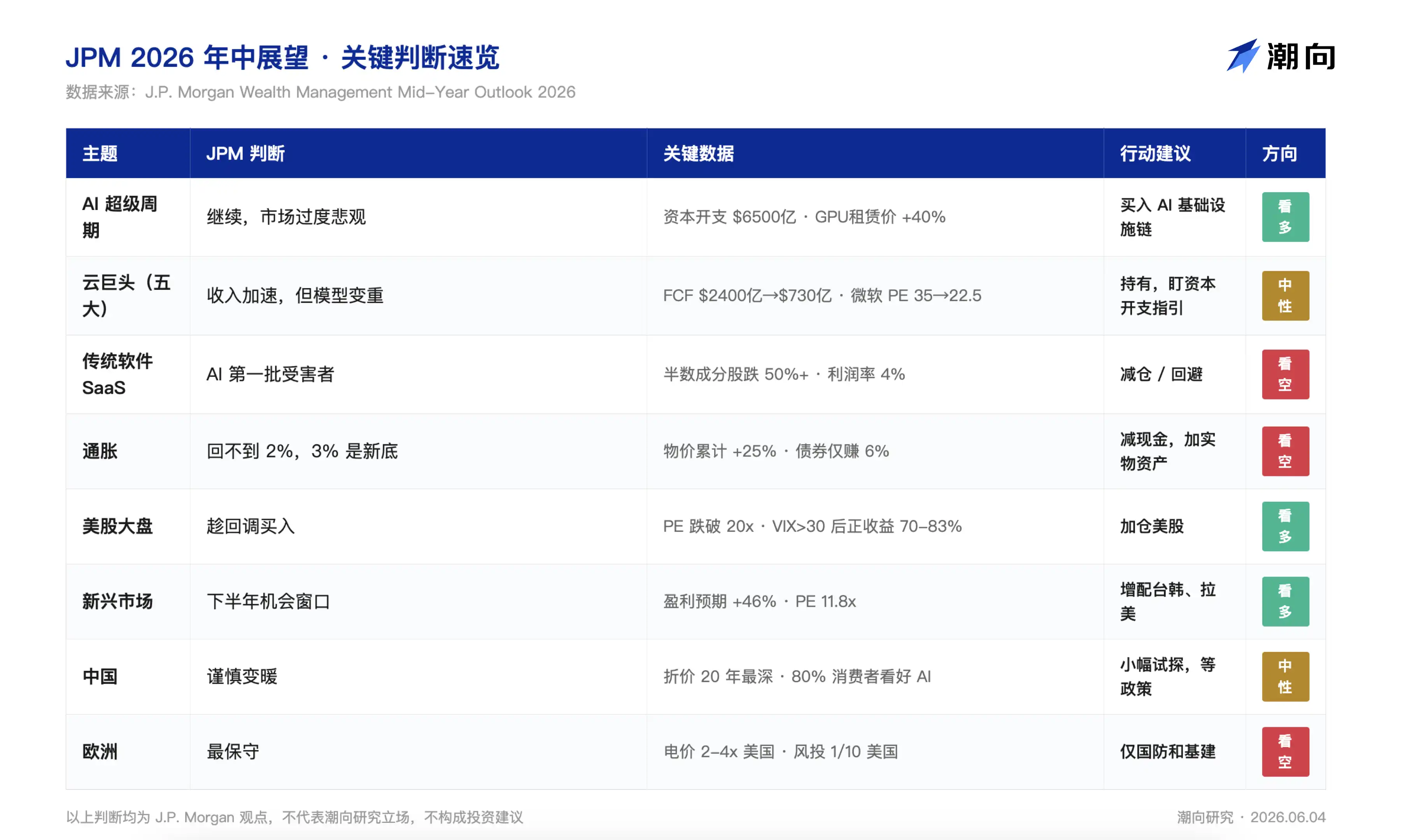
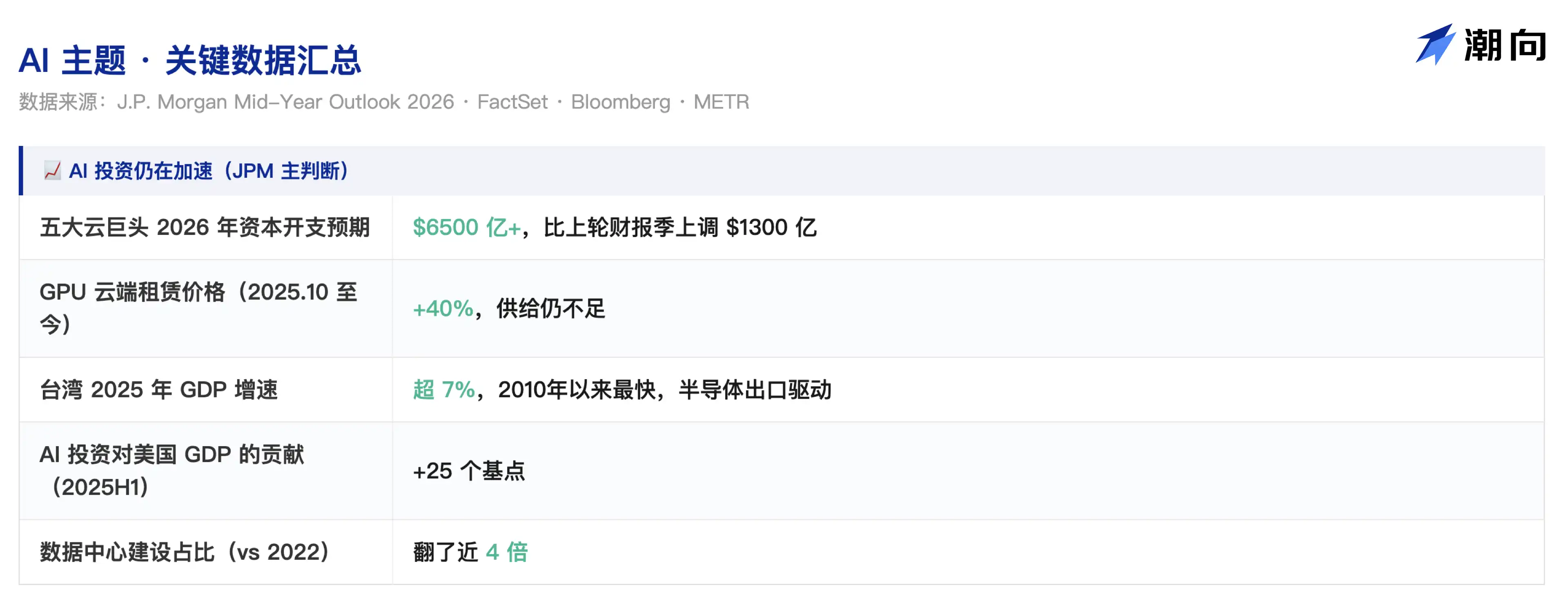
The five Hyperscalers (Microsoft, Meta, Oracle, Google, Amazon) are expected to have 2026 capital expenditures exceeding $650 billion, revised up by $130 billion from the last earnings season. AI-related investment contributed 25 basis points to US real GDP growth in 2025. Taiwan's GDP growth exceeded 7%, the fastest since 2010, driven primarily by semiconductor exports. JPM believes the market is pricing in an "AI peak," but the data does not support this narrative.

2. However, the financial characteristics of Hyperscalers are changing.

Free cash flow is projected to drop from $240 billion in 2024 to $73 billion by the end of 2026. Microsoft's Forward P/E has fallen from an AI-era high of 35x to 22.5x. These companies are transitioning from "light-asset, high-return" to "heavy-asset, high-investment," and the market is still digesting this shift.

3. SaaS is undergoing an underwater massacre.

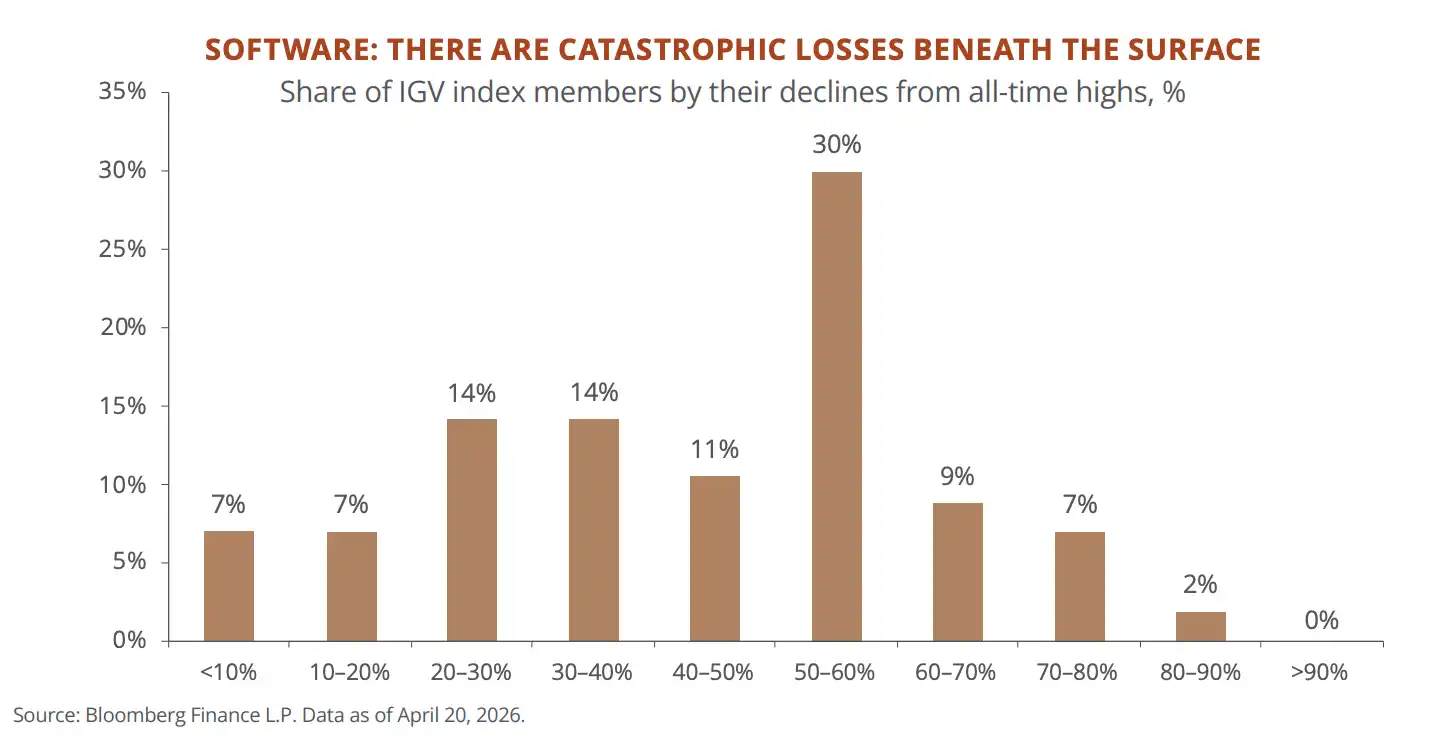
Approximately half of the constituents in the S&P Software Index (IGV) have fallen more than 50% from their all-time highs. JPM's tracked "AI Vulnerable Basket" is down nearly 20% this year. In the private credit market, 21% of exposure is to software companies, rising to 40% when combined with tech and business services. The impact of AI on the subscription-based software business model is already happening.

4. The inflation floor is higher than pre-pandemic; cash is slowly bleeding value.

US core PCE was already sticky at around 3% before the energy shock. Consumer prices have cumulatively risen 25% since 2020, while core fixed income has only returned 6%. Nearly 20% of JPM's clients' assets are in cash and short-term bonds. The report's message is clear: you think you're taking shelter, but you're actually losing money.

5. The Strait of Hormuz blockade is the largest oil supply shock since WWII, but JPM believes you should buy the dip.

Oil prices have nearly doubled, US stocks experienced a roughly 10% correction, and the S&P 500's P/E briefly fell below 20x. JPM's historical data shows that buying after the VIX breaks above 30 yields a 70% to 83% probability of positive returns within 6 months, with an average return of 12.4%.

6. Emerging markets could be an opportunity in the second half.

EM corporate earnings are expected to grow 46%, with a P/E of only 11.8x. Taiwan and South Korea are core nodes in the AI hardware supply chain. Latin America holds over 40% of the world's copper and nearly 60% of its lithium reserves. The discount of Chinese stocks relative to other Asian markets is at its deepest in 20 years, and JP's stance is "cautiously warming."

On AI: The Market is Pricing a "Peak," JP Morgan Thinks It's Too Early
JPM opens by stating that Wall Street's narrative on the AI supercycle has "already become too pessimistic."

Core data supporting this judgment:

  1. Microsoft, Meta, Oracle, Google, and Amazon, the five cloud giants, have a combined 2026 capital expenditure expectation exceeding $650 billion. GPU (core chips for training AI models) cloud rental prices have risen 40% since last October, indicating supply still lags demand. Nvidia's stock trades at a 40% discount to its average P/E over the past decade. The market is pricing in "chip sales peaking," but cloud business revenue is still accelerating.
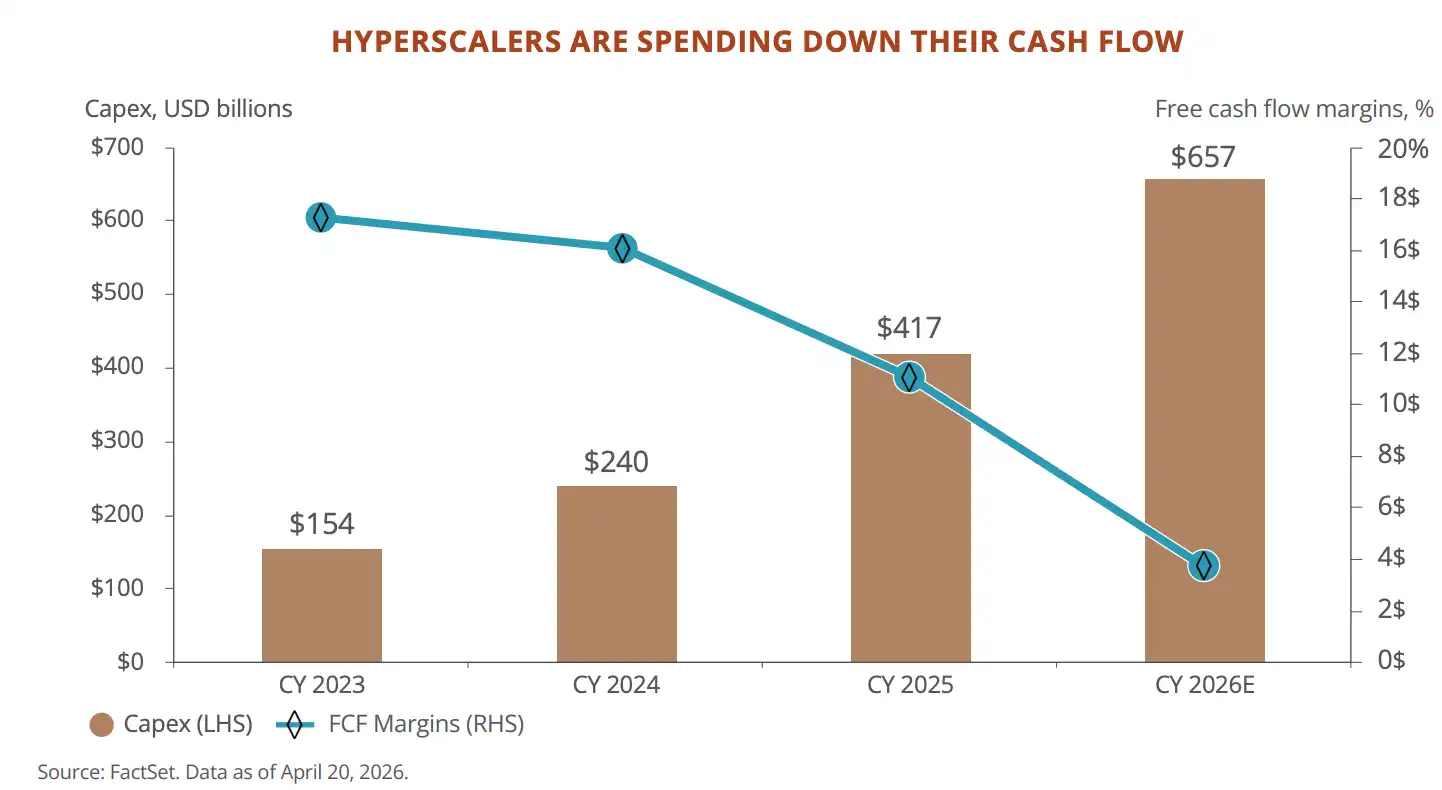
Simultaneously, the financial characteristics of these five companies are changing. Free cash flow is projected to drop from $240 billion in 2024 to $73 billion by end-2026, Microsoft's P/E has fallen from an AI-era high of 35x to 22.5x. The light-asset model that attracted investors over the past decade is being rewritten by heavy capital investment. JPM believes the focus at this stage should be on revenue growth rather than cash flow, but this also means that once demand slows, these investments could become a drag.

A few other judgments on AI serve as localized risk warnings within the larger trend:

Traditional software companies are the first real victims of AI. About half of the constituents in the US software sector index have fallen more than 50% from their highs, with a median operating profit margin of only 4%. The logic of the impact is simple: SaaS (subscription software) charges per head, AI reduces heads. This has already transmitted to the lending market, with about 21% of money in the US direct lending market lent to software companies, and publicly traded tech-focused loan fund prices falling close to the lows of the last cycle. JPM's stress tests show potential leveraged losses could reach 4% in extreme scenarios, but it does not yet constitute a systemic risk.
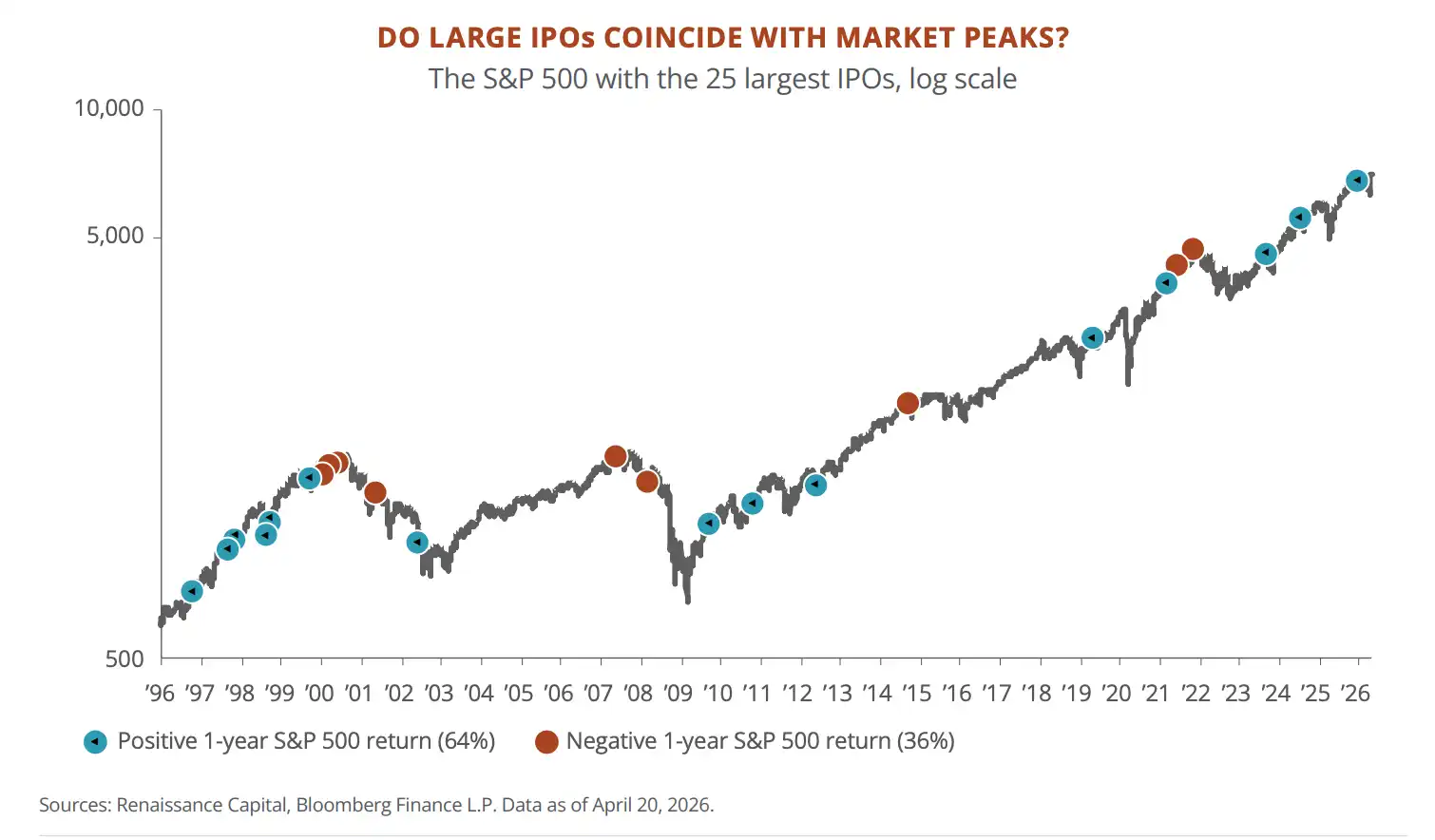
SpaceX, Anthropic, and OpenAI might crowd into IPOs this year, which historically is not a good sign. Following the 25 largest IPOs in the past, the median new stock underperformed the market by 30 percentage points in the first year, with 12 out of 18 falling in their first year. In years with mega IPOs, the median annual market return was only 3%, far below the long-term average of 10%. JPM doesn't say it's definitely a peak, but it is clearly watching the market reaction to SpaceX's IPO as a cycle thermometer.
On Inflation: Inflation Won't Return to 2%, Your Cash and Bonds Are Losing Money

The key point in the inflation section is not that the Strait of Hormuz has pushed up oil prices, but that US inflation hadn't returned to normal even before oil prices were pushed up.

In January 2026, core PCE was at 3.1% year-on-year, with particularly solid increases in local service categories like dining and personal care. Then oil prices doubled. The Fed's model shows that for every $10 increase in oil prices per barrel, inflation rises by about 0.3 percentage points; this time it's a $40 increase.
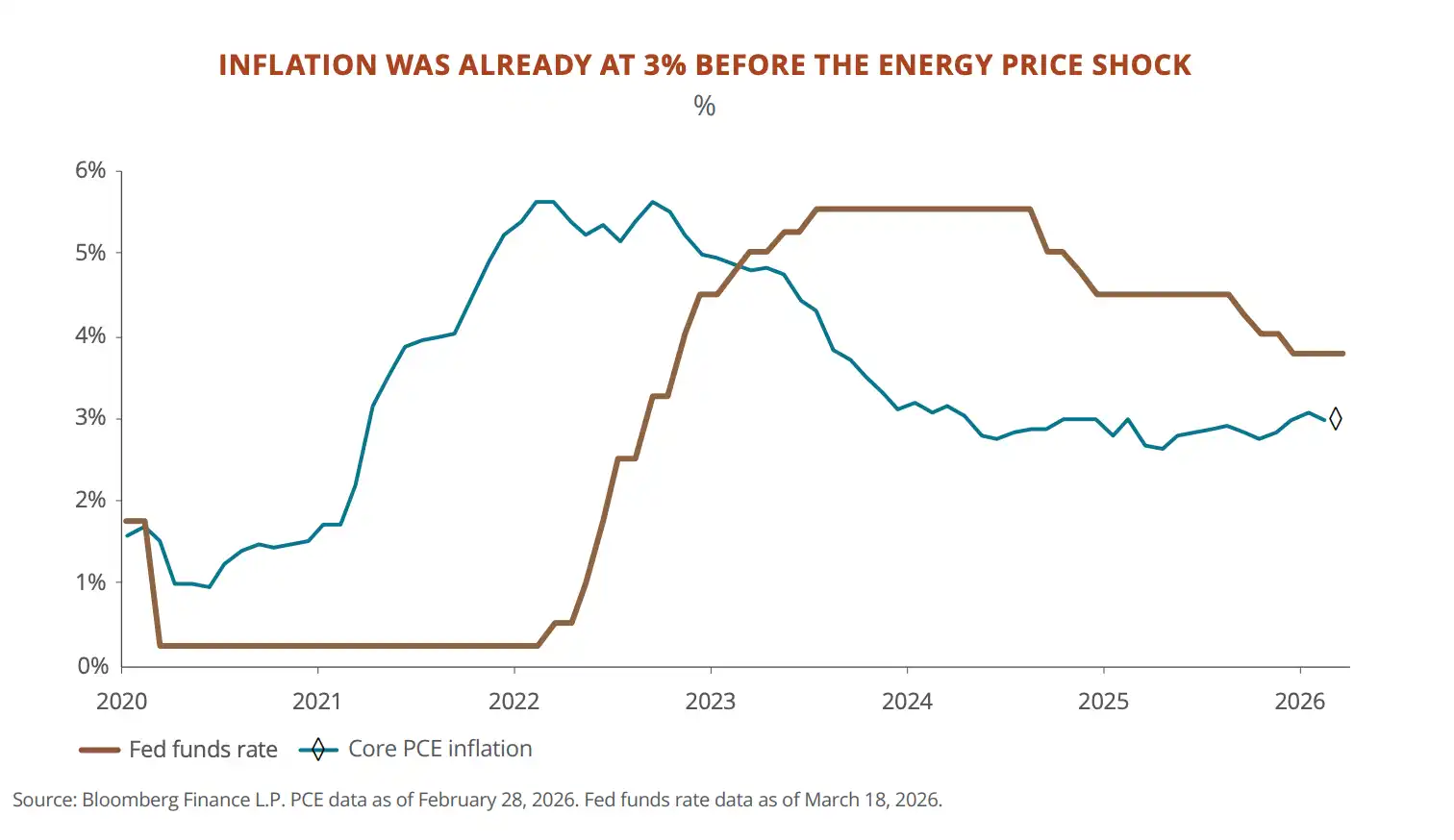
JPM believes a full 1970s-style replay is unlikely. The labor market isn't showing a wage-price spiral, the quit rate is declining, housing inflation has dropped from over 5% at the end of 2024 to just over 3%, and China's overcapacity is also suppressing global goods prices. However, the inflation floor is a notch higher than pre-pandemic, likely oscillating around 3%.

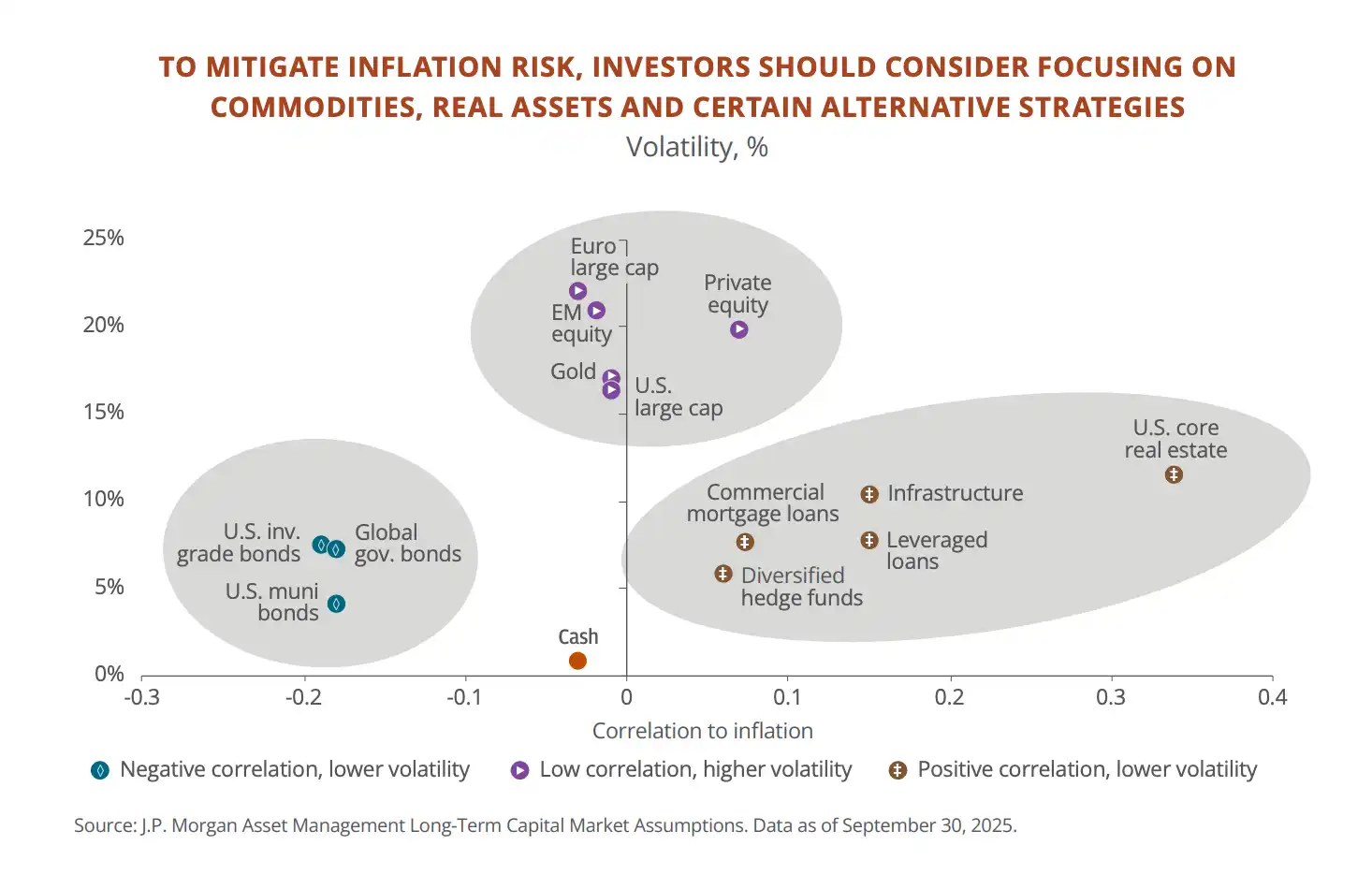
JPM's proposed countermeasure is to increase allocation to real assets.

Since 2020, US prices have cumulatively risen 25%, while bonds have only returned 6%, and cash even less. You think your money is sitting still, but it's actually shrinking every year. Among JPM's own clients, nearly 20% of assets are still in cash and short-term bonds.

Therefore, its suggestion is to move some money into assets that are linked to inflation:

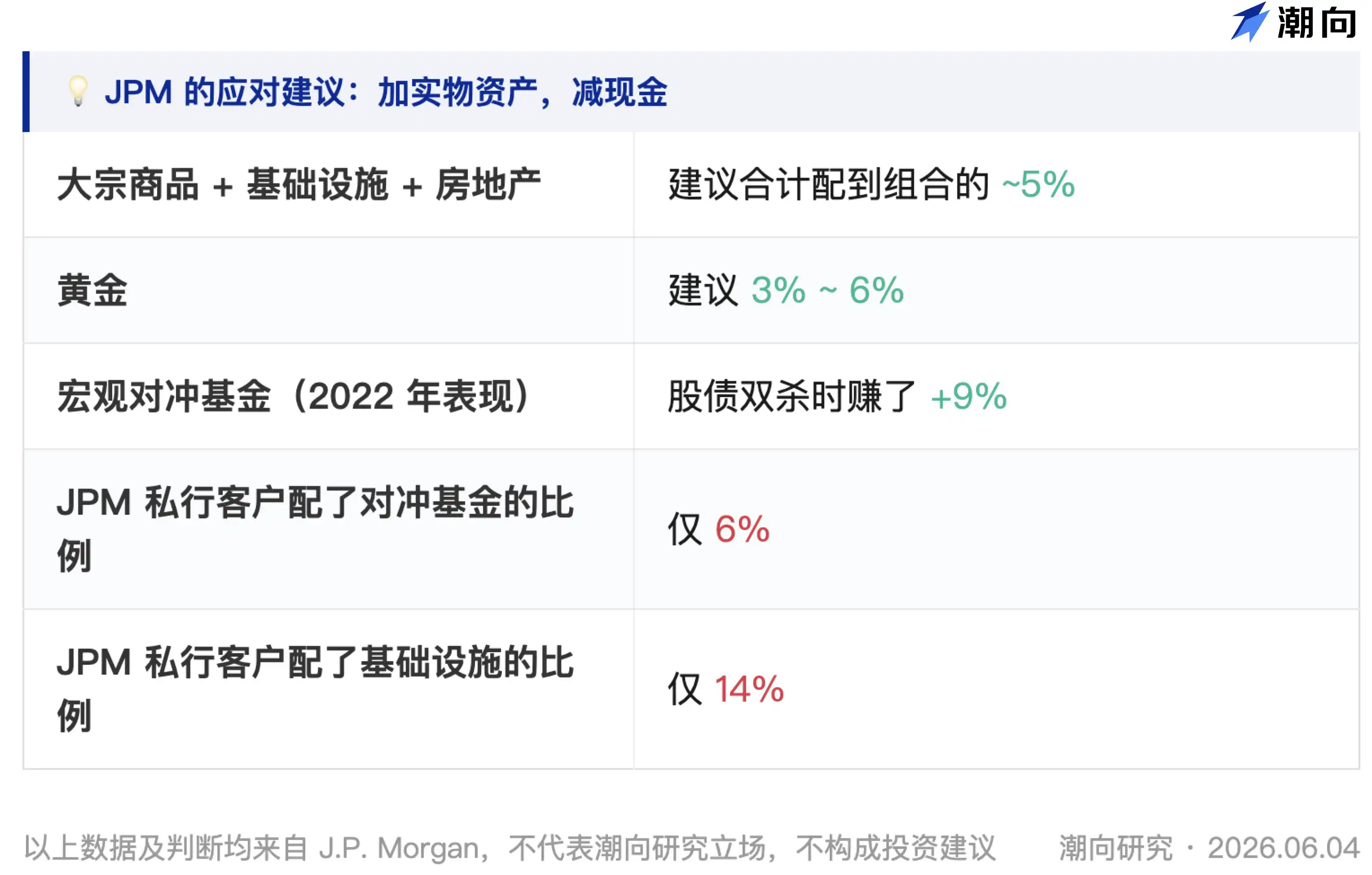
  1. Commodities, infrastructure, real estate—things that rise with prices—are suggested to be allocated around 5% of the portfolio in total.
  2. Gold is separately suggested at 3% to 6%.
  3. Then there are hedge funds. In 2022, when stocks and bonds fell together, macro strategy hedge funds gained 9%. However, JPM also acknowledges that 94% of its private banking clients have never bought hedge funds, and 86% haven't bought infrastructure-like products.
To sum up this section in one sentence:

Inflation may not spiral out of control, but it won't return to 2%. If your portfolio is still the traditional 60/40 stock/bond mix with a pile of cash, JPM thinks you're preparing for a world that no longer exists.

On Geopolitics: Chinese Equities May Be Poised for Structural Revaluation

This section covers the most diverse content, from Middle East conflicts to US-China competition to Europe's troubles. We'll only focus on what directly relates to investment decisions.

1. The Strait of Hormuz blockade is the biggest market shock of the first half of this year. About 20 million barrels of oil pass through this chokepoint daily, accounting for one-fifth of global oil consumption. After the US-Israel joint strikes on Iran, oil prices nearly doubled within days, and European natural gas prices rose nearly 100% in two days. QatarEnergy's CEO said 15% of LNG (liquefied natural gas) capacity could be offline for up to five years. Qatar also supplies about 30% of the world's helium, essential for chip manufacturing, and South Korea has warned of potential chip factory shutdowns.

JPM believes the conflict is moving towards de-escalation, but physical damage and energy risk premiums won't disappear quickly.

Therefore, their advice to investors is: Use the pullback to add to US equity positions.

US stocks fell about 10% in the first half, with the S&P 500 P/E briefly falling below 20x. Historically, buying after the VIX (fear index) breaks above 30 yields a 70% to 83% probability of positive returns within 6 months, averaging a 12.4% gain.

2. The US and China are each building their own ecosystems, and markets may accelerate into two camps. The US is restricting chip exports to China, teaming up with the Netherlands and Japan to control semiconductor equipment. China is expanding exports to non-US markets, with Belt and Road investment hitting a record high in 2025, investing $53 billion in Brazil in one year, and its trade volume with Latin America already exceeds that with the US. JPM's judgment is that future investment returns may increasingly depend on which camp your assets belong to, not just the company's own growth.

But fragmentation is also creating opportunities, especially in emerging markets.

JPM lists several directions:

  1. Latin America holds over 40% of the world's copper and nearly 60% of its lithium, along with abundant nickel, rare earths, and agricultural resources. Foreign direct investment has doubled in the past two decades, central banks' ability to control inflation is stronger than in developed countries, and politics are shifting towards more pragmatic, business-friendly governments.
  2. Middle Eastern Gulf countries are using oil revenues to build AI data centers. Saudi Arabia partnered with Blackstone on a $3 billion data center project, with costs 30% lower than in the US.
  3. East Asia (Taiwan China, South Korea) controls key nodes in the AI hardware supply chain. If AI capital expenditures continue to accelerate, these economies' exports and pricing power will further strengthen.
  4. Chinese equities are at their deepest discount relative to other Asian markets in 20 years; 80% of Chinese consumers are excited about AI products (38% in the US), and electricity costs are about half of those in the US. JPM's stance is "cautiously warming." If policy signals become more clearly business-friendly, Chinese equities may be poised for structural revaluation.

In contrast, Europe is the market where JPM is most conservative. Electricity prices are two to four times those in the US, R&D spending as a share of GDP is only 2.2% (US 3.6%, South Korea 5.2%), and venture capital scale is one-tenth that of the US.

The energy shock is also forcing the ECB to potentially consider re-tightening. In Europe, JPM only recommends buying defense and infrastructure-related stocks, avoiding autos and consumer sectors.
What JPM is Betting On, and What It's Not

Condensing a 60-page report into one sentence: Volatility is an entry opportunity, but the entry stance must change.

What You Should Bet On:

  • AI infrastructure chain (chips, optical modules, power), emerging market equities and bonds, real assets (commodities, infrastructure, gold), defense-related stocks, Chinese AI concepts (cautious addition).

What You Should Not Bet On:

  • Cash, traditional subscription-based software companies, European autos and consumer sectors, and relying solely on a traditional 60/40 stock/bond portfolio model to navigate the second half of this year.

Link to the original research report:

https://www.jpmorgan.com/content/dam/jpmorgan/documents/wealth-management/mid-year-outlook-2026.pdf

This article is Tide Research's compilation and interpretation of J.P. Morgan Wealth Management's Mid-Year Outlook Report 2026. The judgments and recommendations cited in the article are the views of JPM and do not represent the stance of Tide Research, nor do they constitute any investment advice.

Sell-side reports are inherently bullish; JPM is also an investment banking services provider for many of the mentioned companies. The value of the report lies in its framework and data, not in any single conclusion. Look at the logic, not just the direction.

The market carries risks; decision-making should be independent.

Data sources: J.P. Morgan Wealth Management Mid-Year Outlook 2026 · Bloomberg · FactSet · U.S. Bureau of Labor Statistics · IEA · METR · Renaissance Capital

Tide Research · 2026 June 4

Trending Cryptos

Related Questions

QAccording to the J.P. Morgan report, why does the firm believe the AI supercycle is not over, despite market skepticism?

AThe report cites that the five Hyperscalers (Microsoft, Meta, Oracle, Google, Amazon) have increased their 2026 capital expenditure expectations to over $650 billion, an upward revision of $130 billion from the previous earnings season. It also notes that AI-related investments contributed 25 basis points to US real GDP growth in 2025. JPM believes the market is pricing in an 'AI peak' narrative, but the underlying data does not support this conclusion.

QWhat significant change is J.P. Morgan observing in the financial profile of major AI infrastructure companies (Hyperscalers)?

AThe report highlights a shift from a 'light-asset, high-return' model to a 'heavy-asset, high-investment' model. Their collective free cash flow is projected to drop from $240 billion in 2024 to $730 billion by the end of 2026. Microsoft's forward P/E ratio has also fallen from a peak of 35x during the AI era to 22.5x, indicating the market is still digesting this fundamental transformation.

QHow does the report characterize the impact of persistent inflation on traditional cash and bond holdings, and what is JPM's suggested response?

AThe report states that while US consumer prices have risen 25% cumulatively since 2020, core fixed income has only returned 6%, meaning cash and bonds are losing real value. JPM notes that nearly 20% of its clients' assets are in cash and short-term bonds. The suggested response is to reduce cash holdings and increase allocation to real assets like commodities, infrastructure, and real estate (to about 5% of the portfolio) and gold (3-6%) to hedge against inflation.

QWhat opportunity does J.P. Morgan see in emerging markets (EM) for the latter half of the year, and what are the key drivers?

AJPM sees potential in EM due to attractive valuations (P/E of 11.8x) and strong expected earnings growth (46%). Specific drivers include: Taiwan and Korea as core nodes in the AI hardware supply chain; Latin America possessing over 40% of global copper and nearly 60% of lithium reserves; and Gulf states investing oil revenues into cost-competitive AI data centers. The report also notes a historically deep discount for Chinese stocks relative to other Asian markets.

QRegarding the geopolitical risk of the Hormuz Strait blockage, what is J.P. Morgan's historical data-based advice for equity investors?

ADespite the oil price shock causing an approximately 10% market correction and the S&P 500 P/E dipping below 20x, JPM advises using the pullback as a buying opportunity for US equities. Their historical data shows that buying after the VIX (volatility index) breaks above 30 has resulted in a 70% to 83% probability of positive returns within six months, with an average return of 12.4%.

Related Reads

After Three Consecutive Quarters of Decline, Can the Crypto Market Find a Window for Stabilization in Q3?

The cryptocurrency market has just concluded its worst-performing quarter since 2022, with total capitalization dropping 12.6% to $2.1 trillion. All core metrics indicate capital is leaving the sector, not just rotating within it. Bitcoin fell 14.2% and Ethereum dropped 25.4% in Q2, breaking their previous correlation with US tech stocks. A key driver is the reversal in US spot Bitcoin ETF flows, which saw a net outflow of approximately $4.67 billion in Q2, including a record monthly outflow near $4.5 billion in June. While recent data suggests long-term holders are accumulating again, sustained ETF outflows mean continued selling pressure. Market focus is now singularly on the Federal Reserve. The upcoming July FOMC meeting is seen as the most critical event for Q3. A dovish signal could support Bitcoin reclaiming a $68,000-$84,000 range, while a hawkish stance might establish a new trading band around $50,000-$56,000. Additionally, regulatory uncertainty persists, with the progress of the crucial *CLARITY Act* stalling in the Senate, reducing its perceived 2026 passage probability to 40-45%. Despite the broad downturn, a few sectors showed growth. Prediction markets saw nominal volume surge 48.7% year-over-year to $113.8 billion, and tokenized collectibles transaction volume rose 143% quarterly to $1.4 billion. The Real-World Asset (RWA) tokenization sector also continued steady growth, now representing ~$28.1 billion in on-chain value. The market's foundation for an extreme crash appears limited, with Bitcoin price hovering near its 200-week moving average. However, the trading paradigm has shifted from narrative-driven speculation to decisions based on price action, policy developments, and interest rate expectations, making a broad sentiment-driven rally unlikely in the near term.

marsbit17m ago

After Three Consecutive Quarters of Decline, Can the Crypto Market Find a Window for Stabilization in Q3?

marsbit17m ago

BIT Trading Moment: BTC Still Suppressed by Weekly 200 EMA, Rejection May Restart Decline; Storage and Semiconductors that Surged Last Night Begin Falling in Evening Trading

**Crypto & Stock Market Wrap: Bitcoin Tests Resistance, Stocks Retreat After AI Surge** Bitcoin consolidates around $66,000, facing key resistance near $68,000—an area seen as a major psychological and technical hurdle where previous rallies have failed. Analysts note the cryptocurrency is caught between its 200-week moving average (~$63,333) and 200-week EMA (~$68,328). A clear break above $68k is needed to signal a stronger bullish trend, while a rejection could lead to a retest of $63k support. Market sentiment remains cautious, with low futures open interest pointing to a low-liquidity rebound rather than a full bull market. Bitcoin spot ETFs saw another $203 million inflow. US stock futures pointed lower after a strong Tuesday session led by a massive rebound in semiconductors and memory stocks. The rally was fueled by renewed optimism about AI-driven hardware demand, with Micron, SanDisk, and SK Hynix surging. However, those gains reversed in pre-market trading. Super Micro Computer (SMCI) soared over 20% after hours on strong guidance and a record backlog. Other standouts included Rocket Lab and nuclear energy plays Oklo and X-Energy. Rising oil prices (Brent above $91) and climbing Treasury yields (10-year near 4.64%), however, are reigniting inflation concerns and acting as a headwind for equities. In Asia, markets were mixed. South Korea's KOSPI pared early gains to close slightly higher as semiconductor stocks like SK Hynix gave back initial surges. Japan's Nikkei edged lower as the yen hit a fresh 38-year low against the dollar, raising fears of potential market intervention. Key events to watch include the Samsung Galaxy launch, AMD's AI event, and a slew of major tech earnings from Alphabet, Tesla, and IBM after the close on Wednesday, followed by the ECB meeting and Intel's earnings on Thursday.

marsbit25m ago

BIT Trading Moment: BTC Still Suppressed by Weekly 200 EMA, Rejection May Restart Decline; Storage and Semiconductors that Surged Last Night Begin Falling in Evening Trading

marsbit25m ago

Former CFTC Chairman, Circle President Tarbert: Preaching Long-Termism While Cashing Out $30 Million Himself

Former CFTC Chairman and Circle President Heath Tarbert has consistently advocated for a long-term vision in public, urging patience from investors as Circle’s stock price has fallen significantly from its peak. However, it has been revealed that since Circle’s IPO, Tarbert has continuously sold his CRCL shares through pre-arranged trading plans, cashing out approximately $30 million, without making any public market purchases. This contrast between his public messaging and personal actions has drawn criticism. Tarbert joined Circle in July 2023 as Chief Legal Officer, leveraging his regulatory experience to help guide the company through its IPO and expansion. Despite promoting stablecoins as long-term infrastructure, he established a 10b5-1 trading plan just before Circle went public, leading to substantial stock sales over the following year. In March 2026, he initiated another plan to sell more shares. His career trajectory highlights a pattern of moving between high-level regulatory roles and influential positions in the financial sector. After resigning as CFTC Chairman in early 2021, he joined Citadel Securities as Chief Legal Officer just 27 days later, during a period of intense regulatory scrutiny for the firm. He later joined Circle, aiding its efforts to navigate regulatory challenges for its public listing. While Tarbert's expertise in policy and compliance is valuable to companies like Circle, his actions—advocating long-term confidence while personally divesting—raise questions about the alignment between his public statements and his private financial decisions, leaving investors who followed his advice to bear the market risks.

marsbit48m ago

Former CFTC Chairman, Circle President Tarbert: Preaching Long-Termism While Cashing Out $30 Million Himself

marsbit48m ago

Gate Research Institute: The 'Wall Street-ization' Wave of Crypto Financial Products – Competition or Integration?

The article titled "Gate Research Institute: Are Crypto Financial Products Sparking a 'Wall Street' Wave—Competition or Convergence?" explores the evolving relationship between the crypto ecosystem and traditional finance (TradFi). The piece begins by reflecting on Bitcoin's original 2009 vision of decentralization, disintermediation, and moving away from banks. It then contrasts this with the 2024 landscape, where key crypto assets like Bitcoin are increasingly held through Wall Street products like ETFs issued by giants like BlackRock. The article questions whether this signifies that TradFi is systematically taking over the rights to issue, price, custody, and distribute crypto financial assets. The core argument is that this is not a zero-sum takeover but rather a bidirectional convergence where each side addresses the other's weaknesses. Crypto offers 24/7 global markets, programmable settlement, and open access but lacks compliant channels, institutional-grade custody, deep fiat liquidity, and mainstream distribution. TradFi possesses these but is constrained by legacy systems, limited operating hours, and slow settlement. Two primary convergence paths are highlighted: * **Path A (CEX to TradFi):** Exemplified by Gate, which has progressed from offering tokenized stocks and CFDs to providing direct, real stock trading (US, Hong Kong, South Korea) within its platform, using USDT. * **Path B (TradFi to Crypto):** Exemplified by Robinhood, which has integrated crypto trading, acquired exchanges like Bitstamp, and is moving traditional assets like stocks onto the blockchain via tokenization and its own Layer 2. Both paths are ultimately competing to become the next-generation, unified financial account—a "super account" where users can seamlessly trade cryptocurrencies, stocks, ETFs, RWA (Real World Assets), and tokenized treasury products in one interface. The growth of RWA and tokenized treasuries (e.g., BlackRock's BUIDL) is presented as the asset-layer fusion, providing stable, yield-bearing assets on-chain and acting as a bridge between the two worlds. In conclusion, the "Wall Street-ization" of crypto is framed as a mutual transformation. Decentralized ideals persist in the protocol layer, while at the application layer, a more efficient, global, and accessible unified capital market is emerging from this convergence. The future competition lies not between crypto exchanges and stockbrokers, but between platforms vying to offer the most comprehensive asset coverage, liquidity, and user experience within a single account.

marsbit52m ago

Gate Research Institute: The 'Wall Street-ization' Wave of Crypto Financial Products – Competition or Integration?

marsbit52m ago

Trading

Spot

Hot Articles

Discussions

Welcome to the HTX Community. Here, you can stay informed about the latest platform developments and gain access to professional market insights. Users' opinions on the price of AI (AI) are presented below.

活动图片















