Jack Dorsey's Company Is Laying Off 4,000 White-Collar Workers, Replaced by AI

Odaily星球日报Published on 2026-02-27Last updated on 2026-02-27

Abstract

Jack Dorsey's fintech company Block has announced a major workforce reduction, cutting nearly 40% of its employees—around 4,000 roles—to streamline operations and transition toward a flatter, AI-centric organizational structure. Despite reporting growing revenue and profitability, and even raising its 2026 profit guidance to $12.2 billion, Block is proactively restructuring to adapt to rapid AI-driven changes in productivity. Dorsey emphasized that AI tools are fundamentally reshaping how companies operate, enabling exponential growth without proportional increases in staff. This move reflects a broader trend among tech firms like Salesforce, Amazon, and ASML, which have also cut jobs during growth phases by leveraging AI for efficiency. Notably, Block’s stock surged 20% following the announcement, adding nearly $6 billion in market value—effectively valuing each eliminated role at about $1.5 million in created enterprise value. The layoffs primarily affect white-collar roles, as AI excels at tasks involving information processing—a core function of many knowledge-economy jobs. Affected employees will receive severance including 20 weeks' base pay, additional compensation per year served, a $5,000 transition bonus, and six months of continued health insurance. The situation underscores how AI is disrupting traditional employment faster than expected, shifting focus toward reskilling and adaptation in the automated economy.

Original | Odaily Planet Daily (@OdailyChina)

Author | Azuma (@azuma_eth)

In the early hours of this morning Beijing time, financial technology company Block, led by Jack Dorsey (also the founder of Twitter), announced a large-scale layoff plan — nearly 4,000 positions will be cut, reducing the total number of employees from over 10,000 to less than 6,000, in order to promote a leaner, flatter, and AI-centric organizational structure.

Jack Dorsey himself is a fervent Bitcoin maximalist, believing that Bitcoin will ultimately become the native currency of the internet. Block's business is also deeply intertwined with Bitcoin. In addition to directly holding Bitcoin on its balance sheet and providing trading, wallet, and mining products and services, Block is also a long-term funder of Bitcoin core developers.

But this is not the focus of this article — the key point this article aims to emphasize is that, unlike other companies forced to lay off employees due to business contraction, Block is proactively choosing to cut nearly 40% of its positions during a period of growth in both business revenue and profit margins. Simultaneously with the layoffs, Block has further raised its 2026 gross profit guidance to $12.2 billion.

Jack Dorsey explained the reason for this decision in the announcement: "Something has changed. We have seen that the intelligent tools we are building and using, combined with smaller, flatter teams, are giving rise to a new way of working — this fundamentally changes the meaning of building and operating a company, and this change is accelerating rapidly... Rather than passively accepting the change and slowly laying off employees over the next few months or years, it is better to proactively adapt now."
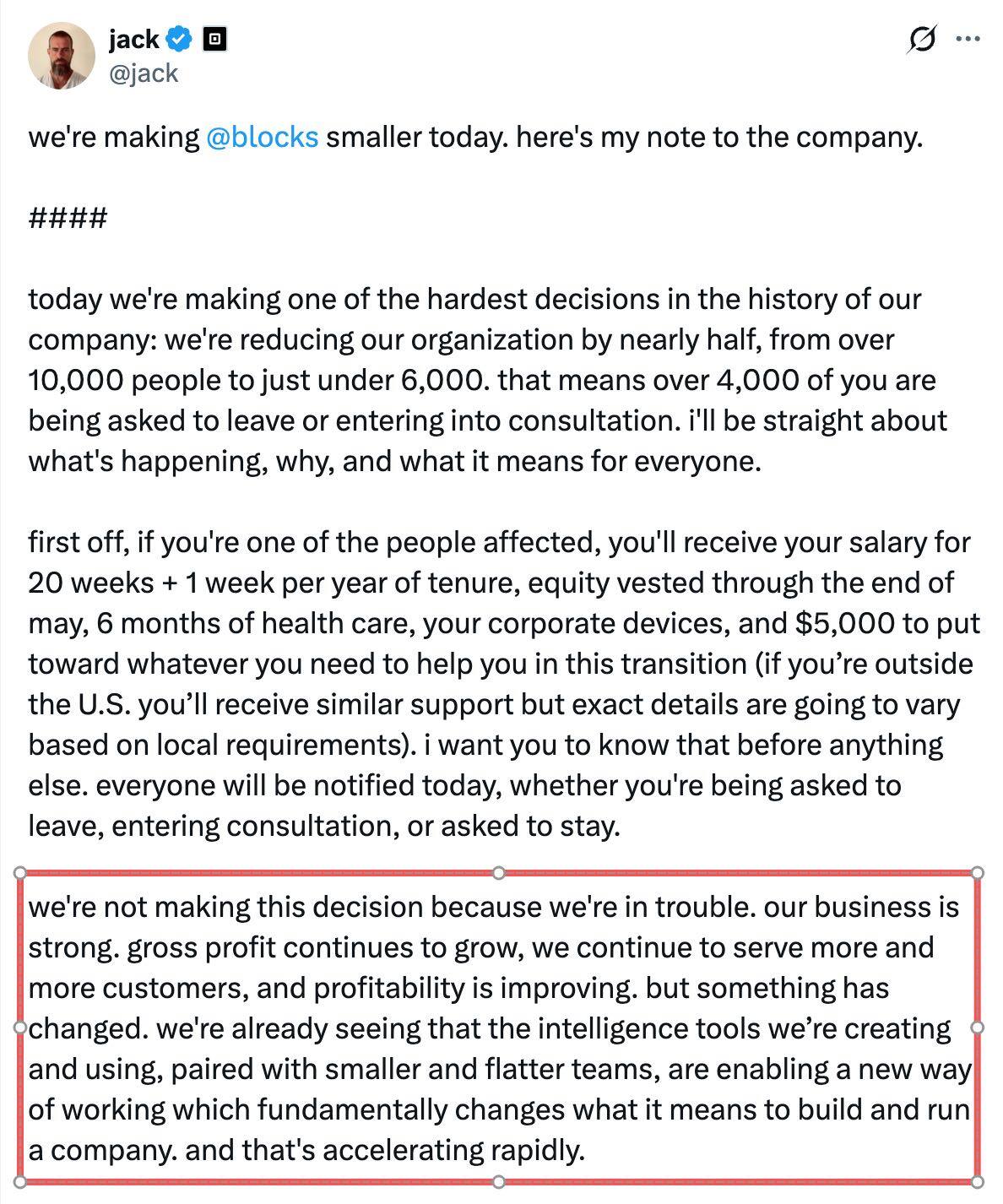
The change mentioned by Jack Dorsey is not new — the rapid development of AI is iterating the traditional paradigm of productivity growth. In the past, enterprises mainly relied on linear growth in employee numbers to increase productivity and expand business scale; but now, with the help of rapidly evolving AI tools, enterprises can achieve exponential growth in productivity while maintaining or even reducing the number of employees.

Overseas influencer and product growth expert Aakash Gupta pointed out that Block is not the first company to make this decision: "Block is not an isolated case. ASML laid off 1,700 people last month while also announcing record order numbers; Salesforce laid off 5,000 people after AI began handling 50% of customer interactions; Amazon laid off 16,000 people in January last year and another 14,000 in October... All these companies were still in a growth trend when they made the decision to lay off employees. Jack Dorsey is just saying out loud what everyone has been tacitly acknowledging, that AI tools combined with smaller team size have completely changed the way a company is operated."

More notably, after Block announced its layoff plan, the capital market quickly gave its response — Block's stock price surged 20%, increasing its market value by nearly $6 billion on the spot. This means that for every position cut, about $1.5 million in enterprise value was created.

It has long been a social consensus that AI will disrupt the job market and eliminate some professions, but many people still underestimate the speed at which this change is arriving. In the past few weeks, we have witnessed the 'dimensionality reduction' impact of Anthropic on multiple industries such as SaaS; seen the 30 million reads of '2028 Global Intelligence Crisis' stirring public sentiment; and now we have Block proactively downsizing without concealing the reason.

Another counterintuitive reality is that while people once believed the threat of AI eliminating jobs would follow a gradual sequence 'from low-end to high-end,' the actual situation is that, due to the immaturity in the field of physical interaction, the first to be eliminated by AI are the white-collar jobs that the market once considered relatively mid-to-high-end. The reason is not complicated: the essence of white-collar work is to perform 'input → processing → output' of information based on specific industry standards, and this is precisely the area where AI large models excel.

In this round of layoffs at Block, affected employees will receive 20 weeks of salary plus an additional week's compensation for each year of service, as well as a $5,000 transition grant. Additionally, Block will continue to provide health insurance for employees for 6 months and allow them to keep their company equipment. The compensation conditions are quite good, but for these laid-off employees and the many positions already threatened by AI, it is time to think about how to avoid being eliminated in the AI era.


Related Questions

QWhat major announcement did Jack Dorsey's company Block make regarding its workforce?

ABlock announced a large-scale layoff plan, cutting nearly 4,000 jobs, which will reduce its total workforce from over 10,000 employees to fewer than 6,000.

QWhat was the stated reason for Block's decision to lay off such a significant portion of its employees despite being in a growth period?

AThe decision was driven by the rapid development of AI tools, which, combined with smaller, flatter teams, are creating a new way of working that fundamentally changes how a company is built and operated. Block chose to proactively adapt to this change rather than react slowly in the future.

QHow did the financial markets react to Block's announcement of the layoffs?

AThe market reacted positively; Block's stock price surged by 20%, increasing its market capitalization by nearly $6 billion, which equates to creating about $1.5 million in enterprise value for each job cut.

QAccording to the article, which sector of the workforce is AI currently impacting most significantly and why?

AAI is currently having the most significant impact on white-collar jobs. This is because the essence of white-collar work involves processing information (input → processing → output) according to specific industry standards, which is precisely the area where AI large language models excel.

QWhat compensation package was offered to the employees who were laid off from Block?

ALaid-off employees will receive 20 weeks of salary plus an additional week for each year of service, a $5,000 transition grant, 6 months of continued health insurance, and they are allowed to keep their company equipment.

Related Reads

Jensen Huang's CMU Speech: In the AI Era, Don't Just Watch, Build

Jensen Huang, CEO of NVIDIA and a first-generation immigrant, delivered the commencement address to Carnegie Mellon University's class of 2026. He shared his personal journey from a humble background to founding NVIDIA, emphasizing resilience, learning from failure, and the responsibility that comes with leadership. Huang framed the present moment as the dawn of the AI revolution, a shift he believes is more profound than previous computing waves. He described AI as fundamentally resetting computing—moving from human-written software to machines that understand, reason, and use tools. This will create a new industry for generating intelligence and transform every sector. While acknowledging AI's potential to automate tasks and displace some jobs, Huang distinguished between the *tasks* of a job and its core *purpose*. He argued AI will augment human capability, not replace humans. The real risk, he stated, is not AI itself, but people being left behind by those who effectively use AI. He presented AI as a generational opportunity for massive infrastructure investment—in chip factories, data centers, energy grids, and advanced manufacturing—that could re-industrialize nations like the U.S. and bridge the digital divide by making computing and intelligent tools accessible to all. Huang called for a balanced approach: advancing AI safely and responsibly, establishing prudent policies, ensuring broad access, and encouraging universal participation. He urged the graduates not to fear the future but to engage with optimism and ambition, reminding them of CMU's motto, "My heart is in the work." His core message was clear: this is their moment to actively build and shape the AI-powered future, not merely observe it.

marsbit24m ago

Jensen Huang's CMU Speech: In the AI Era, Don't Just Watch, Build

marsbit24m ago

The Era Has Arrived Where Human Writers Must Prove They Are Not Machines

The article describes an era where AI-generated content is flooding the market, forcing human authors to prove they are not machines. It begins with the example of dozens of AI-written, error-ridden biographies of Henry Kissinger appearing on Amazon within hours of his death, a pattern repeated for other deceased celebrities and even living experts who find fraudulent books under their names. This spam content has exploded, with monthly new book releases on platforms like Amazon reaching 300,000 by late 2025. The issue spans genres, from suspiciously high proportions of AI-written teen romance and self-help books to dangerous, AI-generated foraging guides containing lethal advice. The platforms' automated review systems, designed to catch plagiarism and banned words, are ill-equipped to detect AI-generated text that avoids these pitfalls while being nonsensical or fraudulent. The problem has infiltrated traditional publishing. A major publisher, Hachette, had to recall a bestselling horror novel after AI detection tools suggested 78% of its content was machine-generated. An acclaimed European philosophy book was later revealed to be entirely written by AI under a fake author persona. In response, authors are fighting back. At the 2026 London Book Fair, 10,000 writers published a blank book titled "Don't Steal This Book" containing only their signatures—using emptiness as a protest weapon in an age of AI overproduction. Initiatives like the "Human Author Certification" program have emerged, ironically placing the burden on humans to prove their work is not machine-made. The article warns of a vicious cycle: AI-generated low-quality books pollute the data used to train future AI models, leading to "model collapse" and an ever-worsening flood of digital waste, eroding trust in publishing and devaluing human creativity.

marsbit49m ago

The Era Has Arrived Where Human Writers Must Prove They Are Not Machines

marsbit49m ago

Trading

Spot
Futures

Hot Articles

Discussions

Welcome to the HTX Community. Here, you can stay informed about the latest platform developments and gain access to professional market insights. Users' opinions on the price of AI (AI) are presented below.

活动图片














