Ivy League Money Buys Bitcoin And Ethereum: Dartmouth Discloses IBIT, ETH Mini Stakes

bitcoinistPublished on 2026-01-15Last updated on 2026-01-15

Abstract

Dartmouth College, via its Trustees, disclosed new investments in cryptocurrency through its endowment. According to a Jan. 14 Form 13F filing, the Ivy League school held 201,531 shares of BlackRock’s iShares Bitcoin Trust ETF (IBIT) valued at over $10 million, and 178,148 shares of the Grayscale Ethereum Mini Trust worth $4.9 million as of Dec. 31, 2025. Combined, these crypto allocations represent roughly 3.8% of the $393 million in total holdings reported on the 13F. The filing indicates both positions were new, as they did not appear in the previous quarter’s report. This move follows similar crypto ETF investments by other endowments, including Brown University and Emory University, while Harvard Management Company reported a $442.9 million IBIT position in its latest filing.

Dartmouth College, via the Trustees of Dartmouth College, disclosed a new position in BlackRock’s iShares Bitcoin Trust ETF (IBIT), reporting 201,531 shares worth $10,006,014 as of Dec. 31, 2025, according to a Form 13F filed on Jan. 14. The same filing also shows a fresh allocation to the Grayscale Ethereum Mini Trust, a rare double-print of BTC and ETH exposure inside an Ivy League endowment’s public equity book.

Dartmouth’s Endowment Adds Bitcoin And Ethereum

Crypto market observers flagged the disclosure immediately. MacroScope, an analyst account that tracks institutional positioning, framed the filing as a meaningful signal from the endowment complex: “Very important filing today. In a 13F, Dartmouth College reported owning 201,531 shares of IBIT as of December 31, valued over $10 million. It also reported owning 178,148 shares of Grayscale Ethereum Mini valued at $4.9 million.”

The SEC filing provides the precise marks. Dartmouth’s Grayscale Ethereum Mini Trust stake was listed at $4,998,833 for 178,148 shares at quarter-end, placing the combined Bitcoin and Ethereum allocations at roughly $15.0 million of reported 13F holdings.

In the context of Dartmouth’s disclosed 13F portfolio, crypto remains a slice rather than a core. The filing’s summary page lists a “Form 13F Information Table Value Total” of $393,306,686 across nine positions. On that math, IBIT represents about 2.5% of the reported book, with the Ethereum Mini position adding roughly 1.3%.

The rest of the holdings read like a traditional endowment liquid sleeve. Dartmouth’s largest position was SPDR S&P 500 ETF Trust at $227,897,664, alongside sizable allocations to emerging markets (iShares Core MSCI Emerging Markets at $50,043,811), a quality-factor ETF (GMO US Quality at $42,153,006), and a value ETF (Vanguard Value at $34,807,928).

Notably, neither IBIT nor the Grayscale Ethereum Mini Trust appeared in Dartmouth’s prior 13F for the quarter ended Sept. 30, 2025, supporting the claim that both positions were new additions heading into year-end.
Notably, Dartmouth is not the first campus allocator to route crypto exposure through the ETF wrapper. Brown University disclosed a new IBIT position in its March 31, 2025 13F, 105,000 shares valued around $4.9 million, the school’s “first foray” into spot bitcoin ETF ownership that quarter.

Emory University moved earlier. In an October 2024 disclosure, the Atlanta-based school reported putting $15.8 million from its endowment into a publicly traded bitcoin ETF, with the filing showing roughly 2.7 million shares of Grayscale’s Bitcoin Mini Trust.

And at the other end of the spectrum sits Harvard’s endowment manager. Harvard Management Co.’s public-equities 13F for the quarter ended Sept. 30, 2025 showed IBIT as its largest reported position, 6,813,612 shares worth about $442.9 million on the filing’s valuation marks.

At press time, Bitcoin traded at $96,284.
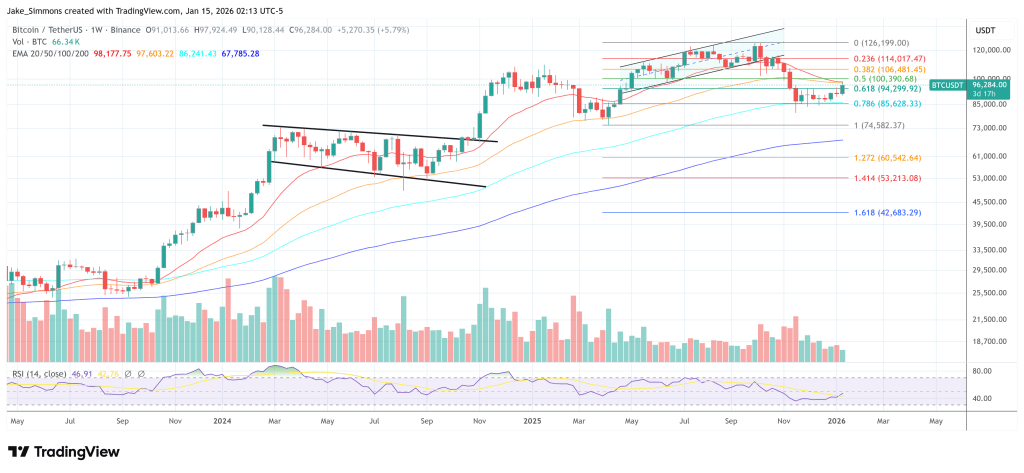
Bitcoin remains above the 0.618 Fib, 1-week chart | Source: BTCUSDT on TradingView.com

Trending Cryptos

Related Questions

QWhat cryptocurrency investments did Dartmouth College disclose in its recent 13F filing?

ADartmouth College disclosed a new position in BlackRock’s iShares Bitcoin Trust ETF (IBIT) with 201,531 shares worth $10,006,014 and a new allocation to the Grayscale Ethereum Mini Trust with 178,148 shares worth $4,998,833.

QWhat is the total value of Dartmouth's combined Bitcoin and Ethereum allocations as reported in the 13F?

AThe combined value of Dartmouth's Bitcoin and Ethereum allocations is approximately $15.0 million.

QHow does Dartmouth's crypto allocation compare to its total reported 13F portfolio value?

AThe IBIT position represents about 2.5% of the reported $393.3 million portfolio, and the Ethereum Mini position adds roughly 1.3%, making crypto a small slice of the overall portfolio.

QWhich other Ivy League or university endowments have invested in Bitcoin ETFs according to the article?

ABrown University disclosed an IBIT position in its March 2025 13F, Emory University invested in a bitcoin ETF in October 2024, and Harvard Management Co. reported IBIT as its largest position with shares worth about $442.9 million in its September 2025 filing.

QWhat was the price of Bitcoin at the time the article was published?

AAt press time, Bitcoin traded at $96,284.

Related Reads

They Raised 17 Billion in Six Months: Data "Tool Sellers" Became the Most Profitable Business in the Embodied Intelligence Track

Over the past six months, data-centric companies serving the embodied AI sector (robotics) have secured over 17 billion RMB in funding in China, highlighting "data" as the most profitable niche. These "shovel sellers"—providing crucial data, models, and infrastructure for training robots—are flourishing despite robots themselves not yet being widely profitable. The surge is driven by a severe scarcity of high-quality physical interaction data needed for robot training. Companies are tackling this through five main approaches: 1) **Teleoperation/Haptic Data**: Building factories for high-precision data collection (e.g., Paxini, Noitom Robotics). 2) **Simulation/Synthetic Data**: Generating vast amounts of virtual training data (e.g., Lightwheel Intelligence, Transcend Dimension). 3) **UMI/Portable Collection**: Using wearable devices to capture human motions directly, bypassing robots (e.g., Jianzhi Robotics, Tashizhihang). 4) **Video Distillation/World Models**: Extracting actionable data from internet videos or using AI world models (e.g., Shutu Technology, Deep Genius). 5) **Data Infrastructure/Platforms**: Offering data processing, standardization, and platform services (e.g., Wuwen Zhike, Yiren Technology). Key players include LiberAI (founded by a 00-year-old PhD), which focuses on human UMI data and world models and recently raised hundreds of millions, and Lightwheel Intelligence, which became a unicorn and secured large orders. However, the industry faces a critical dependency: most data buyers are unprofitable robotics startups relying on venture capital. Data company revenues essentially redistribute this investment. Long-term viability likely belongs only to companies that become essential industry-standard platforms or masters of continuous, high-quality data supply for real-world deployment. The boom is real, but its sustainability hinges on the success of the broader embodied AI ecosystem.

marsbit13m ago

They Raised 17 Billion in Six Months: Data "Tool Sellers" Became the Most Profitable Business in the Embodied Intelligence Track

marsbit13m ago

POAP Repeats the Broken Old Dream of the Internet: Technology Changes, the End Remains Unchanged

POAP, a digital collectibles project that issued blockchain-based badges as proof of attendance at events, announced it is ceasing development after over five years. Born from a 2019 hackathon, POAP evolved from an Ethereum community experiment into a widely adopted credential for conferences, brand activations, and major industry moments like the Ethereum Merge. It aimed to digitize the sentimental value of physical mementos like ticket stubs, allowing users to own and display records of shared experiences. The project raised $10 million in 2022, envisioning POAPs as building blocks for a decentralized social graph and digital identity. Their potential utility for granting exclusive access, airdrops, or rewards drove adoption but also created a fundamental tension. As POAPs became linked to financial incentives, they attracted sybil attacks and speculative collection, undermining their role as authentic records of participation. This conflict between cultural value and crypto-economic utility proved difficult to resolve. POAP's story mirrors the earlier Web2 platform GetGlue, which let users "check-in" to TV shows and collect digital stickers. Despite millions of users and media partnerships, GetGlue struggled to build a sustainable business around an ancillary record of consumption and was eventually shut down. Similarly, POAP found that while the badges held significant cultural meaning for users, this did not easily translate into a viable business model. The very aspects that gave POAP its value—being free, low-barrier, and non-speculative—clashed with the prevalent token-driven monetization strategies in crypto. Ultimately, POAP preserved many digital memories but could not secure its own future.

marsbit13m ago

POAP Repeats the Broken Old Dream of the Internet: Technology Changes, the End Remains Unchanged

marsbit13m ago

Trading

Spot

Hot Articles

What is $BITCOIN

DIGITAL GOLD ($BITCOIN): A Comprehensive Analysis Introduction to DIGITAL GOLD ($BITCOIN) DIGITAL GOLD ($BITCOIN) is a blockchain-based project operating on the Solana network, which aims to combine the characteristics of traditional precious metals with the innovation of decentralized technologies. While it shares a name with Bitcoin, often referred to as “digital gold” due to its perception as a store of value, DIGITAL GOLD is a separate token designed to create a unique ecosystem within the Web3 landscape. Its goal is to position itself as a viable alternative digital asset, although specifics regarding its applications and functionalities are still developing. What is DIGITAL GOLD ($BITCOIN)? DIGITAL GOLD ($BITCOIN) is a cryptocurrency token explicitly designed for use on the Solana blockchain. In contrast to Bitcoin, which provides a widely recognized value storage role, this token appears to focus on broader applications and characteristics. Notable aspects include: Blockchain Infrastructure: The token is built on the Solana blockchain, known for its capacity to handle high-speed and low-cost transactions. Supply Dynamics: DIGITAL GOLD has a maximum supply capped at 100 quadrillion tokens (100P $BITCOIN), although details regarding its circulating supply are currently undisclosed. Utility: While precise functionalities are not explicitly outlined, there are indications that the token could be utilized for various applications, potentially involving decentralized applications (dApps) or asset tokenization strategies. Who is the Creator of DIGITAL GOLD ($BITCOIN)? At present, the identity of the creators and development team behind DIGITAL GOLD ($BITCOIN) remains unknown. This situation is typical among many innovative projects within the blockchain space, particularly those aligning with decentralized finance and meme coin phenomena. While such anonymity may foster a community-driven culture, it intensifies concerns about governance and accountability. Who are the Investors of DIGITAL GOLD ($BITCOIN)? The available information indicates that DIGITAL GOLD ($BITCOIN) does not have any known institutional backers or prominent venture capital investments. The project seems to operate on a peer-to-peer model focused on community support and adoption rather than traditional funding routes. Its activity and liquidity are primarily situated on decentralized exchanges (DEXs), such as PumpSwap, rather than established centralized trading platforms, further highlighting its grassroots approach. How DIGITAL GOLD ($BITCOIN) Works The operational mechanics of DIGITAL GOLD ($BITCOIN) can be elaborated on based on its blockchain design and network attributes: Consensus Mechanism: By leveraging Solana’s unique proof-of-history (PoH) combined with a proof-of-stake (PoS) model, the project ensures efficient transaction validation contributing to the network's high performance. Tokenomics: While specific deflationary mechanisms have not been extensively detailed, the vast maximum token supply implies that it may cater to microtransactions or niche use cases that are still to be defined. Interoperability: There exists the potential for integration with Solana’s broader ecosystem, including various decentralized finance (DeFi) platforms. However, the details regarding specific integrations remain unspecified. Timeline of Key Events Here is a timeline that highlights significant milestones concerning DIGITAL GOLD ($BITCOIN): 2023: The initial deployment of the token occurs on the Solana blockchain, marked by its contract address. 2024: DIGITAL GOLD gains visibility as it becomes available for trading on decentralized exchanges like PumpSwap, allowing users to trade it against SOL. 2025: The project witnesses sporadic trading activity and potential interest in community-led engagements, although no noteworthy partnerships or technical advancements have been documented as of yet. Critical Analysis Strengths Scalability: The underlying Solana infrastructure supports high transaction volumes, which could enhance the utility of $BITCOIN in various transaction scenarios. Accessibility: The potential low trading price per token could attract retail investors, facilitating wider participation due to fractional ownership opportunities. Risks Lack of Transparency: The absence of publicly known backers, developers, or an audit process may yield skepticism regarding the project's sustainability and trustworthiness. Market Volatility: The trading activity is heavily reliant on speculative behavior, which can result in significant price volatility and uncertainty for investors. Conclusion DIGITAL GOLD ($BITCOIN) emerges as an intriguing yet ambiguous project within the rapidly evolving Solana ecosystem. While it attempts to leverage the “digital gold” narrative, its departure from Bitcoin's established role as a store of value underscores the need for a clearer differentiation of its intended utility and governance structure. Future acceptance and adoption will likely depend on addressing the current opacity and defining its operational and economic strategies more explicitly. Note: This report encompasses synthesised information available as of October 2023, and developments may have transpired beyond the research period.

1.5k Total ViewsPublished 2025.05.13Updated 2025.05.13

What is $BITCOIN

Discussions

Welcome to the HTX Community. Here, you can stay informed about the latest platform developments and gain access to professional market insights. Users' opinions on the price of BTC (BTC) are presented below.

活动图片